
Active floorstanding speaker · AI analysis · Master, Rank 4
ATC EL50 Anniversary: Analysis
AI analysis (research): active 3-way floorstanding speaker from ATC with 25 mm S-Spec soft-dome tweeter, 75 mm Superdome midrange, 234 mm Super Linear woofer, discrete 3-channel amp pack (200/100/50 W Class A/B), elliptical walnut cabinet and balanced XLR input. Based on manufacturer data and press reviews, no listening test.
Summary
Sound Vinyl BotPro Champion Highest expected performance of the level according to Manufacturer data and Specialist press. This is an AI assessment, not a listening test.
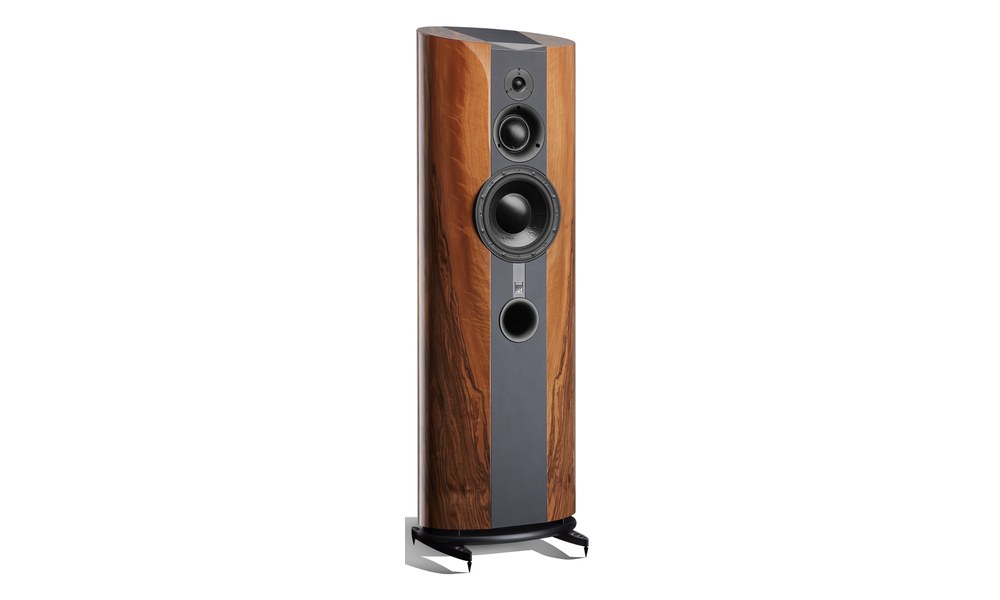
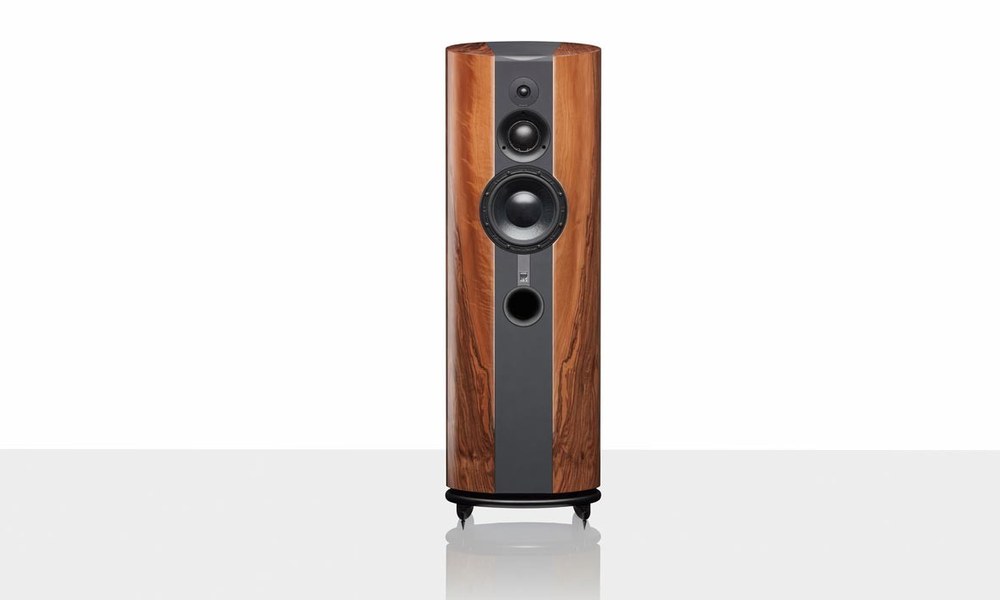
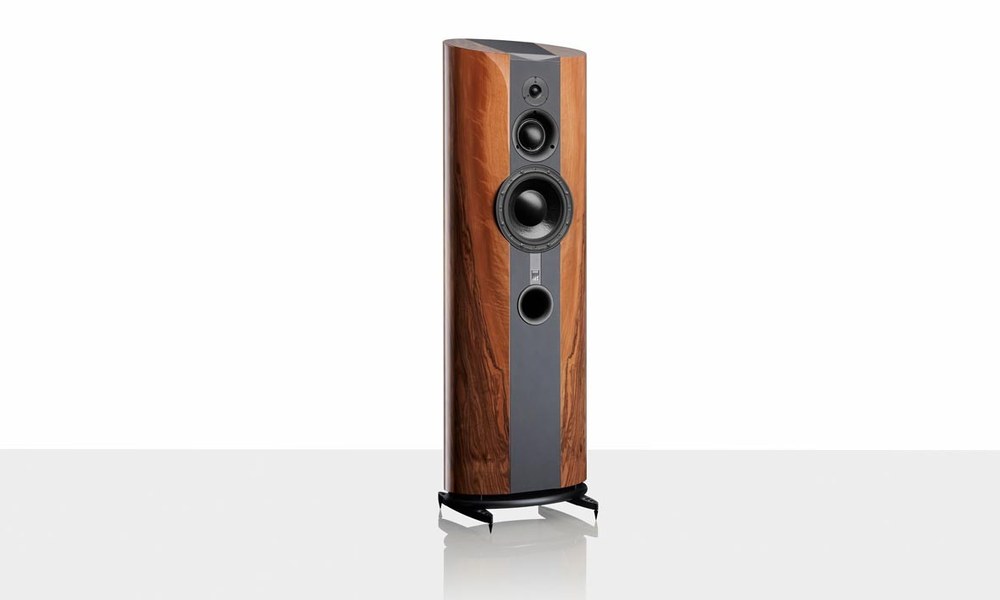
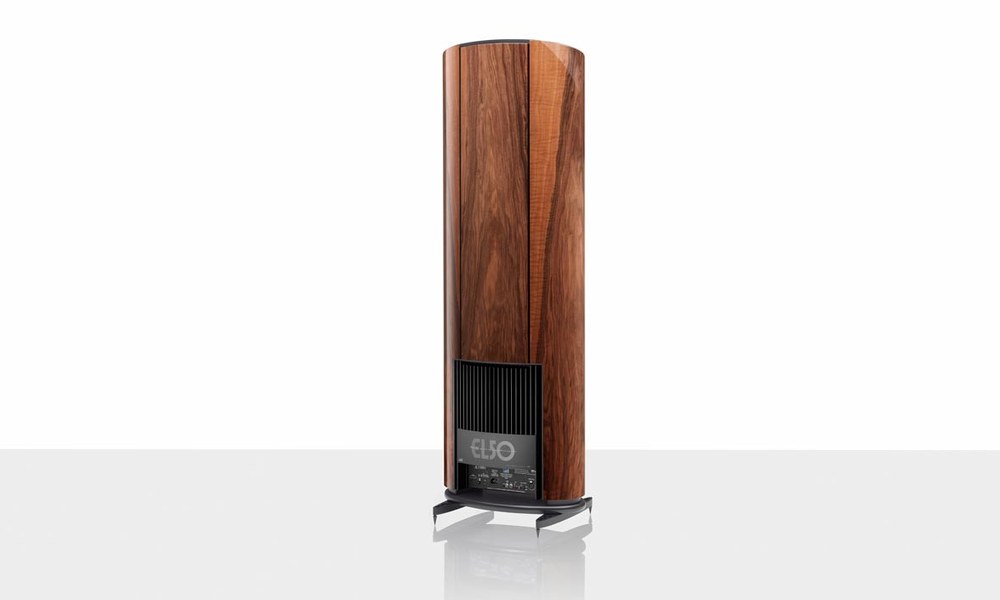
The ATC EL50 Anniversary is the 50-year anniversary model of the British heritage brand: an active 3-way floorstanding pair in an elliptical cabinet, limited to 50 pairs according to ATC, shipping since March 2026. Each speaker uses ATC drivers made in-house: a 25 mm S-Spec soft-dome tweeter, a 75 mm Superdome midrange and a 234 mm SB75-234SL Super Linear woofer. ATC states 32 Hz–25 kHz (−6 dB), max SPL 112 dB (pair, 1 m) and crossover points at 380 Hz and 3.5 kHz (Linkwitz-Riley, order 4). The new discrete amp pack delivers Class A/B MOSFET power with 200 W bass, 100 W mid and 50 W treble — each channel with its own toroidal transformer. Connection is balanced XLR only; input sensitivity (1 V / 2 V) and 12 V trigger are provided. There is no streaming, HDMI or phono — a preamplifier is required. The European RRP is €68,700 per pair (€34,350 per speaker at ATR Audio Trade); UK £49,500, US $99,999 (as of Oct. 2026, without guarantee).
Assumptions
- Price per pair or set according to manufacturer or trade, Stand Oct. 2026, no guarantee
- Vinyl via a phono stage and a preamp with balanced outputs at the XLR input (the speaker has no phono input)
- Free placement with distance to the rear wall, decoupled Turntable
- No in-house measurements or listening tests
Specifications (manufacturer)
| Type | Active 3-way floorstanding speaker · Bass-reflex · Tri-amp |
|---|---|
| Chassis | 25 mm SH25-76S soft-dome tweeter (S-Spec) · 75 mm SM75-150S Superdome midrange · 234 mm SB75-234SL Super Linear woofer |
| Amplifier | Discrete Class A/B MOSFET amp pack: bass 200 W (8 Ω) · Mid 100 W (16 Ω) · HF 50 W (8 Ω); separate toroidal transformer per channel |
| Crossover | Active, Linkwitz-Riley, order 4 · 380 Hz / 3.5 kHz |
| Frequency range | 32 Hz – 25 kHz (−6 dB, anechoic, manufacturer) |
| Max. SPL | 112 dB (pair, IEC weighted pink noise, 1 m, anechoic, manufacturer) |
| Inputs | Balanced XLR (instrumentation input) · Sensitivity switchable 2.2 dBu/1 V or 8.2 dBu/2 V |
| Room correction | no bass control in the manufacturer data · 12 V trigger on/off and link |
| Phono / streaming | No phono, no HDMI, no Wi-Fi — preamplifier and sources are external |
| Dimensions / weight | 1,421 × 459 × 352 mm (H × B × T) · 63 kg per speaker |
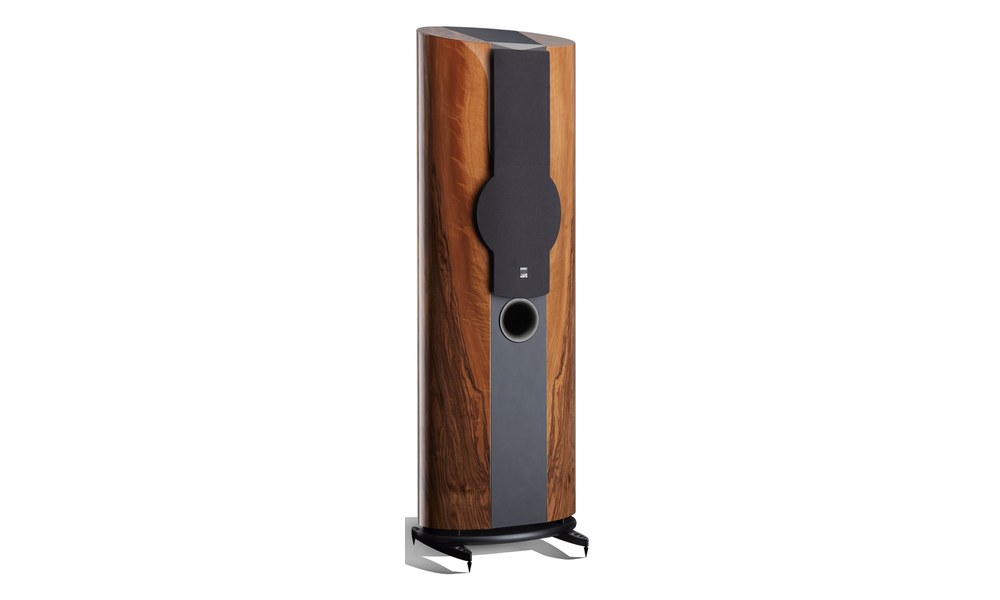
| Finish | Hand-selected European walnut, high-gloss polyester lacquer, napa leather details, ebony inlays at the rear |
| Price guide | RRP €68,700 per pair (EUR, Hi-Fi+) · ATR Audio Trade €34,350 per speaker · UK £49,500 · US $99,999 · as of Oct. 2026 · without guarantee |
Manufacturer specifications (ATC)
| Type | Active 3-way floorstanding loudspeaker · reflex · tri-amp |
|---|---|
| Bass driver | SB75-234SL · 234 mm · 8 Ω (ATC Super Linear) |
| Mid driver | SM75-150S · 75 mm soft dome · 16 Ω |
| High-frequency driver | SH25-76S · 25 mm soft dome S-Spec · 6 Ω |
| Crossover points | 380 Hz and 3.5 kHz · active 4th-order Linkwitz-Riley |
| Frequency response | 32 Hz – 25 kHz (−6 dB, anechoic) |
| Max SPL | 112 dB (per pair, IEC weighted pink noise, 1 m, anechoic) |
| Matched response | ±0.5 dB |
| Bass amplifier | 200 W continuous average into 8 Ω · 0.1% THD · Class A/B MOSFET |
| Mid amplifier | 100 W continuous average into 16 Ω · 0.1% THD · Class A/B MOSFET |
| HF amplifier | 50 W continuous average into 8 Ω · 0.1% THD · Class A/B MOSFET |
| Input | balanced XLR (female, pin 2 hot) · input impedance 20 kΩ · CMRR >80 dB (20 Hz–10 kHz) |
| Input sensitivity | switchable 2.2 dBu/1 V or 8.2 dBu/2 V (ref. full output) |
| Bass shelf | not stated in the manufacturer data |
| Power trigger | on/off and link · Switchcraft L712RA |
| Mains | 220–230 V / 110–115 V factory set |
| Power consumption | idle 77 W / 105 VA · 1/8 power 240 W / 315 VA · full power 600 W / 730 VA |
| Dimensions (H × W × D) | 1,421 × 459 × 352 mm |
| Weight | 63 kg net per speaker |
| Finishes | European Walnut high gloss with napa leather and ebony inlays |
| Phono / streaming / HDMI | not specified by the manufacturer (not provided) |
Source: ATC – official specifications · As of 19 October 2026 · subject to change by the manufacturer
Rating criteria in detail
The four criteria feed into the Vinyl BotPro Index with weights of 25/20/25/30. The index is scaled across all tiers (see Methodology); that is why we do not show individual sub-scores.
Strengths
- In-house ATC drivers and tri-amp with separate power supplies per way
- Elliptical cabinet against diffraction, very rigid multi-layer construction
- International listening reviews with exceptional resolution and control
- Studio accuracy without streaming compromises — a clear signal path via XLR
Weaknesses
- No streaming, no HDMI, no phono — a preamplifier is mandatory
- High price (approx. €68,700 per pair) and limited to 50 pairs
- Large and heavy (63 kg, 1.42 m tall)
Comparison models
| Dynaudio Focus 50 | Index 96, Rank 1, value for money Champion — Status · 3-way · closed-back · approx. €10,000 |
|---|---|
| Bang & Olufsen Beolab 28 | Index 92, Rank 3 — Balance · 3-way · Beam Width Control · from approx. €16,900 |
| Focal Diva Alta Utopia | Index 85, Rank 5 — Balance · 4-way · UWB streaming · approx. €190,000–199,990 |
| Nubert nuZeo 15 | Index 93, Rank 2 — Balance · 3.5-way · Bass-reflex · approx. € 9,600 (pair) |
System matching
Works well with
- Large listening rooms and monitor-minded listeners
- Systems with a high-quality preamp/DAC and phono stage
- Anyone looking for active precision without all-in-one streaming
Less suited
- Small rooms and all-in-one streaming solutions
- Turntables without an external phono stage and preamp
- Budgets below the Master field of the list
Specs & Features
The layout (Amp-Pack with three amplifiers per speaker, XLR input), drivers, enclosure, electronics data and conflicting figures are now collected, with sources, in the analysis below.
What international reviewers heard
Several reviews from the international specialist press are available for the ATC EL50 Anniversary. Here we summarise the overall picture in our own words; all sources are linked at the end of the page.
Sound character
- The international specialist press describes the EL50 as exceptionally resolving and studio-like: little coloration, high transparency, without the grain some active designs show. One review hears a hybrid of monitor and hi-fi speaker — honest, detailed and emotionally engaging.
Tonal balance
- Another review stresses that openness depends on the recording and that the speaker favours accuracy over a permanently airy house sound. One international review praises sweet oboes and full orchestral colour, yet also notes a brightly lit recorder on a reference disc as a sign of high transparency.
Dynamics, bass & staging
- Both reviews highlight controlled, powerful bass and dynamic headroom. One review speaks of physical bass pedals and huge control; a further review calls the bass tight and massive at once, with precise attacks down to the lowest orchestral hits.
Strengths
- Another review praises spatial scale, instrumental body and the ability to convince at moderate levels. One international review highlights clarity, fast transients and insight into mixes — even down to production choices.
Setup, room & partners
- Both reviewers used high-quality preamps and sources into the XLR input; a further review compared ATC’s SCA2 with a passive Music First preamp. Spikes and optional platforms affect timing and treble; the EL50 needs a solid floor and quality upstream.
Consensus & differences
- The reviews agree on resolution, bass control and monitor-like honesty at reference level. Nuances: Another review frames it as ending the search for less coloured amp/speaker combos, one international review stresses the balance between studio monitor and listening pleasure and that the detail may not suit every taste.
Research Consensus
We evaluate the articles by The Ear (04/2026) and hi-fi+ (08/2026) separately, by name and with dates below.
For whom / Matching
Amplifier & Phono stage
No power amplifier needed. A preamplifier with XLR output feeds the EL50; the phono stage sits in front of it. Candidates: Best phono preamps (Master) and suitable line preamps.
Turntable & phono
Decks of Master Level. With 32 Hz bass extension a subsonic filter in the phono stage makes sense; the turntable should stand on a stable, isolated base.
Room & placement
Large to very large rooms; the elliptical cabinet is somewhat forgiving but needs a solid floor and space around it. ATC lists no bass control; room modes can be addressed via placement or the preamp.
Budget & upgrade
At around €68,700 the EL50 sits below the Focal Diva Alta Utopia and above the Dynaudio Focus 50 / Nubert nuZeo 15. If you want streaming built into the speaker, stay with the Focus 50 or the Diva Alta Utopia.
Analysis: the ATC EL50 Anniversary in depth
What this page is: an AI analysis, not a listening session
This page assesses the ATC EL50 Anniversary on the basis of manufacturer information and two dated articles. The basis is ATC's product page with technical data [1], ATC's press release on the launch in February 2026 [2], the article by Jason Kennedy in The Ear from 22 April 2026 [3], the article by Rafael Todes in hi-fi+ from 18 August 2026 [4] and the show report by Jay Garrett in StereoNET from 19 February 2026 [5]. Vinyl BotPro has neither heard nor measured the speakers. Statements about sound belong to the named authors; our own assessments are recognisable as such. No laboratory measurements by a magazine were available for this analysis. Rank, index and prices on this page remain unchanged.
Which model is meant
- EL50 Anniversary: the active 3-way floorstander analysed here, marking ATC's 50th anniversary [1][2].
- EL150 (2006): the first ATC loudspeaker with an elliptical enclosure, designed by company founder Billy Woodman. According to ATC, the EL50 adopts its design language but is a separate model [2].
- SCM50 and SCM50 Anniversary (2004): the classic box-shaped ATC "50" models. According to The Ear, the EL50's drivers are pretty much the same as those in the SCM50 [3]; we still do not transfer statements about the SCM50 to the EL50.
- SCA2: ATC's preamplifier, which ATC lists as a partner [1]. It is not included.
According to ATC, the EL50 is the latest evolution of the "50" concept with discrete active tri-amp technology, first used in the SCM70 in the 1990s and refined through the SCM50 Anniversary (2004) and the SE Series (2014) [2][5]. StereoNET dates the first "50" design to 1978 [5].
Limited run and availability
ATC announced the EL50 Anniversary as an exclusive run of 50 pairs; each pair comes with a hardbound owner's book on the company's history [2]. StereoNET confirms the limit of 50 pairs [5]. The global debut was at the Bristol Hi-Fi Show from 20 to 22 February 2026, and ATC gives availability as March 2026 [2][5]. The press release names no prices; it refers to dealers and distributors [2].
Layout: an active speaker without source selection
Each EL50 contains a three-channel "Amp-Pack" with balanced input, user controls, active crossover and three power amplifiers [1][2]. ATC does not list streaming, HDMI, phono or source selection with volume control. According to the technical data, the only signal input is an XLR socket on the rear [1]. A preamplifier or a source with an adjustable balanced output therefore has to sit in front of it.
According to ATC, the amplifiers deliver 200 W to the woofer, 100 W to the midrange and 50 W to the tweeter, each as continuous power [1][2]. ATC says the amplifiers use MOSFETs in class A/B, are convection-cooled and need no fan [1]. New discrete gain blocks in the balanced instrumentation input and in the fourth-order active crossover are meant to lower noise and distortion [1][2].
According to ATC, the power supply has its own toroidal transformer for each amplifier channel plus a further transformer for the low-voltage supply [1][2]. This is meant to increase headroom under load and reduce intermodulation between the channels [2]. The Ear adds that the EL50's circuit boards now use surface-mount (SMD) components instead of through-hole parts [3].
Technology according to ATC
- Tweeter: SH25-76S "S-Spec", 25 mm, coated fabric dome, compact neodymium motor and dual suspension [1][2].
- Midrange: SM75-150S "Superdome", 75 mm, covering 380 Hz to 3.5 kHz according to ATC [2].
- Woofer: SB75-234SL "Super Linear", 234 mm; a special motor material is said to reduce third-harmonic distortion by up to 15 dB [1][2].
- Crossover: active, fourth-order Linkwitz-Riley, crossing over at 380 Hz and 3.5 kHz [1].
- Frequency range: lower limit 32 Hz (−6 dB, anechoic), upper limit 25 kHz (−6 dB) [1].
- Pair matching: ±0.5 dB [1].
- Maximum SPL: 112 dB (pair, IEC weighted pink noise, 1 m) [1].
- Dimensions and weight: 1,421 × 459 × 352 mm (H × W × D), 63 kg net [1].
ATC says it builds all drivers in-house [1][2]. hi-fi+ writes that the drivers are "nearly all" made in-house [4].
Input and electronics in detail
According to the technical data, the XLR socket is wired pin 2 positive; input impedance is 20 kΩ and common-mode rejection over 80 dB between 20 Hz and 10 kHz [1]. Input sensitivity can be switched between 2.2 dBu (1 V) and 8.2 dBu (2 V) for full output [1]. With a Music First passive transformer preamp, Kennedy found the more sensitive 1 V setting worked best [3].
ATC also states THD+N of 0.0015% (1 kHz, 1 dB below rated power), an electronics frequency response of 8 Hz to 190 kHz, a FET limiter on all channels and protection against DC offset and over-temperature, shown by an LED on the rear [1]. Two Switchcraft sockets serve as trigger input and link [1]. Kennedy notes that passive preamps have no trigger output [3]. The mains voltage is factory set [1].
ATC gives power consumption as 77 W at idle, 240 W at one-eighth power and 600 W at full power [1].
Enclosure
According to ATC, the enclosure is a multilayer laminated structure designed to be very stiff and well damped inside [1]. ATC says the elliptical shape is achieved through complex curved lamination, CNC machining and hand finishing [1]. The woofer sits in a precision-turned aluminium ring bolted to the front [2]. The curved front and edges are meant to reduce edge diffraction and make the on- and off-axis response more uniform [2].
Kennedy describes the sides as vacuum-formed plywood; the radius of the curves is 150 mm and works against diffraction from the midrange upwards [3]. Todes, by contrast, writes of a CNC-cut MDF structure [4]. These statements differ; we leave this open.
According to ATC, the veneer is hand-selected and matched European walnut with a high-gloss polyester lacquer, complemented by ebony inlays on the rear panel and napa leather around the mid and high-frequency drivers and on the lower front [1][2]. According to The Ear, the speaker stands on an oval plinth with machined aluminium outrigger feet; spikes are supplied [3]. hi-fi+ also mentions supplied spikes [4].
Listening impressions according to The Ear (04/2026)
Kennedy calls the EL50 one of, if not the most, convincing loudspeakers he has reviewed in nearly 40 years [3]. The insight into familiar recordings is exceptional, he says, even compared with more expensive amplifier and speaker combinations [3]. His former SCM150 ASL actives did not offer this resolution [3].
He describes treble without grain and listening without fatigue [3]. Because of the control, bass can seem leaner than it is; with suitable recordings, however, it has plenty of power and body [3]. Openness varies strongly from recording to recording; other speakers can sound airier [3]. The EL50 also convinces at moderate volume and does not expose weaker recordings too harshly [3].
Kennedy listened mostly with the Music First Baby Reference passive preamp and, for comparison, the ATC SCA2; he found the Music First more open and the SCA2 more focused and powerful [3]. As weaknesses he lists a less airy presentation than some rivals, size and weight, the price and the need for high-quality partnering equipment [3].
Listening impressions according to hi-fi+ (08/2026)
Todes listened with a dCS Bartók APEX as source and the Townshend Allegri Reference passive preamp [4]. With orchestral recordings he describes plenty of weight and power; he calls the bass control outstanding, "tight and massive" at the same time [4]. Oboe solos were as sweet as he has ever heard them [4].
He also reports one anomaly: in a Philips analogue recording of Bach's 4th Brandenburg Concerto, a recorder sounded very brightly lit in the top register [4]. Todes considers a room node, voicing with a more reticent preamp or the mastering monitors of the time as possible causes [4]. On Townshend Podiums on a tiled floor, he says the presentation tightened and bass timing improved slightly, but the treble became more strident [4].
Todes describes the EL50 as a balancing act between studio monitor and hi-fi speaker, a true hybrid [4]. Some listeners may find it too detailed and analytical [4].
What the articles share and where they differ
Both authors describe high resolution, low colouration and controlled, powerful bass [3][4]. Both listened via passive preamps at the XLR input [3][4]. The differences lie in emphasis: Kennedy considers the search for the least coloured amplifier and speaker combination over [3], while Todes stresses the trade-off between monitor honesty and listening pleasure and reports a conspicuously bright tone on one recording [4].
Fit for vinyl
The EL50 has no phono input and no source selection with volume control. A turntable therefore needs a phono stage and a preamp with balanced outputs feeding the XLR inputs of both speakers [1]. A phono stage with an adjustable XLR output can take on both roles. A separate power amplifier is not needed because the amplifiers are inside the speakers.
Conflicting and open figures
- Enclosure material: multilayer laminate (ATC) [1], vacuum-formed plywood (The Ear) [3], MDF (hi-fi+) [4].
- Enclosure type: The Ear and hi-fi+ list the EL50 as a ported (reflex) design [3][4]; ATC's page does not name the principle in the data used [1].
- Depth: 352 mm according to ATC and The Ear's specification box [1][3]; The Ear's main text says "only 24cm" [3].
- Bass adjustment: a bass-shelf setting is not documented in any of the sources used; ATC lists switchable input sensitivity and trigger [1].
- Warranty: six years, only according to The Ear [3].
- Price: hi-fi+ gives £49,500, €68,700 and $99,999 per pair [4]; The Ear £49,500 [3]. We have not changed the price above (as of Oct. 2026, no guarantee).
Conclusion of the analysis
The sources describe the EL50 Anniversary as a limited, elaborately built active system with in-house drivers, three amplifiers per speaker and separate power supplies per channel [1][2]. Two dated articles praise resolution, low colouration and bass control; they name limits in airiness, price, size and the need for high-quality partnering equipment [3][4]. For vinyl, the route is a phono stage and preamp into the XLR input.
Sources for this analysis
- ATC: EL50 Anniversary (Produktseite mit technischen Daten, abgerufen/accessed 08.11.2026). https://atc.audio/hi-fi/loudspeakers/special-editions/el50/
- ATC: ATC Launches Statement EL50 Anniversary Loudspeaker (Pressemitteilung/press release, Februar/February 2026). https://atc.audio/2026/02/atc-laatc-lunches-statement-el50-anniversary-loudspeaker/
- The Ear: ATC EL50 Anniversary – the search is over (Jason Kennedy, 22.04.2026). https://the-ear.net/review-hardware/atc-el50-anniversary-we-have-arrived/
- hi-fi+: ATC EL50 Anniversary (Rafael Todes, 18.08.2026). https://hifiplus.com/articles/atc-el50-anniversary/
- StereoNET: Bristol Hi-Fi Show: ATC EL50 Anniversary Loudspeaker Launch (Jay Garrett, 19.02.2026). https://www.stereonet.com/news/bristol-hi-fi-show-atc-el50-anniversary-loudspeaker-launch
Created by AI (Vinyl BotPro) from the sources listed; no listening tests or measurements of our own. Detailed human fact-check pending.
What makes this AI analysis special
This section is an AI summary of published international listening reviews and the manufacturer data from ATC. Vinyl BotPro puts the reviewers’ findings into context and links them with the data sheet and comparison models; VinylCination does not run its own listening tests or measurements; all sources are linked at the end of the page. Prices and availability change (as of Oct. 2026, no guarantee); please check technical values against the current data sheet.
Vinyl BotPro Score Logic
The Vinyl BotPro Index runs from 0–100 across all tiers and weights build/technology, features, expected performance and value for money at 25/20/25/30. Master typically sits at ~85–97. ATC EL50 Anniversary receives 86 (rank 4 Master). Very high engineering and expected performance according to listening reviews; sparse features (XLR only) and the high-end price limit the features and value scores. In the stage, the model bears the title Sound Vinyl BotPro Champion. Rank is not Laboratory Evaluation — no Listening test. Details on weighting · Methodology.
Sources
- ATC — EL50 Anniversary (manufacturer page, specifications)
- ATC — launch statement EL50 Anniversary (Feb. 2026)
- The Ear — ATC EL50 Anniversary The Search Is Over (22.04.2026)
- Hi-Fi+ — ATC EL50 Anniversary (18.08.2026)
- StereoNET — Bristol Hi-Fi Show: ATC EL50 Anniversary Loudspeaker Launch
Created by Vinyl BotPro (AI) · AI analysis · As of 20.10.2026 · Corrections: info@vinylcination.de · Prices without guarantee.
Read more: best active floorstanding speakers 2026 · What is hi-fi?