
Active floorstanding speaker · AI analysis · Master, Rank 1
Dynaudio Focus 50: Analysis
AI analysis (research): sealed 3-way active speaker from Dynaudio with a 28 mm Cerotar dome (Hexis), 15 cm MSP midrange, two 18 cm MSP woofers, Pascal Class D amplifiers per way, streaming, two RCA inputs, WiSA and optional Dirac Live. Based on manufacturer data and press reviews, no listening test.
Summary
Value-for-money Vinyl BotPro Champion Best value-for-money estimate of the tier on the data basis (no listening test).
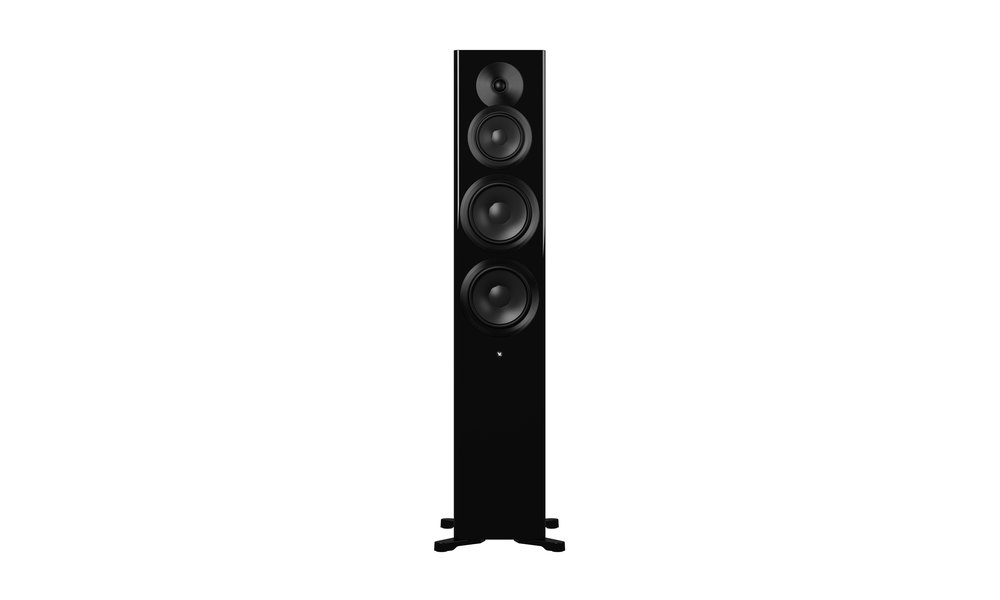
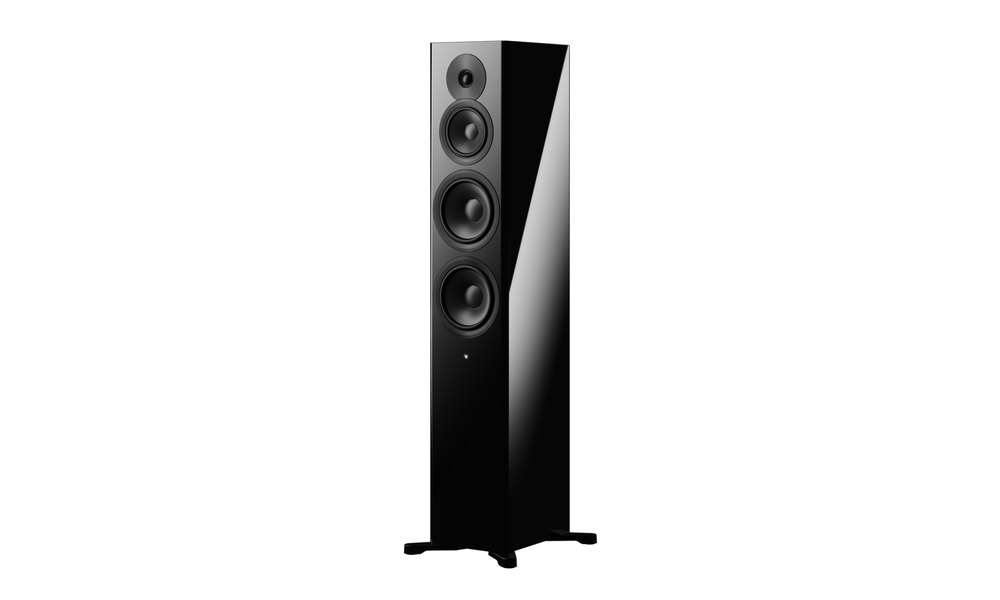
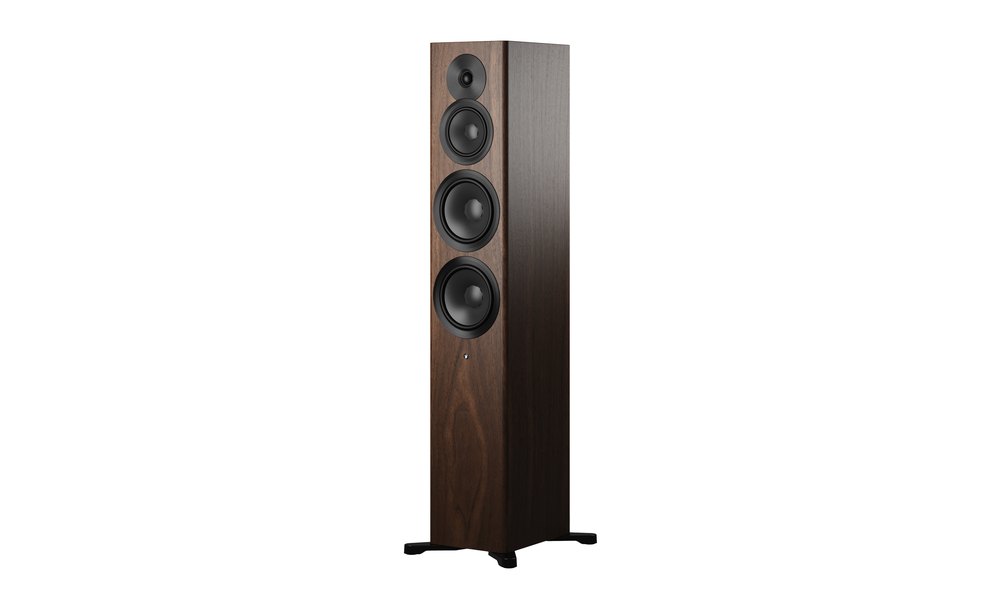
The Dynaudio Focus 50 is the largest model of the active Focus series: a sealed 3-way system with 28 mm Cerotar dome, 15-cm midrange drivers and two 18-cm low-range MSPs, separated at 390 and 4,700 Hz. Dynaudio refers to 20 Hz to 22 kHz (±3 dB) — from a closed-back enclosure of 1.14 m height. Each way has its own Pascal Class D amplifier; the two woofers share one. The connections correspond to Focus 30: WLAN and Ethernet streaming, two RCA analog inputs, Toslink, Koax, Bluetooth, subwoofer output and WiSA radio between the speakers; Dirac Live is optional. The international specialist press recommends Focus 30 and 50 for larger rooms and higher levels. Dynaudio lists approximately 10,000 € per pair (as of Oct. 2026, without guarantee).
Assumptions
- Price per pair or set according to manufacturer or trade, Stand Oct. 2026, no guarantee
- Vinyl via an external phono stage at the RCA line input (the speaker has no phono input) or via a turntable with a built-in preamp
- Free placement with distance to the rear wall, decoupled Turntable
- No in-house measurements or listening tests
Specifications (manufacturer)
| Type | Active 3-way floorstanding speaker · closed-back · DSP crossover |
|---|---|
| Chassis | 28 mm Cerotar domes with hexis · 15 cm MSP-Midrange driver · 2 × 18 cm MSP-woofer |
| Separation frequencies | 390 / 4,700 Hz |
| Amplifier | Pascal Class D, own power amplifier per way |
| Frequency response | 20 Hz – 22 kHz (±3 dB, manufacturer) |
| Inputs | 2 × RCA analog · Toslink · Koax · WLAN/Ethernet streaming · Bluetooth 4.2 |
| Outputs | Subwoofer (RCA) · Triggers |
| Phono | No phono input — external phono stage at RCA |
| Loudspeaker connection | Wi-Fi (24/96) or cable (24/192) |
| Dimensions / weight | 215 × 1,140 × 305 mm (B × H × T) · 33.5 kg per speaker |
| Price guide | approx. 10,000 €/pair (Dynaudio) · as of Oct. 2026 · without guarantee |
Manufacturer specifications (Dynaudio)
| Type | Active streaming floorstanding speaker |
|---|---|
| Amplifier power | per speaker: woofer 280 W · midrange 280 W · tweeter 110 W · load impedance not specified by manufacturer (built-in amplifier) |
| Drivers | 28 mm Cerotar soft dome with Hexis · 15 cm MSP midrange · 2 × 18 cm MSP woofers |
| Frequency response | 20 Hz–22 kHz (±3 dB, 85 dB) · dynamic 18 Hz–36 kHz (−6 dB) |
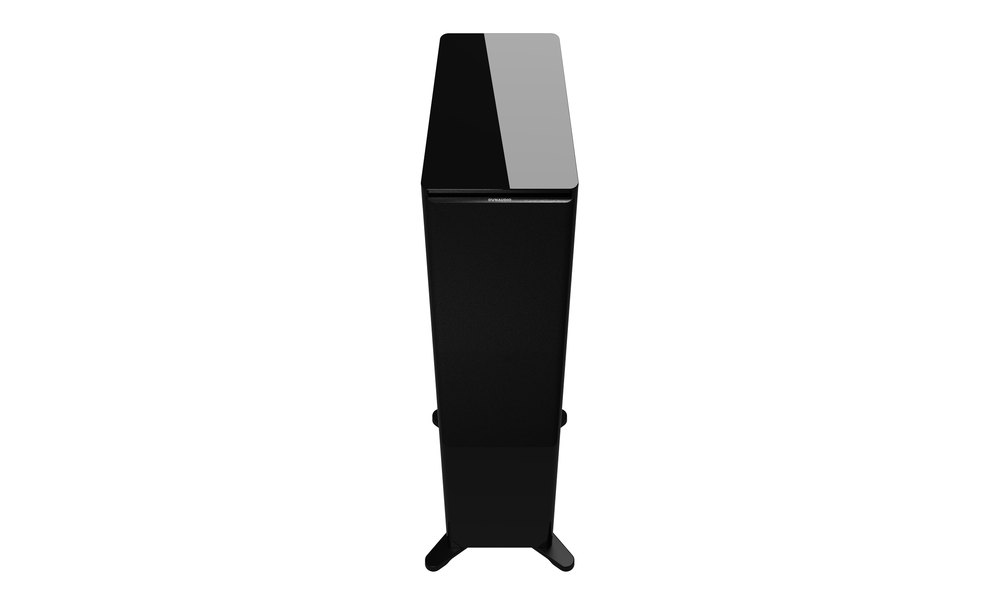
| Dimensions | 215 × 1,140 × 305 mm (W × H × D) · 305 × 1,187 mm incl. feet |
| Weight | 33.5 kg |
Source: Dynaudio – official specifications · As of 16 October 2026 · subject to change by the manufacturer
Rating criteria in detail
The four criteria feed into the Vinyl BotPro Index with weights of 25/20/25/30. The index is scaled across all tiers (see Methodology); that is why we do not show individual sub-scores.
Strengths
- 20 Hz (±3 dB) of closed-back enclosure
- Real 3-way system with own power amplifier per way
- Streaming, two analog inputs, sub-output
- Optional Dirac Live
Weaknesses
- No phono input
- Dirac Live costs extra
- Analog sources are digitized
- Large and heavy
Comparison models
| ATC EL50 Anniversary | Index 86, Rank 4, Sound champion — Status · 3-way · active tri-amp · approx. €68,700 |
|---|---|
| Nubert nuZeo 15 | Index 93, Rank 2 — Balance · 3.5-way · Bass-reflex · approx. € 9,600 (pair) |
| Bang & Olufsen Beolab 28 | Index 92, Rank 3 — Balance · 3-way · Beam Width Control · from approx. €16,900 |
System matching
Works well with
- Large spaces and higher levels
- Vinyl listening aids with high-quality external phono stage
- Who is looking for a complete system with room correction
Less suited
- Small rooms
- Turntable without phono stage
- Purely analog signal way
Specs & Features
The layout (Primary/Client, one amplifier per way), drivers, connections, app settings and conflicting figures are now collected, with sources, in the analysis below.
Research Consensus
We evaluate the articles by Audio (11/2022, with lab results) and Twittering Machines (11/2022) separately and with dates below.
For whom / Matching
Amplifier & Phono stage
There's no need for an amplifier. The Phono stage comes to one of the two RCA inputs. Candidates: Top list Phono preamps.
Turntable & phono
Decks of Master Level. At 20 Hz bass extension, a subsonic filter in the phono stage makes sense; Dirac Live tames room modes that can inflate the bass at the listening position.
Room & placement
Large living rooms, distance to walls, measure Dirac Live after the placement.
Budget & upgrade
With around 10,000 € value-for-money champion of the master level. More bass extension for less money, without streaming: Nubert nuZeo 15.
Analysis: the Dynaudio Focus 50 in depth
What this page is: an AI analysis, not a listening session
This page brings together what can be documented about the Dynaudio Focus 50 from manufacturer documents and dated articles from the specialist press. The basis is Dynaudio's product page with technical data [1], the English user manual for the Focus series [2], Andrzej Kisiel's article with a lab section in the Polish magazine Audio dated 14 November 2022 [3] and Michael Lavorgna's review at Twittering Machines dated 10 November 2022 [4]. Vinyl BotPro has neither heard nor measured these speakers. Measurements come only from [3]; statements about sound are attributed to the named authors. Our own assessments are labelled as such. The page's rank, index and price details remain unchanged.
Which model this is
- Focus 50: the largest model in the current Focus series analysed here, a sealed 3-way floorstander [1].
- Focus 30: the smaller floorstander in the series, a 2.5-way design with two 14 cm drivers [1]. We do not transfer data or listening impressions from the Focus 30.
- Focus 10: the series' compact speaker [1].
- Focus XD (Focus 20/30/60 XD): the previous generation. According to Audio, the XD models 20, 30 and 60 are being replaced by the Focus 10, 30 and 50; the Focus 50 roughly matches the former Focus 60 XD in cabinet and driver size [3]. According to Dynaudio's John Quick, quoted by Twittering Machines, the new series shares virtually nothing with the two previous generations: drivers, cabinets, amplifiers, DSP and streaming platform are all new [4].
The XD series needed an external Connect unit for wireless reception and additional inputs; the new Focus 50 accepts all sources directly at the primary speaker [3].
Layout: two active speakers, Primary and Client
Each Focus 50 is a fully active speaker with its own amplifiers and its own mains connection. Both speakers need mains power; Dynaudio therefore names proximity to power sockets as the first criterion when choosing positions [2]. The inputs are on the Primary, which sends the second channel's signal to the Client [1][2][3]. According to the manual, the two speakers connect to each other wirelessly and automatically on installation [2]. Alternatively, a coaxial cable from "Coax Out" on the Primary to "Coax In" on the Client links them; the wired connection then takes over automatically [2].
Each speaker contains three class-D amplifiers from Pascal in Copenhagen: 110 W for the tweeter, 280 W for the midrange and 280 W for the two woofers, which are driven in parallel [1][4]. So there is one amplifier for each way, not one for every single driver. Dynaudio quotes 1,000 W as peak power [1]. Audio notes that the bass amplifier is no stronger than the midrange amplifier despite driving two woofers; estimating roughly 100 W of demand per woofer, the author still considers the reserve sufficient [3].
Technology according to Dynaudio
- Principle: sealed cabinet, 3 ways, DSP crossover [1].
- Tweeter: 28 mm Cerotar soft dome with the Hexis inner dome from the Confidence series, Ferrite+ magnet with strontium carbonate [1].
- Midrange: 15 cm MSP driver with neodymium magnet, derived from the Contour 60; glass-fibre voice-coil former, aluminium voice coil [1]. According to Dynaudio it is the only dedicated midrange driver in the Focus range [1].
- Woofers: two 18 cm Esotec+ drivers with MSP cones and copper voice coils [1].
- Crossover frequencies: 390 and 4,700 Hz [1].
- Frequency response: 20 Hz to 22 kHz (±3 dB at 85 dB), dynamic 18 Hz to 36 kHz (−6 dB) [1].
- Dimensions and weight: 215 × 1,140 × 305 mm, with feet and grille 305 × 1,187 × 401 mm; 33.5 kg [1].
- Power consumption: maximum 280 W, standby maximum 2 W [1].
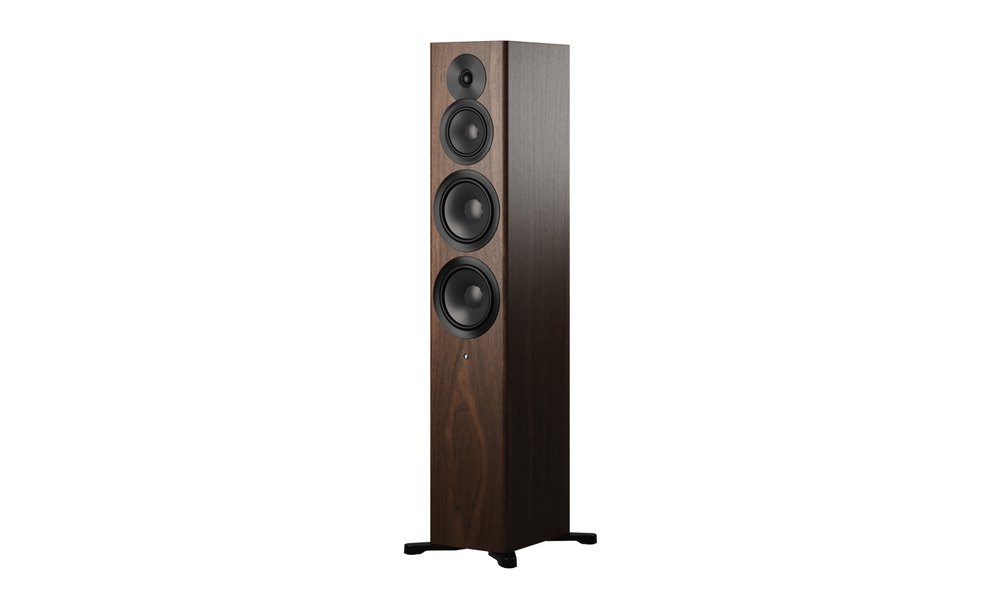
- Finishes: Black and White High Gloss, Blonde Wood, Walnut Wood [1].
To prevent excessive cone excursion at high levels, Dynaudio uses a sliding high-pass filter that relieves the woofers as volume rises [1]. Audio describes the same principle: the bass boost is reduced as power increases, and the lower cut-off frequency rises [3].
Connections and control
According to the datasheet, the Primary has two RCA analogue inputs, one Toslink and one coaxial digital input, a subwoofer output, a trigger output and a coaxial digital output to the Client [1]. The manual clarifies the "2x RCA": it is one stereo line-input pair with sockets "Line L" and "Line R" [2]. Networking is via Wi-Fi or Ethernet, plus Bluetooth 4.2 [1]. Streaming: Roon, AirPlay 2, Chromecast, Tidal Connect, Spotify Connect, Qplay and UPnP [1]. Between the speakers, WiSA runs at up to 24 bit/96 kHz, or a cable at 24 bit/192 kHz [1].
Setup is done in the "Dynaudio Set-up and Control" app [1][2]. Audio stresses that the basic configuration is only possible via the app and that the speakers need an internet connection to start [3]. A remote control is included; according to Audio it works via Bluetooth rather than infrared and has to be paired with the speakers [3]. With wired sources and WiSA it does not control play/pause or track skipping [2]. The "Service" USB sockets are not audio inputs [2].
According to the manual, the speakers wake from standby when audio plays from any source and return to standby after twenty minutes of silence [2]. In the app you can choose between an energy-saving mode and a quick start-up mode with higher standby consumption [2].
Settings in the app
- Room Optimisation: "Neutral" (default), "Near wall" and "Corner"; the last two reduce bass to compensate for the boost from nearby room boundaries. The setting can differ between Primary and Client, but symmetrical placement is described as the better option [2].
- Frequency Balance: "Bright", "Neutral" and "Dark", applied to both speakers [2].
- Analogue input: input sensitivity −6, 0 or +6 dB depending on the source's output level [2].
- Fixed volume: disables volume control when an upstream component controls the level [2].
- Subwoofer high-pass: 80 Hz, plus a trigger output for compatible Dynaudio subwoofers [2].
- Grille EQ: a sensor detects the magnetic grille and applies a slight treble lift; the logo light briefly glows blue [1][2].
- Dirac Live: optional room correction [1][2]. According to Audio it is a paid option [3].
Placement according to Dynaudio's manual
The manual recommends [2]:
- Speakers along one wall, 2 to 4 m apart.
- Listening distance similar to, or slightly more than, the distance between the speakers.
- Toe-in is not necessary but can tighten the central image at the listening position.
- As far from walls as possible, ideally at least 50 cm from each wall.
- Similar acoustic surroundings for both speakers, for example not one in front of curtains and one in front of a bare wall.
- Tweeter at roughly head height at the listening position; both speakers at the same height.
- Running-in: according to Dynaudio, a new speaker needs several weeks of use to reach its full potential [2].
Audio (November 2022): lab results
Audio published measurements with neutral correction [3]:
- Bass: −6 dB at 18 Hz measured from the 30–80 Hz plateau, or about 16–17 Hz from the average level. This matches the manufacturer's figure [1][3].
- Below 20 Hz: a steep high-pass with more than 24 dB/octave [3].
- Room modes: between 20 and 100 Hz, "Wall" and "Corner" each sit about 3 dB below the previous mode on average [3].
- Mid/treble: ±1.5 dB on the main axis (measured at 100 cm height); little variation within ±7° vertically and 15/30° horizontally [3].
- Impedance: this measurement does not apply to an active speaker [3].
Audio gives a price of 49,500 złoty (as of 11/2022) [3].
Audio (November 2022): listening report
Andrzej Kisiel describes the sound as balanced, coherent and orderly, combining density with clarity [3]. He hears the midrange as a step above earlier passive Dynaudio models, transparent without harshness, with precise staging [3]. Average recordings benefit, while very poor ones are not rescued [3]. The author mostly listened with the bass mode for free-standing placement and neutral treble [3]. Audio criticises that the Focus 50 only works with a network connection [3].
Twittering Machines (November 2022)
Michael Lavorgna used the WiSA wireless link between the speakers throughout and controlled playback via Roon [4]. He describes big, deep bass and a soundstage extending beyond the speakers; voices and string instruments had physical presence [4]. He tried Dirac Live with his own measurement microphone and praises the simple process [4]. His conclusion: the sound is "on par with separates" [4]. He gives USD 11,000 per pair (as of 11/2022) [4]. According to the quoted Dynaudio employee, all incoming signals are sample-rate converted only once, to 48, 96 or 192 kHz; the warranty was 5 years on electronics and 8 years on the rest (with registration) [4]. This warranty statement comes from a 2022 interview; current terms may differ.
Conflicting figures
- Digital inputs: Dynaudio lists one Toslink and one coaxial input [1]; Twittering Machines lists two coaxial and one Toslink input [4].
- Wired link: datasheet 24 bit/192 kHz [1]; manual "196 kHz / 24 Bit" [2], probably a typo.
- Treble presets: manual "Bright" [2]; Twittering Machines "light" [4].
- Midrange name: Twittering Machines calls it Esotec+ [4]; Dynaudio describes it as a neodymium MSP driver derived from the Contour 60 [1].
- Second crossover point: Audio sees irregularities around 2.5 kHz in its plot, is surprised by the stated 4.7 kHz and leaves the question open [3].
In a vinyl system
The Focus 50 has no phono input. Audio states explicitly that neither a turntable nor a phono preamp is built in [3]. The RCA input is a line input [2]. A turntable therefore needs an external phono stage or a built-in preamp. Dynaudio mentions turntables "via line-in or a compatible adaptor" [1].
Analogue signals are digitised because the crossover works in DSP; Audio concludes that feeding digital signals is theoretically preferable [3]. The −6/0/+6 dB sensitivity steps allow adjustment to the phono stage's output level [2].
Our assessment: according to the manufacturer and Audio's measurement, the Focus 50 reaches down to about 18 Hz (−6 dB) [1][3]. A subsonic filter in the phono stage can therefore be useful. None of the sources we evaluated comments on the sound with a turntable.
Open points and limits of this analysis
- No listening session of our own and no measurements of our own.
- Two specialist articles from 2022 were evaluated [3][4]; we do not use other sources under our rules.
- Prices are dated (49,500 złoty, 11/2022; USD 11,000, 11/2022) [3][4].
- The manual covers the whole Focus series and partly refers to the Focus 10 [2].
- A human fact-check and a browser check of this page are still pending.
Sources for this analysis
- Dynaudio: Focus 50 (Produktseite mit Beschreibung und technischen Daten, abgerufen/accessed 08.11.2026). https://dynaudio.com/home-audio/focus/focus-50
- Dynaudio: Focus User Manual (PDF, Serienanleitung Focus 10/30/50, englisch/English). https://dynaudio.com/hubfs/Manuals/dynaudio_manuals_home_audio_focus_en.pdf
- Audio (audio.com.pl): Dynaudio Focus 50 – Zespoły głośnikowe (Andrzej Kisiel, 14.11.2022, aus/from Audio 10/2022, mit Labor/with lab section). https://audio.com.pl/testy/stereo/kolumny-glosnikowe/3555-dynaudio-focus-50
- Twittering Machines: Dynaudio Focus 50 Active Wireless Speakers (Michael Lavorgna, 10.11.2022). https://twitteringmachines.com/review-dynaudio-focus-50-active-wireless-speakers/
Created by AI (Vinyl BotPro) from the sources listed; no listening tests or measurements of our own. Detailed human fact-check pending.
What makes this AI analysis special
This section is an AI summary from Manufacturer data and reports from international specialist media. Vinyl BotPro had no physical access, no measurement of our own chain and no listening test. The basis is Dynaudio's product page and series manual, the classification of the Focus series by Stereophile and SoundStage!, and dated articles on the Focus 50 by Audio (with lab section) and Twittering Machines; conflicting figures are marked below. Prices and availability change (as of Oct. 2026, no guarantee); please check technical values against the current data sheet.
Vinyl BotPro Score Logic
The Vinyl BotPro Index runs from 0–100 across all tiers and weights build/technology, features, expected performance and value for money at 25/20/25/30. Master typically sits at ~85–97. Dynaudio Focus 50 receives 96 (Rank 1 Master). Highest expected performance of the master stage according to concept and series classification; value for money solid. In the stage, the model bears the title Value for money Vinyl BotPro Champion. Rank is not Laboratory Evaluation — no Listening test. Details on weighting · Methodology.
Sources
- Dynaudio — Focus 50 (Manufacturer's website, technical data)
- Stereophile — Dynaudio Focus 10 active loudspeaker
- SoundStage! — Recommended Reference Component: Dynaudio Focus 30
Created by Vinyl BotPro (AI) · AI analysis · As of 08.10.2026 · Corrections: info@vinylcination.de · Prices without guarantee.
Read more: best active floorstanding speakers 2026 · What is hi-fi?