
Active subwoofers · AI analysis · Master, Rank 2
Bowers & Wilkins DB1D: Analysis
AI analysis (Research): Bowers & Wilkins active closed-back subwoofer with two opposite 12-inch Aerofoil drivers, 2,000-W digital amplifier, Dynamic EQ digital preamplifier and Room EQ via app. Based on manufacturer data and press reviews, no listening test.
Summary
Sound Vinyl BotPro Champion Highest expected performance of the level according to Manufacturer data and Specialist press. This is an AI assessment, not a listening test.
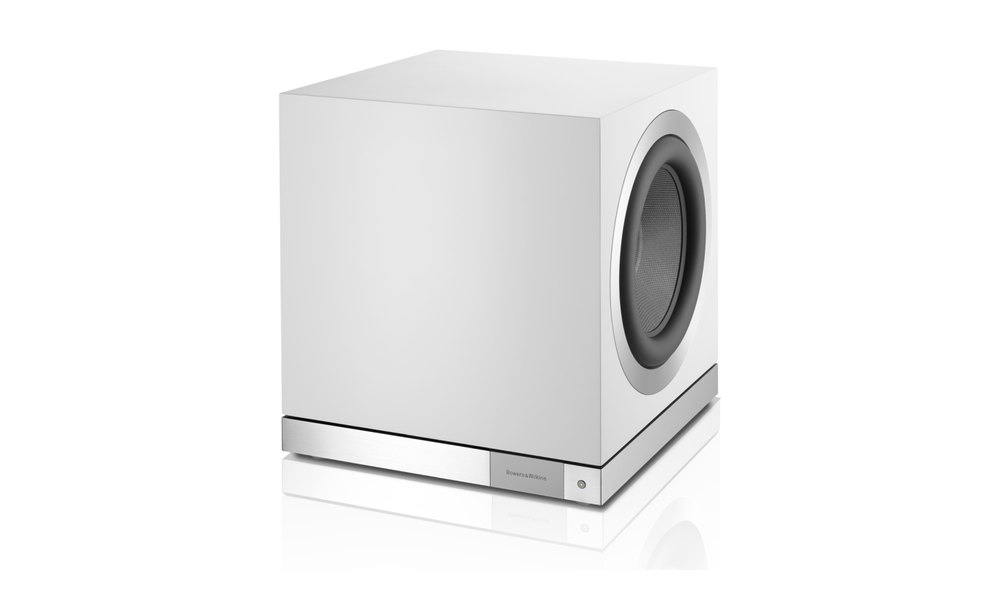
The Bowers & Wilkins DB1D is B&W's strongest subwoofer: two 12-inch Aerofoil drivers work back to back so that the body forces are lifted. A 2,000 W digital amplifier drives both chassis; the enclosure measures 460 × 429 × 410 mm at 43 kg. Dynamic EQ, Room EQ and the sound profiles for music and film are set via app. Australian Hi-Fi (What Hi-Fi?, 16 January 2019) reports Newport Test Labs measurements after calibration of 15 to 200 Hz within ±1 dB, with extension below 9 Hz. Price guide: approximately 5,400 € (as of Oct. 2026, without guarantee).
Assumptions
- Price per subwoofer (piece) according to manufacturer or trade, Stand Oct. 2026, no guarantee
- Operation in addition to stereo main loudspeakers (2.1), low-pass and phase tuned at the listener's place
- Vinyl chain with Phono stage; Subsonic filter recommended
- No in-house measurements or listening tests
Specifications (manufacturer)
| Type | Active subwoofer · Sealed Enclosure · opposing drivers |
|---|---|
| Woofer | 2 × 300 mm (12 inch) Aerofoil, balanced arrangement |
| Electronics | Class D amplifier (Hypex) 2,000 W max. · digital preamplifier with Dynamic EQ |
| Bass extension | 10 – 350 Hz (−3 dB) · −6 dB at 8.5 Hz (manufacturer) |
| Measurement | Room EQ via app · EQ Profiles Music/Film |
| Dimensions / weight | 460 × 429 × 410 mm (H × B × T) · 43 kg |
| Price guide | approx. €5,400 · as of Oct. 2026 · without guarantee |
Manufacturer specifications (Bowers & Wilkins)
| Type | Active subwoofer · two drivers in balanced configuration |
|---|---|
| Amplifier power | 2,000 W class D (Hypex) · max power output 2,000 W · continuous power / load impedance not specified by manufacturer |
| Drivers | 2 × 300 mm (12 in) Aerofoil cone |
| Frequency response | 10–350 Hz (−3 dB, centred on 100 Hz) · frequency range −6 dB: 8.5–500 Hz |
| Inputs | 2 × XLR · 2 × RCA · 2 × 3.5 mm 12 V trigger · RS-232 |
| Dimensions | 460 × 429 × 410 mm (H × W × D) |
| Weight | 43 kg |
Source: Bowers & Wilkins – official specifications · As of 16 October 2026 · subject to change by the manufacturer
Rating criteria in detail
The four criteria feed into the Vinyl BotPro Index with weights of 25/20/25/30. The index is scaled across all tiers (see Methodology); that is why we do not show individual sub-scores.
Strengths
- Infrasonic bass extension
- Countervailing drivers without housing vibration
- Room EQ and extensive EQ options
- Housing Enclosure for the Benefit
Weaknesses
- Very high price
- Setup via App only
- 43 kg weight
- Oversized for small rooms
Analysis: Bowers & Wilkins DB1D in detail
Scope and sources
On the existing VinylCination page the Bowers & Wilkins DB1D carries the title Sound Vinyl BotPro Champion in the Master tier, with Vinyl BotPro Index 91 and rank 2 in that tier (analysis 09/2026). That ranking remains the live page’s; this long analysis adds a named, checked international listening report with laboratory measurements, plus the official manufacturer data. VinylCination has neither heard nor measured the DB1D itself.
The pillar is the listening and measurement article by Australian Hi-Fi, published on What Hi-Fi? on 16 January 2019 (datePublished 2019-01-16T05:18:31+00:00). Australian Hi-Fi is a specialist magazine in continuous publication since 1969; the piece hosted on What Hi-Fi? includes its own “Listening sessions” section and a laboratory report from Newport Test Labs. That is an independent international listening report of the exact DB1D model, not a manufacturer page, an announcement or an award citation.
The Bowers & Wilkins manufacturer page (DB1D product page, retrieved 12 November 2026) states the technical frame: two opposed 300 mm Aerofoil drivers, a 2,000 W digital amplifier (Hypex Class D), frequency response 10 to 350 Hz (−3 dB, referred to 100 Hz), −6 dB at 8.5 Hz, a cabinet of 460 × 429 × 410 mm and 43 kg. The existing product page records the same nominal data; the live table is left unchanged.
Audioholics published a 2017 preview of the DB series, not a completed domestic listening report of the DB1D. We do not use that text as a pillar. Forums, retailer pages and YouTube channels stay outside the source set of this analysis.
Place in the range
The DB1D is the largest active subwoofer in Bowers & Wilkins’s DB series and, on the live page, the maker’s most powerful subwoofer. Two 12-inch Aerofoil drivers sit back to back in a sealed cabinet so that reaction forces cancel. The Aerofoil cone comes from work on the 800 Series Diamond. The subwoofer is controlled only through the “DB Subwoofers” app, not by conventional cabinet pots.
The existing page places it in the Master tier of active subwoofers as Sound champion, behind the SVS SB16-Ultra as value champion (Index 96, rank 1). The REL S/812 sits in the same table with Index 86 at rank 3. This long analysis takes that order from the live page and does not recalculate the index.
Australian Hi-Fi notes that the earlier DB1 appeared in Stereophile’s Class A listing, yet Bowers & Wilkins was still not widely seen first and foremost as a maker of costly subwoofers. In that article the DB1D is presented as the design that changes this. The predecessor is historical context here, not a listening pillar for the DB1D.
Design and manufacturer data
According to the current manufacturer page and the unchanged live table, two 300 mm Aerofoil cones work in a balanced arrangement, driven by a Hypex Class D amplifier rated at 2,000 W maximum and a digital preamplifier with Dynamic EQ. The maker states 10 to 350 Hz (−3 dB) and −6 dB at 8.5 Hz; with the low-pass filter off, the laboratory report of the specialist press extends the upper roll-off further still. Inputs are two XLR, two RCA, a 12 V trigger and RS-232. Calibration runs through Room EQ in the app, with music and movie profiles.
These figures are the manufacturer’s ratings, not VinylCination’s own measurements. If an older short formula differs in wording, that does not change the table. In this case driver size, amplifier power, cabinet and weight match the manufacturer page retrieved on 12 November 2026.
At 460 × 429 × 410 mm and 43 kg the cabinet is more compact than many 16-inch subwoofers, but it is not a tiny living-room cube. The live page gives about €5,400 as a price guide (as of October 2026, without guarantee). Finishes in the 2019 listening report were piano black, piano white and Rosenut veneer; which finishes the maker offers today should be checked on the current sheet, not on that older list.
The app replaces every conventional control: level, low-pass, phase, slope, a five-band equaliser and automatic room correction via the phone or tablet microphone. Australian Hi-Fi records that calibration failed on some Android devices because of microphone incompatibilities; a list of compatible devices then sat on the maker’s site. That is a documented control limitation, not a laboratory judgement of the frequency response.
What the specialist press heard and measured
In its listening sessions Australian Hi-Fi describes the sound of the DB1D as exceptionally deep and at the same time tight. The author writes that the subwoofer goes lower than any similarly sized unit he has heard in his room or at shows; even demanding infra-bass recordings were turned into powerful, accurate bass. What matters, he says, is not only the lower limit but that what one actually hears is tight and unusually realistic.
On organ pedals — among them Dorian’s recording of Jean Guillou playing Mussorgsky’s Pictures at an Exhibition — and on well-recorded electric or double bass with drums, from rock to jazz, the text stresses the immediate impact of the kick drum and the clear drawing of the attack. The speed of the bass is almost surreal; despite the large cones the DB1D could still be joined seamlessly to small bookshelf speakers, which the author treats as an exception to the usual rule of large subs with large floorstanders. That remains his observation in his room, not a general pairing rule.
The same report checked whether a manual calibration with a professional real-time analyser, a measurement microphone and pink noise would audibly beat the app’s automatic equalisation. The spectrum looked flatter, but when switching between the two curves the author could not hear a superiority of his own calibration. His conclusion: Bowers & Wilkins’s automatic calibration is enough in practice. Criticism is reserved for the app itself: it is powerful but not particularly intuitive, and often hides the choices available; a manual is advisable.
Newport Test Labs measured the frequency response after calibration, with the low-pass set to 150 Hz and 12 dB/octave. The result: 15 to 200 Hz within ±1 dB, −3 dB at 10 Hz and −6 dB at 8.5 Hz. The normalised response with the filter on is given as 10 to 240 Hz ±3 dB; with the filter off the roll-off was −3 dB at 350 Hz and −6 dB at 520 Hz. Even without equalisation the curves in the settings shown already looked unusually flat, so correction can go mainly to the room rather than to a gross cabinet irregularity. The laboratory report calls the measured performance outstanding.
Graph 3 of the laboratory report shows the difference between the movie and music profiles: it is confined to 15 to 100 Hz and is modest; the largest deviation is at 40 Hz, where the music trace sits about 3 dB above the movie trace. That is a measured profile difference, not a judgement of our own about which preset is musically preferable.
The What Hi-Fi? verdict on the hosted text is: state-of-the-art deep bass from a reasonably sized — and very attractive — cabinet. Reasons to buy are infrasonic depth, room calibration and extensive EQ options; the only reservation is the app. The live page already used that formula in substance; we now assign it by name to Australian Hi-Fi / What Hi-Fi? of 16 January 2019.
Setup and system
The live page sees the DB1D at a preamplifier output or at the sub out of an active speaker, with the phono stage left in the main path. Low-pass and phase belong at the listening seat, then Room EQ in the app. Australian Hi-Fi stresses that a sensible position reduces the equalisation required, but that the automatic system also makes the subwoofer much less sensitive to placement. The app can calibrate for the sweet spot, a sofa row or a room average.
With extension below 9 Hz on the maker’s rating and in the laboratory (−6 dB at 8.5 Hz), the live page still treats a subsonic filter in the phono stage as essential, and the turntable belongs on a decoupled rack. That is an integration rule of the existing page, not a measurement of our own.
The specialist press notes that the DB1D can also complement smaller standmounts; the live page recommends it mainly with large floorstanders, such as the 800 Series Diamond, and for medium to large rooms. Both statements can stand together: one is a 2019 listening observation, the other is the system matching of the existing list. For very small rooms and for users without a smartphone or tablet the live page finds the DB1D less suitable, not least because setup is tied to the app.
Anyone running the DB1D in a pure stereo system without an HDMI environment stays with the analogue XLR or RCA inputs. The live page mentions Dynamic EQ as a level-dependent adjustment of the response; that is a manufacturer function which Australian Hi-Fi does not walk through as a separate listening variable. We therefore do not treat it as a sonic claim, only as a feature on the data sheet.
A high-pass for the main speakers is a matter for the preamplifier or an external crossover, not for the subwoofer. RS-232 allows integration into a home-automation system; everyday control remains the app.
Price and availability
The existing VinylCination page gives about €5,400 as a guide, as of October 2026, without guarantee of day-to-day retail prices. We take that figure from the live page, not from a fresh price survey in this pass. The article hosted on What Hi-Fi? quoted £3,900, $5,000 and AU$6,900 in 2019; those are historical local prices and are not converted into today’s euro range.
In the Master tier the DB1D stands at Index 91, rank 2, as Sound champion. The SVS SB16-Ultra sits at a €3,249 recommended price and Index 96 as the value champion of the same tier. This long analysis does not recalculate that index; it shows which international listening and measurement text supports the sonic assessment. That is not a buying appeal.
What we do not use
VinylCination has not heard the DB1D itself and has not measured it. Manufacturer claims about Aerofoil and Dynamic EQ remain marketing unless they are covered by the named listening report or the laboratory. The 2017 Audioholics preview of the DB series is not a completed listening report of this model. Forum posts, dealer copy and video channels do not replace the pillar.
German specialist press alone would not suffice under the t646u rule; in the case of the DB1D, Australian Hi-Fi on What Hi-Fi? supplies an international listening text of the exact model, supplemented by the Newport Test Labs report. Measurements and listening notes on the older DB1 concern the predecessor and are not read here as statements about the DB1D.
Conclusion of the analysis
The Bowers & Wilkins DB1D is a sealed active subwoofer with two opposed 300 mm Aerofoil drivers, 2,000 W of Hypex Class D, an official 10 to 350 Hz (−3 dB) and −6 dB at 8.5 Hz, in a 460 × 429 × 410 mm cabinet at 43 kg. Australian Hi-Fi (published on What Hi-Fi? on 16 January 2019) hears unusually deep, tight and fast bass that also joined small standmounts, and finds fault mainly with the less than intuitive app. Newport Test Labs measures 15 to 200 Hz within ±1 dB after calibration and confirms extension to 8.5 Hz (−6 dB).
This long analysis supports the live page’s existing champion ranking with that named international listening and measurement text, without its own measurement and without a buying appeal. Limits remain the single 2019 listening room, the app and microphone caveats of that time, and the decision not to treat previews or awards as a pillar.
Sources
- Australian Hi-Fi / What Hi-Fi?, B&W DB1D review, published 16 January 2019: https://www.whathifi.com/reviews/bandw-db1d
- Bowers & Wilkins, DB1D manufacturer page, retrieved 12 November 2026: https://www.bowerswilkins.com/en-gb/product/subwoofers/db-series/db1d/301087.html
- VinylCination, existing Bowers & Wilkins DB1D product page (price guide about €5,400, as of October 2026; champion ranking Master Sound, Index 91, rank 2).
Created by AI (Vinyl BotPro) from the sources named; no in-house listening tests or measurements. A detailed human fact-check is still outstanding.
Comparison models
| SVS SB16-Ultra | Index 96, Rank 1, value for money champion — 16 inches · closed-back · 3,249 € |
|---|---|
| REL S/812 | Index 86, rank 3 — 12 inches + 12-inch passive membrane · approx. €3,700–3,800 |
System matching
Works well with
- B&W 800 Series Diamond and large floorstanding speakers
- Medium to large listening rooms
- Listeners who integrate by measurement
Less suited
- Small budget
- If you want to set up without a smartphone
- Small rooms
Specs & Features
The DB1D puts two 12-inch Aerofoil drivers in opposite directions into a sealed enclosure; the reaction forces are lifted so that the energy goes into sound rather than housing motion. A digital amplifier with 2,000 W drives both chassis, a digital preamp with Dynamic EQ regulates the frequency response depending on the level.
Room EQ and settings such as low-pass, flank partiality and EQ profiles run via the B&W subwoofer app. Australian Hi-Fi (published on What Hi-Fi? on 16 January 2019) reports that Newport Test Labs measured 15 to 200 Hz within ±1 dB after calibration and notes extension to below 9 Hz.
Research Consensus
Australian Hi-Fi (published on What Hi-Fi? on 16 January 2019) sums up the DB1D as state-of-the-art deep bass from a reasonably sized and very attractive cabinet and praises infrasonic extension, room calibration and the extensive EQ options; the only criticism is the app.
Recurring pattern: exceptionally linear, very deep bass, which fits neatly into large systems via room EQ. VinylCination classifies him as a sound champion of the master level, without own listening test.
For whom / Matching
Connection & Integration
At the pre-out of a pre-press or at the sub-output of an active box. The phono stage from the Top list Phono preamps remains in the main branch.
Turntable & phono
Pass decks from the Master Level. For bass extension below 9 Hz, a subsonic filter is required in the phono stage; the Turntable belongs to a decoupled rack.
Room & placement
Medium to large rooms. After the Placement Room EQ run via app and check low pass as well as phase at the listening place.
Budget & upgrade
Sound champion of the master level for around 5,400 €. The SVS SB16-Ultra offers more membrane area for significantly less money.
What makes this AI analysis special
This section is an AI summary from Manufacturer data and reports from international specialist media. Vinyl BotPro had no physical access, no measurement of our own chain and no listening test. The basis are the manufacturer specifications of Bowers & Wilkins and the test of What Hi-Fi?. The expected performance is derived from construction, datasheet and the judgements of the Specialist press. Prices and availability change (as of Oct. 2026, no guarantee); please check technical values against the current data sheet.
Vinyl BotPro Score Logic
The Vinyl BotPro Index runs from 0–100 across all tiers and weights build/technology, features, expected performance and value for money at 25/20/25/30. Master typically sits at ~85–97. Bowers & Wilkins DB1D receives 91 (Rank 2 Master). Highest performance share of the list; the price lowers the value for money share. In the stage, the model bears the title Sound Vinyl BotPro Champion. Rank is not Laboratory Evaluation — no Listening test. Details on weighting · Methodology.
Sources
Created by Vinyl BotPro (AI) · AI analysis · As of 08.10.2026 · Corrections: info@vinylcination.de · Prices without guarantee.
Read more: best active subwoofers 2026 · Improve your hi-fi system · What is hi-fi?