
Active subwoofers · AI analysis · Master, Rank 1
SVS SB16-Ultra: Analysis
AI analysis (Research): SVS closed-back active subwoofer with 16-inch drivers, STA-1500D Sledge amplifier with 1,500 W RMS, 16 to 460 Hz (±3 dB), RCA and XLR inputs and outputs, display and app control. Based on manufacturer data and press reviews, no listening test.
Summary
Value-for-money Vinyl BotPro Champion Best value-for-money estimate of the tier on the data basis (no listening test).
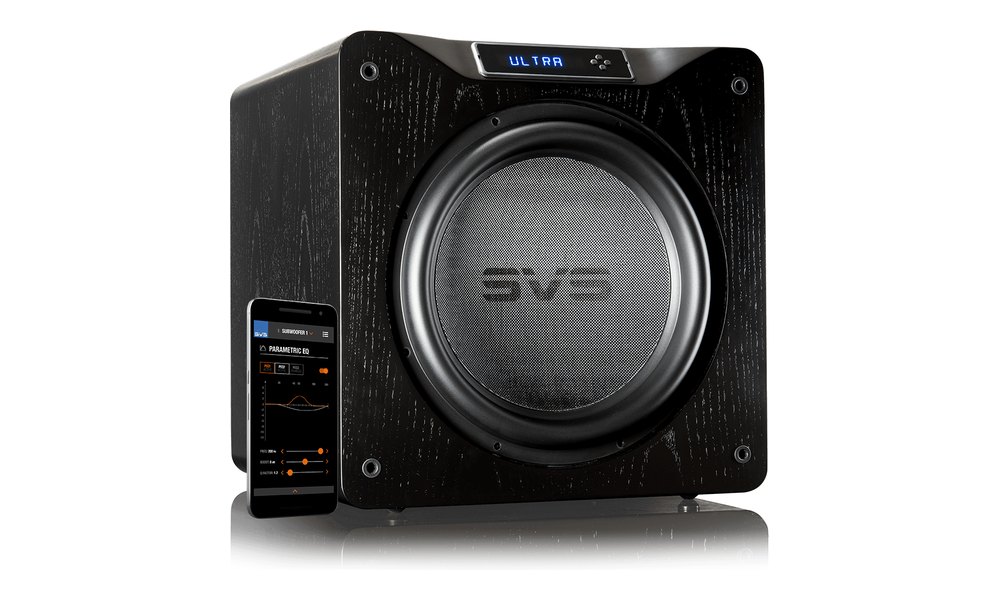
The SVS SB16-Ultra is the largest closed-back subwoofer of SVS: a 16-inch driver with 8-inch swing coil, powered by the Sledge STA-1500D with 1,500 W RMS. SVS refers to 16 to 460 Hz (±3 dB); the enclosure measures approximately 51 × 50 × 58 cm and weighs approximately 55 kg. On the back are only RCA and XLR inputs and outputs as well as a trigger input; the other settings run via display and app. The international specialist press counts him among the finest subwoofers the tester has heard in a large room. SVS mentions an MSRP of 3,249 € (as of Oct. 2026, without guarantee).
Assumptions
- Price per subwoofer (piece) according to manufacturer or trade, Stand Oct. 2026, no guarantee
- Operation in addition to stereo main loudspeakers (2.1), low-pass and phase tuned at the listener's place
- Vinyl chain with Phono stage; Subsonic filter recommended
- No in-house measurements or listening tests
Specifications (manufacturer)
| Type | Active subwoofer · Sealed Enclosure · Front-Firing |
|---|---|
| Woofer | 16 inch with 8 inch coil |
| Amplifier | Sledge STA-1500D · 1,500 W RMS / 5,000+ W tip · Class D |
| Frequency range | 16 – 460 Hz (±3 dB) |
| Inputs/outputs | RCA and XLR (on/off) · Trigger input |
| Operation | Front display · App |
| Dimensions / weight | 20 × 19.5 × 22.9 inches (approx. 51 × 50 × 58 cm, H × B × T) · 122 lb (approx. 55 kg) |
| Price guide | MSRP 3,249 € (SVS) · as of Oct. 2026 · without guarantee |
Manufacturer specifications (SVS)
| Type | Active subwoofer · sealed cabinet |
|---|---|
| Amplifier power | Sledge STA-1500D · 1,500 W RMS continuous · 5,000+ W peak dynamic · load impedance not specified by manufacturer (built-in amplifier) |
| Drivers | 16-inch |
| Frequency response | 16–460 Hz ±3 dB |
| Inputs | RCA and XLR stereo (in/out) · input impedance 22 kΩ |
| Dimensions | 20 × 19.5 × 22.9 in (H × W × D, with grille) · 20 × 19.5 × 20.1 in (without grille) |
| Weight | 122 lb (approx. 55 kg) |
Source: SVS – official specifications · As of 16 October 2026 · subject to change by the manufacturer
Rating criteria in detail
The four criteria feed into the Vinyl BotPro Index with weights of 25/20/25/30. The index is scaled across all tiers (see Methodology); that is why we do not show individual sub-scores.
Strengths
- 16-inch driver in closed-back enclosure
- 1,500 W RMS
- XLR and RCA, Trigger
- Display plus app with parametric EQ
Weaknesses
- Very big and heavy
- No built-in high-pass for the main speakers
- No high-level input
- Oversized for small rooms
Analysis: SVS SB16-Ultra in detail
Scope and sources
On the existing VinylCination page the SVS SB16-Ultra carries the title Value Vinyl BotPro Champion in the Master tier, with Vinyl BotPro Index 96 and rank 1 in that tier (analysis 09/2026). That ranking remains the live page’s; this long analysis adds a named, checked international listening report and the official manufacturer data. VinylCination has neither heard nor measured the SB16-Ultra itself.
The pillar is Larry Greenhill’s report in Stereophile, dated 30 November 2017 on the website. Greenhill listened to the exact SB16-Ultra in a large room of more than 5,000 cubic feet with Quad ESL-989 loudspeakers, first through the 80 Hz high-pass of his Mark Levinson preamplifier and later through a JL Audio CR-1 external crossover. That is an independent international listening report of the exact model, not a manufacturer page and not an award citation.
The SVS manufacturer page (SB16-Ultra product page, retrieved 12 November 2026) states the ratings: sealed cabinet, 16-inch driver with an 8-inch voice-coil, Sledge STA-1500D at 1,500 W RMS and more than 5,000 W peak, 16 to 460 Hz ±3 dB, RCA and XLR in and out, a trigger, a front display and an app, 20 × 19.5 × 22.9 inches with grille, 122 lb (about 55 kg). The live page gives a recommended price of €3,249 (as of October 2026, without guarantee). The table is left unchanged.
We use further measurement or listening texts only when they concern the exact model and are clearly specialist publications. Forums, retailer pages and video channels stay outside. We do not treat an EISA or other award entry as a listening pillar.
Place in the range
The SB16-Ultra is SVS’s largest sealed subwoofer in the Ultra 16 line: a front-firing 16-inch driver with an unusually large voice-coil and four ring magnets, driven by the Sledge STA-1500D amplifier. Control sits mainly in the Bluetooth app and on the front display; the rear panel is deliberately sparse.
The existing page lists it in the Master tier of active subwoofers as value champion and overall first, ahead of the Bowers & Wilkins DB1D (Index 91, Sound champion) and the REL S/812 (Index 86). This long analysis takes that order and does not recalculate the index.
Greenhill came to the product after SVS president Gary Yacoubian flagged a forthcoming design in 2016 and presented the finished model in 2017. The comparison with the smaller SB13-Ultra, which Greenhill had heard earlier, remains documented in his text, but it does not replace a listening report of the SB16-Ultra itself and is read only as his internal comparison.
Design and manufacturer data
According to the maker and the unchanged live table, the SB16-Ultra uses a 16-inch driver with an 8-inch voice-coil outside the magnets, in a sealed cabinet. The Class D amplifier is rated at 1,500 W RMS and more than 5,000 W peak. SVS states 16 to 460 Hz ±3 dB. Connections are RCA and XLR in and out plus a trigger; there is no speaker-level input and no built-in high-pass for the main speakers. Low-pass, slope, phase, polarity, room-gain compensation and parametric EQ run through the app or the display.
These figures are ratings, not measurements of our own. The live page’s size and weight (about 51 × 50 × 58 cm, some 55 kg) match the manufacturer’s 20 × 19.5 × 22.9 inches and 122 lb. Stereophile describes the motor and basket in detail from the maker’s account, including the claim that the 8-inch voice-coil is among the largest in a consumer subwoofer; that remains a manufacturer statement which Greenhill reports, not a figure he re-weighs.
The unit is very large and heavy. Greenhill describes packaging with skids for sliding the cabinet out and used his own sliders to move it around the room. For small living rooms and systems without a pre-out the live page finds it less suitable. The lack of automatic room correction with a supplied microphone is something Greenhill records; parametric EQ and the app stand in only where the user measures or works by ear.
What the specialist press heard and measured
Greenhill’s first impression after a rough placement was tremendous bass solidity and weight, without muddying the clarity of the highs. The first position beside the right-hand ESL-989, however, sounded disconnected; too much bass weight on voices and a shallower stage showed up, for example, in the Kyrie of Misa Criolla and at the conga opening of “Hotel California”. Only after moving the cabinet and fine-tuning with the app (first an 80 Hz low-pass at 24 dB/octave, later, with the CR-1, a 60 Hz high-pass for the Quads and a 40 Hz low-pass at the sub) did the picture cohere.
With that setup the lowest bands of the chromatic scale on Stereophile’s Editor’s Choice sounded sharply defined, as did the 40, 31 and 25 Hz third-octave warble tones. The 20 Hz band was not audible as a tone as such, but it pressurised the room. On Keith Jarrett’s “True Blues” Greenhill found no discontinuities between subwoofer and main speakers when Jarrett stamped as he played. Kick drum, bass drum, timpani and synthesiser sounded solid and clean. Sustained organ pedals filled the large room; on some recordings he reduced the level to take away a slight drone without losing extension.
In comparison with SVS’s own SB13-Ultra, the dearer Revel Ultima Rhythm2 and the JL Audio Fathom f212v2, Greenhill stays with the SB16-Ultra: once placement and crossover were right, it was one of the finest, fastest, best-controlled and most powerful subwoofers he had reviewed in his large listening room. Pitch, speed and the abrupt stopping of deep notes it shared with the SB13-Ultra, but it went deeper and pressurised the room more convincingly. In his text the Rhythm2 and the Fathom offer in part still more features or automatic calibration, but cost many times as much. The live page already carried the core formula “one of the finest … in the large listening room”; we now assign it by name to Stereophile and Greenhill, 30 November 2017.
Greenhill measures and trims at the seat with apps (including AudioTools) but does not present a full laboratory cabinet curve of a kind we could offer as a measurement of our own. The 16 Hz figure remains the maker’s; his listening observations belong to the large room and the Quad electrostatics, not to an arbitrary living room.
Setup and system
The live page sees the connection via XLR or RCA at a pre-out, ideally with its own high-pass for the main speakers, because the SB16-Ultra does not supply one. The phono stage stays in the main path. Greenhill worked in just that way: first the Levinson’s 80 Hz high-pass, later the CR-1. Anyone with only an integrated amplifier and no pre-out will not find a matching interface on the live page.
With 16 Hz extension and 1,500 W RMS the live page still treats a subsonic filter in the phono stage as essential, and the turntable sits on a decoupled support. That is an integration rule of the existing page, not a measurement of our own. The subwoofer is intended for large rooms; position and level belong at the listening seat, and the app allows fine adjustment from the chair even if the cabinet stands behind furniture, because Bluetooth does not need line of sight.
Greenhill describes his room as about 25 feet long and 13 feet wide, with a semi-cathedral ceiling to 12 feet, opening to a hall and kitchen, and more than 5,000 cubic feet in volume. The Quad ESL-989s stood 8 feet from the seat, 57 inches from the front wall, 8 feet apart and slightly toed in. That geometry belongs to his report and is not translated into a general living-room rule.
The app found the unit over Bluetooth without line of sight and allowed level, low-pass, slope, phase and polarity to be set from the chair. A tilted front display, four buttons and a small infrared remote are also provided. Greenhill used the app as the more convenient path. Automatic calibration with a supplied microphone, which dearer models in his comparison offer, is absent; that remains a documented feature difference, not an automatic sonic black mark in every room.
On the company site SVS offers, under the name Merlin, speaker-specific starting values for high- and low-pass. Greenhill checked the suggestion of a 60 Hz high-pass and a 40 Hz low-pass at 12 dB/octave, but could not set different slopes on the CR-1 and chose 24 dB/octave for the Quads’ high-pass. Taking such starting values remains a manufacturer aid, not a measurement by VinylCination.
Anyone playing vinyl through a separate phono stage stays, on the live page, in the main path and uses the subwoofer only below the chosen crossover. Greenhill’s programme — organ, concert piano, a film fanfare, voice and chorus — is typical subwoofer repertoire for a Stereophile report, not a documented turntable comparison on the SB16-Ultra. That yields no statement about individual decks on the list, only that the listening text at hand describes the subwoofer itself in a large room.
The listening report and the live page aim at large floorstanders and electrostatics in large rooms. For small rooms and tight floor space the 55 kg cabinet is, in the existing system matching, oversized. Pair operation is not stated as a requirement in Greenhill’s text; he heard a single unit.
Price and availability
The existing page gives a recommended price of €3,249 (SVS), as of October 2026, without guarantee of day-to-day retail prices. Greenhill quoted $1,999.99 in 2017; that is a historical local price and is not converted into today’s euro range. This long analysis does not recalculate Index 96 and does not make a buying appeal.
In comparison with the SB13-Ultra, which Greenhill had heard in 2015, the SB16-Ultra remains in his text the more accessible, app-driven and, in the deep bass, more massive of the two SVS subwoofers. He explains the higher prices of the Rhythm2 and Fathom f212v2 by extra features, not by a blanket listening ban on the SVS. We take that price and feature relation as his 2017 placing and do not convert it into today’s euro lists.
In the Master tier the SB16-Ultra remains value champion and rank 1. The DB1D costs about €5,400 on the live page and carries the Sound title. That is the placing of the existing list, supported by Greenhill’s listening report, not by a listening experience of our own.
What we do not use
VinylCination has not heard the SB16-Ultra itself and has not measured it. Manufacturer claims about the 8-inch voice-coil remain technical description. Forum posts, dealer copy and video channels do not replace the pillar. Listening notes on the SB13-Ultra, the Revel Rhythm2 or the JL Fathom serve only Greenhill’s documented comparison, not as a substitute pillar.
German specialist press alone would not suffice under t646u; Stereophile supplies an international listening text of the exact model. We do not treat an award text as a listening pillar.
Conclusion of the analysis
The SVS SB16-Ultra is a sealed active subwoofer with a 16-inch driver, an 8-inch voice-coil, 1,500 W RMS and an official 16 to 460 Hz ±3 dB, in a cabinet of about 51 × 50 × 58 cm at some 55 kg. Stereophile (Larry Greenhill, 30 November 2017) hears, after careful placement in a large room, one of the finest, fastest, best-controlled and most powerful subwoofers of his listening room, with solid, fast bass and tangible room fill, without a built-in high-pass and without automatic calibration.
This long analysis supports the live page’s existing champion ranking with that named international listening report, without its own measurement and without a buying appeal. Limits remain the single large room, the Quad chain and the decision not to treat forums or awards as a pillar.
Sources
- Stereophile, Larry Greenhill, SVS SB16-Ultra powered subwoofer, 30 November 2017: https://www.stereophile.com/content/svs-sb16-ultra-powered-subwoofer
- SVS, SB16-Ultra manufacturer page, retrieved 12 November 2026: https://www.svsound.com/products/sb16-ultra
- VinylCination, existing SVS SB16-Ultra product page (recommended price €3,249, as of October 2026; champion ranking Master Value, Index 96, rank 1).
Created by AI (Vinyl BotPro) from the sources named; no in-house listening tests or measurements. A detailed human fact-check is still outstanding.
Comparison models
| Bowers & Wilkins DB1D | Index 91, Rank 2, Sound champion — 2 × 12 inches · Sealed, opposite · approx. €5,400 |
|---|---|
| REL S/812 | Index 86, rank 3 — 12 inches + 12-inch passive membrane · approx. €3,700–3,800 |
System matching
Works well with
- Large listening rooms
- Large floorstanding speakers and electrostats
- Symmetrically wired precursors
Less suited
- Small rooms
- Integrated amplifiers without pre-out
- Living rooms with little floor space
Specs & Features
In the SB16-Ultra, a 16-inch driver with 8-inch coil and four large ring magnets works in a closed-back enclosure. The STA-1500D Sledge Amplifier delivers 1,500 W RMS; SVS calls 16 to 460 Hz (±3 dB).
The back is equipped with RCA and XLR inputs and outputs as well as a trigger input. Low pass, flank partiality, phase, room adjustment and parametric EQ run via the front display or the app. The sub does not have a high pass for the main speakers; for this it needs the high pass of a preliminary stage or an external switch.
Research Consensus
Stereophile (Larry Greenhill, 30 November 2017) calls the SB16-Ultra, after placement and tuning, one of the finest, fastest, best-controlled and most powerful subwoofers he has heard in his large listening room. Matched by app with 80 Hz low pass and 24 dB/octave, the levels were aligned with pink noise; the main speakers ran through the preamplifier’s 80 Hz high-pass.
Recurring pattern: Reference low bass at a price well below the large flagships, provided room and integration are right. VinylCination classifies him as the value for money champion of the master level, without own listening test.
For whom / Matching
Connection & Integration
By XLR or RCA on the pre-out of a pre-press, ideally with its own high-pass for the main speakers. The phono stage from the Top list Phono preamps remains in the main branch.
Turntable & phono
Pass decks from the Master Level. At 16 Hz bass extension and 1,500 W, a subsonic filter belongs to the Phono stage; the Turntable must be set up decoupled.
Room & placement
Big rooms. Find position by measurement or creepest, then vote low pass, phase and level at the listening place.
Budget & upgrade
Value for money champion of the master level for 3,249 €. More compact with infrared bass extension and space calibration is the B&W DB1D.
What makes this AI analysis special
This section is an AI summary from Manufacturer data and reports from international specialist media. Vinyl BotPro had no physical access, no measurement of our own chain and no listening test. The basis are the manufacturer specifications of SVS and the test of Stereophile. The expected performance is derived from construction, datasheet and the judgements of the Specialist press. Prices and availability change (as of Oct. 2026, no guarantee); please check technical values against the current data sheet.
Vinyl BotPro Score Logic
The Vinyl BotPro Index runs from 0–100 across all tiers and weights build/technology, features, expected performance and value for money at 25/20/25/30. Master typically sits at ~85–97. SVS SB16-Ultra receives 96 (Rank 1 Master). Best value for money share of the master level with very high performance. In the stage, the model bears the title Value for money Vinyl BotPro Champion. Rank is not Laboratory Evaluation — no Listening test. Details on weighting · Methodology.
Sources
Created by Vinyl BotPro (AI) · AI analysis · As of 08.10.2026 · Corrections: info@vinylcination.de · Prices without guarantee.
Read more: best active subwoofers 2026 · Improve your hi-fi system · What is hi-fi?