
Streaming Amplifier · AI Analysis · Expert, Rank 2
Cambridge Audio Evo 300 Review
AI analysis (research): the new flagship of the Evo range with 2 × 300 W from Hypex NCOREx modules in a dual-mono layout, balanced preamplifier, analogue volume control, MM phono, HDMI eARC and StreamMagic – for €3,999 RRP. Guidance from manufacturer data and international listening tests, no own listening test.
Summary
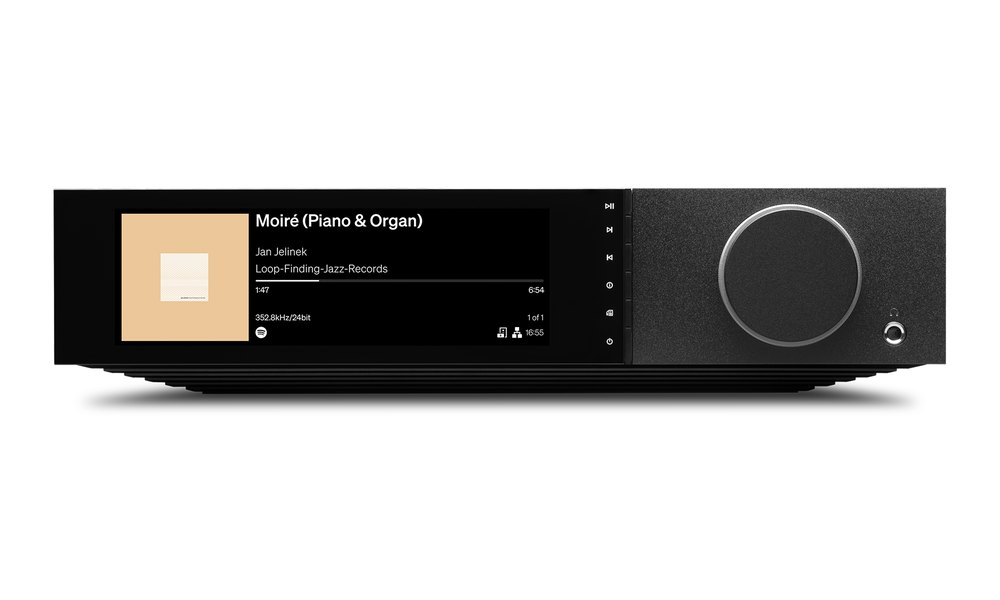
The Cambridge Audio Evo 300 is the new top model of the Evo range and, since the Edge series was discontinued, the most expensive product from Cambridge Audio. According to the manufacturer it delivers 2 × 300 W into 8 Ω and 2 × 550 W into 4 Ω from two Hypex NCOREx modules in a dual-mono layout. New compared with the Evo 150 SE are the balanced preamplifier, the analogue volume control, the ES9038Q2M DAC and the 7.8-inch display. For the turntable there is an MM phono stage, plus XLR, HDMI eARC, USB and StreamMagic with Roon Ready. MSRP 3,999 € (as at 24.10.2026, without guarantee). Several reviews praise its power, fine detail and soundstage, while another review finds the dynamics flat. In the Expert field the Evo 300 lands at rank 2 with index 82 – directly behind the Yamaha R-N2000A and ahead of the Arcam SA45.
Assumptions
- A system with streaming as the main source, a turntable with an MM cartridge and possibly a TV via HDMI
- Passive speakers of any size, including low-sensitivity designs, in living rooms of normal size
- Listening impressions exclusively from published international press, technical data from the manufacturer
Technical data (public)
| Type | Streaming integrated amplifier (all-in-one), dual mono, balanced preamplifier |
|---|---|
| Power | 2 × 300 W into 8 Ω · 2 × 550 W into 4 Ω · Class D (Hypex NCOREx) |
| DAC / formats | ESS Sabre ES9038Q2M · USB up to 32 bit/768 kHz and DSD512 · optical, coaxial and HDMI up to 24 bit/192 kHz |
| Phono | 1 × MM |
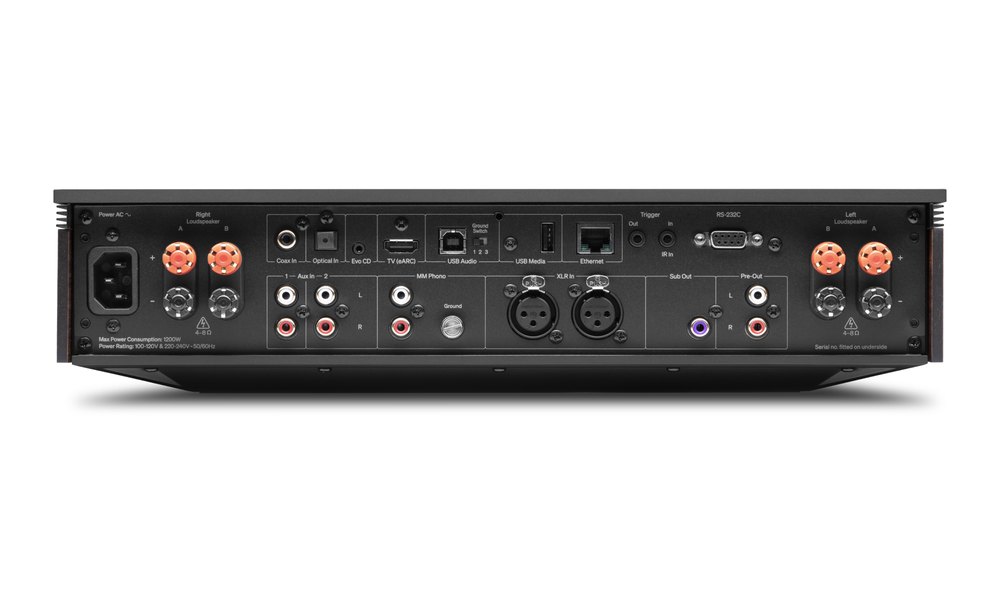
| Inputs | 2 × RCA · 1 × XLR · 1 × optical · 1 × coaxial · HDMI eARC · USB-B · Bluetooth 5.4 |
| Outputs | Speakers A + B · preamp output · Subwoofer output · Headphones 6.35 mm |
| Streaming | StreamMagic · AirPlay 2 · Chromecast · Spotify Connect · TIDAL · Qobuz · Deezer · UPnP · Roon Ready |
| Dimensions / weight | 387 × 89 × 352 mm (W × H × D) · 7.2 kg |
| Price guide | DE MSRP 3,999 € · £3,499 · $3,999 · As of 24.10.2026 · without guarantee |
Manufacturer specifications (Cambridge Audio)
| Type | Streaming integrated amplifier (all-in-one) · dual mono · balanced preamplifier |
|---|---|
| Power output | 2 × 300 W into 8 Ω · 2 × 550 W into 4 Ω |
| Amplification | Class D, Hypex NCOREx |
| Volume control | analogue, separate for left, right and subwoofer |
| DAC | ESS Sabre ES9038Q2M |
| Analogue inputs | 2 × RCA · 1 × balanced XLR · 1 × moving-magnet phono |
| Digital inputs | 1 × optical (Toslink) · 1 × coaxial (S/PDIF) · HDMI eARC · USB audio (type B, class 1/2) · Bluetooth 5.4 |
| Outputs | Speakers A + B · 6.35 mm headphone · preamp output · subwoofer output · Bluetooth transmit (up to aptX HD) |
| Streaming | StreamMagic · UPnP · AirPlay 2 · Chromecast built-in · Spotify Connect · TIDAL · Qobuz · Deezer · internet radio · Roon Ready |
| Sample rates | USB class 2 up to 32-bit/768 kHz PCM and DSD512 · optical and coaxial up to 24-bit/192 kHz · HDMI eARC up to 24-bit/192 kHz |
| Frequency response | 20 Hz – 20 kHz +0/−3 dB |
| Power consumption | max. 1,200 W · eco standby < 0.5 W · network standby < 2 W |
| Display | 7.8 inch |
| Dimensions (W × H × D) | 387 × 89 × 352 mm |
| Weight | 7.2 kg |
| Finish | Black · side panels wood or black, interchangeable |
| MC phono / room correction | not specified by the manufacturer (MM phono; 7-band EQ and room compensation via app) |
Source: Cambridge Audio – official specifications · As of 24 October 2026 · subject to change by the manufacturer
Rating criteria in detail
The four criteria feed into the Vinyl BotPro Index with weights of 25/20/25/30. The index is scaled across all tiers (see Methodology); that is why we do not show individual sub-scores.
Strengths
- Plenty of power: 2 × 300 W into 8 Ω according to the manufacturer, and as much as 348 W in a published lab test
- According to listening tests, fine resolution, a large soundstage and great composure even at high levels
- Balanced preamplifier with analogue volume, XLR input and MM phono
- StreamMagic app, HDMI eARC and USB DAC very mature according to all reviewers
Weaknesses
- Phono for MM only, solid but not outstanding
- Only a 7-band EQ and a room slider, no microphone-based room correction
- Another review finds the dynamics flat and prefers the cheaper Arcam SA35
- No additional connections compared with the Evo 150 SE
Comparison models
| Yamaha R-N2000A | Class AB network receiver with MM/MC phono and YPAO – rank 1 and sound champion of the tier, cheaper |
|---|---|
| Cambridge Audio EVO 150 SE | Smaller sibling with 150 W and the same connections – value champion of the tier |
| NAD M10 V3 | Compact Hypex streaming amplifier with Dirac Live – less power, but with room correction |
| NAD M33 V2 | Master reference with Dirac Live and bridging option – much more expensive |
System matching
Works well with
- Power-hungry speakers and large rooms
- Systems with streaming, a TV and a turntable with an MM cartridge
- Listeners who want simple operation via app and remote
Less suited
- Anyone who wants to connect an MC cartridge directly
- Difficult rooms that need measured room correction
- Small systems in which the Evo 150 SE already offers enough power
Specs & Features
The Evo 300 uses two Hypex NCOREx modules, one per channel, powered by their own switch-mode supply. The preamplifier is balanced throughout, and volume is controlled in the analogue domain, separately for left, right and the subwoofer. Conversion is handled by an ESS ES9038Q2M on the digital board, which accepts up to 32 bit/768 kHz and DSD512 via USB.
On the rear there are two RCA inputs, an XLR input and an MM phono input with a ground terminal, plus optical, coaxial, HDMI eARC and USB-B with a ground-lift switch. Two pairs of speakers can be connected and switched via the app, and there are preamp and subwoofer outputs. The subwoofer output can be adjusted in level, crossover frequency and phase. Dimensions 387 × 89 × 352 mm, weight 7.2 kg. RRP €3,999 (as of 24.10.2026, no guarantee).
What international reviewers heard
Several international listening tests are available for the Cambridge Audio Evo 300. Here we summarise the overall picture in our own words; all sources are linked at the end of the page.
Sound character
- One international review describes the Evo 300 as confident and dynamic, with plenty of insight into the music, and awards 89 % for sound. A further review hears a sound without hard edges that at first seems almost soft and is very hard to unsettle.
Tonal balance
- One review praises the tonal realism and very deep bass, which keeps a firm grip even on standmount speakers. A second review highlights a very refined treble and the clean transition from the midrange into the bass.
Dynamics, bass & staging
- The Evo 300 keeps quiet passages small and builds big crescendos effortlessly. One international review calls the soundstage outstanding because it extends well beyond the speakers, and another review describes powerful, gripping dynamics with orchestral music.
Strengths
- Both reviewers stress the power reserves: A further review also drove much more expensive speakers without any sign of strain. A second review also praises the analogue inputs thanks to the new balanced preamp.
Setup, room & partners
- The built-in MM phono stage is solid but not outstanding, and another review prefers the Arcam SA35 with a turntable. One more review also misses Dirac-style room correction, as there is only a 7-band EQ and a room slider.
Consensus & differences
- International reviews agree that the Evo 300 combines plenty of power with fine detail and a large soundstage. A further review disagrees: the sound is powerful but dynamically flat and less engaging than the cheaper Arcam SA35.
Research Consensus
The sources are very good for a streaming amplifier presented in June 2026: a detailed manufacturer page with data sheet, a listening test with lab measurements from the specialist press and further listening tests from the specialist press. Recurring patterns: plenty of power, fine resolution, a large soundstage and mature operation. Criticism mainly concerns the basic phono stage, the lack of room correction and, in international reviews, the dynamics. The verdict of international reviews is assessed in detail in the section What the international specialist press hears.
For whom / Matching
Speakers
With 300 W into 8 Ω, the Evo 300 drives almost any speaker. Another reviewer used it to drive speakers costing many times as much; two further reviews used Kudos Titan 505.
Turntable and phono
The MM phono stage is good enough for a good turntable with an MM cartridge. Anyone using an MC cartridge or wanting more from their turntable connects an external phono preamp to one of the line inputs.
Budget
At €3,999 RRP (as of 24.10.2026, no guarantee), the Evo 300 sits in the upper part of the Expert tier. Anyone who needs less power gets the same connections for less in the EVO 150 SE.
Upgrade
Anyone coming from the Evo 75 or Evo 150 gets double the power, a balanced preamplifier and the better DAC, all operated the same way.
What makes this AI analysis special
This section is an AI summary of published international listening reviews and the manufacturer data from Cambridge Audio. Vinyl BotPro puts the reviewers’ findings into context and links them with the data sheet and comparison models; VinylCination does not run its own listening tests or measurements; all sources are linked at the end of the page. Prices and availability change (as of Oct. 2026, no guarantee); please check technical values against the current data sheet.
Vinyl BotPro Score Logic
The Vinyl BotPro Index is scaled 0–100. Expert is typically ~70–84. The Evo 300 receives 82 (rank 2 Expert): very strong scores for technology/build thanks to the dual-mono power stage, balanced preamplifier and the published lab data, very good features and a high performance expectation from four international listening tests. Deductions apply to value for money and to the basic MM phono stage without MC. The champion seals remain unchanged: sound Yamaha R-N2000A, value Cambridge Audio EVO 150 SE. Weights: technology/build ~25 · features ~20 · performance (expected) ~25 · value for money ~30. Rank ≠ lab rating – no listening test. Details: Details on weighting · Methodology.
Created by Vinyl BotPro (AI) · AI analysis · As of 24.10.2026 · Corrections: info@vinylcination.de · Prices without guarantee.
Manufacturer and concept
Cambridge Audio was founded in Cambridge in 1968 and is now based in London. The brand became known for affordable amplifiers and CD players, and later added network players and its own streaming platform, StreamMagic. With the Evo range, Cambridge Audio introduced compact streaming amplifiers in 2021 that combine streamer, DAC, preamplifier and power amplifier in one case. The Evo 75 and Evo 150 were followed by the Evo 150 SE in 2025.
The Evo 300 was introduced in June 2026 and is the new flagship of the range. Because Cambridge Audio has discontinued the Edge series, it is also the brand's most expensive single product. The name reveals the main goal: double the power of the Evo 150 SE. It also gains a new balanced preamplifier, a better DAC and a larger display. The concept stays the same: connect speakers, install the app, listen to music.
Technology explained
Hypex NCOREx in dual mono
The power amplifier consists of two Class D modules from the Dutch maker Hypex in the NCOREx series, one per channel. Class D works with fast-switching transistors and very high efficiency. That is why a lot of power fits into a slim case that hardly gets warm. Cambridge Audio quotes 300 W into 8 Ω and 550 W into 4 Ω. In a published lab test, the Evo 300 even delivered 348 W into 8 Ω and 650 W into 4 Ω, with very low distortion across the usual power range.
Balanced preamplifier and analogue volume
In the Evo 150 SE the preamplifier was single-ended. In the Evo 300 it is balanced, which suppresses interference and makes the XLR input genuinely useful. Volume is not controlled digitally but in the analogue domain, separately for the left and right channels and the subwoofer. This keeps full resolution even at low levels.
DAC and streaming
For conversion the Evo 300 uses an ESS ES9038Q2M, one step above the chip in the Evo 150 SE. Via USB it accepts up to 32-bit/768 kHz and DSD512. Streaming is handled by fourth-generation StreamMagic with Spotify Connect, TIDAL Connect, Qobuz Connect, AirPlay 2, Chromecast and Roon Ready.
Sound according to international reviews
Four detailed international listening reviews are available, and three of them are very positive. The international specialist press awards 89 % for sound and describes great composure, plenty of insight into the music and gripping dynamics with orchestral recordings. One review names the Evo 300 a Best Buy and calls the soundstage outstanding. A second review highlights how finely the amplifier renders small ensembles before opening up effortlessly as the music builds.
One international review reaches a different verdict. The team gives full marks for usability, features and build, but only three out of five stars for sound. The Evo 300 sounds powerful and clean, but dynamically flat. In a direct comparison, the cheaper Arcam SA35 seems livelier and more detailed. Anyone considering the Evo 300 should therefore audition it with their own speakers.
Features and practical use
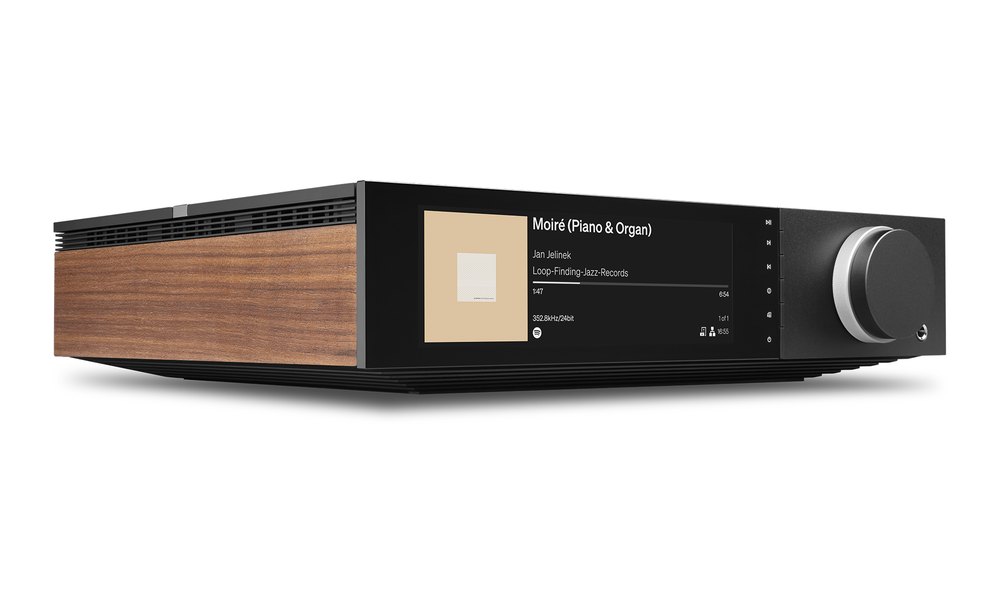
All reviewers agree on usability: the StreamMagic app is one of the best of its kind, and alongside the app there are buttons on the unit and a well-made remote. The 7.8-inch display shows album art, track information or level meters. The side panels in wood or black slatted design attach magnetically, and both are included in the box.
For the turntable there is an MM phono input with a ground terminal. A further review calls it solid but not outstanding, and another review heard a more balanced result from the Arcam SA35 with a turntable. An external phono preamp can be connected to one of the three line inputs. The TV connects via HDMI eARC, and this works reliably.
Who is the Evo 300 for?
The Evo 300 suits anyone who wants plenty of power in a compact unit and wants to bring streaming, TV and turntable together in one place. It pays off especially with large or power-hungry speakers. Anyone who wants to connect an MC cartridge directly, or who has a difficult room that needs microphone-based room correction, should look at the NAD M10 V3 or the Yamaha R-N2000A.
How it compares
In the Expert tier of streaming amplifiers, the Evo 300 ranks second. The Yamaha R-N2000A stays ahead because it offers an MM/MC phono stage and YPAO room calibration and costs less. The Cambridge Audio EVO 150 SE has the same connections and remains the value champion. The Arcam SA45 costs more and offers Dirac Live as well as separate MM and MC inputs.
More questions about the Cambridge Audio Evo 300
Does the Evo 300 have a phono input?
Yes, for MM cartridges. MC cartridges need an external phono preamp connected to a line input.
Does the Evo 300 support Roon, AirPlay and Chromecast?
Yes. It is Roon Ready and supports AirPlay 2 and Chromecast. Spotify Connect, TIDAL Connect and Qobuz Connect are also included.
Can I connect a subwoofer?
Yes. Level, crossover frequency and phase of the subwoofer output can be set in the app.
What is different from the Evo 150 SE?
Double the power, a dual-mono power stage, a balanced preamplifier, analogue volume control, a better DAC and a larger display. The connections are the same.
Does the Evo 300 have room correction?
There is no microphone-based calibration. The app offers a 7-band equaliser and a slider that adapts the sound to rather damped or rather reverberant rooms.
Conclusion
The Cambridge Audio Evo 300 is a very powerful, well-equipped streaming amplifier with excellent usability. Three of four international listening reviews praise its power, fine detail and soundstage, while another review misses dynamics. At the turntable, the MM phono stage is fine for getting started, and anyone who wants more can add an external phono preamp. With an index of 82 it ranks second in the Expert tier.
Sources
- Cambridge Audio — Evo 300 Premium Streaming Amplifier (product page, technical data)
- Hi-Fi News — Cambridge Audio Evo 300 streaming integrated amplifier (listening test)
- Hi-Fi News — Cambridge Audio Evo 300 Lab Report (measurements)
- AVForums — Cambridge EVO 300 All In One System Review (listening test)
- The Ear — Cambridge Evo 300; a different sort of flagship (listening test)
- What Hi-Fi? — Cambridge Audio Evo 300 review (listening test)