
Bookshelf speaker · AI analysis · Expert, rank 12
Castle Walmer 1 Review
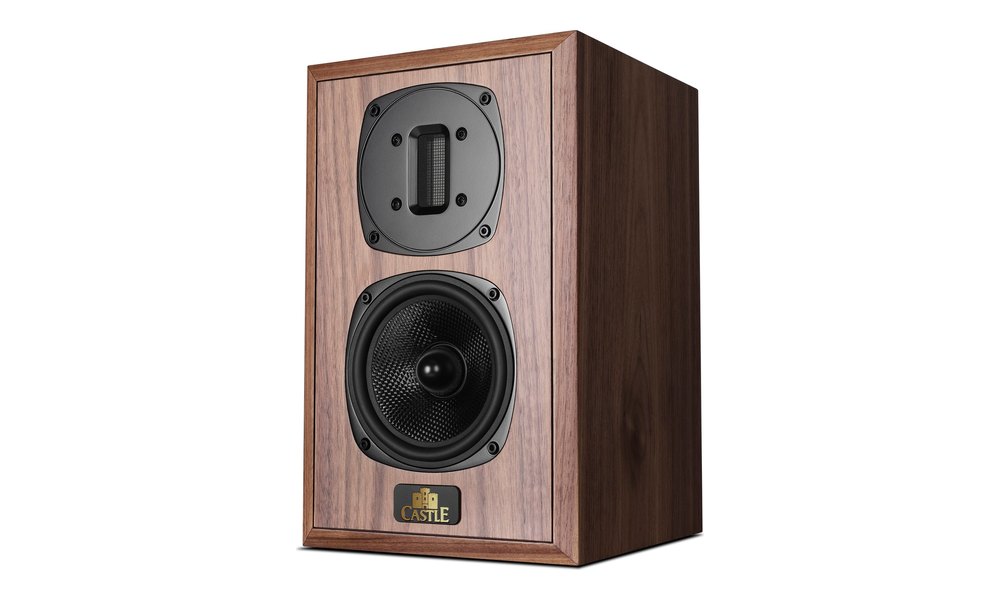
AI analysis (research): compact 2-way bookshelf speaker from Castle's new Walmer series — 12 × 45 mm true ribbon tweeter, 130 mm mid/bass driver made of woven carbon fibre, 86 dB and 8 Ω compatible, hand-built in Great Britain and finished in real wood veneer. Guidance from specs & press coverage, not a listening test.
Summary
The Castle Walmer 1 is the compact speaker of the new Walmer series, with which the traditional British brand Castle expanded its UK-made range at the end of August 2026; it has been in stores since September. The price is around 3,000 € per pair (EU guide; UK RRP £2,499, US $3,499; as of Oct. 2026, without guarantee). According to Castle, Walmer is the more technically elaborate of the two new series: instead of a silk dome, it uses a 12 × 45 mm true ribbon tweeter, derived from the Avon series, together with a 130 mm mid/bass driver made of woven carbon fibre. For VinylCination, what counts is the mix of ribbon resolution, a compact cabinet and an uncritical load: 8 Ω compatible, minimum 4.3 Ω, with 25 to 100 W recommended. In the Expert field, the Walmer 1 lands at rank 12 with index 73.
Assumptions
- Pair price: EU guide around 3,000 €, UK RRP £2,499 according to the manufacturer and the press; as of Oct. 2026, no guarantee
- Small to medium-sized living room, placement on stands with some distance from the wall
- Integrated amplifier with 25–100 W and clean load stability down to 4.3 Ω
- No own listening protocol; source base = manufacturer data + specialist press
Technical data (public)
| Type | 2-way bookshelf speaker (standmount) · Bass-reflex · rear-firing port |
|---|---|
| Chassis | 1 × 12 × 45 mm true ribbon · 1 × 130 mm mid/bass driver made of woven carbon fibre |
| Frequency response | 55 Hz–20 kHz (±3 dB) · bass roll-off 48 Hz (−6 dB) |
| Crossover frequency | 2.8 kHz |
| Sensitivity | 86 dB (2.83 V / 1 m) |
| Impedance | 8 Ω compatible (min. 4.3 Ω) |
| Rec. Amplifier power | 25–100 W |
| Max. SPL | 95 dB |
| Enclosure | 9.5 l volume · real wood veneer in walnut or black oak · hand-built and veneered in Great Britain |
| Dimensions / weight | H 334 mm (with plinth) · W 210 mm · D 220 mm (+30 mm terminals) · 7.5 kg per speaker |
| Price guide | around 3,000 €/pair (EU) · £2,499 (UK) · 3,499 $ (US) · as of Oct. 2026 · without guarantee |
Manufacturer specifications (Castle)
| Type | 2-way bookshelf speaker (standmount) · Bass-reflex · rear-firing port |
|---|---|
| Chassis | 1 × 12 × 45 mm true ribbon · 1 × 130 mm mid/bass driver made of woven carbon fibre |
| Frequency response | 55 Hz–20 kHz (±3 dB) · bass roll-off 48 Hz (−6 dB) |
| Crossover frequency | 2.8 kHz |
| Sensitivity | 86 dB (2.83 V / 1 m) |
| Impedance | 8 Ω compatible (min. 4.3 Ω) |
| Rec. Amplifier power | 25–100 W |
| Max. SPL | 95 dB |
| Enclosure | 9.5 l volume · real wood veneer in walnut or black oak · hand-built and veneered in Great Britain |
| Dimensions / weight | H 334 mm (with plinth) · W 210 mm · D 220 mm (+30 mm terminals) · 7.5 kg per speaker |
Source: Castle – official specifications · As of 16 October 2026 · subject to change by the manufacturer
Rating criteria in detail
The four criteria feed into the Vinyl BotPro Index with weights of 25/20/25/30. The index is scaled across all tiers (see Methodology); that is why we do not show individual sub-scores.
Strengths
- A genuine ribbon tweeter (12 × 45 mm) in a compact 2-way cabinet
- Mid/bass driver made of woven carbon fibre, developed specifically for the handover to the ribbon
- 8 Ω compatible, minimum 4.3 Ω, 25–100 W: a wide choice of amplifiers
- Hand craftsmanship and real wood veneer from British production
Weaknesses
- 86 dB and 95 dB maximum SPL: better suited to small and medium-sized rooms
- Bass extension down to 55 Hz (±3 dB) — anyone who wants more bass should plan for a subwoofer
- Rear bass reflex port: allow some distance from the rear wall
Comparison models
| Bowers & Wilkins 705 S3 | Index 79, rank 3 — similar price (approx. 2,998–3,200 €), carbon dome tweeter-on-top and Continuum mid/bass driver |
|---|---|
| Piega Premium 301 Gen2 | Index 75, rank 7 — also with a ribbon tweeter, aluminium cabinet, approx. 2,900 € |
| Sonus Faber Sonetto II G2 | Index 76, rank 6 — Italian wood styling, approx. 2,750 € |
| KEF R3 Meta | Index 72, value-for-money champion Expert — 3-way with Uni-Q, more affordable (approx. 2,400 €) |
System matching
Works well with
- Integrated amplifiers with 50–100 W and a built-in phono stage from the Expert class
- Small to medium-sized living rooms and placement on stands
- Listeners looking for fine, airy treble reproduction
Less suited
- Large rooms with a wish for high volume (maximum SPL according to the manufacturer 95 dB)
- Placement right against the rear wall (rear bass reflex port)
- Anyone expecting deep bass without a subwoofer — then check a floorstanding speaker
Specs & Features
According to Castle, the Walmer 1 is a 2-way bass reflex system with 9.5 litres of volume and a rear port. At the top sits the 12 × 45 mm true ribbon tweeter: here the magnetic field drives the extremely light, conductive foil directly, without a separate voice coil on a dome. Castle originally developed this tweeter for the Avon series and cites fast response, fine detail resolution and wide horizontal dispersion as its advantages. Below it works a 130 mm mid/bass driver made of woven carbon fibre, which according to the manufacturer was developed specifically for an extended upper midrange so that it hands over cleanly to the ribbon at 2.8 kHz.
Castle quotes a frequency response of 55 Hz to 20 kHz (±3 dB), a bass roll-off at 48 Hz (−6 dB), 86 dB sensitivity at 2.83 V and a maximum SPL of 95 dB. The impedance is specified as 8 Ω compatible, with a minimum of 4.3 Ω; amplifiers with 25 to 100 W are recommended. At 334 mm high including the plinth, 210 mm wide and 7.5 kg per speaker, the Walmer 1 stays compact. Cabinet and veneer are made by hand in Great Britain; walnut and black oak are available.
The sister series Tintagel relies on a silk dome and a fibre cone, the Walmer series on woven carbon fibre and a ribbon. According to Castle, the carbon fibre, with high stiffness at low weight, should deliver cleaner bass transients and less colouration without making the midrange sound hard. The aim of the voicing is Castle's typical warmth, complemented by more precision and openness.
Research Consensus
The sources are the manufacturer's information — product page and user manual with the specifications — and the launch reports of established specialist media. The international specialist press describes the Walmer series as an offering for listeners who want more technical refinement, speed, openness and scale than Tintagel, and lists the prices for all four models. One review sees the new series as an expansion of Castle's British manufacturing, which is thus no longer reserved for the most expensive models alone.
Another review calls the Walmer 1 the more interesting standmount for anyone specifically looking for a true ribbon tweeter without moving up to considerably more expensive specialist brands, and highlights its compact size for rooms where larger monitors would be visually intrusive. The magazine names the Bowers & Wilkins 705 S3 as direct competition. One international review highlights the distinctive real-wood look and the detailed, delicate treble that the ribbon promises.
Recurring patterns across the sources: British craftsmanship, real wood and a clear split between the two series — Walmer as the more technically ambitious line with ribbon and carbon fibre. VinylCination summarises these patterns as an AI summary of the specialist press — without its own track list and without any partnership claim.
For whom / Matching
Amplifier
86 dB is a medium sensitivity: for normal levels in a living room, 50 to 100 W of clean power is enough, and the impedance minimum of 4.3 Ω is uncritical for common integrated amplifiers. Suitable models with a phono input are listed in the amplifier top list (Expert). A solid cable from the speaker cable top list is enough for the connection.
Turntable & phono
A ribbon tweeter reproduces fine treble details very directly — this makes differences in cartridge, stylus profile and alignment audible. A cartridge with a fine stylus profile (see the stylus shapes guide) and a low-noise phono stage from the phono preamp top list show their strengths here. Because the bass extension ends at 48 Hz (−6 dB), subsonic content from warped records stays largely out of the picture.
Room & placement
The Walmer 1 is designed for small to medium-sized rooms. The bass reflex port is at the rear, so the speaker needs some distance from the rear wall; the starting point is a stereo triangle on sturdy stands with a slight toe-in. The wide horizontal dispersion of the ribbon that Castle mentions favours a broad listening area.
Budget & upgrade
At around 3,000 € per pair (as of Oct. 2026), the Walmer 1 sits in the middle of the Expert price band, level with the Bowers & Wilkins 705 S3 and the Piega Premium 301 Gen2. Within the series, the 3-way Walmer 2 floorstander (UK £4,999 per pair) follows with the same ribbon and its own midrange driver. Anyone wanting to move further up in the bookshelf format will find the Master tier.
What makes this AI analysis special
This section is an AI summary of manufacturer data and specialist-press reports from August to October 2026. Vinyl BotPro had no physical access, no measurement chain of its own and no listening test. The expected performance is derived from the driver concept, the data sheet and the launch reports of the specialist press; as soon as in-depth lab tests appear, VinylCination will put them into context. Prices and availability change (as of Oct. 2026). Please verify technical values against the current datasheet and with your dealer.
Vinyl BotPro Score Logic
The Vinyl BotPro Index is scaled 0–100. Expert is typically ~70–84. The Castle Walmer 1 receives 73 (rank 12 Expert): high technology/build shares thanks to the true ribbon tweeter, the carbon mid/bass driver and British craftsmanship, solid features for a passive compact speaker, an expected performance based on the launch reports and a medium value-for-money weight at around 3,000 €. This places it between the Canton Reference 9 (74) and the KEF R3 Meta (72). Weights: technology/build ~25 · features ~20 · performance (expected) ~25 · value for money ~30. Champion seals deliberately not reassigned: Sound remains Dynaudio Contour 20i, value for money KEF R3 Meta. Rank is not Laboratory Evaluation — no Listening test. Details: Details on weighting · Methodology.
Sources
- Castle — Walmer 1 (product page with specifications)
- Castle — Tintagel & Walmer user manual (specifications, PDF)
- What Hi-Fi? — Castle launches four new speakers (28.08.2026)
- StereoNET — Castle Broadens British-Made Speaker Push With Four New Models (11.09.2026)
- eCoustics — Castle Tintagel and Walmer Speakers (01.10.2026)
- TechRadar — Castle's new 70s-inspired stereo speakers (31.08.2026)
Created by Vinyl BotPro (AI) · Novelty of the Day 08.10.2026 · Updated on 08.10.2026 · Version 1.0 · Corrections: info@vinylcination.de · Prices without guarantee.
Read more: best bookshelf speakers 2026 · Improve your hi-fi system · What is hi-fi?