
Active floorstanding speaker · AI analysis · Expert, Rank 2
Dynaudio Focus 30: Analysis
AI analysis (Research): Closed-back 2.5-way active speaker from Dynaudio with 28 mm Cerotar dome (Hexis), two 14 cm MSP mid/bass drivers, three Pascal Class D amplifiers (280/280/110 W), streaming, two RCA inputs, WiSA and optional Dirac Live. Based on manufacturer data and press reviews, no listening test.
Summary
Sound Vinyl BotPro Champion Highest expected performance of the level according to Manufacturer data and Specialist press. This is an AI assessment, not a listening test.
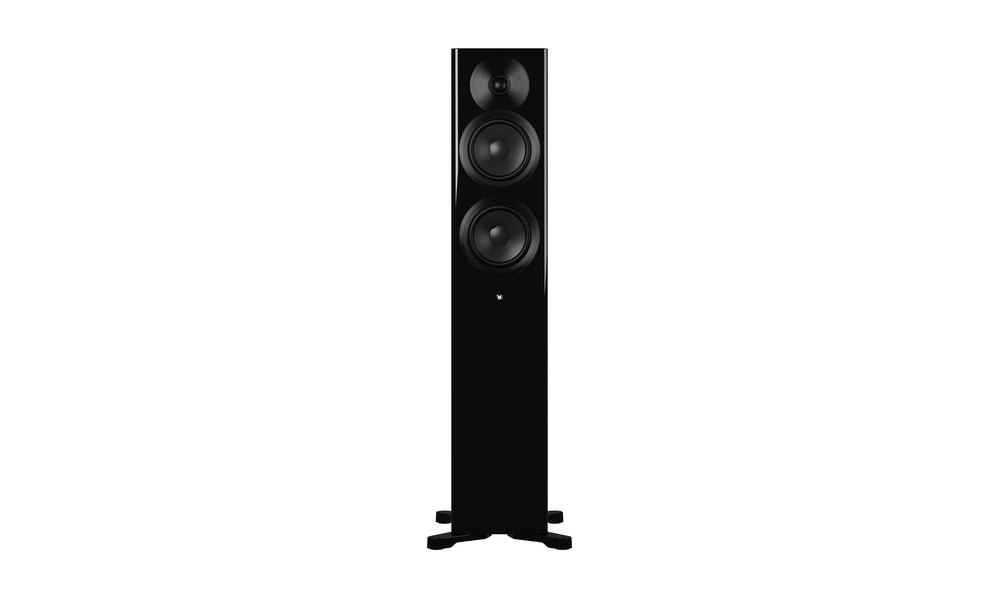
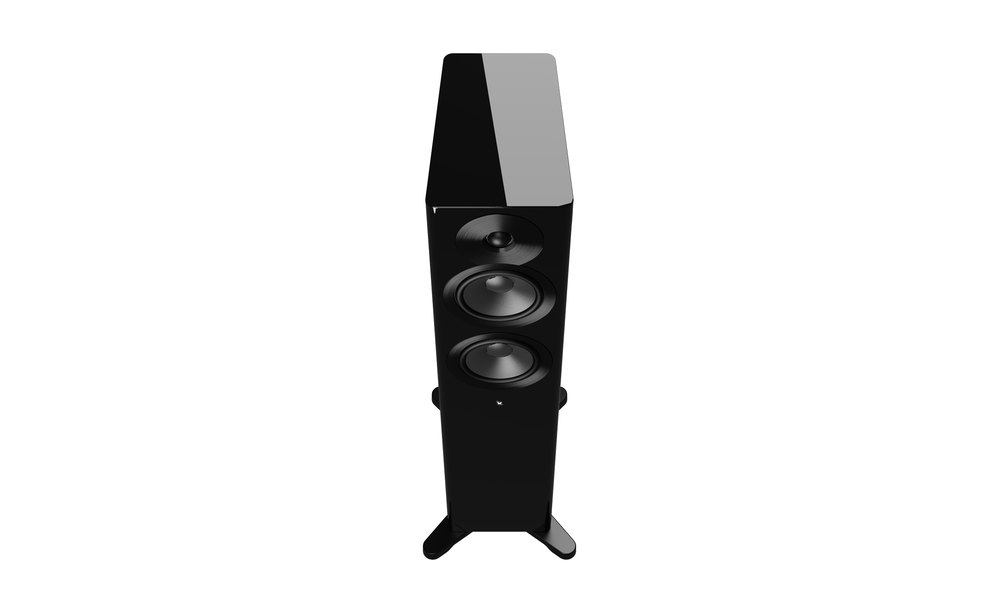
The Dynaudio Focus 30 is the middle floorstanding speaker of the active Focus series: a sealed 2.5-way system with 28 mm Cerotar dome and two 14-cm MSP bass drivers, each chassis with its own Pascal amplifier. Dynaudio refers to 30 Hz to 22 kHz (±3 dB). Streamed via WLAN or Ethernet with AirPlay 2, Chromecast, Roon, Spotify Connect and Tidal Connect, plus two RCA analog inputs, Toslink, Koax, Bluetooth and subwoofer output. The speakers connect via WiSA or Cable. SoundStage! leads the Focus 30 as recommended reference component: transparent representation, effortless dynamics, accurate imaging and bass extension, with Dirac Live as a decisive plus. Dynaudio lists approximately 7,500 € per pair (as of Oct. 2026, without guarantee).
Assumptions
- Price per pair or set according to manufacturer or trade, Stand Oct. 2026, no guarantee
- Vinyl via an external phono stage at the RCA line input (the speaker has no phono input) or via a turntable with a built-in preamp
- Free placement with distance to the rear wall, decoupled Turntable
- No in-house measurements or listening tests
Specifications (manufacturer)
| Type | Active 2.5-way floorstanding speaker · closed-back · DSP crossover |
|---|---|
| Chassis | 28 mm Cerotar domes with hexis · 2 × 14 cm MSP-woofer |
| Separation frequencies | (220) / 2,400 Hz |
| Amplifier | Pascal Class D: 280 W + 280 W + 110 W per box |
| Frequency response | 30 Hz – 22 kHz (±3 dB, manufacturer) |
| Inputs | 2 × RCA analog · Toslink · Koax · WLAN/Ethernet streaming · Bluetooth 4.2 |
| Outputs | Subwoofer (RCA) · Triggers |
| Phono | No phono input — external phono stage at RCA |
| Loudspeaker connection | WiSA wireless (24/96) or cable (24/192) |
| Dimensions / weight | 180 × 900 × 261 mm (B × H × T) · 16.2 kg per speaker |
| Price guide | approx. 7,500 €/pair (Dynaudio) · as of Oct. 2026 · without guarantee |
Manufacturer specifications (Dynaudio)
| Type | Active streaming floorstanding speaker |
|---|---|
| Amplifier power | per speaker: woofer 280 W · midrange 280 W · tweeter 110 W · load impedance not specified by manufacturer (built-in amplifier) |
| Drivers | 28 mm Cerotar soft dome with Hexis · 2 × 14 cm MSP |
| Frequency response | 30 Hz–22 kHz (±3 dB, 85 dB) · dynamic 18 Hz–36 kHz (−6 dB) |
| Dimensions | 180 × 900 × 261 mm (W × H × D) · 268 × 947 mm incl. feet |
| Weight | 16.2 kg |
| Power consumption | max 280 W · standby max 2 W |
Source: Dynaudio – official specifications · As of 16 October 2026 · subject to change by the manufacturer
Rating criteria in detail
The four criteria feed into the Vinyl BotPro Index with weights of 25/20/25/30. The index is scaled across all tiers (see Methodology); that is why we do not show individual sub-scores.
Strengths
- Recommended Reference Component award
- Own Pascal power amplifier for each chassis
- Optional Dirac Live Room Correction
- Two analog inputs plus streaming and sub-output
Weaknesses
- No phono input
- Dirac Live costs extra and needs a measuring microphone
- Analog sources are digitized
- According to SoundStage! comparison, the KEF LS60 looks a little bigger in the sound image
Comparison models
| DALI Rubicon 6 C | Index 83, Rank 1 — Balance · Hybrid-Treble · Radio-active · approx. €7,000 |
|---|---|
| Buchardt A700 LE | Index 71, Rank 3, value for money Champion — Status · 3.5-way · sealed/cardioid · approx. €6,500 |
System matching
Works well with
- Average living space
- Vinyl listening aids with high-quality external phono stage
- Who takes room correction seriously
Less suited
- Turntable without phono stage
- Purely analog signal way
- Very large rooms with party level
Specs & Features
The layout (Primary/Client, one amplifier per driver), connections, app settings, Dirac Live and conflicting figures are now collected, with sources, in the analysis below.
Research Consensus
We evaluate the reviews by SoundStage! Simplifi (12/2022) and HiFi.nl (09/2022) separately and with dates below.
For whom / Matching
Amplifier & Phono stage
There's no need for an amplifier. The Phono stage comes to one of the two RCA inputs. Candidates: Top list Phono preamps.
Turntable & phono
Decks of Expert Level match the resolution. Dirac Live smoothes room modes that can otherwise make rumble in the bass more audible with vinyl.
Room & placement
Medium living rooms, Placement with distance to walls; Dirac Live after the Placement measure.
Budget & upgrade
With around 7,500 € sound champion of the expert level. More bass extension offers the Focus 50; cheaper with a lot of technology the Buchardt A700 LE.
Analysis: the Dynaudio Focus 30 in depth
What this page is: an AI analysis, not a listening session
This page assesses the Dynaudio Focus 30 on the basis of manufacturer documents and two dated specialist articles. The basis is Dynaudio's product page with technical data [1], the English user manual for the Focus series [2], Gordon Brockhouse's review at SoundStage! Simplifi dated 1 December 2022 [3] and Jamie Biesemans's article at HiFi.nl dated 1 September 2022 [4]. Vinyl BotPro has neither heard nor measured these speakers. Listening impressions are attributed to the respective authors; our own assessments are labelled as such. The page's rank, index and price details remain unchanged.
Which model this is
- Focus 30: the slim floorstander of the current Focus series analysed here, 2.5 ways, three drivers [1].
- Focus 50: the larger 3-way floorstander with a dedicated midrange driver, two 18 cm woofers and a lower bass limit [1][4]. We do not transfer its data.
- Focus 10: the series' compact speaker [1][3].
- Focus 30 XD: the predecessor with a rear bass-reflex port; the new Focus 30 is sealed [3]. In the XD generation, wireless connectivity came via the optional Connect transmitter; the new series has the network streamer built into the Primary [3].
The new series was presented at the High End show in Munich in May 2022 [3][4].
Layout: Primary and Client
The Focus 30 is sold as a stereo pair. The Primary carries all inputs and the network hardware and sends the signal to the Client [1][3]. According to SoundStage!, the Client only has a mains inlet, a coaxial S/PDIF input for the wired link, a USB service port, a pairing button and a power switch [3]. Both speakers need mains power [2].
Between the speakers, WiSA transmits at up to 24 bit/96 kHz, or up to 24 bit/192 kHz via a coaxial cable [1][3]. According to the manual, the wired link takes over automatically as soon as the cable is connected [2]. By default the left speaker is the Primary; this can be changed in the app [3].
Drivers and amplifiers according to Dynaudio
- Principle: sealed cabinet, 2.5 ways, DSP crossover [1].
- Tweeter: 28 mm Cerotar soft dome with Hexis, derived from the Esotar 3 of the Confidence series, Ferrite+ magnet with strontium carbonate [1].
- Mid/bass drivers: two 14 cm Esotec+ drivers with MSP cones and aluminium voice coils [1].
- Crossover: (220)/2,400 Hz [1]. SoundStage! explains the brackets: the lower driver only works below 220 Hz, while the upper one hands over to the tweeter at 2.4 kHz [3].
- Amplifiers: three Pascal class-D amplifiers per speaker, 110 W for the tweeter and 280 W for each of the two mid/bass drivers [1][3]. So here every driver has its own amplifier [1].
- Frequency response: 30 Hz to 22 kHz (±3 dB at 85 dB), dynamic 18 Hz to 36 kHz (−6 dB) [1].
- Dimensions and weight: 180 × 900 × 261 mm, with feet 268 × 947 × 342 mm; 16.2 kg [1].
- Power consumption: maximum 280 W, standby maximum 2 W [1].
A sliding high-pass filter reduces bass at high levels to protect drivers and amplifiers; according to Dynaudio this gives deeper bass at low volume [1]. HiFi.nl confirms the impression of a full sound at low volume, for example as background music [4].
Connections, app and remote control
According to the datasheet, the Primary offers two RCA analogue inputs (one stereo pair, "Line L/R", according to the manual), one Toslink and one coaxial digital input, a subwoofer output, a 12 V trigger, plus Ethernet, Wi-Fi and Bluetooth 4.2 [1][2][3]. HiFi.nl mentions Bluetooth with AAC support [4]. Streaming: AirPlay 2, Chromecast, Roon, Spotify Connect, Tidal Connect, Qplay and UPnP [1].
The Bluetooth remote controls volume, mute, playback and source selection; three buttons call up internet radio favourites [3]. Initial setup is done in the Dynaudio app; SoundStage! describes how the speakers connected to each other via WiSA on first power-up and then entered Wi-Fi setup mode [3].
- Room Optimisation: Neutral, Wall, Corner, separately for the left and right speaker.
- Frequency Balance: Neutral, Dark (many hard surfaces), Bright (lots of absorption in the room).
- Analogue input sensitivity: −6, 0 or +6 dB [2].
- Fixed volume: HiFi.nl announced this option as a firmware update, selectable per input [4]; the manual lists it under the advanced settings [2].
- Subwoofer: when the sub output is enabled, the DSP applies an 80 Hz high-pass to the Focus 30 [2][3].
- WiSA sample rate: 48 kHz by default for longer range; SoundStage! switched to 96 kHz and had no dropouts [3].
Day-to-day operation according to the manual
According to the manual, the speakers wake from standby as soon as a source plays and return to standby after twenty minutes of silence [2]. There are two start-up modes: an energy-saving mode with a longer start-up time and a quick start-up mode with higher standby consumption [2]. The Bluetooth input is not selected automatically when a paired device starts playing; it has to be chosen in the app or with the remote [2]. With wired sources and WiSA, the remote does not control play/pause or track skipping [2]. The "Service" USB sockets are not audio inputs [2].
The magnetic grille slightly reduces treble output; a sensor detects it and the DSP applies a matching treble lift [1][2]. HiFi.nl describes how the logo briefly glows blue when this happens and also lights up when the volume changes [4]. According to Dynaudio, a new speaker needs several weeks of use to reach its full potential [2]; the SoundStage! sample had already been run in for several days by the distributor [3].
TV and WiSA
Via WiSA, the Focus 30 can receive audio directly from compatible sources, such as some LG TVs with a USB transmitter or Primare preamps [3][4]. HiFi.nl ran it with an LG OLED and reports smooth operation without lip-sync problems [4]. For TVs without WiSA, there is the optical input [2][4]. None of the sources mentions an HDMI input.
Dirac Live: cost and process
Dirac Live is optional. According to SoundStage!, the licence costs USD 159 (up to 500 Hz) or USD 249 (full band), plus a calibrated USB microphone [3]. HiFi.nl gives EUR 159 or 249 and also recommends a microphone stand; measurements are taken at at least nine positions [4]. According to SoundStage!, Dirac overrides the Room Optimisation settings when active, and five Dirac profiles can be stored [3]. HiFi.nl switched Dirac off for TV viewing because it adds a little delay [4].
Placement according to Dynaudio's manual
The series manual recommends [2]:
- 2 to 4 m between the speakers, along one wall.
- Listening distance about the same as, or slightly more than, the distance between the speakers.
- Toe-in is optional; it can tighten the central image.
- As far from walls as possible, ideally at least 50 cm.
- Similar acoustic surroundings for both speakers.
- Tweeter at roughly head height, both speakers at the same height.
SoundStage! placed the speakers about 2.1 m apart and about 2.3 m from the listening position, roughly 41 cm from the rear wall. Because of asymmetrical room boundaries, the author chose "Wall" on the left and "Corner" on the right [3].
SoundStage! Simplifi (December 2022)
Gordon Brockhouse listened in his living room and streamed via AirPlay 2, Chromecast, Roon and UPnP without dropouts [3]. Without correction, he found piano tone close to perfect but the double bass thuddy and indistinct [3]. With "Wall"/"Corner" the bass became clearer; only Dirac Live evened out the room's peaks and gave the double bass clear definition [3]. With Carl Nielsen's Fourth Symphony he describes a wide stage with precise lateral imaging and good front-to-back layering; without Dirac, timpani and double basses sounded thuddy, with Dirac more defined [3]. Compared with an Elac Navis ARF-51 system with an NAD preamp and Dirac, he found the Focus 30 more transparent and the Elac system more powerful but more congested [3]. Compared with the KEF LS60 Wireless, the KEF sounded bigger and punchier, the Focus 30 more transparent and more precise in imaging; depending on the piece, one or the other came out narrowly ahead [3]. His conclusion: transparent presentation, effortless dynamics, pinpoint imaging and bass extension; he calls Dirac Live the clincher [3]. Price according to SoundStage!: USD 8,250 per system (as of 12/2022) [3].
HiFi.nl (September 2022)
Jamie Biesemans listened to the Blonde Wood finish [4]. He describes a coherent, large and enveloping sound with a holographic character; he heard no traces of DSP processing [4]. With film sound via the optical input he praises the stage and dialogue intelligibility, but finds the speaker more refined than spectacular for big effects [4]. HiFi.nl awards 4.5 out of 5 and gives EUR 7,500 per set (as of 09/2022) [4]. As minus points the site names the extra cost of Dirac and its lower benefit for TV viewing [4].
Conflicting figures
- Height with feet: Dynaudio 947 mm [1]; SoundStage! 36.3 inches (about 922 mm) [3]; HiFi.nl "about 94 cm" [4].
- Dirac prices: SoundStage! in US dollars, HiFi.nl in euros, 159/249 in each case [3][4]; both figures are from 2022.
- WiSA rate: datasheet "up to 24/96" [1]; SoundStage! describes 48 kHz as the factory setting [3].
- Wired link: datasheet 24 bit/192 kHz [1], manual "196 kHz / 24 Bit" [2], probably a typo.
In a vinyl system
The Focus 30 has no phono input; the RCA input is a line input [2][4]. HiFi.nl states explicitly that a phono preamp is required and used a Pro-Ject X2 B with a Phono Box S3 B [4]. With Dirac (up to 500 Hz), the author listened to Ólafur Arnalds on vinyl and describes a large, coherent sound with a tangible bass foundation [4]. This is the only statement about vinyl playback in the sources we evaluated.
Our assessment: analogue signals pass through the speaker's DSP [1][3]. The −6/0/+6 dB sensitivity steps allow adjustment to the phono stage [2]. A subsonic filter in the phono stage can be useful, as Dynaudio quotes a dynamic 18 Hz (−6 dB) [1].
Open points and limits of this analysis
- No listening session of our own and no measurements of our own; the sources contain no lab measurements.
- Two specialist articles from 2022 were evaluated [3][4].
- Prices are dated (USD 8,250, 12/2022; EUR 7,500, 09/2022) [3][4].
- The manual covers the whole Focus series [2].
- A human fact-check and a browser check of this page are still pending.
Sources for this analysis
- Dynaudio: Focus 30 (Produktseite mit Beschreibung und technischen Daten, abgerufen/accessed 08.11.2026). https://dynaudio.com/home-audio/focus/focus-30
- Dynaudio: Focus User Manual (PDF, Serienanleitung Focus 10/30/50, englisch/English). https://dynaudio.com/hubfs/Manuals/dynaudio_manuals_home_audio_focus_en.pdf
- SoundStage! Simplifi: Dynaudio Focus 30 Active Loudspeaker System (Gordon Brockhouse, 01.12.2022). https://www.soundstagesimplifi.com/index.php/equipment-reviews/219-dynaudio-focus-30-active-loudspeaker-system
- HiFi.nl: Dynaudio Focus 30 – Totaaloplossing met veel stijl (Jamie Biesemans, 01.09.2022). https://hifi.nl/artikel/31438/Review-Dynaudio-Focus-30-Totaaloplossing-met-veel-stijl.html
Created by AI (Vinyl BotPro) from the sources listed; no listening tests or measurements of our own. Detailed human fact-check pending.
What makes this AI analysis special
This section is an AI summary from Manufacturer data and reports from international specialist media. Vinyl BotPro had no physical access, no measurement of our own chain and no listening test. This is based on Dynaudio's product page and series manual, the SoundStage! award and dated reviews by SoundStage! Simplifi and HiFi.nl; conflicting figures are marked below. Prices and availability change (as of Oct. 2026, no guarantee); please check technical values against the current data sheet.
Vinyl BotPro Score Logic
The Vinyl BotPro Index runs from 0–100 across all tiers and weights build/technology, features, expected performance and value for money at 25/20/25/30. Expert typically sits at ~70–84. Dynaudio Focus 30 receives 80 (Rank 2 Expert). Highest expected performance of the expert level according to Specialist press; Value for money solid. In the stage, the model bears the title Sound Vinyl BotPro Champion. Rank is not Laboratory Evaluation — no Listening test. Details on weighting · Methodology.
Sources
- Dynaudio — Focus 30 (Manufacturer's website, technical data)
- SoundStage! — Recommended Reference Component: Dynaudio Focus 30
- SoundStage! Simplifi — Dynaudio Focus 30 active loudspeaker system
- Stereophile — Dynaudio Focus 10 active loudspeaker
Created by Vinyl BotPro (AI) · AI analysis · As of 08.10.2026 · Corrections: info@vinylcination.de · Prices without guarantee.
Read more: best active floorstanding speakers 2026 · What is hi-fi?