
Active bookshelf speaker · AI analysis · Starter, Rank 2
ELAC Debut ConneX DCB41: Analysis
AI analysis (Research): 2-way active speaker from ELAC with 4.5-inch mid/bass driver, ¾-inch dome, 2 × 50 W, HDMI ARC, switchable line/phono input, USB, optically and Bluetooth aptX. Based on manufacturer data and press reviews, no listening test.
Summary
Value-for-money Vinyl BotPro Champion Best value-for-money estimate of the tier on the data basis (no listening test).
The ELAC Debut ConneX DCB41 bundles many connections in a compact pair: HDMI ARC for the TV, USB for the computer, optically, Bluetooth aptX and an RCA input that can be switched between line and MM-Phono. ELAC refers to 2 × 50 W, a 4.5-inch polypropylene mid/bass driver and a ¾-inch soft-dome tweeter; the frequency response extends down to 66 Hz anechoic and, according to the manufacturer, to about 50 Hz in a room. What Hi-Fi? gave the DCB41 its Awards in 2023 and 2024 and praises the clear, balanced sound; the editors see the built-in phono preamp as a usable starting point. The ELAC MSRP is 529 € per pair (as of Oct. 2026, without guarantee).
Assumptions
- Price per pair or set according to manufacturer or trade, Stand Oct. 2026, no guarantee
- Vinyl via the phono input of the box or via an external phono stage at the analog input
- Placement on stands or free with some distance to the rear wall
- No in-house measurements or listening tests
Specifications (manufacturer)
| Type | Active 2-way bookshelf speaker · Bass-reflex |
|---|---|
| Chassis | ¾-inch soft-dome tweeter · 4.5-inch mid/bass driver (polypropylene) |
| Amplifier | 2 × 50 W |
| Frequency response | 66 Hz – 25 kHz (anechoic) · approx. 50 Hz in the room (manufacturer) |
| Max. SPL | 102 dB |
| Inputs | HDMI ARC · RCA with line/phono switching · USB (24/96) · Optical · Bluetooth aptX |
| Outputs | Subwoofer output |
| Phono | Built-in phono preamplifier (MM) |
| Dimensions | 139.7 × 244.5 × 203.2 mm (W × H × D) |
| Price guide | MSRP 529 €/pair (ELAC) · as of Oct. 2026 · without guarantee |
Manufacturer specifications (ELAC)
| Type | Active bookshelf speaker pair |
|---|---|
| Amplifier power | 2 × 50 W · test conditions / load impedance not specified by manufacturer (built-in amplifier) · THD ≤ 0.20 % |
| Drivers | ¾ in soft dome · 4.5 in polypropylene woofer |
| Frequency response | 66 Hz–25 kHz (anechoic) · 50 Hz–25 kHz (in-room) |
| Max. SPL | 102 dB (1 m) |
| Inputs | HDMI ARC · line/phono switchable · USB (96 kHz/24-bit) · optical |
Source: ELAC – official specifications · As of 16 October 2026 · subject to change by the manufacturer
Rating criteria in detail
The four criteria feed into the Vinyl BotPro Index with weights of 25/20/25/30. The index is scaled across all tiers (see Methodology); that is why we do not show individual sub-scores.
Strengths
- Phono input: Turntable without additional device
- HDMI ARC, USB, optical and Bluetooth aptX in a compact pair
- What Hi-Fi? Awards 2023 and 2024
- Subwoofer output
Weaknesses
- Phono preamp more for occasional listening
- Volume and input controls on the back, no level indicator
- No Wi-Fi streaming
- For large rooms and high levels too small
Comparison models
| Fyne Audio Cubitt 5 | Index 54, Rank 1, Sound champion — Bookshelf · coaxial (IsoFlare) · bass reflex · approx. €649 |
|---|---|
| Triangle AIO Twin | Index 50, Rank 3 — Shelf · 2-way · Bass-reflex · approx. €699 |
System matching
Works well with
- Turntables with MM system, even without own preamplifier
- Desk, study and TV in small room
- Beginners looking for a complete system with a few cables
Less suited
- Large rooms with party levels
- Listeners who already own a high-quality external phono stage and want WLAN streaming
- Placement close to a wall with little space behind
Specs & Features
The technology, connections and manufacturer data are now collected, with sources, in the analysis below.
Research Consensus
We evaluate What Hi-Fi? (12/2022, updated 11/2024) and HomeTheaterHifi (10/2022) separately below, including their differing views on the phono input.
For whom / Matching
Amplifier & Phono stage
A separate amplifier is not required. The Phono input takes a MM turntable directly; for more sound quality, an external Phono stage from the Top list Phono preamps can be attached to the line input later.
Turntable & phono
Suitable are Turntable with MM system, for example from the Top list Turntable (starter). The grounding cable of the drive belongs to the mass terminal, otherwise it's buzzing. Decks with built-in preamplifier run via line mode.
Room & placement
Desk, small living room or study. Stands or sideboard, tweeters at ear height, a few centimeters of air to the rear.
Budget & upgrade
With 529 €, the DCB41 is the value for money champion of the starter stage. More bass brings a subwoofer to the sub-output (Top list Active subwoofer); with WLAN streaming and phono, the Triangle AIO Twin continues.
Analysis: the ELAC Debut ConneX DCB41 in depth
What this is: an AI analysis, not a listening test
This page summarises what can be documented about the ELAC Debut ConneX DCB41 from manufacturer data and international reviews. Vinyl BotPro has neither listened to nor measured the system. Where we describe sound, we paraphrase the named publications as they phrased it under their own conditions, each with a date. Our own assessments are marked as such. This section changes nothing about the rating, rank or index.
To keep models apart: the DCB41 belongs to the Debut ConneX series. Despite the name, it is not part of the passive Debut speaker series such as Debut 2.0 or Debut 3.0, even though What Hi-Fi? compares its voicing with them [2]. ELAC now also offers a larger model in the same series, the DCB61 [1]. This page covers only the DCB41; we do not carry over any details of the DCB61.
The concept: one active and one passive speaker
The DCB41 is a pair in which one speaker contains all the electronics: amplification, inputs and controls. The second speaker is passive and is connected with a supplied speaker cable [2][5]. A switch on the active unit sets which speaker is left and which is right [5].
ELAC describes the aim as the simplest possible solution for music and movies without extra equipment [1]. What Hi-Fi? accordingly treats the DCB41 as a compact, affordable hi-fi system rather than just a pair of speakers [2]. It has no network streamer: there is neither wi-fi nor Ethernet. Sources come in via Bluetooth or the wired inputs [2].
Drivers and cabinet
According to ELAC, each speaker is a two-way bass reflex design [1]:
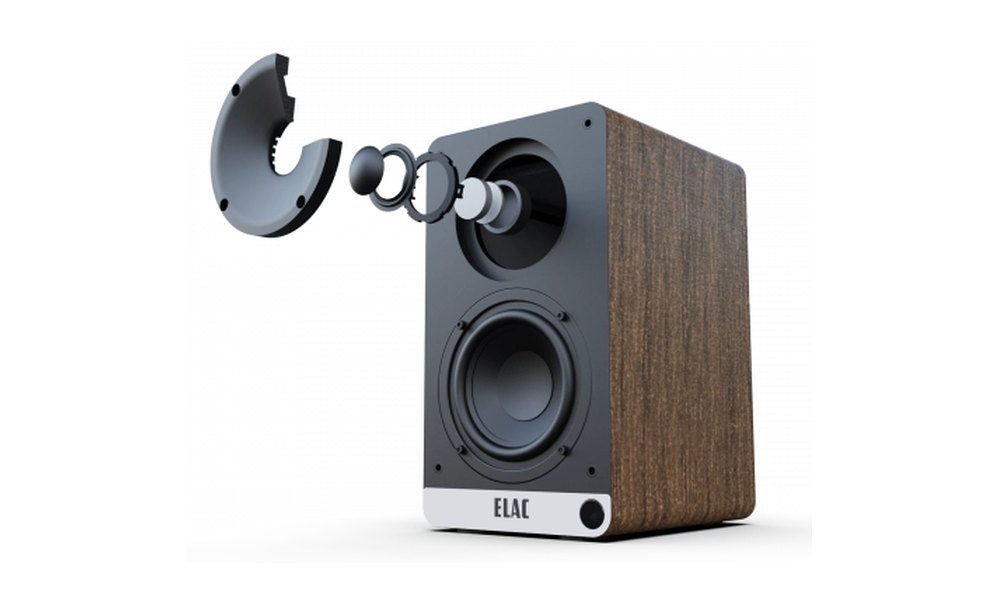
- Tweeter: ¾-inch (19 mm) soft dome in a custom waveguide meant to control dispersion and directivity and so improve imaging and balance [1].
- Mid/bass driver: 4½ inches with a polypropylene cone, long excursion and a wide-roll surround for more bass [1].
- Bass reflex: the port fires to the rear and, according to ELAC, follows an "S" path for better low-frequency extension and less port noise [1]. HomeTheaterHifi describes a rear slot port [5].
- Cabinet: ¾-inch MDF, according to HomeTheaterHifi [5].
What Hi-Fi? lists the mid/bass driver as 10 cm in its spec box [2]. ELAC gives 4½ inches, about 11.4 cm [1]. The difference may come down to whether the cone or the frame is measured; we cannot prove that. We use the manufacturer figure.
Amplification and XBass
ELAC specifies 2 × 50 W, distortion of no more than 0.2 per cent and a signal-to-noise ratio of at least 90 dB [1]. ELAC does not state the load at which the power is measured. The amplifiers are Class D [5]. HomeTheaterHifi found them robust: the system played loud without noticeable strain [5].
"XBass" is a bass boost that can be switched off [1]. According to HomeTheaterHifi there are two levels, +3.5 dB and +7 dB, centred at 55 Hz [5]. It is operated from the remote control [5]. The reviewers use it differently:
- What Hi-Fi? found that XBass adds a welcome dose of weight but can easily sound too obvious, so the team left it off. The bass stayed controlled even close to a rear wall and with XBass engaged [2].
- HomeTheaterHifi used the 7 dB level on a desk well away from walls, the 3.5 dB level near a wall, and no boost at all with a subwoofer [5].
Our conclusion: XBass is a placement tool rather than a fixed sound setting.
Connections
For its size, the connection panel is broad [1][2][5]:
- HDMI ARC with CEC: connect the TV and control the volume with the TV remote [1].
- USB for Windows and Mac computers, up to 24-bit/96 kHz; the volume follows the computer [1]. HomeTheaterHifi played via Roon up to this limit [5].
- Optical digital [1].
- Bluetooth with aptX [1].
- RCA input, switchable between line and MM phono, with a ground screw [1][5].
- Subwoofer output: according to HomeTheaterHifi it sends a signal below 200 Hz while the speakers continue to run full range [5].
- USB-A for firmware updates [1][5].
What Hi-Fi? would also have liked a coaxial digital input and a second analogue line input, but considers the overall provision well judged [2].
Operation: the most common criticism
Volume and input selection share a rotary knob on the back of the active speaker [2][5]. What Hi-Fi? calls this awkward and misses a volume indicator; without one, switching sources can lead to unpleasant surprises [2]. HomeTheaterHifi would also like a visible volume indication [5]. In daily use, the supplied infrared remote handles input selection and XBass [1][5].
Specifications according to the manufacturer
In November 2026 ELAC's product page lists [1]:
- Bass reflex, powered
- 2 × 50 W
- Frequency response 66 Hz to 25 kHz (anechoic), 50 Hz to 25 kHz (in-room)
- Distortion ≤ 0.20%, signal-to-noise ≥ 90 dB
- Maximum output 102 dB at 1 m
- Dimensions 5½ × 9⅝ × 8 inches (W × H × D), about 140 × 245 × 203 mm
- Weight 7.6 lb (active) and 6.3 lb (passive), about 3.4 kg and 2.9 kg
- Mains voltage 120 to 240 V
- In the box, according to a review: remote control, batteries, HDMI cable, speaker wire, power cord, rubber feet, grilles [5]
In November 2026 ELAC shows the finishes Black Ash, Walnut, Royal Blue and Orange [1]. The 2022 reviews mention only the first three [2][5].
Awards
What Hi-Fi? named the DCB41 "Best powered speakers" at its Awards 2023 [3]. The review page also lists it as an Awards 2024 winner [2]. In July 2026 the magazine refers to a total of four What Hi-Fi? Awards since it was first reviewed in 2022, and still lists it as the powered option of choice in its budget speaker guide [4]. That article does not name the individual years of all four awards.
This allows the "Award" mentioned on this page to be attributed to a specific source: What Hi-Fi? Awards.
What Hi-Fi? (first December 2022, updated November 2024)
What Hi-Fi? first published its review in December 2022 and updated it in November 2024 [2]. It lists £529, $595 and AU$999; the verdict, by contrast, says AU$900 [2]. Sound received five stars, build and features four each [2].
The key points [2]:
- Via the digital inputs the system is clear, balanced and insightful, with a good level of detail organised into a cohesive and musical whole.
- The presentation is controlled and even-handed, like the passive Debut 2.0 series. The pricier Triangle AIO Twin is more energetic; the DCB41 is more understated but eminently likeable.
- The voicing is slightly rounded, so it is forgiving of weaker recordings without penalising better ones.
- Bluetooth is audibly the most limited link; the analogue line input loses some transparency but keeps the system's strengths.
- Don't expect party levels. It works best with a little space behind it on a solid, low-resonance support, ideally stands.
The phono input: how the reviews compare
For this site, the phono input is especially important. The reviews judge it differently:
- What Hi-Fi? found the built-in phono stage fine for occasional use, but a little too opaque and lacking in dynamic expression to hold interest for long. If vinyl is a priority, it suggests budgeting for an outboard phono stage such as the Rega Fono Mini A2D [2].
- HomeTheaterHifi connected a Technics SL1200 MK6 with an Audio-Technica VM540ML. The sound was clean, with no hint of distortion, overload or added noise. The built-in stage may not be as flexible as a good separate one, but is more than good enough for budding or casual vinyl listeners [5].
So both agree: usable as a starting point, with an external phono stage the better solution for demanding listening [2][5]. In practice: the input can be switched to line, so an external phono stage or a turntable with a built-in preamp can be connected [1][5]. The turntable's ground wire belongs on the ground screw [1].
HomeTheaterHifi (October 2022)
Carlo Lo Raso reviewed the DCB41 for HomeTheaterHifi; the article was published on 31 October 2022 at a price of $599.98 per pair [5]. He used the system in several places [5]:
- Desk: clear and transparent with an appealing midrange, but a little bass-shy away from walls; with XBass +7 dB much punchier without muddying the rest. Imaging from the small tweeters was precise and centred.
- Kitchen: closer to a wall, XBass +3.5 dB was enough. The Bluetooth connection stayed stable across kitchen and living room.
- Living room with the TV: via the optical input, a clear gain over TV sound; with a small ELAC subwoofer and no XBass, a balanced 2.1 system.
His verdict: surprisingly full, natural sound for the size and very flexible connections; the only thing missing is a volume indicator [5]. The article also mentions that the well-known designer Andrew Jones had left ELAC [5]. None of the sources names who designed the DCB41.
How it compares with alternatives, according to What Hi-Fi?
What Hi-Fi? compares the DCB41 with pricier systems such as the Triangle AIO Twin and the KEF LSX II [2]. These offer network streaming, which the DCB41 lacks [2]. In terms of sound, the magazine describes the Triangle as more energetic and the DCB41 as more understated and unobtrusive [2]. In July 2026 What Hi-Fi? again points out that wi-fi streaming is missing, but that the aptX connection works seamlessly [4].
Above all, these comparisons show what the DCB41 is meant for: a simple system with wired inputs and Bluetooth, not a streaming speaker. Anyone who already uses a streamer, a TV with HDMI ARC or a computer does not necessarily need network streaming; anyone who listens only through streaming apps relies on Bluetooth, which What Hi-Fi? found to be the weakest link sonically [2]. This is our conclusion from the sources.
Placement according to the sources
- What Hi-Fi? found the DCB41 not overly fussy about placement. It works best with a little space behind it on a solid, low-resonance support; stands are ideal but not always practical [2].
- According to What Hi-Fi?, the bass stayed controlled even relatively close to a rear wall [2].
- HomeTheaterHifi spaced the speakers about 4 feet (about 1.2 m) apart on a desk and sat at least as far away; imaging was precise in this setup [5].
- Because the port fires to the rear, distance from the wall changes the bass. HomeTheaterHifi compensated with the XBass levels [5].
Where the sources agree
- Sound: balanced, natural and full for the size; understated rather than spectacular [2][5].
- Features: an unusually wide range of inputs for a compact active system, including HDMI ARC and phono [2][5].
- Limits: limited level and bass for large rooms; no wi-fi streaming; rear-panel controls without a volume indicator [2][5].
- Phono: usable as a starting point, an external stage is better [2][5].
Who the DCB41 suits
Based on the sources evaluated, the DCB41 suits
- beginners looking for a compact system for a desk, study or small living room [2][5];
- listeners who want to connect a TV, computer, smartphone and turntable to one device [1][2][5];
- vinyl beginners with an MM cartridge who can add an external phono stage later [2][5].
According to the sources it is less suited to large rooms and high levels [2], to listeners who expect wi-fi streaming [2], and to anyone who values a volume display [2][5]. A subwoofer on the sub output adds bass [5].
Prices and dates
The prices in the reviews ($599.98 in 2022; £529, $595) are historical [2][5]. In July 2026 What Hi-Fi? reported considerably lower retail prices in the UK [4]. The euro price in the tables on this page remains unchanged and is dated separately.
Open points and limits of this analysis
- No independent lab measurements in the sources evaluated; all technical values are manufacturer figures.
- Mid/bass driver: 4½ inches (ELAC) versus 10 cm (What Hi-Fi?) [1][2].
- Australian price: AU$999 and AU$900 within the same review [2].
- Award years: 2023 and 2024 are documented; the source does not name the other two of the four awards individually [2][3][4].
- A detailed human fact-check of this analysis is still pending.
Sources for this analysis
- ELAC: Debut ConneX DCB41 (Produktseite/product page). https://elac.com/dcb41
- What Hi-Fi? (12/2022, aktualisiert/updated 05.11.2024): Elac Debut ConneX DCB41 review. https://www.whathifi.com/reviews/elac-debut-connex-dcb41
- What Hi-Fi? Awards 2023: Best standmount speakers 2023 (inkl./incl. best powered speakers). https://www.whathifi.com/awards/best-standmount-speakers-2023
- What Hi-Fi? (01.07.2026): Looking for powered speakers on a budget? … four-time Award winner. https://www.whathifi.com/speakers/hi-fi-speakers/looking-for-powered-speakers-on-a-budget-we-recommend-this-neat-affordable-and-talented-four-time-award-winner
- HomeTheaterHifi.com / Secrets (31.10.2022, Carlo Lo Raso): ELAC Debut ConneX DCB41 Powered Speaker Review. https://hometheaterhifi.com/reviews/speaker/bookshelf/elac-debut-connex-dcb41-powered-speaker-review/
Created by AI (Vinyl BotPro) from the sources listed; no listening tests or measurements of our own. Detailed human fact-check pending.
What makes this AI analysis special
This section is an AI summary from Manufacturer data and reports from international specialist media. Vinyl BotPro had no physical access, no measurement of our own chain and no listening test. The basis are the manufacturer specifications of ELAC and the reviews by What Hi-Fi? and HomeTheaterHifi. The expected performance is derived from construction, datasheet and the judgements of the Specialist press. Prices and availability change (as of Oct. 2026, no guarantee); please check technical values against the current data sheet.
Vinyl BotPro Score Logic
The Vinyl BotPro Index is multi-level 0–100 and weighted Technology/Build, features, expected performance and value for money with 25/20/25/30. Starter is typically ~40–54. ELAC Debut ConneX DCB41 receives 53 (Rank 2 starters). Best value for money share of the starter level, very strong features with Phono and HDMI ARC. In the stage, the model bears the title Value for money Vinyl BotPro Champion. Rank is not Laboratory Evaluation — no Listening test. Details on weighting · Methodology.
Sources
- ELAC — Debut ConneX DCB41 (Manufacturer's website, technical data)
- What Hi-Fi? — Elac debut ConneX DCB41 review
Created by Vinyl BotPro (AI) · AI analysis · As of 08.10.2026 · Corrections: info@vinylcination.de · Prices without guarantee.
Read more: best active bookshelf speakers 2026 · What is hi-fi?