
Active bookshelf speaker · AI analysis · Starter, Rank 1
Fyne Audio Cubitt 5: Analysis
AI analysis (research): Fyne Audio's first active loudspeakers — a compact pair with a 5-inch IsoFlare coaxial driver, active DSP crossover, up to 240 W in total, a phono input for MM and high-output MC, HDMI ARC, optical, RCA and Bluetooth aptX HD. Guidance from manufacturer data and international listening tests, no own listening test.
Summary
Sound Vinyl BotPro Champion Highest expected performance of the level according to Manufacturer data and Specialist press. This is an AI assessment, not a listening test.
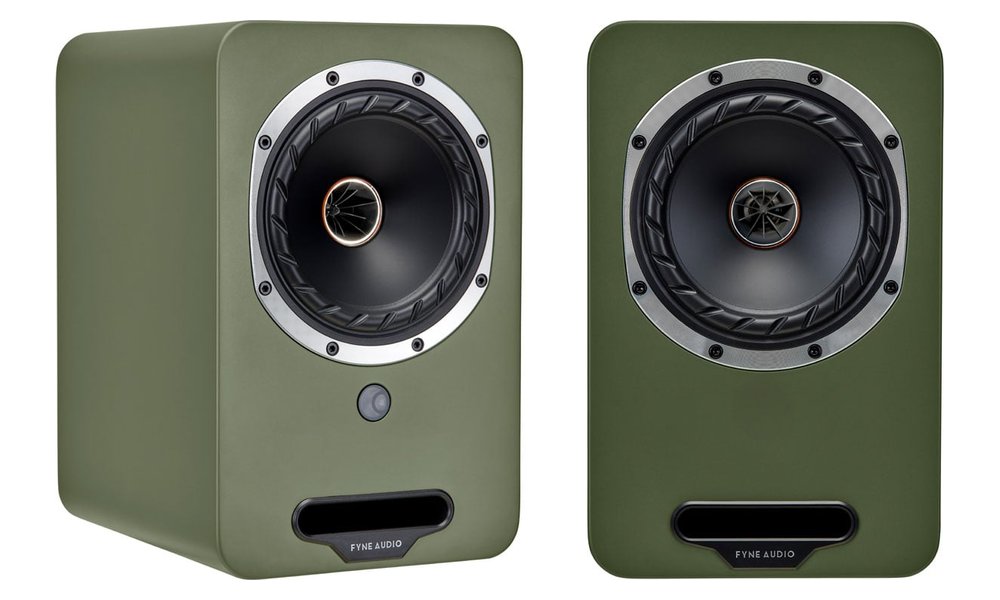
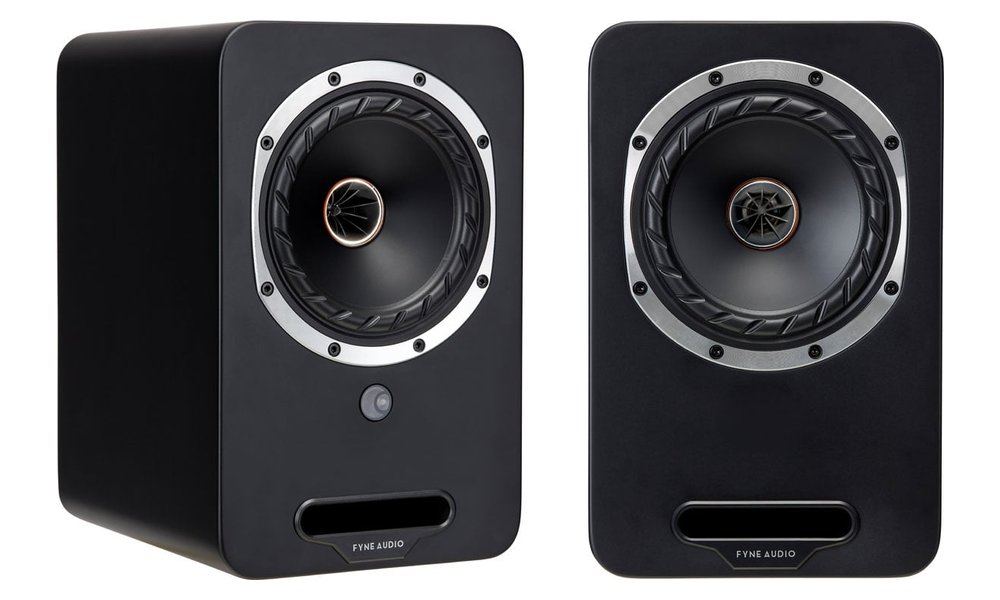
The Fyne Audio Cubitt 5 are the Scottish brand's first active loudspeakers: a compact pair of primary and secondary speaker with Fyne's own 5-inch IsoFlare coaxial driver, which has a 19 mm titanium dome tweeter at its centre. An active DSP crossover splits the signal; Fyne quotes up to 240 W in total and 43 Hz to 34 kHz (−6 dB, typical in room). Important for turntables: the phono input accepts MM and high-output MC cartridges, joined by HDMI ARC, optical, RCA, Bluetooth 5.0 with aptX HD and a subwoofer output. What Hi-Fi? lists it as a 2026 Awards winner, StereoNET calls it "Highly recommended", and AVForums rates it a Best Buy. The pair costs around 649 € in the EU (UK RRP 549 £; as of 18.10.2026, without guarantee).
Assumptions
- Pair price around 649 € (EU market price), UK RRP 549 £; as of 18.10.2026, without guarantee
- Vinyl via the built-in phono input (MM or high-output MC) or via an external phono stage on the RCA input
- Placement on stands or a sideboard, close to a wall also works
- No own listening protocol; source base = manufacturer data + international listening tests
Specifications (manufacturer)
| Type | Active bookshelf speaker · Primary and secondary speaker · active DSP crossover |
|---|---|
| Chassis | 5-inch IsoFlare coaxial driver with 19 mm titanium dome (point source) |
| Amplifier | up to 240 W in total · Measurement conditions not specified by the manufacturer |
| Frequency response | 43 Hz – 34 kHz (−6 dB, typical in room) |
| Inputs | Phono (MM or high-output MC) · RCA (Line) · Optical · HDMI ARC · Bluetooth 5.0 aptX HD/AAC |
| Outputs | Subwoofer output |
| Phono | Built-in phono preamp (MM or high-output MC) with ground terminal |
| Resolution | up to 24 bit / 96 kHz |
| Dimensions / weight | 260 × 165 × 215 mm (primary) or 223 mm deep (secondary) · 4.2 kg / 3.6 kg |
| Price guide | approx. 649 €/pair (EU market price) · UK RRP 549 £ · As of 18.10.2026 · without guarantee |
Manufacturer specifications (Fyne Audio)
| Type | Active bookshelf speaker (pair of primary and secondary unit), active DSP crossover |
|---|---|
| Amplifier power | total maximum 240 W · measurement conditions/load impedance not specified by the manufacturer (built-in amplifier) |
| Drivers | 5-inch IsoFlare with 19 mm concentric titanium dome tweeter (time-aligned point source) |
| Frequency response | 43 Hz – 34 kHz (−6 dB, typical in room) |
| Inputs | Bluetooth 5.0 (aptX HD, AAC) · HDMI ARC (2.0 PCM) · analogue RCA (line) · phono (MM or high-output MC) · optical digital |
| Outputs | subwoofer |
| Resolution | 24-bit / 96 kHz (maximum) |
| Speaker link | wired speaker-level connection between primary and secondary unit |
| Remote control | infrared |
| Auto standby | after 20 minutes without signal |
| Power consumption | 200 W · standby: not specified by the manufacturer |
| Mains voltage | 100–240 V (universal) |
| Dimensions (H × W × D) | primary unit 260 × 165 × 215 mm · secondary unit 260 × 165 × 223 mm (incl. grille and terminals, excl. feet) |
| Weight | primary unit 4.2 kg · secondary unit 3.6 kg (net) |
| Finishes | Arctic White, Midnight Black, Olive Green, Pearl Titanium, Pebble Grey |
Source: Fyne Audio – official specifications · As of 18 October 2026 · subject to change by the manufacturer
Rating criteria in detail
The four criteria feed into the Vinyl BotPro Index with weights of 25/20/25/30. The index is scaled across all tiers (see Methodology); that is why we do not show individual sub-scores.
Strengths
- Phono input for MM and high-output MC: turntables without an extra box
- Coaxial driver with a stable, wide stereo image
- HDMI ARC for the TV, plus optical, RCA and Bluetooth aptX HD
- What Hi-Fi? Award 2026, Best Buy at AVForums
Weaknesses
- No Wi-Fi streaming, no app and no tone controls
- No USB input for a computer
- Operation only via infrared remote control
- What Hi-Fi? and AVForums heard faint background hiss at idle
Comparison models
| ELAC Debut ConneX DCB41 | Index 53, rank 2, value-for-money champion — bookshelf · 2-way · Bass-reflex · approx. €529 |
|---|---|
| Q Acoustics M20 HD | Index 48, Rank 4 — Shelf · 2-way · Bass-reflex · approx. €500–600 |
System matching
Works well with
- Turntables with an MM or high-output MC cartridge and no separate preamp
- Living rooms with a TV (HDMI ARC) and smaller rooms
- Listeners who connect sources by cable and don't want an app system
Less suited
- Users who expect streaming and multiroom built into the speaker
- Desks with a computer as the main source (no USB)
- Large rooms at very high levels without a subwoofer
Specs & Features
The layout (primary speaker with the amplifiers, passively driven secondary), driver, connections, operation and manufacturer data are now collected, with sources, in the analysis below.
What international reviewers heard
We evaluate the reviews by What Hi-Fi? (Ioan Hazell, 06/2026), StereoNET (Jay Garrett, 10/2026) and AVForums (Ed Selley, 10/2026) separately, with names and dates, below, including the phono input.
Research Consensus
Where the three reviews agree and where they differ is set out in the analysis below under "Where the sources agree" and "Open points".
For whom / Matching
Amplifier & Phono stage
A separate amplifier is not required. The phono input takes MM and high-output MC cartridges directly; if you want to upgrade later, connect an external phono stage from the phono preamp ranking to the RCA input.
Turntable & phono
Matching turntables with MM cartridges are in the turntable ranking (Starter). The ground wire goes to the ground terminal on the primary speaker; a streamer joins via RCA or optical.
Room & placement
Stands or a sideboard, tweeters ideally at ear height and angled slightly towards the listening position. The speakers cope well with placement near a wall and also work on a desk.
Budget & upgrade
At around 649 €, the Cubitt 5 lead the Starter level. More deep bass comes from a subwoofer on the sub output (active subwoofer ranking); if you want streaming in the speaker, the Premium level has models such as the PSB iQ2.
Analysis: the Fyne Audio Cubitt 5 in depth
What this page is: an AI analysis, not a listening session
This page summarises what can be documented about the Fyne Audio Cubitt 5 from manufacturer documents and three international reviews. Vinyl BotPro has neither listened to nor measured these speakers. We paraphrase sound descriptions as the named authors wrote them under their own conditions, each with a date, and we flag our own assessments. This section does not change the page's rank, index or prices.
The model
The Cubitt 5 are Fyne Audio's first active speakers [3][5]. According to StereoNET, the name comes from the company's new headquarters at Cubitt Court near Glasgow [4]. So far there is only this one Cubitt model; StereoNET says Fyne plans more but names no specific models yet [4]. Larger IsoFlare drivers and built-in streaming are possibilities, not announcements [4].
Technically the Cubitt 5 is related to Fyne's passive F5E: AVForums describes the same driver assembly as the starting point, but without the F5E's BassTrax port arrangement [5].
Layout: active primary, passive secondary
This is worth a close look, because the sources word it differently.
- Fyne specification: "Wired speaker level connection between Primary & Secondary" [1][2].
- Manual: the amplifier connection panel is on the left primary speaker. It has a speaker socket for the right speaker, connected with the supplied latching 3 m cable [2]. An 8 m cable is available as an accessory [2][3].
- StereoNET: left speaker active, right speaker passive [4].
- AVForums: the crossover is active and sits before the amplifiers; the umbilical carries signal and power [5].
- What Hi-Fi?: on the one hand two 60 W Class D amplifiers "in each of the enclosures", on the other a master speaker housing power, amplification, DAC and connections [3].
Our reading: the manufacturer's specification and manual clearly indicate that all amplifiers sit in the primary speaker and the secondary is driven passively. What Hi-Fi?'s wording about amplifiers in each enclosure contradicts this; we leave that conflict open. Undisputed: the system is active, with a DSP crossover before the power amplifiers and one amplifier per driver [1][5].
Driver and cabinet
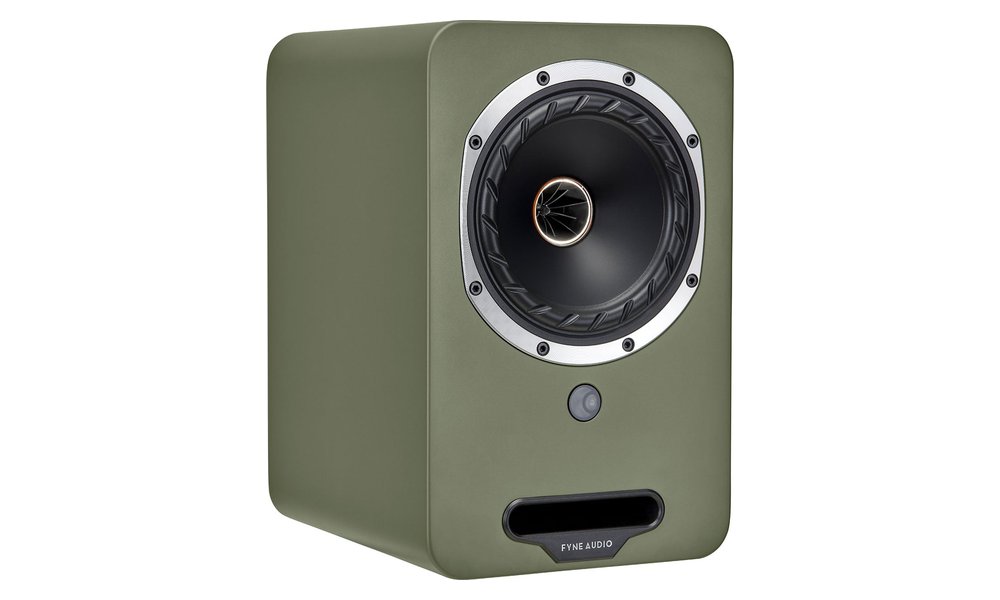
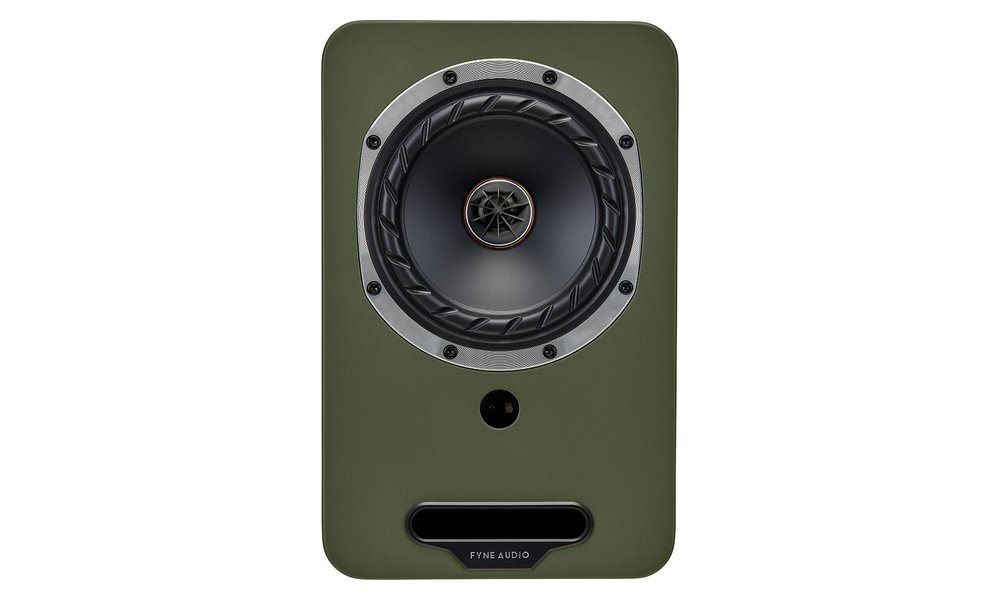
- IsoFlare coaxial driver: 5 inch with a 19 mm titanium dome at its centre, described by Fyne as a time-aligned point source [1].
- Diameter: AVForums gives 127 mm, What Hi-Fi? and StereoNET 12.5 cm and 125 mm [3][4][5].
- Cone: "multi-fibre", with the fluted FyneFlute surround [3][5].
- Cabinet: high-density MDF with rounded edges [1]; according to StereoNET with internal bracing and a cast aluminium chassis [4].
- Bass reflex: front-firing port [3][4]. StereoNET considers placement more forgiving than with rear-ported rivals as a result [4].
- Finishes: Arctic White, Midnight Black, Olive Green, Pearl Titanium, Pebble Grey [1].
Amplification
Fyne quotes a total maximum of 240 W and an active DSP crossover [1][2]. AVForums and What Hi-Fi? break this down as 60 W per driver, Class D [3][5]. AVForums considers 60 W per driver the more meaningful figure [5]. Fyne does not state measurement conditions for the power figure [1]. Power consumption is 200 W according to the spec sheet [1].
Connections
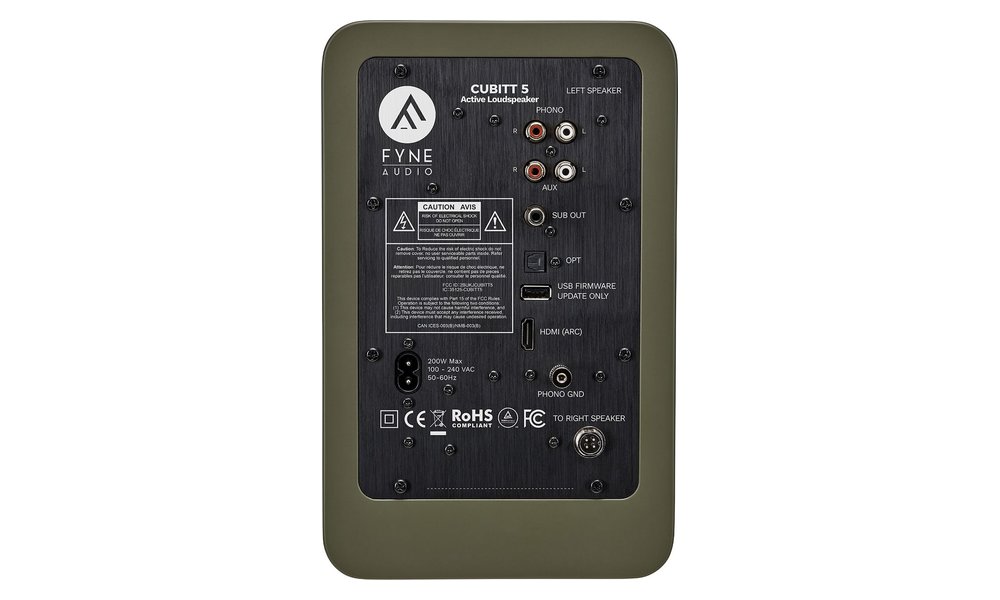
On the primary speaker [1][2]:
- Phono for MM and high-output MC cartridges, plus a ground terminal
- AUX (RCA, line level)
- optical, up to 24-bit/96 kHz
- HDMI ARC, PCM stereo only
- Bluetooth 5.0 with aptX HD and AAC
- subwoofer output (mono)
- USB for firmware updates from a stick only, not for audio
What Hi-Fi? writes "HDMI eARC" [3]. Fyne says HDMI ARC and notes that with some TVs the eARC function must be disabled [1][2]. There is no Wi-Fi, Ethernet, app or tone control [3][4]. According to StereoNET, Wi-Fi and streaming were discussed but left out for simplicity and price [4].
Operation
Control is via an infrared remote: power, input selection, Bluetooth track skip and pairing, volume, mute [2]. There are no buttons on the speakers [3][4]. A light on the front of the left speaker shows red for standby and briefly blue for remote commands [2]. Volume and the selected input are not displayed [3][4]. What Hi-Fi? reports being caught out by a high volume left over after a break [3]. A holder for the remote is fitted to the back of the secondary speaker [2][3].
After about 20 minutes without a signal the speakers go into standby [1][2]. They wake up when a signal arrives, except on the phono input: there you have to press the power button on the remote [2].
Specifications according to Fyne
- Frequency response 43 Hz to 34 kHz (−6 dB, typical in room) [1]
- Primary 260 × 165 × 215 mm, secondary 260 × 165 × 223 mm (H × W × D) [1]
- Weight 4.2 kg (primary) and 3.6 kg (secondary) [1]
- Mains voltage 100 to 240 V [1]
What Hi-Fi? (June 2026)
Ioan Hazell reviewed the Cubitt 5 for What Hi-Fi?, published on 26 June 2026 and updated on 19 October 2026, then priced at £549, $749 or AU$1,495 [3]. The page lists it as a What Hi-Fi? Awards 2026 winner and gives 5 for sound and build and 4 for features [3]. The impressions [3]:
- Taut sound across all inputs, airy treble, controlled bass that is strong for the size.
- Good timing; composed even at high volume.
- Very stable stereo image; no hole in the middle even with the speakers far apart.
- Best results on stands near the rear wall; also good on a desk.
- Slight background hiss with no music, a little higher than rivals, but not bothersome during playback.
- The first pair clipped on the RCA input; a replacement pair worked without problems.
Criticism concerned the lack of buttons and display [3].
StereoNET (October 2026)
Jay Garrett reviewed the Cubitt 5 for StereoNET on 12 October 2026, with prices of £550, €649, $749 and AU$1,499 [4]. He gave 9 out of 10 and called them "Highly recommended" [4]. His impressions [4]:
- Balanced, insightful and engaging; taut bass, open midrange, clean treble without glassy sibilance.
- Stable, coherent imaging and a wide sweet spot, which he credits to the IsoFlare driver.
- Compared with the Argon Forte A5 WiFi, more of a traditional mini monitor, more controlled and more refined in the midrange.
- Compared with the KEF Coda W, a little more forceful and dynamic; the KEF sounds smoother and better focused in the midrange.
AVForums (October 2026)
Ed Selley reviewed the Cubitt 5 for AVForums on 16 October 2026, then priced at £549, and gave it 9 points and a Best Buy [5]. His impressions [5]:
- Exceptional imaging for the size; the speakers largely disappear from the sound.
- Clearly more bass than the passive F5E. In his room the bass reached 50 Hz without notable roll-off; this is a listening description, not a documented measurement.
- More forgiving than expected with poorly mastered recordings.
- He preferred the DAC in his Bluesound Node Nano to the internal DAC.
- Slight noise at idle that gets quieter after a short time; he suspected it might be specific to his samples.
The phono input
According to Fyne, the input is for MM and high-output MC cartridges; the ground terminal is there to prevent hum [1][2]. The three reviews heard it like this:
- What Hi-Fi?: detailed and energetic with a Rega Planar 3 RS Edition, fine for most users; if vinyl is your main source, consider a standalone phono stage [3].
- StereoNET: surprisingly good with an Ortofon 2M Red, but not a match for a proper standalone phono stage [4].
- AVForums: decent, low enough in noise and with enough gain; with a Gold Note MM cartridge on an AVID deck [5].
StereoNET speaks of a turntable sitting "sensibly within the Fyne's orbit" [4]. The phono cable has to reach the primary speaker; the sources do not imply that the turntable must stand directly next to the speaker. Fyne does not state a permissible cable length.
For vinyl: what the sources show
- An MM or high-output MC cartridge connects directly; the ground wire goes to PHONO GND [2].
- On the phono input, a signal does not wake the speakers from standby [2].
- An external phono stage can be used on the AUX input, since phono and AUX are separate [1][2].
- StereoNET sees the separate inputs as a way to grow the system with an external phono stage, DAC or streamer [4].
Placement
According to the manual, placement in a corner or near the rear wall increases bass, while moving the speakers into the room reduces it; Fyne recommends experimenting [2]. The speakers can sit on a shelf, desk, work surface or stand [2]. What Hi-Fi? got the best results on stands near the rear wall and praised desktop behaviour, with little bass blurring and little vibration [3]. AVForums and StereoNET used Solidsteel stands, and StereoNET also used a desk with an optical feed from a PC [4][5]. Fyne recommends about 40 hours of running in at normal levels [2].
The connecting cable is 3 m long; wider spacing needs the 8 m cable [2][3]. AVForums notes that excess cable will often need to be stowed [5].
With a TV
TV sound arrives via HDMI ARC, but only as PCM stereo; the TV must be set accordingly [2]. AVForums used a Philips OLED and describes more weight and scale than built-in TV speakers [5]. There is no volume display, which according to What Hi-Fi? can lead to surprises when switching between TV and music [3].
Comparison models in the sources
- Ruark MR1 Mk3: smaller and cheaper; What Hi-Fi? finds the Cubitt 5 more agile and grippier in the bass and more faithful, if slightly less energetic [3].
- KEF Coda W: larger and more expensive, with USB-C and newer Bluetooth; What Hi-Fi? sees the Cubitt 5 as an honourable but not threatening challenger [3][4].
- Argon Forte A5 WiFi: with network streaming; StereoNET hears it as livelier and bassier, the Cubitt 5 as more controlled [4].
We do not derive a ranking from these comparisons.
Where the sources agree
- Sound: balanced, controlled bass, stable imaging [3][4][5].
- Phono: usable to good, but below good standalone stages [3][4][5].
- Features: sensible for turntable and TV; no streaming, no USB audio, no buttons [3][4][5].
- Noise: What Hi-Fi? and AVForums heard slight background hiss with no music [3][5].
Open points and limits of this analysis
- Amplifier location: Fyne and the manual describe a speaker-level link to the secondary; What Hi-Fi? writes of amplifiers in each enclosure [1][2][3].
- HDMI: ARC according to Fyne, eARC according to What Hi-Fi? [1][3].
- Driver diameter: 125 or 127 mm depending on the source [3][4][5].
- Prices: Fyne £549.98; reviews £549–550, $749, €649 [1][3][4]. The page's price information stays unchanged.
- Noise: whether the background hiss occurs on all samples is open [3][5].
- A detailed human fact-check of this analysis is still pending.
Sources for this analysis
- Fyne Audio – Cubitt 5 (Produktseite mit Spezifikationen). https://www.fyneaudio.com/products/cubitt-5/
- Fyne Audio – Cubitt 5 Manual (Bedienungsanleitung). https://www.fyneaudio.com/support/cubitt-5-manual/
- What Hi-Fi? – Ioan Hazell (mit Ketan Bharadia), Fyne Audio Cubitt 5 review (26.06.2026, aktualisiert 19.10.2026). https://www.whathifi.com/speakers/fyne-audio-cubitt-5
- StereoNET – Jay Garrett, Fyne Cubitt 5 Active Loudspeaker Review (12.10.2026). https://www.stereonet.com/reviews/fyne-cubitt-5-active-loudspeaker-review
- AVForums – Ed Selley, Fyne Cubitt 5 Active Speaker Review (16.10.2026). https://www.avforums.com/reviews/fyne-cubitt-5-active-speaker-review.23906/
Created by AI (Vinyl BotPro) from the sources listed; no listening tests or measurements of our own. Detailed human fact-check pending.
What makes this AI analysis special
This section is an AI summary of published international listening reviews and the manufacturer data from Fyne Audio. Vinyl BotPro puts the reviewers’ findings into context and links them with the data sheet and comparison models; VinylCination does not run its own listening tests or measurements; all sources are linked at the end of the page. Prices and availability change (as of Oct. 2026, no guarantee); please check technical values against the current data sheet.
Vinyl BotPro Score Logic
The Vinyl BotPro Index is multi-level 0–100 and weighted Technology/Build, features, expected performance and value for money with 25/20/25/30. Starter is typically ~40–54. Fyne Audio Cubitt 5 receives 54 (rank 1 Starter). Highest expected performance in the level according to international listening tests, strong vinyl features with phono input and HDMI ARC at a moderate price. In the stage, the model bears the title Sound Vinyl BotPro Champion. Rank is not Laboratory Evaluation — no Listening test. Details on weighting · Methodology.
Sources
- Fyne Audio — Cubitt 5 (manufacturer page, technical data)
- What Hi-Fi? — Fyne Audio Cubitt 5 review
- StereoNET — Fyne Cubitt 5 Active Loudspeaker Review
- AVForums — Fyne Cubitt 5 Active Speaker Review
Created by Vinyl BotPro (AI) · Updated on 18.10.2026 · Version 1.0 · Corrections: info@vinylcination.de · Prices without guarantee.
Read more: best active bookshelf speakers 2026 · What is hi-fi?