
Active bookshelf speaker · AI analysis · Expert, Rank 1
KEF LS50 Wireless II: Analysis
AI analysis (research): streaming active pair from KEF with the 12th-generation Uni-Q (25 mm aluminium dome with MAT, 130 mm aluminium cone), separate amplifiers per driver, HDMI eARC, optical, coaxial, 3.5 mm analogue input and subwoofer output. Based on manufacturer data and press reviews, no listening test.
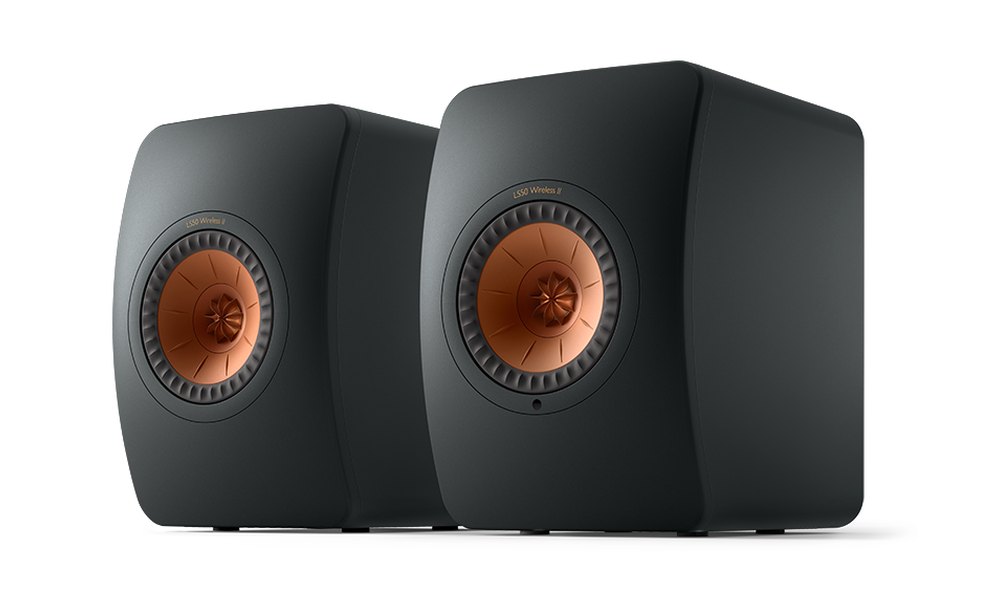
Summary
Value-for-money Vinyl BotPro Champion Best value-for-money estimate of the tier on the data basis (no listening test).
The KEF LS50 Wireless II turns the concept of the passive LS50 Meta into a complete streaming system: a Uni-Q coaxial driver with Metamaterial Absorption Technology (MAT), separate amplifiers for tweeter and mid/bass driver and a streaming platform with AirPlay 2, Google Cast and Roon Ready. KEF refers to 45 Hz to 28 kHz (±3 dB), 40 Hz (−6 dB) and 108 dB maximum level. Inputs are HDMI eARC, optical, coaxial, 3.5 mm analog and network, with a subwoofer output; the speakers connect wirelessly (24/96) or via cable (24/192). According to KEF, What Hi-Fi? has given the LS50 Wireless II several awards since 2021 (Product of the Year 2021, Award 2025); StereoNET (01/2021) credits it with a detailed, nuanced sound and excellent imaging. KEF mentions 2,499 € per pair (as of Oct. 2026, without guarantee).
Assumptions
- Price per pair or set according to manufacturer or trade, Stand Oct. 2026, no guarantee
- Vinyl via an external phono stage at the 3.5 mm analogue input (the LS50 Wireless II has no phono input)
- Placement on stands or free with some distance to the rear wall
- No in-house measurements or listening tests
Specifications (manufacturer)
| Type | Active streaming bookshelf speaker · Uni-Q coaxial chassis · Bass-reflex |
|---|---|
| Chassis | Uni-Q (generation 12): 25 mm aluminium dome with MAT · 130 mm aluminium membrane |
| Amplifier | Per speaker: mid/bass Class D 280 W · tweeter Class AB 100 W |
| Frequency response | 45 Hz – 28 kHz (±3 dB) · 40 Hz – 47 kHz (−6 dB) |
| Max. SPL | 108 dB |
| Inputs | WLAN/Ethernet streaming (up to 24/384) · HDMI eARC · Optical · Coaxial · 3.5 mm analogue · Bluetooth 5.0 |
| Outputs | Subwoofer Output (RCA) |
| Phono | No phono input — external phono stage at the 3.5 mm input |
| Loudspeaker connection | Wireless (24/96) or Cable (24/192) |
| Dimensions / weight | 305 × 200 × 311 mm (H × W × D) · 20.1 kg (pair) |
| Price guide | MSRP 2,499 €/pair (KEF EU) · as of Oct. 2026 · without guarantee |
Manufacturer specifications (KEF)
| Type | Active streaming bookshelf speaker |
|---|---|
| Amplifier power | per speaker: LF 280 W class D · HF 100 W class A/B · load impedance not specified by manufacturer (built-in amplifier) |
| Drivers | LF 130 mm aluminium cone · HF 25 mm vented aluminium dome with Metamaterial Absorption Technology (Uni-Q) |
| Frequency response | 45 Hz–28 kHz (±3 dB, 85 dB/1 m) · frequency range 40 Hz–47 kHz (−6 dB) |
| Max. SPL | 108 dB |
| Inputs | network up to 384 kHz/24-bit · optical up to 96 kHz · coaxial up to 192 kHz · HDMI up to 192 kHz · analogue 3.5 mm |
| Outputs | RCA subwoofer output |
| Dimensions | 305 × 200 × 311 mm (H × W × D) |
| Weight | 20.1 kg (pair) |
| Power consumption | 200 W (operating) |
Source: KEF – official specifications · As of 16 October 2026 · subject to change by the manufacturer
Rating criteria in detail
The four criteria feed into the Vinyl BotPro Index with weights of 25/20/25/30. The index is scaled across all tiers (see Methodology); that is why we do not show individual sub-scores.
Strengths
- What Hi-Fi? awards: Product of the Year 2021 and Award 2025
- Uni-Q with MAT: precise imaging, wide radiation
- HDMI eARC, coaxial, optical, analogue and subwoofer output
- Separate power stages per chassis, room and installation EQ in the app
Weaknesses
- No phono input: external phono stage required
- Analog only as 3.5 mm socket
- Best on your own stands
- According to What Hi-Fi?, not ideal for smaller rooms
Comparison models
| Nubert nuZeo 4 | Index 77, Rank 2 — Bookshelf · 2-way · bass reflex · approx. € 2,800 (pair) |
|---|---|
| Dynaudio Focus 10 | Index 75, Rank 3, Sound champion — Bookshelf · 2-way · sealed · approx. €5,000 |
System matching
Works well with
- Medium living rooms with stand-placement
- Vinyl listeners with a high-quality external phono stage
- Streaming, TV via eARC and music from a single source
Less suited
- Turntable without additional phono stage
- Anyone who uses XLR connections only
- Very large rooms with party level without subwoofer
Specs & Features
The drivers, amplifiers, signal processing, connections and manufacturer data are now collected, with sources, in the analysis below.
Research Consensus
We evaluate the reviews by What Hi-Fi? (2020, updated 11/2024), StereoNET (01/2021) and SoundStage! Simplifi (07/2021), and the measurements by Erin's Audio Corner (09/2021), separately and with dates below.
For whom / Matching
Amplifier & Phono stage
There's no need for an amplifier. For VinylCination, an external phono stage is required at the 3.5 mm analog input (RCA-to-jack cable); candidates are listed in the Top list Phono preamps. The analog signal is digitized internally.
Turntable & phono
Matching decks range from the Premium to the Expert Level. With decks that produce noticeable rumble, a phono stage with a subsonic filter can keep low-frequency noise away from the woofer.
Room & placement
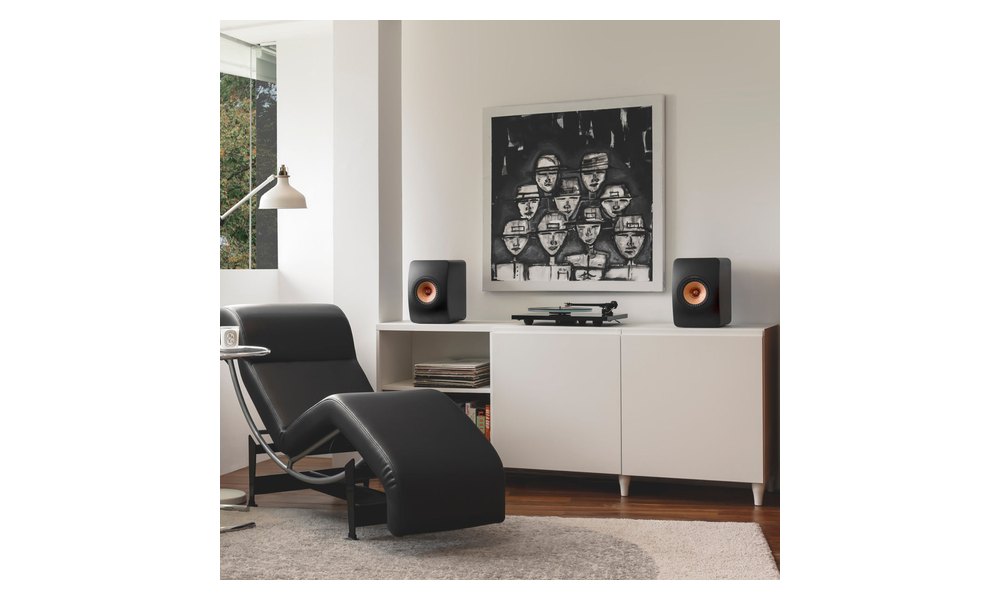
Medium rooms, placement on stands with some distance from the rear wall; Distance from the wall and room size can be entered in the KEF Connect app.
Budget & upgrade
With €2,499, the LS50 Wireless II is the value for money champion of the expert stage. More bass extension brings a subwoofer like the KEF KC62; a floorstanding KEF system is the KEF LS60 Wireless.
Analysis: the KEF LS50 Wireless II in depth
What this page is: an AI analysis, not a listening test
This page summarises what can be documented about the KEF LS50 Wireless II from manufacturer information and international reviews. Vinyl BotPro has neither listened to nor measured these speakers. Sound descriptions are paraphrased as the named authors wrote them under their own conditions, each with a date. Measurements come from the cited sources. Our own assessments are labelled as such. This section does not change the score, rank or index.
Keeping the models apart
- LS50 Wireless (2016): the predecessor, launched in 2016 according to What Hi-Fi? [2]. SoundStage! gives its amplifiers as 200 W and 30 W [4]; What Hi-Fi? names the cable required between the two speakers as a small weak point [2].
- LS50 Meta: the passive speaker with the same driver and cabinet but no electronics [4]. It is not rated on this page.
- LSX II and LS60 Wireless: other KEF systems that What Hi-Fi? compares separately [2]. They are not covered here either.
Everything below refers only to the LS50 Wireless II.
The concept
KEF describes the LS50 Wireless II as a complete system: streaming, amplification, conversion and speakers in two boxes [1]. According to SoundStage!, it is an active design with separate amplifiers for the mid/bass driver and the tweeter and a digital crossover [4]. All inputs sit on the primary speaker [4]. Out of the box the speakers link wirelessly; alternatively, the supplied 3 m Ethernet cable connects the two [4].
Drivers and cabinet
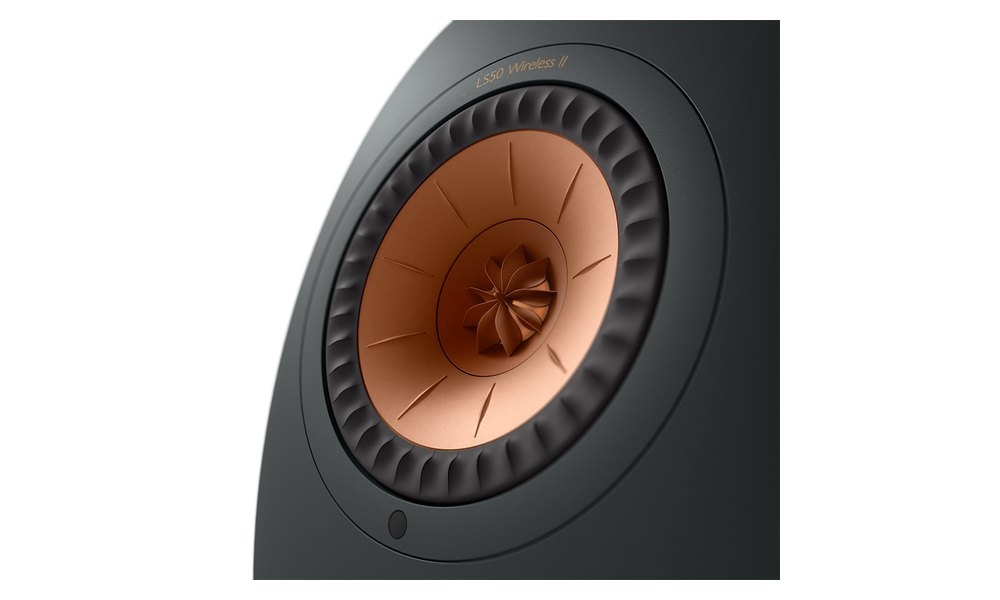
- 12th-generation Uni-Q: a 25 mm vented aluminium dome tweeter in the centre of an aluminium-cone mid/bass driver [1].
- Mid/bass size: KEF states 130 mm [1]; StereoNET mentions 135 mm [3]. We give both figures.
- MAT: behind the tweeter sits a disc with about 30 channels of different shapes, intended to absorb the tweeter's rear radiation [4]. KEF claims 99 % absorption [1].
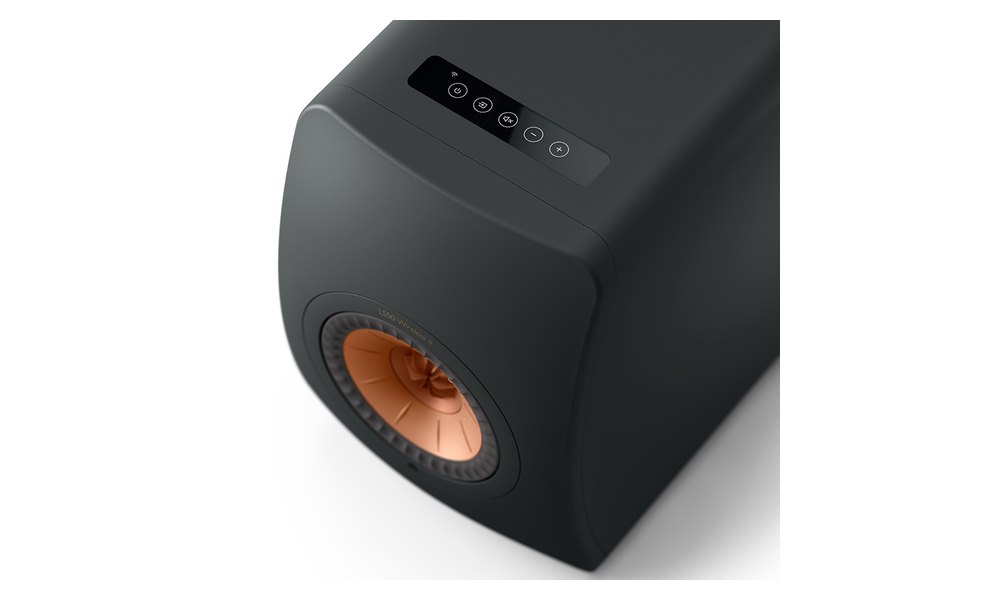
- Cabinet: MDF with a curved front baffle and a rear bass port [4].
- Crossover frequency: 1.9 kHz [4].
Amplification and signal processing
Each speaker has two amplifiers: 280 W Class D for the mid/bass driver and 100 W Class AB for the tweeter [1][4]. According to SoundStage!, that adds up to 760 W for the pair [4]. KEF gives a maximum output of 108 dB at 1 m [1].
Signal paths according to KEF [1]:
- Wireless link between the speakers: everything is converted to 24-bit/96 kHz.
- Cable link: everything is converted to 24-bit/192 kHz.
- Network up to 24/384, optical up to 24/96, coaxial and HDMI up to 24/192.
- Formats include MQA, DSD64 and DSD128.
Latency is below 6 ms with phase correction and a wireless link, according to KEF's white paper as quoted by SoundStage! [4].
Connections and streaming
On the primary speaker [1][4]:
- HDMI eARC
- optical, coaxial
- 3.5 mm analogue input
- Ethernet and Wi-Fi (2.4/5 GHz), Bluetooth 5.0
- subwoofer output (RCA); according to SoundStage!, the secondary speaker has one as well [4]
- USB-A for service only
Streaming: AirPlay 2, Google Cast, Roon Ready, UPnP, Spotify Connect, Tidal Connect, plus Amazon Music, Qobuz, Deezer and internet radio in the app [1]. According to SoundStage!, the USB-B computer input of the predecessor is gone [4].
Room adjustment in the app
According to SoundStage!, the KEF Connect app offers two modes [4]:
- Normal: stand or desk, distance to the wall, room acoustics (damped, moderate, lively), room size, subwoofer yes or no.
- Expert: bass trim in wall mode, presence in desk mode, treble trim, phase correction, bass extension (Less, Standard, Extra), plus filters, level and polarity for a subwoofer.
In early 2021, StereoNET lists wall mode, desk mode and subwoofer output level, plus fine-tuning of the volume steps [3]. In September 2021, Erin's Audio Corner praises being able to set the subwoofer crossover and level directly in the app [5].
Specifications according to KEF
KEF states in November 2026 [1]:
- Frequency response 45 Hz to 28 kHz (±3 dB), 40 Hz to 47 kHz (−6 dB), measured at 85 dB/1 m and dependent on EQ settings
- Maximum output 108 dB
- Power consumption 200 W
- Dimensions 305 × 200 × 311 mm (H × W × D)
- Weight 20.1 kg
SoundStage! gives 48 Hz to 28 kHz in the Standard bass mode [4]. On weight: SoundStage! gives 22.2 lb for the primary and 20 lb for the secondary speaker [4], StereoNET about 10 kg per speaker [3]. KEF's 20.1 kg therefore fits the pair.
Awards
On its product page, KEF lists several What Hi-Fi? Awards: Product of the Year 2021, Best all-in-one system over £1,500 (2022), Best speaker system £1,500–3,000 (2024) and Best speaker system over £1,500 (2025) [1]. In its review, What Hi-Fi? gives five stars each for sound, features and build [2]. StereoNET awarded 9 out of 10 [3].
What Hi-Fi? (2020, updated November 2024)
What Hi-Fi? published its review in 2020 and updated it in November 2024 [2]. Key points [2]:
- A big performance leap over the predecessor, with a clean, punchy sound.
- MAT is clearly audible in the purity of the treble; the midrange is clearer and the bass more defined.
- The presentation is more open, with more detail and better instrument separation, so it sounds much less congested.
- Drawbacks: best placed on dedicated stands; won't suit smaller rooms.
The verdict: a sequel of rare quality that meets high expectations [2].
StereoNET (January 2021)
Matthew Jens reviewed the LS50 Wireless II for StereoNET on 29 January 2021, priced at £2,250 at the time [3]. His observations [3]:
- Setup was easy: the Google app on his Android phone recognised the speakers immediately and added them to the Wi-Fi network.
- A lot of tight midbass for the size; for a wall-shaking effect he recommends a subwoofer.
- Very high levels stayed clean; he describes volume levels hardly expected from boxes this size.
- He also played vinyl through the system and heard plenty of detail.
- Linked wirelessly, he heard no latency between the speakers and very good imaging.
His verdict: comprehensively better than the predecessor both sonically and functionally, with detailed sound, superb imaging and plenty of power; he was considering buying a pair himself [3]. After the review he named KEF's then newly announced KC62 as a likely subwoofer partner [3].
SoundStage! Simplifi (July 2021)
Gordon Brockhouse reviewed the LS50 Wireless II for SoundStage! Simplifi, then priced at $2,499 per pair [4]. He placed them on 28-inch stands, 7 feet apart and 16 inches from the wall [4]. His impressions [4]:
- High timbral accuracy, fast delivery, a broad and deep soundstage.
- Surprisingly weighty bass for compact speakers and thrilling dynamics; no congestion in big orchestral passages.
- HDMI eARC did not work reliably with his Samsung TV; KEF called this a known Samsung issue and recommended the optical input. With another TV, eARC worked without problems.
His verdict: a standout product and, for him in July 2021, the best deal in hi-fi [4].
Further listening details from SoundStage!
Brockhouse describes some details more closely [4]:
- A double bass sounded deep, robust, taut and tuneful; the bass drum in an orchestral recording came without bloat, although less deep than through larger speakers.
- Kick drums sounded slightly thuddy to him.
- Cymbals sounded effortless and not splashy in loud orchestral passages.
- He noticed no lip-sync delay with TV pictures.
In our assessment, these details show where the compact speaker's limits lie: in the deepest bass and the impact of very low notes, not in resolution or imaging.
Setup, finishes and contents
- Stands: according to What Hi-Fi?, the underside has threaded inserts in each corner to lock onto KEF's S2 stands [2]. What Hi-Fi? says this is the easiest way to tell them apart from the predecessor [2].
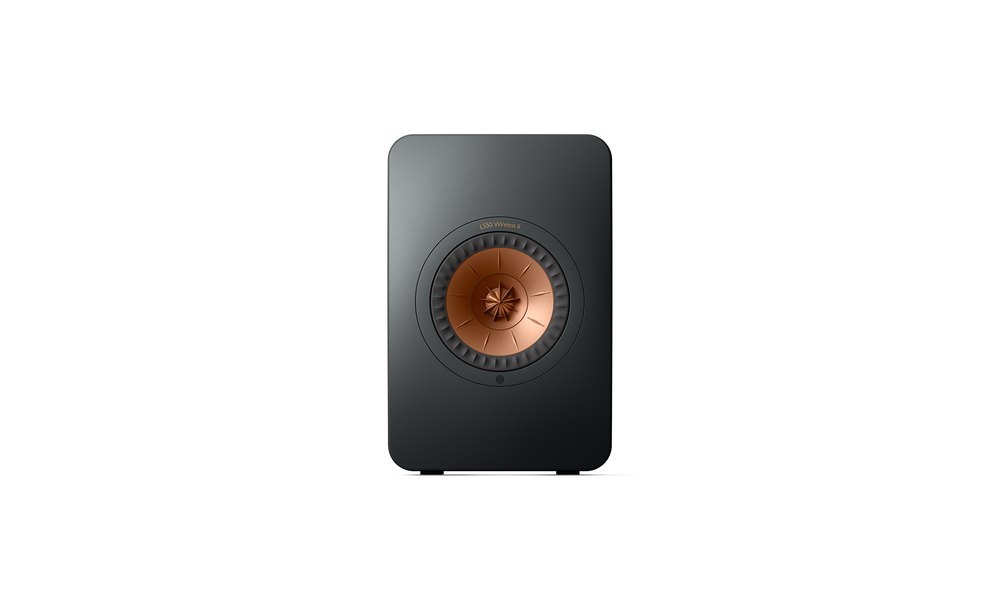
- Finishes: SoundStage! describes matte rather than glossy finishes as on the predecessor [4]. The colour of cone and waveguide depends on the finish, for example copper-coloured on Carbon Black and Mineral White [4]. In November 2026, KEF lists Carbon Black, Titanium Grey, Mineral White and the special editions Royal Blue and Crimson Red [1].
- Controls: the primary speaker has a touch panel for volume and source; a small remote is included [3].
- Contents according to KEF: speaker pair, remote, interspeaker cable, power cord, quick start guide [1].
- Smart home: KEF lists integrations for Elan, RTi, Crestron Home, Savant, Control4 and URC [1].
Where the sources agree
- Progress: clearly better than the predecessor LS50 Wireless [2][3][4].
- Imaging: precise, with a deep soundstage [3][4][5].
- Bass: a lot for the size, but with limits; a subwoofer extends the system [3][5].
- Ease of use: simple setup and a good app [3][4][5].
Erin's Audio Corner: measurements (September 2021)
Erin's Audio Corner measured the LS50 Wireless II with a Klippel Near-Field Scanner [5]. The author's assessment:
- Mostly neutral, with a dip between 1 and 3 kHz.
- A very deep soundstage; width could be greater.
- Not a speaker for high levels: about 90 dB maximum at 4 m. He sees the sweet spot at 80 to 85 dB at 4 m or 90 dB at 2 m.
- Bass below 50 Hz is limited.
He recommends the speakers if expectations about level and deep bass stay realistic [5]. This contrasts somewhat with StereoNET, which described very high levels as clean [3]. Different room sizes, listening distances and standards may explain this; the sources do not resolve the conflict.
For vinyl: what the sources show
The LS50 Wireless II has no phono input [1]. KEF nevertheless explicitly promotes it for turntables too [1]. In our assessment, this means:
- A turntable needs a phono stage connected to the 3.5 mm analogue input [1].
- The analogue signal is digitised because the crossover works digitally [4].
- The only analogue input is a 3.5 mm socket; several analogue sources require a switch.
StereoNET listened to vinyl through the system and describes plenty of detail [3]. The article does not say which phono stage was used.
Who the LS50 Wireless II suits
Based on the sources reviewed, it suits
- listeners who want to connect streaming, TV and turntable to one compact system [1][4];
- medium-sized rooms and stand placement [2][4];
- listeners who may add a subwoofer later [3][5].
According to the sources, it is less suited to very high levels in large rooms [5] and to smaller rooms [2]. The sources differ in their view of room size.
Prices and dates
Prices in the reviews are historical: £2,250 (StereoNET, 01/2021) [3] and $2,499 (SoundStage!, 07/2021) [4]. The euro price in this page's tables is unchanged and dated separately.
Open points and limits of this analysis
- Driver size: 130 mm (KEF) versus 135 mm (StereoNET) [1][3].
- Frequency response: 45 Hz (KEF today) versus 48 Hz in Standard bass mode (SoundStage!) [1][4].
- Maximum level: clean according to StereoNET, limited according to Erin's Audio Corner [3][5].
- Software: the reviews refer to 2020/2021 firmware; later updates have not been reviewed.
- A detailed human fact-check of this analysis is still pending.
Sources for this analysis
- KEF – LS50 Wireless II (Produktseite EU, Spezifikationen, Auszeichnungen). https://eu.kef.com/products/ls50-wireless-2
- What Hi-Fi? – KEF LS50 Wireless II review (2020, aktualisiert 11/2024). https://www.whathifi.com/reviews/kef-ls50-wireless-ii
- StereoNET – Matthew Jens, KEF LS50 Wireless II Review (29.01.2021). https://www.stereonet.com/reviews/kef-ls50-wireless-ii-review
- SoundStage! Simplifi – Gordon Brockhouse, KEF LS50 Wireless II Active Loudspeakers (01.07.2021). https://www.soundstagesimplifi.com/index.php/equipment-reviews/175-kef-ls50-wireless-ii-active-loudspeakers
- Erin's Audio Corner – Kef LS50 Wireless II Speaker Review (06.09.2021, Klippel-NFS-Messungen). https://www.erinsaudiocorner.com/loudspeakers/kef_wireless_ii/
Created by AI (Vinyl BotPro) from the sources listed; no listening tests or measurements of our own. Detailed human fact-check pending.
What makes this AI analysis special
This section is an AI summary from Manufacturer data and reports from international specialist media. Vinyl BotPro had no physical access, no measurement of our own chain and no listening test. The basis are the manufacturer specifications of KEF as well as What Hi-Fi?, StereoNET, SoundStage! Simplifi and Erin's Audio Corner. The expected performance is derived from construction, datasheet and the judgements of the Specialist press. Prices and availability change (as of Oct. 2026, no guarantee); please check technical values against the current data sheet.
Vinyl BotPro Score Logic
The Vinyl BotPro Index runs from 0–100 across all tiers and weights build/technology, features, expected performance and value for money at 25/20/25/30. Expert typically sits at ~70–84. KEF LS50 Wireless II receives 83 (Rank 1 Expert). Balanced high in all four criteria; the cheapest price per pair of the expert level secures the value for money title. In the stage, the model bears the title Value for money Vinyl BotPro Champion. Rank is not Laboratory Evaluation — no Listening test. Details on weighting · Methodology.
Sources
- KEF — LS50 Wireless II (Manufacturer's website, technical data and price)
- What Hi-Fi? — KEF LS50 Wireless II review
- StereoNET — KEF LS50 Wireless II review
Created by Vinyl BotPro (AI) · AI analysis · As of 08.10.2026 · Corrections: info@vinylcination.de · Prices without guarantee.
Read more: best active bookshelf speakers 2026 · What is hi-fi?