
Active bookshelf speaker · AI analysis · Expert, Rank 3
Dynaudio Focus 10: Analysis
AI analysis (Research): Sealed 2-way active speaker from Dynaudio with 28 mm Cerotar soft dome (Hexis), 14 cm MSP mid/bass driver, separate Pascal Class D amplifiers (280 W / 110 W), WiSA radio, streaming, two RCA inputs and subwoofer output. Based on manufacturer data and press reviews, no listening test.
Summary
Sound Vinyl BotPro Champion Highest expected performance of the level according to Manufacturer data and Specialist press. This is an AI assessment, not a listening test.
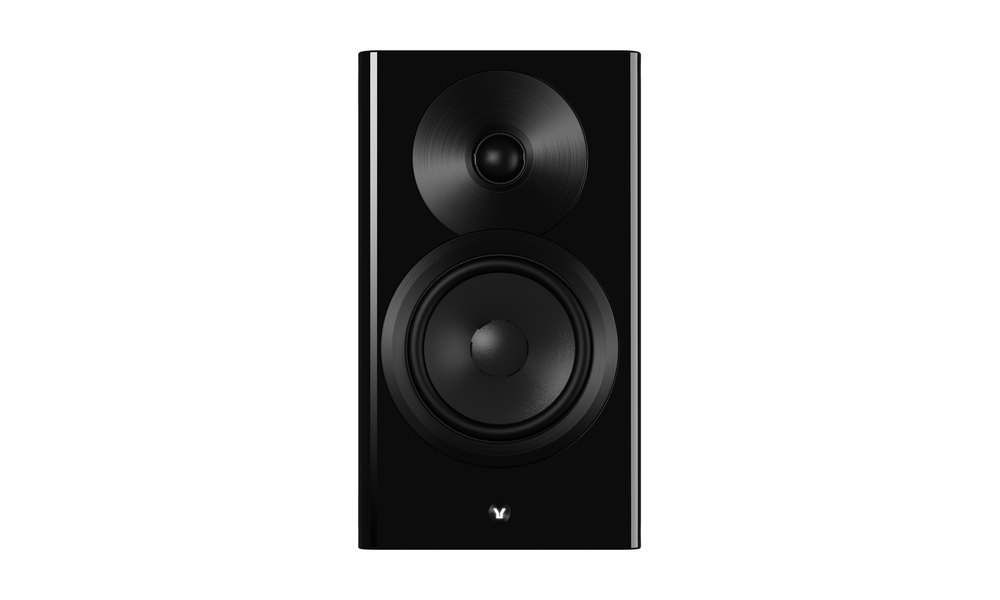
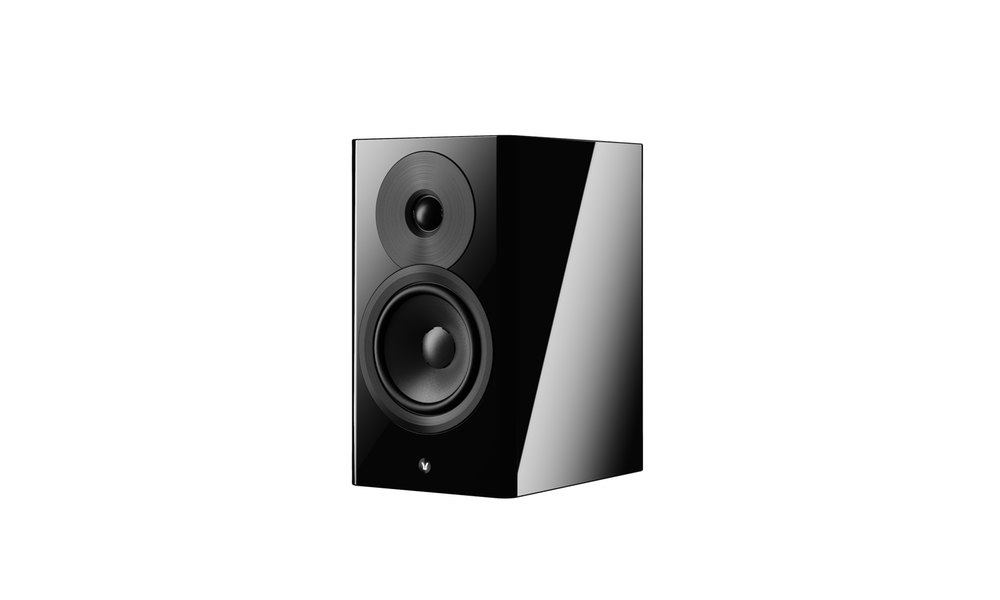
The Dynaudio Focus 10 is the smallest model of the active Focus series: a sealed two-way monitor with a 28 mm Cerotar soft dome and a 14 cm mid/bass driver of polypropylene with an MSP additive, crossed over at 2,200 Hz. Each chassis has its own Pascal Class D amplifier (280 W Woofer, 110 W Tweeter). Streamed via WLAN or Ethernet with the usual services, the speakers connect via WiSA (24/96) or Cable (24/192). Two RCA analog inputs, Toslink and coaxial digital and a subwoofer output complement the system; Dirac Live can optionally be used for room correction. Stereophile (02/2023) calls the Focus 10 one of the most musically satisfying one-stop solutions the reviewer has heard, with precise imaging and natural midrange — within the limits of image size and bass set of a small speaker. Dynaudio lists approximately 5,000 € per pair (as of Oct. 2026, without guarantee).
Assumptions
- Price per pair or set according to manufacturer or trade, Stand Oct. 2026, no guarantee
- Vinyl via an external phono stage at an analogue input (the Focus 10 has no phono input)
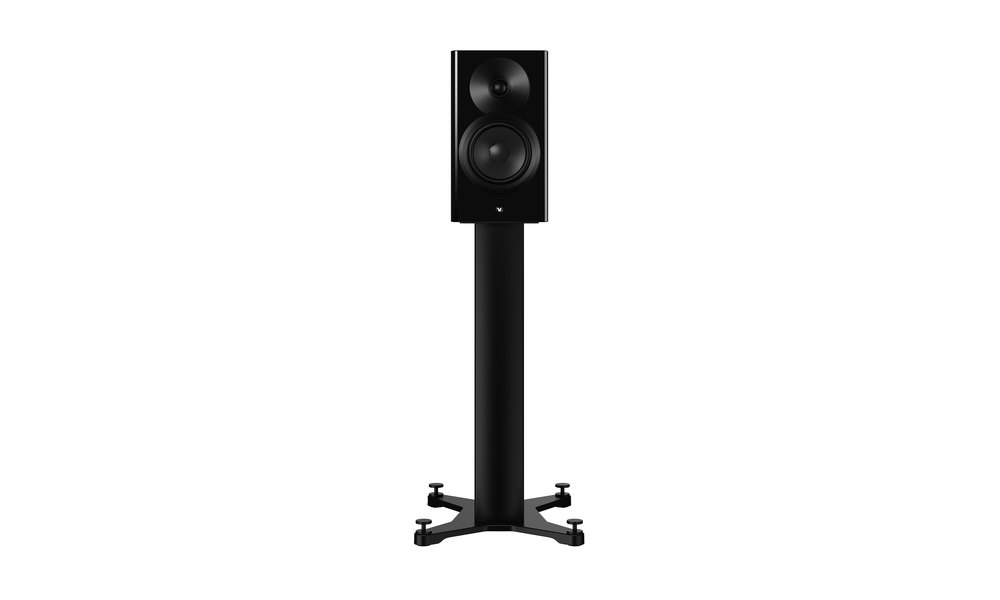
- Placement on stands or free with some distance to the rear wall
- No in-house measurements or listening tests
Specifications (manufacturer)
| Type | Active 2-way bookshelf speaker · closed-back · DSP crossover |
|---|---|
| Chassis | 28 mm Cerotar soft dome with Hexis · 14 cm MSP mid/bass driver |
| Crossover frequency | 2,200 Hz |
| Amplifier | Pascal Class D: 280 W (woofer) + 110 W (tweeter) per box |
| Frequency response | 43 Hz – 22 kHz (±3 dB, manufacturer) |
| Inputs | 2 × RCA analog · Toslink · coaxial · Wi-Fi/Ethernet streaming · Bluetooth 4.2 |
| Outputs | Subwoofer (RCA) · trigger |
| Phono | No phono input — external phono stage at RCA |
| Loudspeaker connection | WiSA wireless (24/96) or cable (24/192) |
| Dimensions / weight | 180 × 315 × 261 mm (W × H × D) · 7.5 kg per speaker |
| Price guide | approx. 5,000 €/pair (Dynaudio) · US 5,500 $ · as of Oct. 2026 · without guarantee |
Manufacturer specifications (Dynaudio)
| Type | Active streaming bookshelf speaker |
|---|---|
| Amplifier power | per speaker: woofer 280 W · tweeter 110 W · load impedance not specified by manufacturer (built-in amplifier) |
| Drivers | tweeter 28 mm Cerotar soft dome with Hexis · mid/woofer 14 cm MSP |
| Frequency response | 43 Hz–22 kHz (±3 dB, 85 dB) · dynamic 22 Hz–36 kHz (−6 dB) |
| Weight | 7.5 kg |
| Power consumption | max 280 W · standby max 2 W |
Source: Dynaudio – official specifications · As of 16 October 2026 · subject to change by the manufacturer
Rating criteria in detail
The four criteria feed into the Vinyl BotPro Index with weights of 25/20/25/30. The index is scaled across all tiers (see Methodology); that is why we do not show individual sub-scores.
Strengths
- One of the most musical complete solutions
- Own Pascal power amplifier for each chassis
- Two analog inputs plus streaming and sub-output
- Optional room correction with Dirac Live
Weaknesses
- Small image size and limited bass volume according to Stereophile
- Best below about 85 dB of listening level
- No phono input
- High price for a compact system
Comparison models
| Nubert nuZeo 4 | Index 77, Rank 2 — Shelf · 2-way · Bass-reflex · approx. € 2,800 (pair) |
|---|---|
| Buchardt A500 | Index 73, Rank 4 — Shelf · 2.5-way · closed-back · approx. € 3,500 (pair) |
| KEF LS50 Wireless II | Index 83, Rank 1, value for money champion — shelf · Uni-Q coaxial · streaming · approx. €2,499 |
| DALI Rubicon 2 C | Index 71, Rank 5 — Bookshelf · 2-way · wireless active · approx. €4,400 |
System matching
Works well with
- Small to medium rooms and close listening distance
- Listeners with high-quality external phono stage
- Classical, Jazz and Acoustic Music
Less suited
- Large rooms and rock at high levels
- Who expects very large-format imaging
- Turntable without additional phono stage
Specs & Features
The cabinet, drivers, amplifiers, connections and manufacturer data are now collected, with sources, in the analysis below.
Research Consensus
We evaluate Jason Victor Serinus's review (Stereophile, 02/2023), John Atkinson's measurements and his Dirac Live follow-up (10/2023) separately below.
For whom / Matching
Amplifier & Phono stage
There's no need for an amplifier. The Phono stage comes to one of the two RCA inputs; the second remains free for CD player or tape deck. Candidates: Top list Phono preamps.
Turntable & phono
Decks of the Expert Level match the Focus 10 resolution. A subsonic filter in the phono stage can keep low-frequency rumble away from the woofer; according to the manufacturer, the Focus 10's sliding high-pass filter is designed to protect it at high volume.
Room & placement
Small to medium rooms, stand placement, rather close listening distance. Dirac Live helps with pronounced room modes.
Budget & upgrade
With around 5,000 € per pair expensive for a compact system, but sound champion of the expert stage. More level and bass extension offers the Dynaudio Focus 30; cheaper with similar functionality is the KEF LS50 Wireless II.
Analysis: the Dynaudio Focus 10 in depth
What this is: an AI analysis, not a listening test
This page summarises what can be documented about the Dynaudio Focus 10 from manufacturer data and international reviews. Vinyl BotPro has neither listened to nor measured the speakers. Where we describe sound, we paraphrase the named authors as they phrased it under their own conditions, each with a date. Measured values come from Stereophile's measurements, not from measurements of our own. Our own assessments are marked as such. This section changes nothing about the rating, rank or index.
To keep models apart: the Focus 10 is the smallest model in the active Focus series, which also includes two floorstanders, the Focus 30 and Focus 50 [2]. It should not be confused with the older active predecessor, the Focus 200 XD, which Stereophile explicitly describes as a completely different speaker [2]. The series was unveiled at High End Munich 2022; the review appeared in February 2023 [2].
The concept: a complete music system
Dynaudio describes the Focus 10 as a complete wireless sound system: two compact active speakers with built-in streaming, DSP and amplifiers [1]. Streaming covers Spotify Connect, Tidal Connect, AirPlay 2, Chromecast, Roon, UPnP, QPlay and Bluetooth 4.2; the Primary speaker joins the network via wi-fi or Ethernet [1]. According to Stereophile, in the simplest case all you need is two wall outlets and a wireless network [2].
One speaker is the "Primary", the other the "Client" [1][4]. They are linked either wirelessly via WiSA at up to 24-bit/96 kHz or by cable (RCA digital) at up to 24-bit/192 kHz [1]. According to Stereophile, Dynaudio uses WiSA because it operates outside the normal wi-fi band, is more robust and has a latency of only about 1 ms [2]. According to the manufacturer, a WiSA-compatible TV or USB dongle can also connect wirelessly [1].
Cabinet, drivers and amplifiers
- Cabinet: sealed, not bass reflex [1]. Stereophile describes how DSP and amplifier power extend the bass and control cone excursion [2].
- Tweeter: 28 mm Cerotar soft dome with "Hexis", an insert directly behind the dome [1]. According to Dynaudio chief engineer Stephen Entwistle, it controls the diaphragm's resonant behaviour and also protects it from being pushed in [2].
- Mid/bass driver: 14 cm [1]. The specification sheet calls it "MSP" [1], the description text "Esotec+" [1]. Entwistle told Stereophile that the cone is polypropylene with an MSP (magnesium silicate polymer) additive [2].
- Crossover: digital (DSP), crossover frequency 2,200 Hz [1].
- Amplifiers: a dedicated Pascal class-D module per driver, 280 W for the woofer and 110 W for the tweeter, per speaker [1][2]. According to Stereophile, Pascal had originally included a compressor to prevent overload in PA systems, which the engineers bypassed for Dynaudio [3].
Stereophile describes the signal processing like this: with a cable link, everything is sample-rate converted once to 24/192; with WiSA, to 24/48 or 24/96 as the user chooses [2]. According to Stereophile, the converters are an ADAU1979 (A/D) and an ADAU1962A (D/A) from Analog Devices [2].
The sliding high-pass filter
The bass behaviour is a distinctive feature. Dynaudio describes a "sliding" high-pass filter that limits woofer excursion as the volume rises [1]. Entwistle explained to Stereophile that at low levels the Focus 10 reaches down to 20 Hz, while at high levels it behaves more like an ordinary bookshelf speaker [2]. Dynaudio itself listens at 3 m and an average of 80 dB [2].
John Atkinson measured this [5]:
- At a low level, full output down to about 30 Hz.
- At around 90 dB (C-weighted, 1 m), full output only down to about 60 Hz.
- At 72 dB, the DSP equalises and extends the bass, with a steep fourth-order (24 dB per octave) rolloff below.
According to the sources, in practice this means: in small rooms with a short listening distance, the Focus 10 delivers far more bass than its size suggests; in large rooms at high levels, it does not [2][6].
Features and operation
On the Primary speaker [1][4]:
- 2 × RCA analogue
- 1 × Toslink, 1 × RCA digital
- Subwoofer output (RCA) and 12 V trigger
- Wi-fi, Ethernet, Bluetooth 4.2
There is no phono input [1], so a turntable needs an external phono stage connected to an analogue input. Via the analogue input, Stereophile measured an input impedance of 8 kohms [5]; the coaxial input accepted up to 192 kHz, the optical input up to 96 kHz [5].
- Three DSP positions in the app: near a wall, in a corner, in free space.
- Optional Dirac Live room correction.
- Magnetic "Smart Grille": the speaker senses the grille and adjusts its EQ.
- Remote control; firmware updates over the network.
At Stereophile, the "Wall" and "Corner" settings in the app made a noticeable difference: the bass became tighter [3].
Specifications according to the manufacturer
In November 2026 Dynaudio lists [1]:
- Sealed 2-way system, DSP crossover at 2,200 Hz
- 280 W (woofer) and 110 W (tweeter) per speaker
- Frequency response 43 Hz to 22 kHz (±3 dB at 85 dB), dynamic 22 Hz to 36 kHz (−6 dB)
- Dimensions 180 × 315 × 261 mm (W × H × D), 276 mm deep with grille
- Weight 7.5 kg
- Maximum power consumption 280 W, standby maximum 2 W
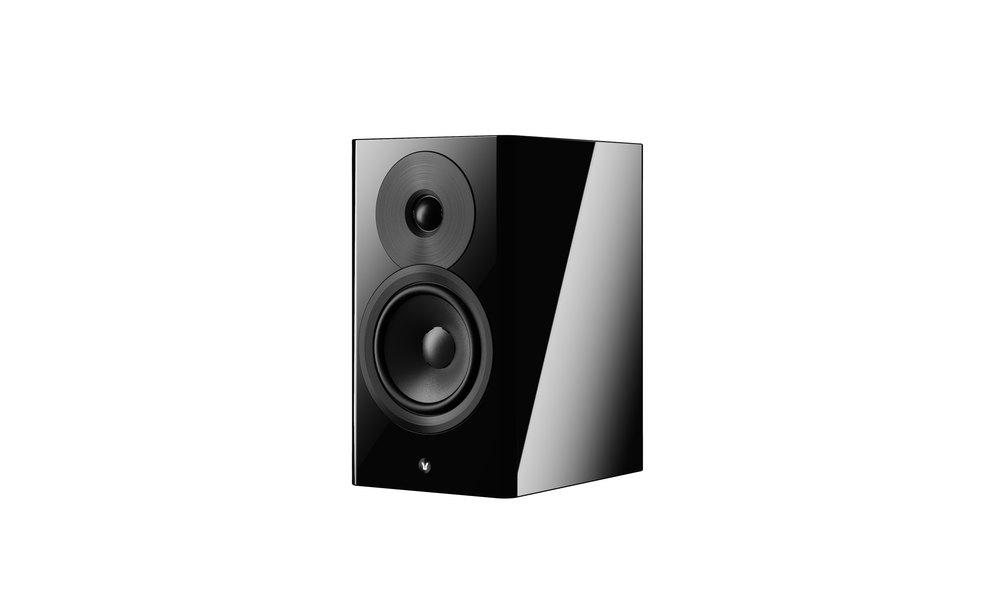
- Finishes Black High Gloss, White High Gloss, Blonde Wood, Walnut Wood
Stereophile's specifications give 0.5 W standby instead of 2 W [4]. The sources do not explain the difference; we give both figures. Stereophile also lists a warranty of 5 years on the electronics and 8 years on the speakers (with registration), in the US [4].
Stereophile: Jason Victor Serinus's review (February 2023)
Jason Victor Serinus reviewed the Focus 10 for Stereophile; the article was published on 3 February 2023, when the US price was $5,500 per pair [2][4]. He listened in his living room, mostly via Roon and Tidal Connect, and compared wired with wireless operation [3].
His key observations [3]:
- The sound was natural, balanced from top to bottom and invitingly warm, without the dryness of early class-D amplification.
- With a cable between the speakers, the music had more substance and the soundstage more depth than via WiSA. Fully wireless, transparency decreased somewhat.
- Via WiSA, 24/48 sounded more spacious than 24/96 on one recording; on other music, 24/96 delivered more colour.
- Even with a large orchestra, the soundstage stayed coherent and uncongested, but the image was small.
- Reverberation decayed naturally, without the truncation often heard with class D.
His conclusion: one of the most musically satisfying one-stop solutions he had heard, within its limitations of image size and bass quantity. Anyone who wants to play loud or has a larger room would probably be better served by the Focus 30 or 50. Stereophile explicitly recommends the Focus 10 ("Highly recommended") [3].
Stereophile: John Atkinson's measurements
John Atkinson measured different samples that Dynaudio had shipped directly [5]. The key findings:
- Frequency response: even overall on the tweeter axis, with a slight excess between 1 and 1.6 kHz and a slight dip between 5 and 7 kHz [5].
- Tone controls: "Bright" and "Dark" tilt the response by about ±1 dB at 200 Hz and 20 kHz [5].
- Dispersion: even horizontally; vertically, a suckout at 2.9 kHz, 10° above and below the axis [5].
- Level: with 200 mV input and the volume at maximum, Stereophile measured 87.5 dB (B-weighted) at 1 m [5].
- Cabinet: a resonance at 676 Hz on all surfaces, which Atkinson considers unlikely to be very audible given its high Q and frequency [5].
- Latency: 11.7 ms compared with a passive speaker, due to A/D and D/A conversion and the digital crossover [5].
Atkinson's verdict: the measurements indicate a "well-sorted design" [5].
Stereophile: follow-up with Dirac Live (2023)
In a follow-up, Atkinson investigated the built-in Dirac Live room correction [6]. It appeared in Stereophile Vol. 46 No. 11 and online on 30 October 2023 [6]. His findings:
- Without Dirac, he found the highs a little hot; with "Dark" the balance was right [6].
- The first Dirac filter boosted 60 to 200 Hz by up to 5 dB too much. The cause: he had measured too loud, so the high-pass filter was already reducing the bass. The Dirac measurement should therefore be made at the intended listening level [6].
- With a new filter, the in-room response between 300 Hz and 3.7 kHz was within ±0.7 dB [6].
- Too much correction restricted soundstage depth and hall ambience [6].
- Dirac adds about 61.5 ms of latency, which matters for film soundtracks [6].
His conclusion: even without Dirac, the Focus 10 offers easy setup, precise imaging, a natural midrange and surprising bass extension for its size, as long as the level stays below about 85 dB. For relatively small rooms it is a great complete music system; Dirac takes its sound quality to another level [6].
For vinyl: what the sources support
None of the sources describes the Focus 10 with a turntable. Only the technology is documented: there are two analogue RCA inputs but no phono input [1]. In our assessment this means:
- An external phono stage is a must.
- The analogue signal is digitised, because the entire crossover and signal processing is digital [2][5]. For listeners who want a purely analogue path, that rules it out; for most others it does not.
- The second analogue input remains free for another source [1].
Streaming in practice, according to Stereophile
- Tidal Connect: Entwistle prefers it because the speaker pulls the music directly from the Tidal server instead of routing it through the smartphone, so the phone's audio settings do not interfere [3].
- Roon: Stereophile held the review until Dynaudio received Roon Ready certification, then used a Roon server [3].
- Source comparison: to Serinus, WAV files from a USB stick on the server sounded a little more direct and colourful than FLAC streamed wirelessly from Qobuz; musically he found both very satisfying [3].
- Upsampling: between a 24/192 stream and a 16/44.1 stream that the wired speakers upsampled to 24/192 themselves, he heard hardly any difference. He finds the internal upsampling very convincing [3].
- Grille: the speaker sensed when the grille was removed; without it, the sound seemed a little more direct to Serinus, but the difference was not dramatic [3]. With the grille on, Atkinson measured a slightly deeper mid-treble dip and slightly more level in the top octave [5].
Our assessment: Stereophile describes the differences between connection types as audible but small. According to this source, anyone who wants the best possible playback should link the speakers by cable [3].
Where the sources agree
- Sound: natural, balanced, precise imaging [3][6].
- Limits: a small soundstage and limited bass quantity at high levels and in large rooms [3][5][6].
- Operation: easy setup via the app [5][6].
- Room adaptation: the position setting in the app and Dirac Live improve the bass; Dirac needs care [3][6].
Who the Focus 10 suits
Based on the sources evaluated, the Focus 10 suits
- listeners in small to medium rooms with a short listening distance [2][6];
- listeners who want a complete streaming system without separate components [1][3];
- vinyl listeners with an external phono stage [1].
According to the sources it is less suited to high levels and large rooms [3][6] and to listeners who expect a very large image [3].
Prices and dates
The US price of $5,500 dates from February 2023 [2][4]. The euro price in the tables on this page remains unchanged and is dated separately.
Open points and limits of this analysis
- Mid/bass driver name: "MSP" (spec sheet) and "Esotec+" (description, Stereophile) [1][4]; according to Entwistle the cone is polypropylene with an MSP additive [2].
- Standby consumption: 2 W (Dynaudio) versus 0.5 W (Stereophile) [1][4].
- Samples: different samples were auditioned and measured [4][5].
- Firmware: the reviews refer to 2023 firmware [5][6]; later changes have not been evaluated.
- A detailed human fact-check of this analysis is still pending.
Sources for this analysis
- Dynaudio – Focus 10 (Herstellerseite, Spezifikationen). https://dynaudio.com/home-audio/focus/focus-10
- Stereophile – Jason Victor Serinus, Dynaudio Focus 10 active loudspeaker (03.02.2023), Seite 1. https://www.stereophile.com/content/dynaudio-focus-10-active-loudspeaker
- Stereophile – Dynaudio Focus 10, Seite 2 (Hörteil und Fazit). https://www.stereophile.com/content/dynaudio-focus-10-active-loudspeaker-page-2
- Stereophile – Dynaudio Focus 10, Specifications. https://www.stereophile.com/content/dynaudio-focus-10-active-loudspeaker-specifications
- Stereophile – John Atkinson, Dynaudio Focus 10, Measurements. https://www.stereophile.com/content/dynaudio-focus-10-active-loudspeaker-measurements
- Stereophile – John Atkinson, Dynaudio Focus 10, Tests with Dirac Live (Vol. 46 No. 11, online 30.10.2023). https://www.stereophile.com/content/dynaudio-focus-10-active-loudspeaker-tests-dirac-live
Created by AI (Vinyl BotPro) from the sources listed; no listening tests or measurements of our own. Detailed human fact-check pending.
What makes this AI analysis special
This section is an AI summary from Manufacturer data and reports from international specialist media. Vinyl BotPro had no physical access, no measurement of our own chain and no listening test. The basis are the manufacturer specifications of Dynaudio and Stereophile's review with measurements and its Dirac Live follow-up. The expected performance is derived from construction, datasheet and the judgements of the Specialist press. Prices and availability change (as of Oct. 2026, no guarantee); please check technical values against the current data sheet.
Vinyl BotPro Score Logic
The Vinyl BotPro Index runs from 0–100 across all tiers and weights build/technology, features, expected performance and value for money at 25/20/25/30. Expert typically sits at ~70–84. Dynaudio Focus 10 receives 75 (Rank 3 Expert). Highest expected performance of the expert level according to Specialist press; the high price per pair presses the value for money share. In the stage, the model bears the title Sound Vinyl BotPro Champion. Rank is not Laboratory Evaluation — no Listening test. Details on weighting · Methodology.
Sources
- Dynaudio — Focus 10 (Manufacturer's website, technical data)
- Stereophile — Dynaudio Focus 10 active loudspeaker
- Stereophile — Dynaudio Focus 10: Tests with Dirac Live
Created by Vinyl BotPro (AI) · AI analysis · As of 08.10.2026 · Corrections: info@vinylcination.de · Prices without guarantee.
Read more: best active bookshelf speakers 2026 · What is hi-fi?