
Cartridge · AI analysis · Master, rank 13
Lyra Delos Review
AI analysis (research): MC cartridge by Jonathan Carr with New Angle geometry and asymmetrical damping; based on manufacturer data and the international specialist press.
Summary
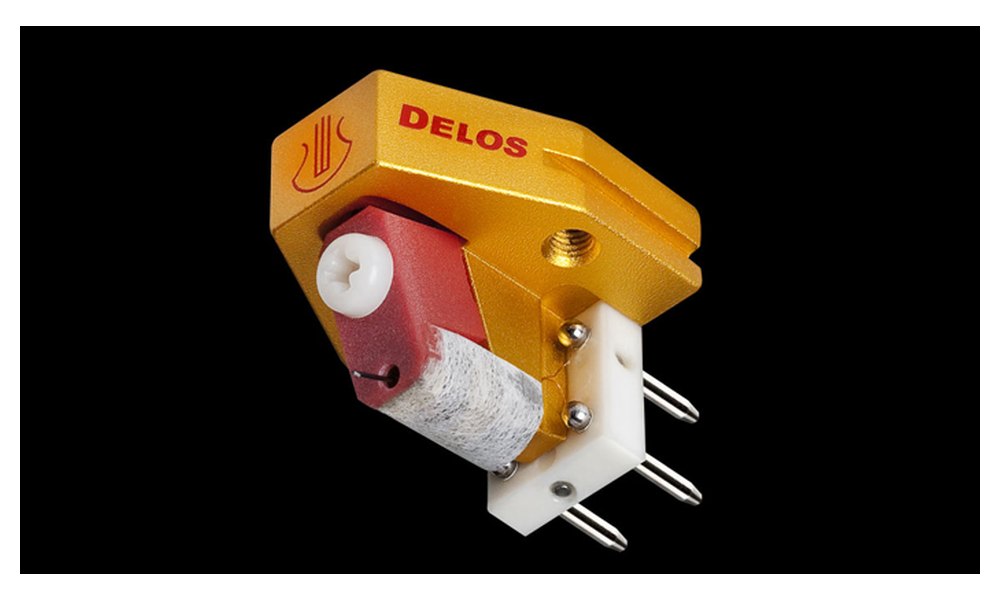
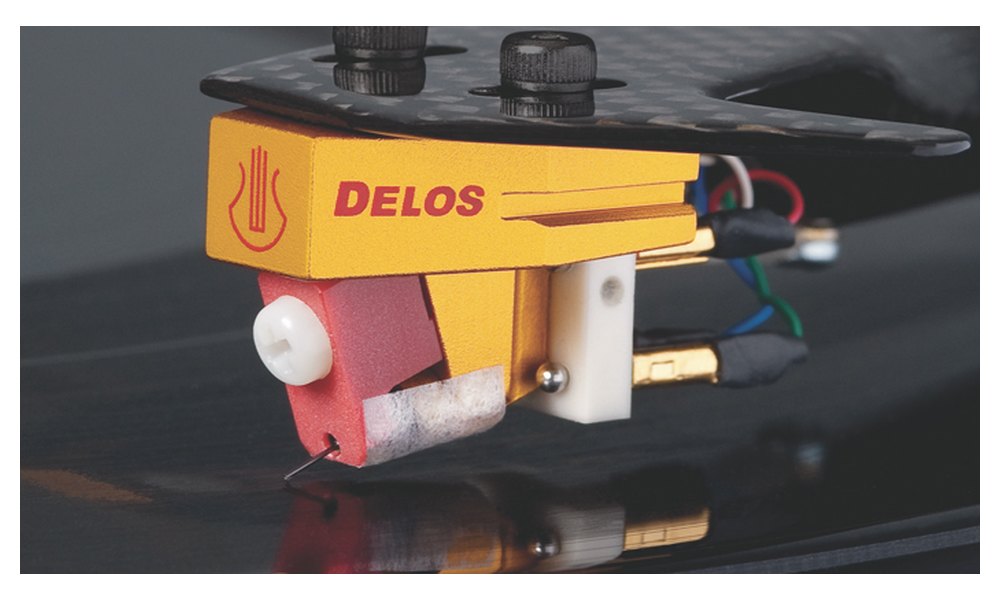
The Lyra Delos (approx. 1,700–1,790 €) is an MC cartridge with Lyra's New Angle design: only under tracking force are magnet, coils and core precisely aligned. Add to that a nude Namiki Microridge diamond on solid boron and an aluminium body. Lyra quotes 0.6 mV output and a weight of 7.3 g.
Specs (public / manufacturer)
| Type / Stylus | low-output MC · nude Namiki Microridge (2.5 × 75 µm) · solid boron cantilever |
|---|---|
| Output / Impedance | 0.6 mV (5 cm/s) · coil 6.3 Ω, 9.5 µH · 6N copper |
| Frequency range / channel separation | 10 Hz–50 kHz · over 30 dB (1 kHz) |
| Compliance | approx. 12 × 10⁻⁶ cm/dyn (100 Hz, manufacturer figure “approx.”) · medium compliance |
| Tracking force | 1.65–1.75 g · recommended 1.72 g |
| Load | 97.6–806 Ω direct · step-up transformer for 5–10 Ω |
| Body / weight | aluminium, non-parallel shape · 7.3 g |
| Price guide | approx. €1,700–1,790 · Sept 2026 |
Manufacturer specifications (Lyra)
| Type / Stylus | low-output MC · nude Namiki Microridge (2.5 × 75 µm) · solid boron cantilever |
|---|---|
| Output / Impedance | 0.6 mV (5 cm/s) · coil 6.3 Ω, 9.5 µH · 6N copper |
| Frequency range / channel separation | 10 Hz–50 kHz · over 30 dB (1 kHz) |
| Compliance | approx. 12 × 10⁻⁶ cm/dyn (100 Hz, manufacturer figure “approx.”) · medium compliance |
| Tracking force | 1.65–1.75 g · recommended 1.72 g |
| Load | 97.6–806 Ω direct · step-up transformer for 5–10 Ω |
| Body / weight | aluminium, non-parallel shape · 7.3 g |
Source: Lyra – official specifications · As of 16 October 2026 · subject to change by the manufacturer
Matching tips
- Good fit: MC phono stages with adjustable load
- Good fit: Step-up transformers for 5–10 Ω
- Good fit: Medium-mass, finely adjustable tonearms
- Less suited: MM-only phono stages
- Less suited: Anyone looking for a warm, romantic sound
Lyra Delos compared
The table shows the Delos next to the Master cartridges in this list with the closest Vinyl BotPro Index. The basis is manufacturer data and international reviews from the trade press.
| Model | Price range | Index |
|---|---|---|
| Hana Umami Blue | approx. €2,400–2,500 | 88 |
| Ortofon Cadenza Bronze | approx. €2,300–2,499 | 87 |
| Lyra Delos | approx. €1,700–1,790 | 86 |
| Ortofon Cadenza Red | approx. €1,236–1,499 | 85 |
| Audio-Technica AT-ART9XI | approx. €1,399–1,549 | 85 |
Technology in detail
In conventional MC cartridges, magnet, coils and core are only precisely aligned without tracking force; during playback the angle shifts. Lyra solves this in the Delos with a shallower body angle and asymmetrical dampers: only under tracking force does everything align precisely. This is meant to improve resolution, tracking and dynamics.
The nude Namiki Microridge diamond (2.5 × 75 µm) is mounted directly on a solid boron cantilever. The 6N copper coils sit on a square permalloy former. The aluminium body is machined from solid and has no parallel surfaces, to reduce resonances.
Lyra quotes 0.6 mV output, 6.3 Ω coil impedance and 10 Hz to 50 kHz. 1.72 g tracking force and 97.6 to 806 Ω load at the MC input are recommended. With a weight of 7.3 g and medium compliance, the Delos suits medium to medium-high mass tonearms.
Setup & pairing: Lyra Delos
phono stage
According to Lyra, the Delos delivers 0.6 mV. It needs an MC phono stage with enough gain; Lyra recommends 97.6 to 806 Ω loading or a step-up transformer for 5 to 10 Ω. Pure MM inputs are not enough. Suitable stages are listed in the best phono preamps.
Tonearm
With 7.3 g weight and medium compliance (approx. 12 × 10⁻⁶ cm/dyn), the Delos suits medium to slightly heavier tonearms with fine adjustment. You can check the match with the compatibility check.
Alignment
Lyra recommends 1.72 g tracking force. Because of the New Angle design, magnet and coils only line up correctly at exactly this force, so a precise stylus gauge is worth it.
What the specialist press says
One review calls the Delos technically brilliant and musical: very neutral, fast, detailed and dynamic, with abilities above its price class.
Another review praises the exquisite transparency and well-formed dimensionality and found the Delos an exciting cartridge with many phono stages.
Who is it for?
For vinyl listeners with a good MC phono stage looking for a fast, neutral and highly resolving cartridge.
What makes this AI analysis special
This AI analysis combines Lyra's technical data with international reviews. All measurements are manufacturer specifications. As of October 2026.
Frequently asked questions about the Lyra Delos
Which phono stage does the Lyra Delos need?
An MC phono stage with enough gain for 0.6 mV. Lyra recommends 97.6 to 806 Ω loading or a step-up transformer for 5 to 10 Ω.
What tracking force does the Delos need?
Lyra specifies 1.65 to 1.75 g, with 1.72 g recommended.
Which tonearm suits the Lyra Delos?
With 7.3 g weight and medium compliance (approx. 12 × 10⁻⁶ cm/dyn), it suits medium to slightly heavier tonearms.
What does the trade press say about the Lyra Delos?
A second review calls it technically brilliant, neutral, fast and dynamic. A further review praises its fine transparency and three-dimensional imaging.
How much does the Lyra Delos cost?
Around €1,700 to €1,790 (as of Sept. 2026, without guarantee).
How the score comes about
The index reflects the New Angle design, the Microridge diamond on solid boron and the very positive reviews in international magazines. The Vinyl BotPro Index on this page remains 86 (Master, rank 13) — guidance from manufacturer data and the specialist press, no in-house listening session. The four criteria engineering/build, features, expected performance and value for money are weighted 25/20/25/30 and scaled across all tiers. Methodology
Vinyl BotPro Index: 86 (Master 85–97) · Label: AI research · Sept 2026
Manufacturer and concept
Lyra is a Japanese cartridge maker that builds moving-coil designs only. The designs go back to Jonathan Carr, and production is by hand in small numbers. In the range, the Delos sits between the entry models and the more expensive Kleos and Etna. It brings the core idea of the bigger models – the New Angle geometry – to a price that is still comparatively accessible for a hand-built MC cartridge.
The concept addresses a question most cartridges leave open: what happens to the geometry once the stylus sits in the groove? Tracking force pushes the cantilever up into the body, the damper gives way, and the coils no longer sit at right angles to the magnetic field. Lyra designs the Delos so that this shift is accounted for from the start.
Technology explained
New Angle geometry and asymmetric damping
In the Delos the generator is deliberately pre-angled at rest. Only when the recommended tracking force of 1.72 g is applied do the coils and the magnetic field line up exactly as intended. Lyra adds asymmetric damping: the dampers in front of and behind the pivot are designed differently, so the cantilever does not drift sideways under load. In practice this means tracking force is not a rough guide on the Delos but part of the design. Staying well below or above it gives away the advantage.
Stylus and cantilever
The nude Namiki Microridge diamond has a 2.5 × 75 µm profile according to Lyra. Line-contact profiles touch the groove wall over a longer contact line than an elliptical stylus. That helps with fine treble detail and with the inner grooves near the end of a side, where wavelengths are especially short. The solid boron cantilever is stiff and light, so the stylus movement reaches the generator with as little alteration as possible.
Generator and body
The coils are wound from 6N copper on a square Permalloy core. With 6.3 Ω coil impedance and 0.6 mV output, the Delos is a classic low-output MC. The aluminium body is machined from solid and avoids parallel surfaces so that no standing resonances build up inside. At 7.3 g the cartridge is of medium weight. Lyra states a compliance of about 12 × 10⁻⁶ cm/dyn; together with the weight, this puts the resonance frequency in medium-mass tonearms in the favourable range of roughly 8 to 12 Hz.
Sound according to international reviews
Two detailed reviews from major English-language magazines are available. One review describes the Delos as technically brilliant and musical at the same time: very neutral, fast, detailed and dynamic, with abilities above its price class. One review highlights its fine transparency and three-dimensional spaciousness and describes the Delos as thrilling across several phono stages.
Both reviews paint a similar picture: the Delos is not a warm-sounding cartridge but a fast, open type. In practice, the rest of the system should not be tuned towards hardness or glare. We do not run our own listening tests; this assessment is based on these sources and the manufacturer data.
Features and practice
The Delos needs a tonearm in which tracking force, overhang, azimuth and ideally arm height (VTA) can be finely adjusted. The recommended 1.72 g should be checked with a digital stylus gauge; the scale on the counterweight is not precise enough. For the phono stage, Lyra gives a load range of 97.6 to 806 Ω. In practice it pays to start at around 100 to 200 Ω and compare calmly. Anyone using a step-up transformer should choose one designed for 5 to 10 Ω source impedance.
For gain, 0.6 mV calls for an MC stage with around 60 dB or more, so that no hiss is audible at normal volume. Suitable models are listed in our best phono preamps, for example the Musical Fidelity MX-VYNL with switchable MC impedance.
Who it suits
The Delos suits vinyl listeners who already own a good turntable with an adjustable tonearm and want to take the step to a high-resolution MC cartridge. It rewards careful set-up and a low-noise MC phono stage. It is less suitable for turntables with a fixed cartridge, for MM-only phono inputs and for listeners looking for a soft, easy-going sound.
Comparison with alternatives
- Ortofon Cadenza Red: a little cheaper, also MC, with higher output and therefore less demanding on the phono stage.
- Audio-Technica AT-ART9XI: similar price range, line-contact stylus, also low output; an alternative for listeners who want a different voicing.
- Ortofon Cadenza Black: the next step up, with a higher index and a clearly higher price.
- Hana Umami Blue: more expensive, with a different emphasis on tonal colour.
All cartridges with index and price are listed in our best cartridges.
More questions about the Lyra Delos
How long does the Lyra Delos stylus last?
Lyra gives no fixed number of hours. Line-contact profiles are generally considered long-lasting, provided stylus and records are kept clean. On an MC cartridge the stylus cannot be replaced by the owner; Lyra offers an exchange through its dealers.
Do I need a step-up transformer for the Delos?
Not necessarily. An MC phono stage with enough gain is sufficient. A transformer is an alternative if the existing phono stage only handles MM.
Verdict
The Lyra Delos brings the New Angle technology of the larger Lyra models to a lower price class. Manufacturer data and the international press describe a fast, neutral and highly resolving MC cartridge that requires precise set-up and a good MC phono stage. In the Master level of our best list it ranks 11th with an index of 86 – a cartridge for listeners who put detail and pace above warmth and are prepared to take time over a really careful set-up.
Sources
Read more: best cartridges 2026 · Stylus shapes explained · What is hi-fi?