
Phono preamps · AI analysis · Master, place 11
MoFi UltraPhono Pro Review
AI analysis (research): MoFi's new MM/MC phono stage with the core circuit of the flagship MasterPhono – discrete J-FET/MOSFET gain, passive RIAA without feedback, gain and loading on the front panel, XLR output – for an RRP of €3,249. Guidance from manufacturer data and international listening tests, no own listening test.
Summary
The MoFi UltraPhono Pro is the new mid-range phono stage from MoFi Electronics, the hardware arm of the US label Mobile Fidelity Sound Lab. It closes the large gap between the compact UltraPhono and the flagship MasterPhono and adopts its core circuit: discrete J-FET and MOSFET gain stages, a passive RIAA equalisation without feedback and a multi-stage regulated power supply. Gain (three settings) and loading (five values) are selected on the front panel, and output is via RCA and balanced XLR. MSRP 3,249 € (as at 23.10.2026, without guarantee). The international specialist press awards 89 % for sound quality and calls it the benchmark at this price. In the Master field, the UltraPhono Pro lands at rank 11 with Index 88 – directly behind the Parasound Halo JC 3+ and ahead of the Allnic H-5500.
Assumptions
- One turntable, one cartridge: the UltraPhono Pro has exactly one RCA input for MM and MC
- Assessment for common MM and MC cartridges that work with 100 Ω to 47 kΩ loading
- Listening findings from the published international specialist press, measurements from published lab tests
Technical data (public)
| Type | MM/MC phono stage (voltage input), all-discrete, J-FET/MOSFET |
|---|---|
| Equalisation | Passive RIAA without feedback · accuracy ±0.05 dB |
| Gain | RCA output 40 / 52 / 65 dB · XLR output 46 / 58 / 71 dB |
| Loading | 100 Ω · 300 Ω · 500 Ω · 1 kΩ · 47 kΩ |
| Connections | 1× RCA input · RCA and XLR output · separate ground posts (chassis/signal) |
| Functions | Mono · Subsonic filter · Mute · Dimmer |
| Frequency response / distortion | 10 Hz–50 kHz ±0.2 dB · THD 0.005 % (10 mV, 1 kHz, A-weighted) |
| Max. Output / output impedance | 10 V RMS (1 % THD) · XLR 230 Ω · RCA 115 Ω |
| Dimensions / weight | approx. 432 × 64 × 288 mm (17 × 2.5 × 11.35 in) · approx. 3.2 kg |
| Price guide | DE MSRP 3,249 € · £2,499 · $2,495 · As of 23.10.2026 · without guarantee |
Manufacturer specifications (MoFi Electronics)
| Type | MM/MC phono stage (voltage mode), all-discrete J-FET/MOSFET |
|---|---|
| Input | 1× RCA, single-ended |
| Outputs | RCA and XLR (balanced) |
| Gain, RCA output | 40 / 52 / 65 dB |
| Gain, balanced output | 46 / 58 / 71 dB |
| Loading | 100 Ω, 300 Ω, 500 Ω, 1 kΩ, 47 kΩ |
| RIAA accuracy | ±0.05 dB (passive, zero feedback) |
| Frequency response | 10 Hz–50 kHz ±0.20 dB |
| THD | 0.005% (10 mV, 1 kHz, 40/65 dB, A-weighted) · 0.010–0.013% (1 mV) |
| S/N ratio (A-weighted) | balanced 40 dB: 93 dB · balanced 65 dB: 85 dB · RCA 40 dB: 83 dB · RCA 65 dB: 75 dB |
| Max. output | 10 V RMS (1% THD) |
| Output impedance | balanced 230 Ω · unbalanced 115 Ω |
| Functions | mono, subsonic filter, mute, dim |
| Dimensions | 17 × 2.5 × 11.35 in (approx. 432 × 64 × 288 mm) |
| Weight | 7 lbs (approx. 3.2 kg) |
Source: MoFi Electronics – official specifications · As of 23 October 2026 · subject to change by the manufacturer
Rating criteria in detail
The four criteria feed into the Vinyl BotPro Index with weights of 25/20/25/30. The index is scaled across all tiers (see Methodology); that is why we do not show individual sub-scores.
Strengths
- Core circuit of the flagship MasterPhono at roughly half the price
- In published lab measurements, very low distortion, a very accurate RIAA curve and around 25 dB of overload margin
- Gain and loading adjustable in seconds on the front panel, plus a balanced XLR output
- Subsonic filter and mono button that genuinely help in everyday use
Weaknesses
- Only one input: two turntables or tonearms need a second phono stage
- Five loading values and no capacitance selection – exotic cartridges with special requirements are harder to match
- No current (transimpedance) input as on the MasterPhono
Comparison models
| Parasound Halo JC 3+ | Also discrete and with balanced outputs, two inputs – rank 10, more expensive |
|---|---|
| Lehmann Audio Decade Jubilee | German alternative in a similar price range with extensive loading adjustment |
| Vertere PHONO-1 LX | Considerably cheaper, MM/MC with a balanced option – the entry into the Master field |
| Musical Fidelity Nu-Vista Vinyl S | Nuvistor circuit with four inputs – rank 7, almost twice the price |
System matching
Works well with
- Systems with a high-quality turntable and an MM or MC cartridge of conventional design
- Preamplifiers or integrated amplifiers with a balanced XLR input
- Compact ported speakers, where the subsonic filter tightens the bass
Less suited
- Several decks or tonearms on one stage
- Low-output MCs that need a current input or very fine loading values
- Anyone expecting a remote control or level meters
Specs & Features
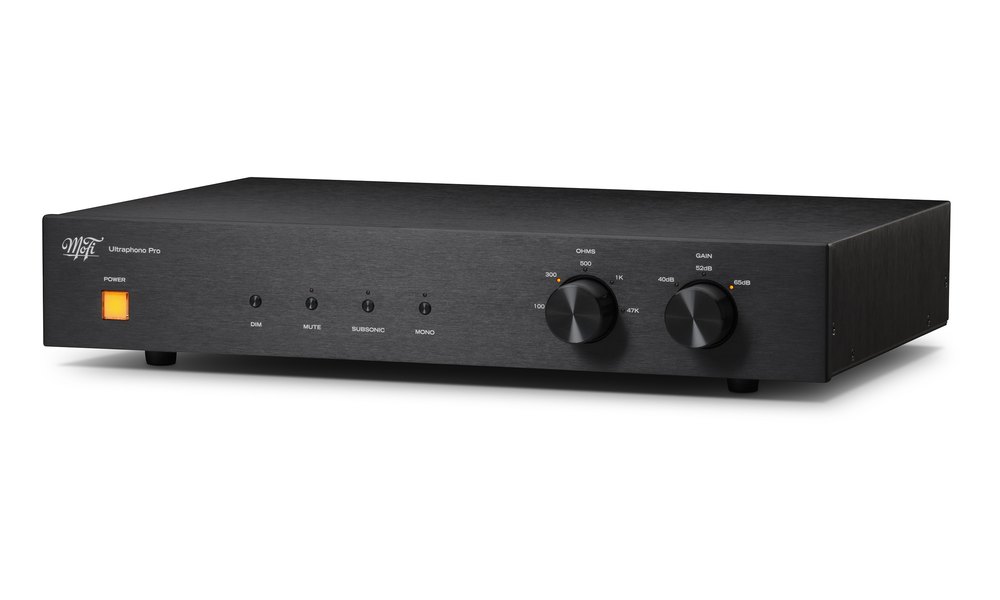
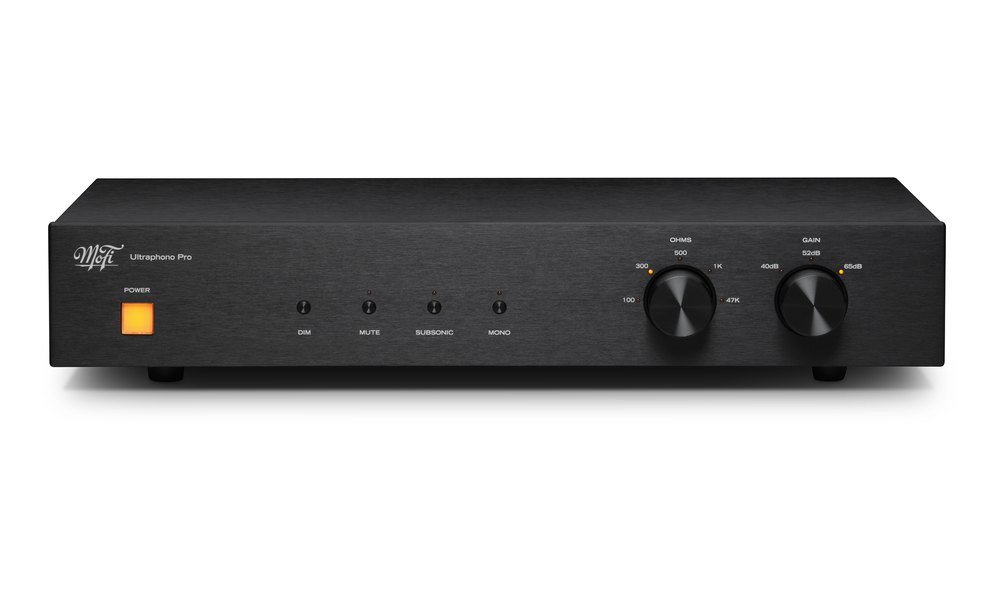
The UltraPhono Pro is a purely analogue unit in an enclosure the size of the MasterPhono, but without wooden cheeks and VU meters. MoFi developed it together with engineer Peter Madnick, who is also behind the MasterPhono. The gain stages are all-discrete with J-FETs and MOSFETs and DC-coupled, and a servo keeps the output free of DC. Equalisation is passive and without feedback, using film capacitors; according to the manufacturer it stays within ±0.05 dB of the RIAA curve.
On the front panel sit a selector for loading (100 Ω to 47 kΩ) and one for gain, plus buttons for dim, mute, subsonic filter and mono. The RCA output offers 40, 52 or 65 dB, the XLR output 6 dB more in each case. According to the manufacturer, the power supply uses seven regulation stages. Dimensions approx. 432 × 64 × 288 mm, weight approx. 3.2 kg. RRP €3,249 (as of 23.10.2026, no guarantee).
What international reviewers heard
Several international listening tests are available for the MoFi UltraPhono Pro. Here we summarise the overall picture in our own words; all sources are linked at the end of the page.
Sound character
- One review describes the UltraPhono Pro as a distinctly refined, sweet-sounding phono stage. The reviewer hears the same delicacy he values in the small UltraPhono, but with considerably more substance.
Tonal balance
- Another review highlights a very dark, quiet background against which tonal colours sound vivid and honest. According to the review, decays and ambient information remain finely traceable.
Dynamics, bass & staging
- On dense productions with deep bass and hard transients, the UltraPhono Pro kept textures, tempo and attacks cleanly apart. One international review praises precise leading edges and refined microdynamics.
Strengths
- One review names its closeness to the more expensive MasterPhono flagship as its greatest strength: the sonic gap is small, and the extra cost goes mainly into the power input, displays and additional settings. The verdict is 89 percent for sound quality.
Setup, room & partners
- In the review, two different MC cartridges worked ideally into 100 Ω at 65 dB, and two MM cartridges into 47 kΩ at 40 dB. With small ported speakers, the subsonic filter audibly tightened the bass without side effects.
Consensus & differences
- Both reviewers regard the UltraPhono Pro as a benchmark for its price. One review notes that very expensive top-tier stages offer even more resolution, while another review sees the limits mainly with exotic cartridges that need unusual loading.
Research Consensus
The sources are good for a phono stage presented in early 2026: a detailed manufacturer page with data sheet, a listening test with lab section from the specialist press, a detailed listening test from the specialist press, and the presentation and a show report on the pre-production model in the specialist press. Recurring patterns: the UltraPhono Pro sounds refined and calm, with a very dark background and precise transients, and comes very close to the pricier MasterPhono. The sources also agree that the limitations lie in the features, not in the sound. The verdict of international reviews is assessed in detail in the section What the international specialist press hears.
For whom / Matching
Cartridges
MM cartridges run into 47 kΩ at 40 dB, high-output MCs at 52 dB. For low-output MCs there are 65 dB at the RCA and 71 dB at the XLR output, and loading can be chosen between 100 Ω and 1 kΩ. A second review ran two different MCs without problems at 100 Ω with the highest gain.
Amplifier
An amplifier with a balanced input is ideal, because the XLR output delivers an extra 6 dB and a low-interference connection. A normal RCA line input works just as well.
Budget
At an RRP of €3,249 (as of 23.10.2026, without guarantee), the UltraPhono Pro sits roughly in the price range of the Lehmann Decade Jubilee and well below the MasterPhono. Anyone running just one turntable does not pay for unused inputs here.
Upgrade
Anyone coming from a compact phono stage such as the MoFi UltraPhono or an Expert stage such as the Pro-Ject Phono Box RS2 gets more calm, more overload margin and an XLR output.
What makes this AI analysis special
This section is an AI summary of published international listening reviews and the manufacturer data from MoFi. Vinyl BotPro puts the reviewers’ findings into context and links them with the data sheet and comparison models; VinylCination does not run its own listening tests or measurements; all sources are linked at the end of the page. Prices and availability change (as of Oct. 2026, no guarantee); please check technical values against the current data sheet.
Vinyl BotPro Score Logic
The Vinyl BotPro Index is cross-tier 0–100. Master typically sits at ~85–97. The UltraPhono Pro receives 88 (rank 11 Master): strong scores for technology/build thanks to the adopted MasterPhono circuit, a high performance expectation from two international listening tests and very good lab figures, plus good value for money. Points are deducted for features, because there is only one input and few loading values. The Parasound Halo JC 3+ (89) is just ahead; against the Allnic H-5500 with the same index, value for money decides in favour of the UltraPhono Pro according to the methodology. The champion seals remain unchanged: sound Luxman EQ-500, value for money Musical Fidelity M6x Vinyl. Weights: technology/build ~25 · features ~20 · performance (expected) ~25 · value for money ~30. Rank ≠ lab rating – no listening test. Details: Details on weighting · Methodology.
Created by Vinyl BotPro (AI) · AI analysis · As of 23.10.2026 · Corrections: info@vinylcination.de · Prices without guarantee.
Manufacturer and concept
MoFi stands for Mobile Fidelity Sound Lab, a US label that has been pressing audiophile reissues of records since the late 1970s. Under the name MoFi Electronics, the company has also been building its own hardware for several years: turntables, cartridges and phono stages. The idea behind it is simple. What the label's mastering engineers cut into the vinyl should come back out at home as completely as possible. The first phono stages, StudioPhono and UltraPhono, were small units the size of a paperback with an external power supply. The flagship MasterPhono followed as a large two-compartment unit with VU meters, a remote control and many adjustment options.
Between UltraPhono and MasterPhono there was a large price gap. That is exactly where the UltraPhono Pro comes in, which MoFi presented in January 2026. Despite the name, it is technically not a souped-up UltraPhono but a slimmed-down MasterPhono. It was again developed by Peter Madnick, who is responsible for electronics at MoFi. The goal: keep the flagship's core circuit and leave out everything that does not directly contribute to the sound. The result is a unit with one input, a few well-chosen settings and a price at roughly half that of the flagship.
Technology explained
Discrete gain with J-FETs and MOSFETs
A cartridge delivers only a few millivolts, a moving-coil cartridge often well under one millivolt. The phono stage has to amplify this tiny signal a hundred to a thousand times without adding noticeable noise. Many units use integrated operational amplifiers for this. The UltraPhono Pro, by contrast, is built entirely from discrete components: J-FETs at the input, because they work with very low noise, and MOSFETs in the output stage. The circuit is DC-coupled, so there are no coupling capacitors in the signal path. To keep DC off the output nonetheless, a servo removes it in the background. The input and output stages come straight from the MasterPhono.
Passive RIAA equalisation without feedback
Records are cut with reduced bass and boosted treble. The phono stage has to reverse this RIAA curve exactly. In the UltraPhono Pro this is done passively, with a network of resistors and capacitors between the gain stages, and without feedback. MoFi uses film capacitors with 1 percent and resistors with 0.1 percent tolerance. The manufacturer quotes an accuracy of ±0.05 dB, and in a published lab test the deviation between 20 Hz and 20 kHz was even within ±0.04 dB. That keeps the tonal balance of the record intact.
Power supply
With such small signals, the power supply has a say in the noise level. MoFi quotes seven stages of voltage regulation. One review describes a switch-mode supply whose interference fields are suppressed by several cascaded regulation stages. Unlike the MasterPhono, everything sits in a single enclosure instead of being split between two compartments for the supply and the signal path.
Sound according to international reviews
One review tested the UltraPhono Pro with a listening review and lab report and awards 89 percent for sound quality. The reviewer knows both the MasterPhono and the small UltraPhono from his own use. His impression: the Pro sounds refined and pleasant, but with more power and control than its little sibling, and comes astonishingly close to the flagship. On dense recordings with lots of bass and many effects, it kept everything in view. The conclusion is clear: at this price, he knows of no phono stage that sounds better.
A second review first ran the unit in a system of the same price class and then in a very expensive reference chain. There too, the UltraPhono Pro left a strong impression: a very quiet background, vivid and honest tonal colours, believable scale and refined microdynamics. Compared with phono stages beyond 30,000 dollars it lacks some ultimate resolution and transparency, but for value-conscious vinyl listeners it is the first choice. The published lab figures fit this picture: very low distortion, around 25 dB of overload margin at every gain setting and a signal-to-noise ratio that, even for MC, sits below the running noise of good turntables.
Features and everyday use
Operation is deliberately simple. On the left sits the orange illuminated power switch, in the middle four small buttons for dim, mute, subsonic filter and mono, and on the right the two rotary switches for loading and gain. One international review says it had the unit set up in ten minutes. The mono button is useful for mono records because it reduces noise and groove noise from vertical tracing. The subsonic filter attenuates frequencies below the audible range that arise from warped records or a tonearm resonance. With small ported speakers in particular, this can make the bass cleaner.
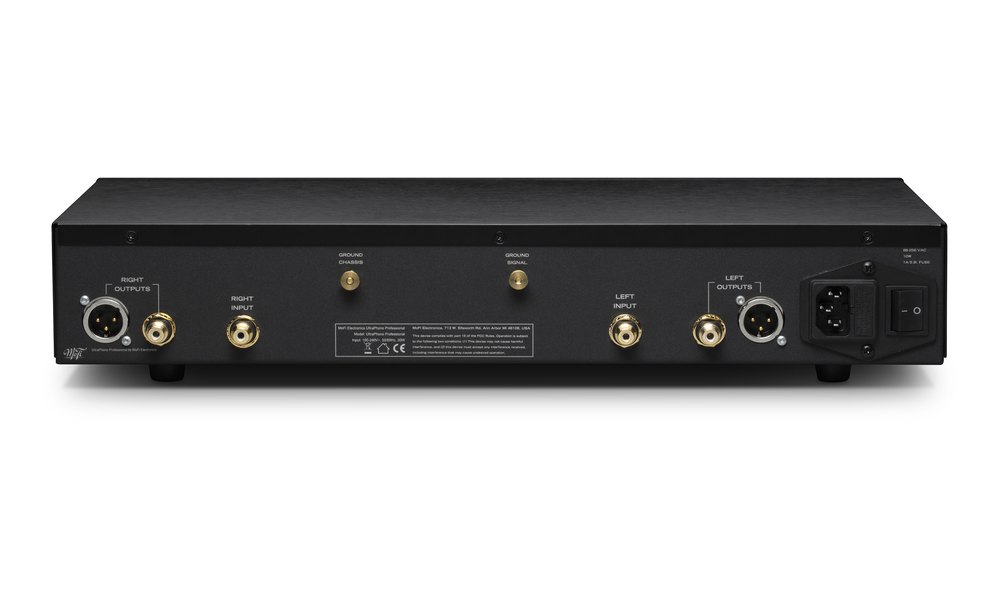
On the rear there is one RCA input, one RCA and one XLR output, and separate ground posts for chassis and signal. What is missing is a second input, a remote control, level meters and a current input for low-output MCs as offered by the MasterPhono. Capacitance for MM cartridges cannot be changed.
Who it suits
The UltraPhono Pro suits anyone who runs a good turntable with one cartridge and wants a phono stage that gets as much as possible out of the groove without detours. With three gain settings and five loading values it covers the vast majority of MM and MC cartridges. Anyone with an amplifier that has an XLR input benefits from the balanced output. It is less suited to collectors with two decks or a second arm and to owners of very quiet or unusual MC cartridges that need a current input or exotic loading values.
Comparison with alternatives
In the Master tier of our best-of list, the Parasound Halo JC 3+ is just ahead: also discrete, with two inputs, but more expensive. Closest in price is the Lehmann Audio Decade Jubilee from Cologne. The Vertere PHONO-1 LX is the cheaper entry into the Master field, while the Musical Fidelity Nu-Vista Vinyl S with nuvistor tubes and four inputs costs almost twice as much. Those who want to spend less will find the Pro-Ject Phono Box RS2 with very extensive loading options in the Expert tier.
More questions about the MoFi UltraPhono Pro
How does the UltraPhono Pro differ from the MasterPhono?
The core circuit with input and output stages and passive RIAA is very similar. The MasterPhono adds a current input, more gain and loading values, VU meters, a remote control and a two-compartment enclosure. The UltraPhono Pro costs about half as much.
Does it work with MM and MC?
Yes. MM is intended for 47 kΩ and 40 dB, MC cartridges for 52 or 65 dB and a load between 100 Ω and 1 kΩ. The XLR output adds 6 dB in each case.
Do I need the XLR output?
No, the RCA output is enough for any line-level input. With a balanced amplifier input, however, you get 6 dB more level and a connection that is less prone to interference.
How much does the UltraPhono Pro cost in Germany?
The RRP is €3,249 (as of 23 Oct 2026, without guarantee).
Conclusion
The MoFi UltraPhono Pro brings the MasterPhono's core circuit into a simpler enclosure with one input and a well-thought-out set of settings. Manufacturer data, lab measurements and two international listening reviews paint the picture of a very quiet, refined and dynamic phono stage that comes close to the flagship in sound. The limits lie in the features, not in the sound. In the Master tier of our best-of list it ranks 11th with Index 88.
Sources
- MoFi Electronics — UltraPhono Pro Phonostage (product page, technical data)
- Hi-Fi News — MoFi UltraPhono Pro phono preamplifier (listening review)
- Hi-Fi News — MoFi UltraPhono Pro Lab Report (measurements)
- Positive Feedback — MoFi UltraPhono Pro Phono Stage (listening review)
- StereoNET — MoFi UltraPhono Pro Puts a Finer Point on the Vinyl Signal Chain
- Analog Planet — AXPONA report with the pre-production model
Read more: best phono preamps 2026 · What is hi-fi?