
Turntable · AI analysis · Master, rank 8
SME Model 8 Review
AI analysis (research): the new entry into the SME world with 40 per cent more chassis mass than the Model 6, a thicker acetal platter, DSP speed control from the Model 60 and the legendary 309 tonearm included. Assessed from manufacturer data and three international reviews including lab measurements, no in-house listening test.
Summary
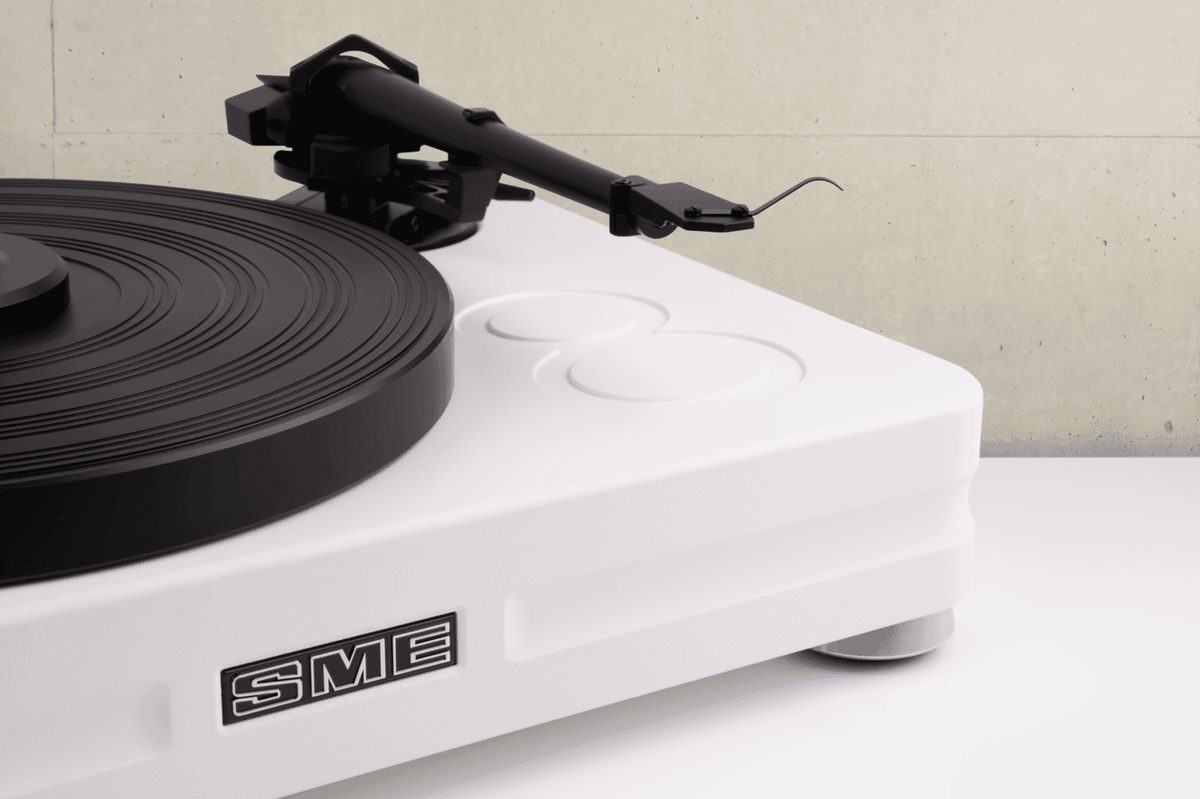
The SME Model 8 replaces the Model 6 as the smallest turntable from the British precision manufacturer. SME has reworked almost everything: the chassis of machined high-density polymer resin is thicker and has around 40 per cent more mass, the acetal platter is sturdier, the speed control is technically derived from the flagship Model 60, and instead of the M2-9 the famous 309 tonearm with magnesium tube and detachable headshell now sits on the plinth. The Model 8 was presented in June 2025; in the UK it costs £9,999, in Germany around €10,800 with tonearm (as of 31.10.2026, no guarantee). Three detailed international reviews describe an exceptionally stable, quiet and precise deck with strong bass. In the Master field the Model 8 lands at rank 8 with an index of 90.
Assumptions
- Assessed is the package of deck, 309 tonearm, speed control and record weight; the cartridge is extra
- The reviews used upper-class MC cartridges; the result applies to a system at this level
- German price as market price, UK price from the manufacturer, both including tonearm
Technical data (public)
| Drive | Belt · AC motor with two coils · external speed control with DSP sine-wave generator (bi-phase) and discrete power amplifier |
|---|---|
| Speed | 33⅓ / 45 rpm · fine adjustment in steps of around 0.0133 Hz · stroboscope disc included |
| Platter | acetal, 300 mm diameter, thicker than on the Model 6 · record weight included |
| Chassis | CNC-machined from high-density polymer resin · around 40 % more mass than Model 6 · four height-adjustable isolation feet |
| Tonearm | SME 309 · magnesium arm tube · detachable magnesium headshell · tungsten counterweight · ball-race bearings · Crystal Cable internal wiring |
| Tonearm data | effective mass 9.5 g · cartridge weight 6–17 g · tracking force 0–2.5 g · effective length 232.2 mm · mounting distance 215.4 mm · offset 23.2° · overhang 17 mm |
| Connections | gold-plated WBT RCA sockets · ground post · 24 V input from the control unit |
| Dimensions / weight | deck 435 × 150 × 320 mm (W × H × D), 12.4 kg · control unit 152 × 85 × 275 mm, 2.4 kg · power consumption 5–10 W |
| Phono / auto | No (external phono stage required) / manual |
| Finishes | Black, White, Midnight Blue |
| Price guide | around €10,800 with 309 tonearm (market price in Germany) · £9,999 (UK) · As of 31.10.2026 · without guarantee |
Manufacturer specifications (SME)
| Type | belt-drive turntable, SME 309 tonearm fitted, external speed control unit |
|---|---|
| Speeds | 33⅓, 45 rpm · fine adjustment in steps of approx. 0.0133 Hz |
| Drive | AC motor with twin coils · DSP sine-wave generator (bi-phase, frequency and amplitude) with discrete power amplifier |
| Chassis | CNC-machined high-density polymer resin · approx. 40% more mass than Model 6 · four height-adjustable isolation feet |
| Platter | 300 mm diameter · record clamp supplied |
| Tonearm | SME 309 · magnesium arm tube · detachable magnesium headshell · tungsten counterweight · ball-race bearings · Crystal Cable internal wiring |
| Tonearm geometry | effective length 232.2 mm · mounting distance 215.4 mm · offset 23.2° · overhang 17 mm |
| Tonearm data | effective mass 9.5 g · cartridge weight 6–17 g · tracking force 0–2.5 g · capacitance 15 pF/channel |
| Connections | gold-plated WBT RCA sockets · earth terminal · 24 V input |
| Dimensions turntable | 435 × 150 × 320 mm (W × H × D) · 12.4 kg |
| Speed control unit | 152 × 85 × 275 mm (W × H × D) · 2.4 kg · power consumption 5–10 W |
| Finishes | Black, White, Midnight Blue |
Source: SME – official specifications · As of 31 October 2026 · subject to change by the manufacturer
Rating criteria in detail
The four criteria feed into the Vinyl BotPro Index with weights of 25/20/25/30. The index is scaled across all tiers (see Methodology); that is why we do not show individual sub-scores.
Strengths
- Very stable pitch and quiet running, in the lab 0.02 % wow with the record weight
- Tight, deep and cleanly defined bass, focused soundstage
- 309 tonearm with detachable headshell for quick cartridge changes
- Excellent build, simple set-up, not very sensitive to placement
Weaknesses
- Clear price jump over the predecessor Model 6
- Record weight is a must, otherwise bass and speed stability suffer
- Rather matter-of-fact than thrilling in dynamics and rhythm
Comparison models
| SME Model 6 | The direct predecessor with M2-9 arm, lighter chassis and older speed control – cheaper while still available, but technically clearly below the Model 8 |
|---|---|
| Clearaudio Ovation | Mass-loaded deck from Erlangen with magnetic bearing at rank 7, cheaper, but arm depends on the package – more flexibility, less of a complete package |
| Luxman PD-191A | Japanese belt drive with its own tonearm at rank 9, similarly priced – the alternative for fans of Japanese precision mechanics |
| SME Model 12 MK2 | The big brother with aluminium chassis and 12-inch arm at rank 10 – more mass and soundstage, but more expensive and larger |
| Musical Fidelity M8xTT | British rival with arm included, slightly cheaper – also a complete package, but without the classic 309 tonearm |
System matching
Works well with
- MC cartridges of medium to low compliance from 6 to 17 g from the cartridge top list
- Top-class MC-capable phono stages from the phono preamp top list
- Normal, sturdy furniture or racks – according to the manufacturer a special stand is not required
Less suited
- Anyone expecting a built-in phono preamp or automatic operation
- Anyone wanting to use light MM cartridges with very high compliance
- Anyone looking for a particularly punchy, forward sound
Specs & Features
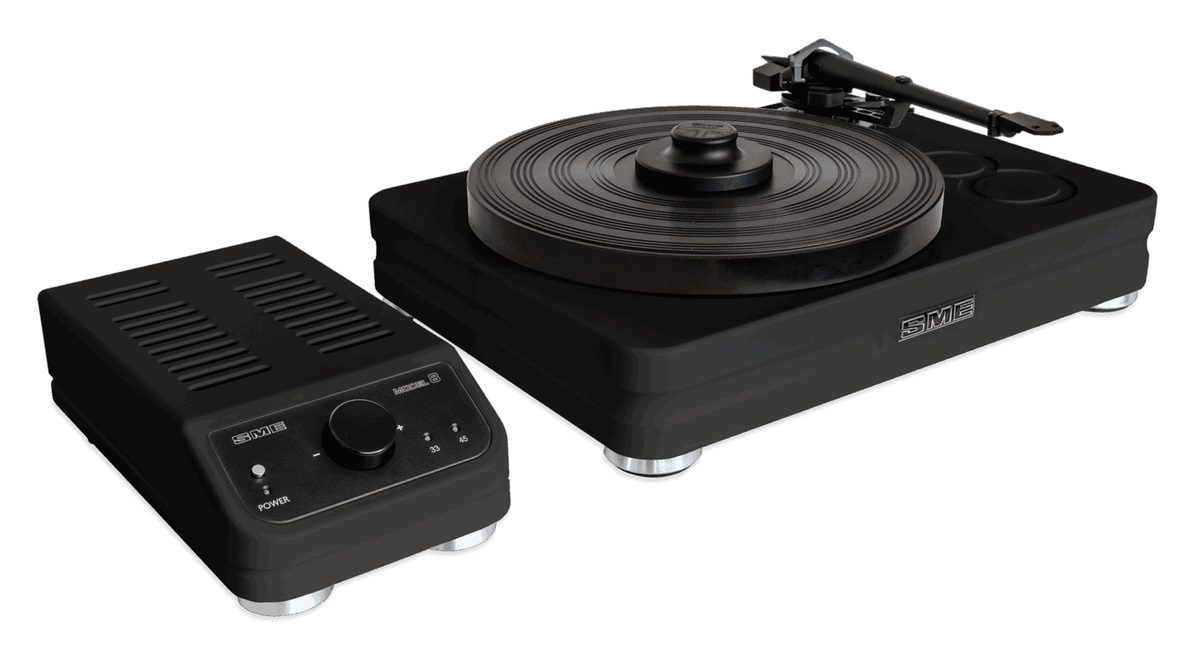
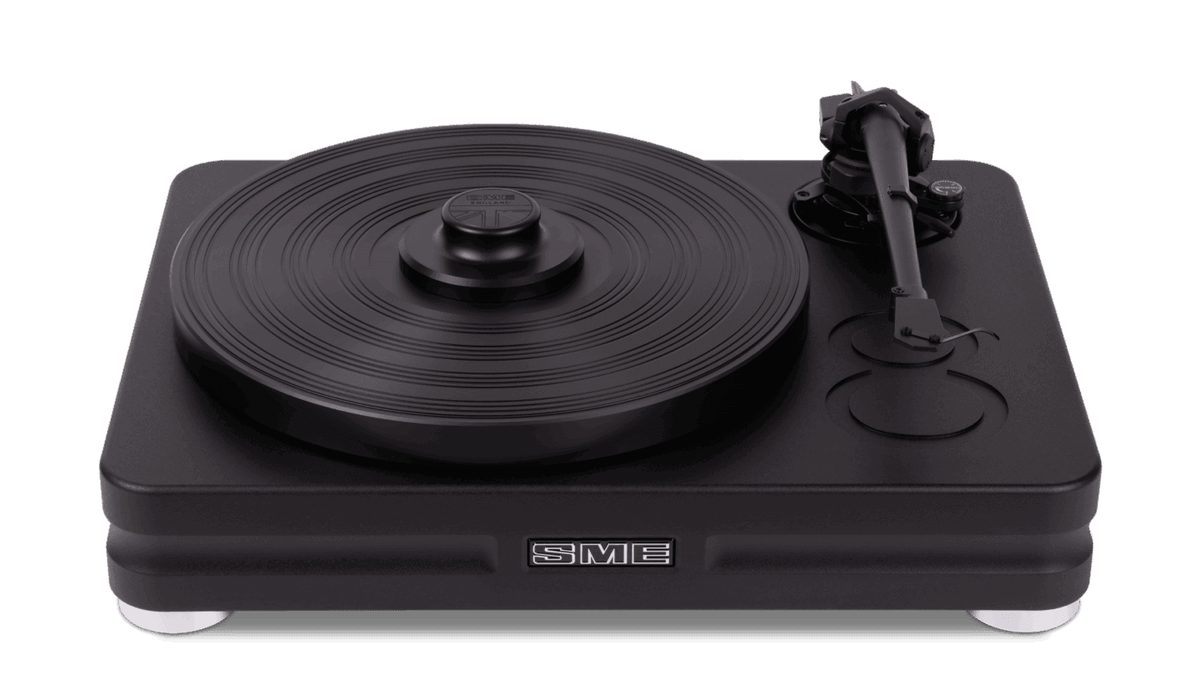
The chassis of the Model 8 is CNC machined from a block of high-density polymer resin. The material resembles the heavily damped plastic of the new SME tonearms and is meant to absorb resonances instead of passing them on like metal. Compared with the Model 6, the plinth is thicker and has around 40 per cent more mass; the footprint stays compact at 435 × 320 mm. SME makes the main bearing, spindle and pulleys to the same tolerances as on its large turntables. The acetal platter is thicker than before and has a diameter of 300 mm; its surface is finely grooved and needs no mat.
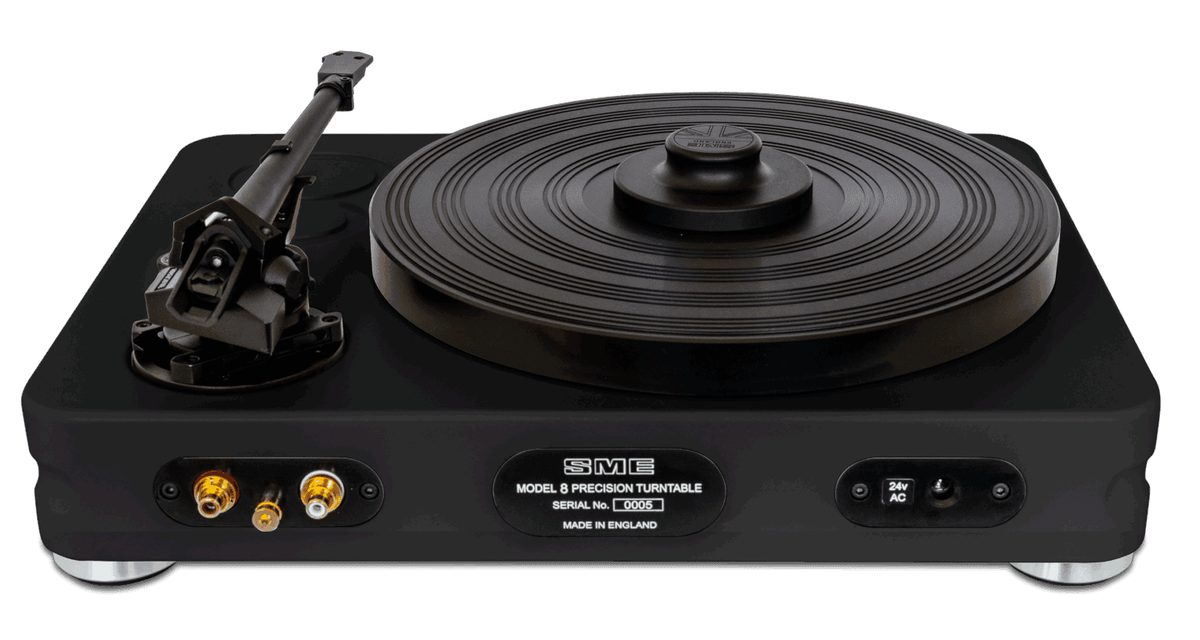
The control unit stands separately. A DSP generates two clean sine waves, which a discrete power amplifier boosts and feeds to the two coils of the AC motor. Speed can be adjusted in steps of around 0.0133 Hz, and a stroboscope disc is included. The 309 tonearm sits on the plinth with magnesium tube, tungsten counterweight, ball-race bearings in all planes and Crystal Cable internal wiring. The magnesium headshell is detachable and allows azimuth adjustment. At the rear there are gold-plated WBT RCA sockets and an earth terminal. The box also contains a record weight, alignment protractor and tools.
What international reviewers heard
International listening reviews of the SME Model 8 are available from the international specialist press. Here we summarise the overall picture in our own words; all sources are linked at the end of the page.
Sound character
- The basic character is calm, composed and controlled. The Model 8 keeps order even on dense orchestral and electronic recordings, holds pitch steady and lets fine detail emerge from a very quiet background.
Tonal balance
- Tonally the deck is largely neutral with a slight touch of warmth in the midrange. The treble stays clear and precise without turning hard, so the chosen cartridge can show its own character.
Dynamics, bass & staging
- The bass is seen as a clear strength: tight, deep and cleanly defined, with a firm grip on bass lines and kick drum. The soundstage is focused and well layered in depth, but does not extend far beyond the speakers.
Strengths
- Running quietness, pitch stability and the high build quality are seen as the greatest strengths. In the lab, with the record weight fitted, the deck reached 0.02% wow and 0.04% flutter with a rumble figure of −74.0 dB.
Setup, room & partners
- The supplied record weight is a must: without it the record slips slightly on the smooth acetal platter, the bass becomes less sure-footed and speed varies measurably more. Placement and proximity to the speakers, on the other hand, proved uncritical.
Consensus & differences
- All reviews praise stability, bass control, precision and build. They disagree on emotional impact: some hear a gripping, detailed presentation, others miss a little dynamic nuance and rhythmic drive and find the result rather matter-of-fact.
Research Consensus
The source situation is very good: SME publishes a detailed owner's manual with all dimensions and tonearm data, plus three detailed international reviews from 2025 and 2026, one of them with lab measurements. All agree on stability, calm, precision, bass control and build. Only the assessment of emotional impact differs. One technical point runs through all of them: without the supplied record weight the deck falls short of its potential. The verdict of international reviews is assessed in detail in the section What the international specialist press hears.
In short: anyone looking for a complete precision turntable with one of the best-known tonearms in analogue history who only needs to choose a cartridge will find the Model 8 an exceptionally solid partner for many years. Anyone wanting more soundstage and mass should look at the SME Model 12 MK2.
For whom / Matching
Cartridges
The 309 has an effective mass of 9.5 g and accepts cartridges from 6 to 17 g. This suits most MC cartridges of medium compliance, such as an Audio-Technica AT-ART20, with which the Model 8 was used in one of the reviews, or an Ortofon Cadenza Black. Thanks to the detachable headshell, a second cartridge can be kept ready pre-mounted.
Phono
There is no built-in phono stage. An MC phono stage from the phono preamp top list suits this class.
Budget
Around €10,800 for the package with arm (as of 31.10.2026, no guarantee) plus cartridge: realistically, expect to invest €12,000 to €14,000 for the complete source.
Upgrade
The most important accessory is already included: the record weight. Beyond that, a better cartridge from the cartridge top list is more worthwhile than accessories for the deck.
What makes this AI analysis special
This section is an AI summary of published international reviews and SME's manufacturer data. Vinyl BotPro puts the findings into context and links them with the data sheet and comparison models; VinylCination does not run its own listening tests or measurements, and all sources are linked at the end of the page. Prices and availability change (as of Oct. 2026, no guarantee); please check technical values against the current data sheet.
Vinyl BotPro Score Logic
The Vinyl BotPro Index is cross-tier 0–100. Master typically sits at ~85–97. The Model 8 receives 90 (rank 8 Master): very high scores for technology/build thanks to chassis, bearing, DSP control and 309 tonearm, expected performance at a high Master level based on three reviews and the lab measurement, good features with the arm included, and a price/performance weighting that takes the hefty increase over the predecessor into account. With the same index it ranks behind the cheaper Clearaudio Ovation and ahead of the slightly more expensive Luxman PD-191A. The tier's champion badges remain unchanged. Weights: technology/build ~25 · features ~20 · performance (expected) ~25 · value ~30. Rank ≠ lab rating – no listening test of our own. Details: Details on weighting · Methodology.
Created by Vinyl BotPro (AI) · AI analysis · As of 31.10.2026 · Corrections: info@vinylcination.de · Prices without guarantee.
Manufacturer and concept
SME was founded in 1946 in Steyning in the south of England and has been known above all for tonearms since the 1960s. The Series V and its derivatives are still regarded as a benchmark for precision and build, and the company also makes its large turntables such as the Model 30 and Model 60 almost entirely in-house. For a long time SME was out of reach for most record lovers. That changed in 2020 with the Model 6: it was the brand's first entry-level deck, the first with a solid, non-suspended chassis and the first with an AC motor.
The Model 8 replaces the Model 6 entirely. SME presented it in June 2025 together with the larger Model 35. The basic idea remains the same: a compact belt-drive deck with an external speed controller and a tonearm included. But almost every part has been reworked. The chassis is thicker and heavier, the platter sturdier, the speed control more modern, and above all the tonearm changes from the M2-9 to the 309 – an arm that has been regarded since 1988 as the most affordable route to the sound of the legendary Series V. The price has risen noticeably: in Germany the package costs around €10,800 (as of 31 Oct 2026, no guarantee).
Technology explained
Polymer resin chassis instead of aluminium
SME's large turntables are made of solid aluminium. For the Model 8, SME uses a high-density polymer resin that is CNC machined. This lowers costs but also has acoustic reasons: the material is stiff and heavily damped at the same time, so vibrations from the motor, bearing and surroundings die away quickly instead of spreading through the plinth. Compared with the Model 6, the chassis is much thicker and has around 40 per cent more mass. Four height-adjustable feet with integrated isolation support it and are also used to level the deck. There is no suspension as on the large SME models – which keeps set-up and adjustment simple.
Bearing, platter and record weight
The main bearing, spindle and pulleys are made to the same tolerances as on the expensive SME decks. A compact aluminium sub-platter carries the acetal platter. Acetal, also known as POM, has mechanical properties similar to vinyl and drains vibration from the record well. The platter is thicker than on the predecessor and its mass sits further towards the rim, which increases rotational inertia and thus running stability. The surface is finely grooved and replaces a mat. Because it is fairly smooth, a heavy record weight is supplied. It couples the record firmly to the platter and, as the lab measurement shows, is essential for full speed stability.
Drive and speed control
Belt drive separates motor and platter mechanically. The Model 8 uses a custom-made AC motor with two coils. The external control unit generates two pure sine waves via DSP, and a discrete power amplifier uses them to drive the motor. This technology comes from the Model 60. Because frequency and amplitude are generated digitally, speed hardly varies even when the mains supply is unclean. The user can fine-tune the speed in steps of around 0.0133 Hz and check it with the supplied stroboscope disc. The motor starts with gently rising torque, which protects the belt; it takes five to six seconds to reach stable speed.
The 309 tonearm
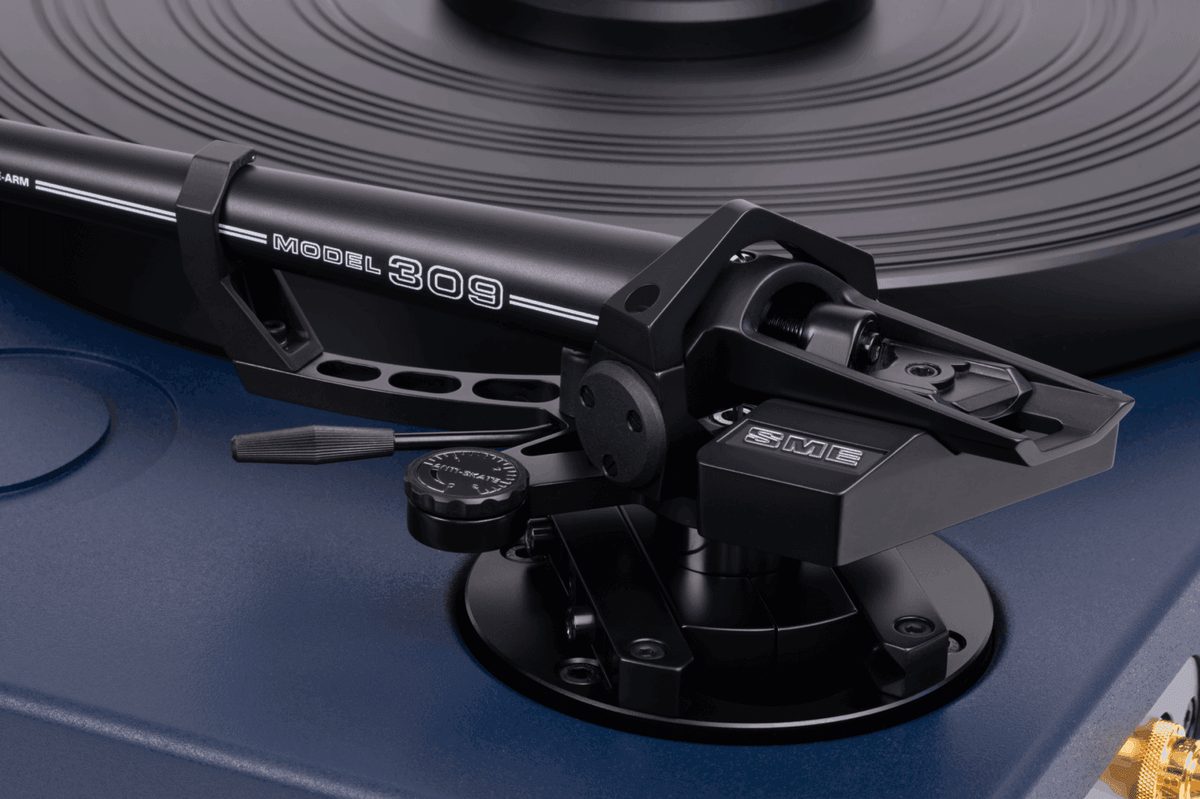
The 309 is the second offspring of the Series V and has been in the range since the late 1980s. Its arm tube is cast from magnesium and internally damped, and the headshell, also magnesium, is detachable. This makes it easy to switch between two cartridges and allows azimuth adjustment. The counterweight is tungsten, and all bearings are precision ball races. Effective mass is 9.5 g, cartridges from 6 to 17 g can be balanced, and tracking force goes up to 2.5 g. Effective length is 232.2 mm with a 23.2° offset angle and 17 mm overhang. For the Model 8 the arm is wired with Crystal Cable, with a capacitance of only 15 pF per channel.
Sound: what the reviews show
The three reviews paint a clear picture. The Model 8 is not a deck that makes every record bigger, brighter or more dramatic. It provides a very quiet, stable foundation on which the cartridge can show what it can do. Piano chords stand firm without wavering, reverb and quiet detail come through clearly, and even dense passages stay orderly. The bass is consistently described as a major strength: deep, tight and clearly defined. The midrange has a slight touch of warmth, and the treble is precise but never sharp.
Opinions differ on emotion. Some reviewers hear a gripping, detailed presentation that quickly becomes addictive. Others find the Model 8 a little too restrained compared with the best decks in its price class: dynamic nuances in voice and piano and rhythmic drive come across slightly less vividly. This is summarised in detail in the section on the international reviews above.
Features and everyday use
Set-up
Set-up is simple for a deck of this class. Fit the belt over the sub-platter and motor pulley, level the deck with a spirit level using the four feet, place the platter, connect the control unit. The tonearm is already fitted, and the headshell is supplied separately so the cartridge can be mounted easily. An alignment protractor and the right tools are included. Speed is set at the factory.
Placement
SME states explicitly that the Model 8 can be used on any sturdy piece of furniture without a dedicated rack. One review confirms that the deck is not very sensitive to its support or to proximity to loudspeakers. A solid, level rack is still the best choice.
Operation
The control unit has a power switch and a rotary control for 33⅓ and 45 rpm. The same control is used for fine adjustment in setting mode; the electronics save changes automatically after 20 seconds without input. The record weight sits over an unthreaded spindle – place it and you are done. There is no dust cover.
Connection
The signal leaves the deck via gold-plated WBT RCA sockets, next to an earth terminal. There is no built-in phono preamp. An MC-capable phono stage with adjustable loading suits the Model 8.
Who it suits
The Model 8 is aimed at record lovers looking for a source for many years who value precision, stability and build. A typical move is from a good Expert-level deck, such as a Rega Planar 8 or a Technics SL-1300G, to a complete package with one of the best-known tonearms in analogue history. Anyone who likes to swap cartridges benefits from the detachable headshell. Anyone looking for a particularly punchy, forward sound or expecting automatic operation and a built-in phono preamp should look elsewhere.
Comparison with alternatives
The direct comparison is the SME Model 6: it was much cheaper, but uses the simpler M2-9 arm, a lighter chassis and an older speed control. The reviews see the Model 8 as a clear step forward. The Clearaudio Ovation sits one place ahead with the same index because it costs less; it relies on a mass-loaded deck with magnetic bearing. The Luxman PD-191A follows directly behind and also comes with its own arm. More mass and a bigger soundstage come with the SME Model 12 MK2 with aluminium chassis, which is more expensive and larger. The Musical Fidelity M8xTT is a slightly cheaper British complete package. All models are in the Master level of the top list.
More questions about the SME Model 8
Is a tonearm included?
Yes. The SME 309 is fitted and the detachable headshell is supplied. A cartridge is not included.
What is the difference from the SME Model 6?
The Model 8 has a thicker chassis with around 40 per cent more mass, a sturdier platter, speed control derived from the Model 60 and the 309 tonearm instead of the M2-9. It replaces the Model 6.
Do I need the record weight?
Yes. Without the weight the record can slip slightly on the smooth platter; bass and speed stability then become measurably worse.
Which cartridges suit the 309?
Cartridges from 6 to 17 g with medium compliance, above all MC cartridges. The arm's effective mass is 9.5 g.
How much does the SME Model 8 cost?
Around €10,800 with tonearm in Germany and £9,999 in the UK (as of 31 Oct 2026, no guarantee).
Conclusion
The SME Model 8 turns the brand's entry-level deck into a serious Master-level turntable. A heavier chassis, sturdier platter, speed control from the flagship and the 309 tonearm deliver very quiet, stable and precise playback with strong bass. Anyone seeking a little more temperament should compare; anyone who wants a complete, long-lasting precision turntable will find one of the most convincing packages in its class here. With an index of 90 it ranks 8th in the Master level.
Sources
- SME — Model 8 (product page)
- SME — Model 8 owner's manual (April 2025, technical data)
- Hi-Fi News & Record Review — SME Model 8/309 turntable/tonearm (Oct. 2025)
- Hi-Fi News & Record Review — SME Model 8/309: Lab Report (Oct. 2025)
- What Hi-Fi? — SME Model 8 turntable review (2025)
- StereoNET — SME Model 8 Turntable Review (04.09.2026)
Read more: best turntables 2026 · What is hi-fi?