
Active subwoofers · AI analysis · Expert, Rank 1
SVS SB-3000 R|Evolution: Analysis
AI analysis (research): sealed active subwoofer from SVS with a new 13-inch high-excursion driver, 1,200 W RMS (4,000+ W peak) Class-D MOSFET, 17 to 230 Hz (±3 dB), RCA and XLR inputs, OLED rear panel and app control with phase, room-gain compensation and 6-band parametric EQ. Based on manufacturer data and press reviews, no listening test.
Summary
Sound Vinyl BotPro Champion Highest expected performance of the level according to Manufacturer data and Specialist press. This is an AI assessment, not a listening test.
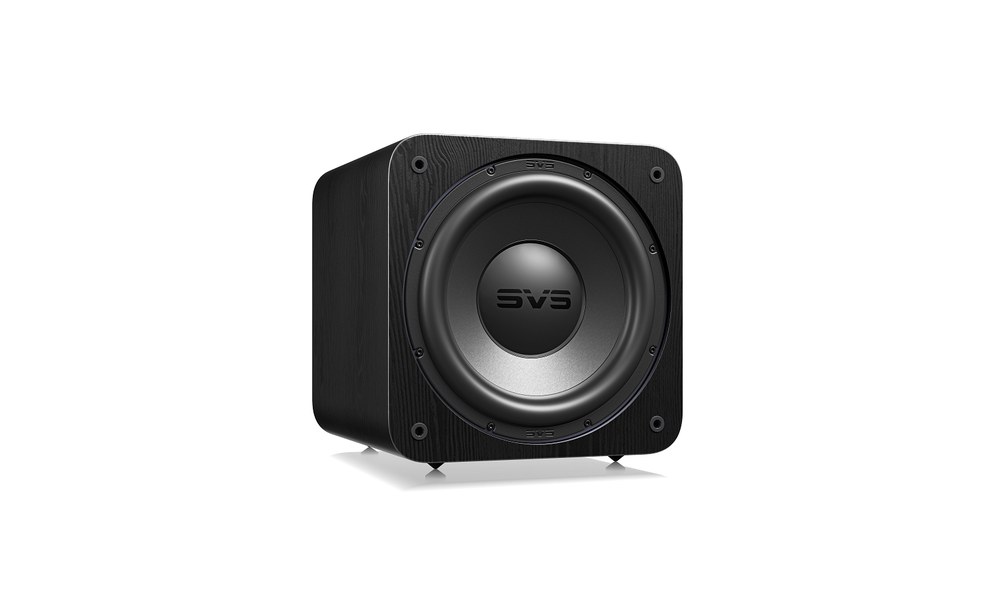
The SVS SB-3000 R|Evolution has replaced the SB-3000 since January 2026: the same compact form factor (39.7 × 38.5 × 42.6 cm, 24.9 kg), but a new 13-inch driver, a stronger amplifier and the Analog Devices DSP from the Ultra R|Evolution platform. SVS quotes 1,200 W RMS and over 4,000 W peak plus 17 to 230 Hz (±3 dB); in small to mid-size rooms the maker expects 2–3 Hz more extension. New versus the predecessor: balanced XLR inputs alongside RCA, OLED with display flip, six PEQ bands instead of three, and Auto EQ room calibration in the app, added by update after launch. Several international specialist publications have assessed the subwoofer in listening tests; AVForums awards, among other scores, 9 out of 10 for value for money. In Germany SVS lists €1,749 (as of Oct. 2026, without guarantee).
Assumptions
- Price per subwoofer (piece) according to manufacturer or trade, Stand Oct. 2026, no guarantee
- Operation in addition to stereo main loudspeakers (2.1), low-pass and phase tuned at the listener's place
- Vinyl chain with Phono stage; Subsonic filter recommended
- No in-house measurements or listening tests
Specifications (manufacturer)
| Type | Active subwoofer · Sealed Enclosure · Front-Firing |
|---|---|
| Woofer | 13 inch (33 cm) high-excursion, vented 1100 aluminium cone |
| Amplifier | 1,200 W RMS / 4,000+ W tip · Class D MOSFET (STA-1200D2) |
| Frequency range | 17 – 230 Hz (±3 dB) |
| Inputs | RCA stereo · XLR stereo · LFE · Triggers · IR |
| DSP / app | 295 MHz Analog Devices · 56-bit · 6-band PEQ · Room-gain compensation · 3 presets · Auto EQ (app) |
| Dimensions / weight | 397 × 385 × 426 mm (H × W × D, with grille) · 24.9 kg |
| Price guide | 1,749 € (SVS Germany) · as of Oct. 2026 · without guarantee |
Manufacturer specifications (SVS)
| Type | Active subwoofer · sealed cabinet |
|---|---|
| Amplifier power | STA-1200D2 class D · 1,200 W RMS continuous · 4,000+ W peak · load impedance not specified by manufacturer (built-in amplifier) |
| Drivers | 13-inch, 1100 aluminium cone |
| Frequency response | 17–230 Hz ±3 dB |
| Inputs | RCA · balanced XLR (18 kΩ, up to 4 Vrms / +14 dBu) |
| Dimensions | 397 × 385 × 426 mm (H × W × D, with grille) · 397 × 385 × 397 mm (without grille) |
| Weight | 24.9 kg |
Source: SVS – official specifications · As of 16 October 2026 · subject to change by the manufacturer
Rating criteria in detail
The four criteria feed into the Vinyl BotPro Index with weights of 25/20/25/30. The index is scaled across all tiers (see Methodology); that is why we do not show individual sub-scores.
Strengths
- 17 Hz (±3 dB) of closed-back enclosure
- 1,200 W RMS and a new 13-inch driver
- XLR and RCA, app with 6-band PEQ and Auto EQ
- International listening tests
Weaknesses
- No high-level input
- No built-in high-pass for the main speakers
- 24.9 kg and deep enclosure
- Auto EQ only added by app update after launch
Comparison models
| SVS SB-3000 | Index 80, Rank 2, value for money champion — 13 inches · closed-back · 1,449 € |
|---|---|
| KEF KC62 | Index 79, rank 3 — 2 × 6.5 inch · Force-Cancelling · 1,799 € |
System matching
Works well with
- Small to mid-size stereo rooms
- Preamps and active speakers with sub-out or pre-out
- Listeners who tune from the seat via the app
Less suited
- Integrated amplifiers without pre-out
- Anyone who wants a Speakon high-level connection like REL
- Very large home-theatre rooms chasing maximum SPL
Specs & Features
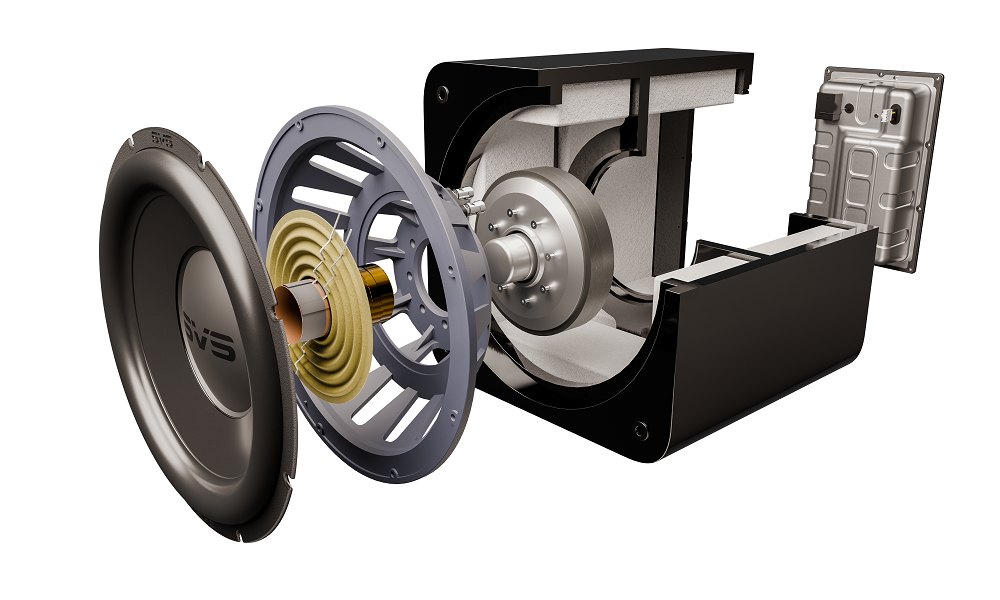
Inside the SB-3000 R|Evolution a new 13-inch long-throw driver with an overhung motor, vented 1100 aluminium cone and SBR surround works in a braced, sealed MDF cabinet. The STA-1200D2 Class-D amplifier with discrete MOSFETs delivers 1,200 W RMS and over 4,000 W peak; SVS quotes 17 to 230 Hz (±3 dB).
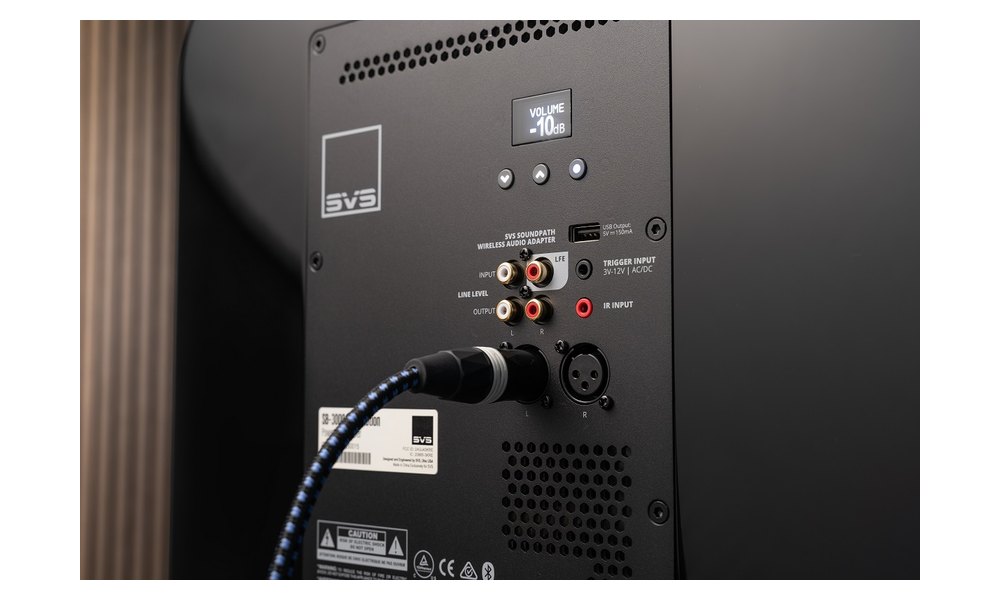
A 295 MHz Analog Devices DSP with 56-bit filtering handles low-pass, phase, polarity, six PEQ bands, room-gain compensation and three presets. Control runs via the OLED rear panel or the SVS app (iOS/Android/Fire). Inputs: RCA and XLR (stereo, the right RCA input doubles as the LFE input), trigger and IR; optional SoundPath wireless adapter. Iso-elastomer feet and grille are included.
Research Consensus
An international review listens to the SB-3000 R|Evolution together with the Ultra Evolution bookshelf speakers as a 2.1 system: after app tuning (including 80 Hz, −15 dB) the system sounds “life-size”, and the subwoofer delivers weight and air movement without sounding detached. Another review calls the bass precise and room-filling and describes a clearly wider soundstage after correct placement. AVForums awards, among other scores, 9 out of 10 for value for money, praises power and control and would like a little more finesse in quiet music passages.
Recurring pattern: a compact sealed 13-inch design with more reserves than the predecessor, strong app integration and clear stereo suitability. The international listening tests are summarised in detail in the section “What international reviewers heard”. VinylCination summarises this as an AI reading, without its own listening test.
For whom / Matching
Connection & Integration
Via RCA or XLR at a preamp’s pre-out or an active speaker’s sub output; for a high-pass on the main speakers you need the preamp’s crossover or an external filter. The phono stage from the Top list Phono preamps remains in the main branch.
Turntable & phono
Decks from the Expert level fit. At 17 Hz extension a subsonic filter in the phono stage is mandatory for warped records; the turntable should sit on a decoupled support.
Room & placement
Small to medium-sized rooms. The reviews stress placement and app fine-tuning at the listening position; check phase and level before using a corner or near-wall position, and use Auto EQ, which is now available via an app update.
Budget & upgrade
At 1,749 € the R|Evolution sits above the predecessor SB-3000 (value champion of the tier). More compact with a high-pass output is the KEF KC62; more cone area for large rooms comes from the SB16-Ultra.
What makes this AI analysis special
This section is an AI summary from Manufacturer data and reports from international specialist media. Vinyl BotPro had no physical access, no measurement of our own chain and no listening test. This is based on SVS's specifications and international listening tests. The expected performance is derived from construction, datasheet and the judgements of the Specialist press. Prices and availability change (as of Oct. 2026, no guarantee); please check technical values against the current data sheet.
Vinyl BotPro Score Logic
The Vinyl BotPro Index runs from 0–100 across all tiers and weights build/technology, features, expected performance and value for money at 25/20/25/30. Expert typically sits at ~70–84. SVS SB-3000 R|Evolution scores 83 (rank 1 Expert). Highest performance share in the Expert tier with very rich features; the premium over the predecessor slightly lowers the value score. In the stage, the model bears the title Sound Vinyl BotPro Champion. Rank is not Laboratory Evaluation — no Listening test. Details on weighting · Methodology.
Created by Vinyl BotPro (AI) · AI analysis · As of 08.10.2026 · Corrections: info@vinylcination.de · Prices without guarantee.
Concept: why a sealed 13-inch sub
SVS builds subwoofers in two basic forms: ported (the PB models) and sealed (the SB models). The SB-3000 R|Evolution belongs to the second group. A sealed cabinet rolls off below its resonance more gently than a ported one, at 12 dB per octave instead of 24 dB. That gentle slope matches the natural bass lift that almost every living room adds below roughly 40 Hz. In practice a sealed sub often sounds deeper in the room than the spec sheet suggests, and it responds quickly to transients because there is no air mass in a port that keeps resonating.
The trade-off is efficiency. A sealed box needs more amplifier power and more cone excursion for the same deep-bass level. This is where the R|Evolution version comes in: SVS pairs a new 13-inch long-throw driver with the STA-1200D2 amplifier, rated at 1,200 W RMS and more than 4,000 W peak. With almost the same cabinet as the earlier SB-3000, it gains headroom without taking up more floor space.
Technology explained
Driver and cabinet
The 13-inch driver uses a vented 1100-series aluminium cone and an SBR surround. Aluminium is stiff and light, so the cone barely deforms even at high excursion. The overhung motor and long stroke (30.1 mm Xmax according to SVS) let it move the volume of air a sealed box needs for deep notes. The MDF cabinet is internally braced so the walls do not resonate, and the iso-elastomer feet decouple it from the floor, which helps on wooden floors where a sub can otherwise excite the whole surface.
DSP and app
Tuning is handled by a 295 MHz Analog Devices DSP with 56-bit filtering. It controls the low-pass filter, phase, polarity, six parametric EQ bands, room gain compensation and three presets. You can use the OLED display on the back or, more conveniently, the SVS app for iOS, Android and Fire. The practical benefit is that every setting can be changed from the listening seat. Room gain compensation trims the deepest octave if a small room boosts it too much, and the PEQ bands can tame individual room modes, the boomy notes that appear in most living rooms between 30 and 80 Hz. Auto EQ in the app was added by update after launch and has already been used in several international reviews; manual setup remains available as well.
Connections
Inputs are stereo RCA, stereo XLR, a trigger input and an IR receiver, and according to Stereophile the right RCA input doubles as the LFE input for AV receivers; SVS rates the balanced input at up to 4 Vrms (+14 dBu) into 18 kΩ. There is no speaker-level input, and the sub does not high-pass the main speakers itself. If you want to relieve the mains, you need the bass management of a preamp or AV receiver, or an external crossover. The optional SoundPath wireless adapter avoids a long cable run.
Setup in practice
For a stereo system with a turntable, a proven order is: put the sub at your listening seat, play music with steady bass, then walk around the room and find the spot where the bass sounds most even. Place the sub there. Next set the crossover: with large floorstanders usually between 40 and 60 Hz, with bookshelf speakers between 60 and 90 Hz (one review used about 80 Hz with the Ultra Evolution bookshelves). Then adjust phase until the crossover region sounds fullest, and set the level last. A common mistake is running the sub too loud; set correctly, you only notice it when you switch it off and the foundation and sense of space disappear.
Vinyl adds one point. A sub that reaches 17 Hz (±3 dB) also reproduces rumble and record warps below the audible range. The cone then pumps visibly and the amplifier wastes headroom. A subsonic filter in the phono stage is therefore a good idea, and the turntable should sit on a decoupled support away from the sub.
Who it suits
The SB-3000 R|Evolution suits listeners with small to medium rooms who want real deep bass in a compact cabinet, connected to a preamp, streamer or active speakers with a sub output or pre-out, or to an AV receiver for shared music and film use. It is less suited to integrated amplifiers without a pre-out, and very large rooms at high levels call for a bigger model or two subs.
Compared with alternatives
- SVS SB-3000: the predecessor with the same concept, less power and a simpler DSP; cheaper, and the value champion of the tier.
- KEF KC62: far more compact with two opposed 6.5-inch drivers and a high-pass output for the main speakers.
- REL Planar PL-2: a slim sub for wall or furniture mounting with REL-style high-level connection.
All models with index and price are in the best active subwoofers list.
Analysis: the SVS SB-3000 R|Evolution in depth
What this analysis adds
The sections above briefly summarise manufacturer data and three international reports. For this analysis we widened the source base and tied every statement to a dated source: SVS's current US product page [1] and the German product page with its price [2], Audioholics' show report on the launch at CES 2026 [3], Tom Fine's review at Stereophile [4] with its measurement sidebar [5], Gene Hopstetter's report at HomeTheaterHifi [6], Martin Dew's review at AVForums [7], the detailed room and integration study by the Hurba Brothers at Soundnews [8] and Mike Prager's long-term report at Future Audiophile [9].
Where the review samples came from matters for context. Stereophile reviewed the speakers and the subwoofer together at the suggestion of SVS's VP of marketing [4]. Future Audiophile asked SVS for a pair and bought it after a few months; the site uses affiliate links [9]. Soundnews thanks the retailer AVstore for the two loan units [8]. AVForums only says that it was supplied with the Black Ash version [7], and HomeTheaterHifi does not state the origin explicitly [6]. Vinyl BotPro has neither heard nor measured the SB-3000 R|Evolution. Statements about sound and measurements belong to the authors named; we mark our own calculations and conclusions. Rank, index and prices on this page remain unchanged. In our research we did not find a German-language specialist review of the R|Evolution version itself; the German reports we found cover the predecessor.
Context: successor to SVS's best-selling subwoofer
SVS introduced the 3000 R|Evolution Series at CES in January 2026 [3]. It inherits technology from the larger 17-Ultra R|Evolution and 5000 R|Evolution series and consists of the sealed SB-3000 R|Evolution and the ported PB-3000 R|Evolution [3]. At the time, Audioholics quoted about 1,300 US dollars for the SB-3000 R|Evolution and 1,800 US dollars for the PB-3000 R|Evolution [3]. The US product page now lists 1,299.99 US dollars in Black Ash and 1,399.99 US dollars in Piano Gloss Black or White, plus 5% off when buying two subwoofers [1]. In Germany SVS lists 1,749 euros including VAT and shipping [2], and AVForums quotes 1,549 pounds in the UK for Black Ash and 1,649 pounds for the gloss versions [7].
Our own calculation: without Germany's 19% VAT, 1,749 euros corresponds to roughly 1,470 euros; US prices are usually quoted before sales tax. The gap to the predecessor SB-3000, which our list shows at 1,449 euros, is 300 euros or about 21%.
Future Audiophile describes the R|Evolution as a refinement of SVS's most popular sealed subwoofer with a far more powerful DSP, a re-engineered driver, more EQ options and a little more extension [9]. The author owns two of the older SB-3000 himself and concludes that the sum of many incremental improvements justifies the new name, but that it is not a must-have upgrade for owners of the predecessor [9].
Driver and motor: what SVS specifies
The US product page gives far more detail than the summary above [1]. According to SVS the 13-inch driver weighs 10.5 kilograms, 8.4 kilograms of which is the motor. It uses an overhung motor, meaning a voice coil that is longer than the magnetic gap, which keeps the drive force consistent at long excursion. SVS quotes 30.1 millimetres of Xmax and 72.9 millimetres of mechanical excursion [1][2]. The voice coil is flat-edge wound and split-wind and sits on a 2-inch aluminium former. Two toroidal Y30 ferrite magnets, a shorting sleeve on the pole piece, a cast aluminium basket, a 6.5-inch Nomex composite spider and a vented 1100 aluminium cone complete the design [1].
Comparing the two manufacturer pages reveals two inconsistencies. The German page translates the overhung motor as a floating drive configuration, lists a copper shorting sleeve instead of the 6063 aluminium sleeve on the US page, and mentions an NBR rubber surround in one place and an SBR surround in another [1][2]. In this analysis we follow the more detailed US version [1]; the differences look like translation errors, but only SVS itself could clarify them.
The sealed cabinet is made of MDF with internal bracing and damping, and according to SVS the front baffle is particularly rigid [1]. With the grille the subwoofer measures 397 × 385 × 426 millimetres; without the grille it is 397 millimetres deep, and it weighs 24.9 kilograms [1][2]. Future Audiophile notes that the new, simpler grille makes the sub about an inch shallower than its predecessor [9].
Amplifier, power supply and DSP: the measurable changes
According to SVS the STA-1200D2 amplifier delivers 1,200 watts continuous and more than 4,000 watts peak through four discrete 60-ampere, 200-volt MOSFETs [1]. Future Audiophile puts the predecessor at 800 watts continuous and 2,500 watts peak [9]. SVS says a switch-mode power supply with power factor correction holds the supply rail at a constant 160 volts regardless of mains voltage between 100 and 240 volts [1][2]. For the amplifier SVS specifies less than 0.05% THD+N at rated power, and for the acoustic result 20 to 60% less THD+N in the critical low-frequency range than the previous generation [1]. Standby consumption is 0.5 watts [1][9].
Our own calculation: 1,200 instead of 800 watts is 1.8 dB more electrical power on paper, and 4,000 instead of 2,500 watts peak is about 2 dB. How much of this reaches the room depends on excursion, limiter and cabinet. We found no CEA-2010 maximum-output measurement for the SB-3000 R|Evolution; the well-known Audioholics measurements cover the predecessor, and for the new model the site has only published its show report [3].
The Analog Devices DSP runs at 295 MHz with double-precision 56-bit filtering. SVS claims more than five times the processing power of its earlier subwoofers [1][2], while Future Audiophile speaks of about six times the power of the chip in the old SB-3000 [9]. According to SVS the converters achieve more than 120 dB signal-to-noise ratio [1].
What was measured and what was not
SVS says its 17 to 230 Hz (±3 dB) specification comes from a quasi-anechoic ground-plane measurement two metres away from reflective structures. SVS explicitly notes that the curve says nothing about maximum output, and it expects 2 to 3 Hz deeper extension in small to mid-size rooms because the roll-off is tuned to make use of room gain [1].
Stereophile measured the subwoofer in the nearfield of its driver as part of the system review, but the measurements concentrate on the bookshelf speaker [5]. The sidebar states that the subwoofer extends the system's bass by an octave, giving 20 Hz in one place and 17 Hz in another [5]. Stereophile publishes no separate distortion or maximum-output curve for the subwoofer. At very low frequencies a subwoofer radiates in all directions anyway, Stereophile notes, because the wavelength is far larger than the cabinet [5]. Our own calculation: at 17 Hz the wavelength is about 20 metres.
The most extensive measurements come from Soundnews, though in its own living room and with two subwoofers [8]. There, frequency response and waterfall measurements show how strongly the room shapes the result: modes at about 35 and 70 Hz decay faster with the subwoofers but do not disappear [8]. These data therefore describe the interaction of device and room, not the device alone.
What international reviewers heard
Stereophile listened to the SB-3000 R|Evolution with the Ultra Evolution Bookshelf as a 2.1 system [4]. Without the subwoofer the bookshelf speakers reached down to about 40 Hz but could not fill the room with deep bass. After tuning in the app, with the low-pass at 80 Hz and −12 dB per octave and a subwoofer level of −15 dB, the system sounded to Tom Fine like a pair of floorstanders, "life-sized", without the subwoofer standing out from the sound [4]. He left phase and polarity at their defaults. With orchestral recordings such as Stravinsky's Firebird and with jazz double bass, he describes an audibly stronger foundation [4].
HomeTheaterHifi describes the first subwoofer in what had been a pure stereo system [6]. At first the bass sounded directional and bloated; only after the internal low-pass was switched off, because the preamp was already filtering, and the sub was moved to a corner to the right of the sofa did it blend in. After that Gene Hopstetter describes more precise bass-drum placement, more audible double bass on older jazz CDs and a much larger soundstage [6].
AVForums mainly praises power and stamina in home cinema and calls the bass with music tight and musically voiced [7]. As a weakness Martin Dew notes that the subwoofer is less sympathetic to low-level music passages than some, admittedly pricier, alternatives; in a quiet passage with muted bass it laid things on a little too thick [7]. In the visible sub-scores AVForums gives 8 out of 10 for build quality and 9 out of 10 for value for money [7].
Future Audiophile listened to two units in place of two old SB-3000 and reports a moderate but distinct improvement in bass clarity, which the author attributes mainly to lower distortion and the better EQ options [9]. Soundnews describes tighter, faster and more articulate bass with two integrated units and stresses the spatial information below 30 Hz [8].
Connections in detail
The rear panel carries left and right RCA inputs, balanced XLR inputs, an RCA pass-through output, a 12-volt trigger, an IR input and a USB socket that powers the optional SoundPath wireless adapter [1][4][7]. According to Stereophile the stereo inputs are summed to mono ahead of the DSP; with a home-cinema processor the right-channel RCA input serves as the LFE input [4]. None of the sources describes a third, separate LFE connector. According to AVForums an LFE mode in the app resets the settings to factory values, such as 0 degrees phase and positive polarity, so that the preamp or AV receiver can take over bass management [7].
SVS specifies 10 kilohms input impedance for RCA and 18 kilohms for XLR, each for signals up to 4 volts RMS, which for XLR equals +14 dBu [1]. The trigger input accepts 3 to 12 volts AC or DC [1]. There is no speaker-level input for loudspeaker cables. For that, Future Audiophile points to SVS's SoundPath speaker-level adapter at about 100 US dollars [9]. HomeTheaterHifi used the SoundPath wireless adapter, and pairing of transmitter and receiver happened automatically [6]. The report gives two different prices for it, however, 199 and 179.99 US dollars [6].
App, phase and Auto EQ in practice
The app controls volume, the low-pass filter with frequency and slope, phase, polarity, six parametric EQ bands, room gain compensation, tuning modes, power management and three presets [1][6]. Stereophile describes room gain compensation as a switchable high-pass filter with adjustable frequency and slope [4]. Soundnews singles out the phase resolution in 1-degree steps as the most important tool; in its room the right subwoofer received 32 degrees and the left 7 degrees of phase correction [8].
Automatic calibration shows how quickly things have changed since launch. At CES, SVS announced Auto EQ via a firmware update for the first quarter of 2026 [3]. In May 2026 HomeTheaterHifi still wrote that, according to SVS literature from March, the feature was coming [6], and the German product page still lists it as "coming soon" today [2]. Stereophile, on the other hand, reports that Auto EQ was added around press time [4], AVForums used the feature for music [7], and the US product page describes it as an available update [1]. Future Audiophile used Auto EQ with SVS's separate 45-dollar microphone; alternatively, the app first calibrates the smartphone microphone [9]. After Auto EQ and before his own room correction, the measured curves at the listening position were notably smoother, according to Prager [9]. SVS recommended the external microphone to him for demanding systems [9].
Placement: one subwoofer or two
Soundnews explains the room problem with a simple formula: the lowest axial mode is the speed of sound divided by twice the room dimension [8]. In its 5.5 × 4 × 2.6 metre test room this gave about 32, 44 and 67 Hz [8]. Our own calculation for a typical living room of 5 × 4 × 2.5 metres: about 34, 43 and 69 Hz. That is exactly where a subwoofer works.
At Soundnews a single subwoofer already improved the length mode without any adjustment, but made the width mode around 44 Hz worse because it excited it from one side only; only two symmetrically placed units smoothed it out [8]. SVS recommends two subwoofers for more even bass at several seats and more headroom, and names opposite diagonal corners, the mid-points of the side walls or the front stage as proven positions [1]. Future Audiophile placed its two units in the front-right and rear-left corners [9], and Stereophile refers in a footnote to pairs placed directly next to the main speakers [4].
For stereo systems in small rooms a well-placed single subwoofer remains a sensible start; all sources stress that position, phase and level matter more than raw power [4][6][8]. Soundnews explicitly calls the thorough tuning of two units time-consuming [8].
Turntables, phono and deep bass
Two points matter for a vinyl system. HomeTheaterHifi had a Thorens TD-124 with a Jelco tonearm, a Zu Audio DL-103 cartridge and a Schiit Stjarna phono stage in its system, but the listening examples described come from CD, SACD and Blu-ray [6]. None of the sources offers a dedicated evaluation with records. SVS marketing VP Nick Brown explicitly names tube amplifiers with turntables as a suitable setting for the 2.1 system in his comments to Stereophile [4].
General context, not from the sources: record warps and the resonance of tonearm and cartridge sit in the infrasonic range below about 20 Hz. A subwoofer reaching 17 Hz at −3 dB, plus room gain, can reproduce these signals with visible cone movement. A subsonic filter in the phono stage, decoupled placement of the turntable and some distance from the subwoofer are therefore sensible. As Stereophile describes it, the app's room gain compensation can additionally limit the lowest range [4].
Comparisons from the sources
Compared with the predecessor SB-3000, Future Audiophile heard a moderate but clear improvement, but does not urge owners of the old model to switch [9]. The PB-3000 R|Evolution, with the same driver in a ported cabinet, is much larger at 557 × 465 × 626 millimetres and, according to Audioholics, aimed at higher output in larger rooms [3][9]. Audioholics explicitly qualifies the rule of thumb of sealed for music and ported for film [3].
AVForums names the Perlisten R8s with an 8-inch driver for finer reproduction in small rooms and the KEF KC62, now 1,550 pounds in the UK, as alternatives [7]. Future Audiophile compares it with the REL T/7x, which does without DSP and app and recommends speaker-level connection, and with the Martin Logan Abyss 8, which offers similar app functions and Anthem room correction [9].
Verdict on the source situation
The sources paint a consistent picture: plenty of power and extension from a compact sealed cabinet, a very comprehensive app with fine phase and EQ control, and good integration into stereo systems when placement and tuning are right [4][6][8][9]. The clearest criticism concerns quiet music passages, where AVForums would like more restraint [7]. Independent measurements of the new model's maximum output and distortion are still missing, so the manufacturer's figures on these points are not externally confirmed [1][5]. For vinyl listeners with a preamp output, the SB-3000 R|Evolution remains a very strong candidate on this evidence; without a pre-out it needs the separate speaker-level adapter [9].
Sources for this analysis
- SVS: SB-3000 R|Evolution (Produktseite USA mit technischen Daten/product page USA with specifications, abgerufen/accessed 11.11.2026). https://www.svsound.com/products/sb-3000-revolution-subwoofer
- SVS Deutschland: SB-3000 R|Evolution (Produktseite DE mit Preis und technischen Daten/German product page with price and specifications, abgerufen/accessed 11.11.2026). https://www.svsound.de/SB-3000-R-Evolution/101427/
- Audioholics: SVS Launches First-Ever Soundbar and New 3000 R|Evolution Series Subwoofers at CES 2026 (Jacob Green, 15.01.2026). https://www.audioholics.com/news/svs-3000-r-evolution
- Stereophile: SVS Ultra Evolution Bookshelf loudspeaker & SB-3000 R|Evolution subwoofer (Tom Fine, 21.08.2026). https://www.stereophile.com/content/svs-ultra-evolution-bookshelf-loudspeaker-sb-3000-revolution-subwoofer
- Stereophile: SVS Ultra Evolution Bookshelf loudspeaker & SB-3000 R|Evolution subwoofer – Measurements (Messteil zum Test/measurement sidebar of the review, 21.08.2026). https://www.stereophile.com/content/svs-ultra-evolution-bookshelf-loudspeaker-sb-3000-revolution-subwoofer-measurements
- HomeTheaterHifi (Secrets of Home Theater and High Fidelity): SVS SB-3000 R|Evolution Subwoofer Review (Gene Hopstetter, 04.05.2026). https://hometheaterhifi.com/reviews/speaker/subwoofers/svs-sb-3000-revolution-subwoofer-review/
- AVForums: SVS SB-3000 R|Evolution Subwoofer Review – Medium package, big sound (Martin Dew, 21.08.2026). https://www.avforums.com/reviews/svs-sb-3000-revolution-subwoofer-review.23788/
- Soundnews: SVS SB-3000 R|Evolution – When the Room Becomes the Real Challenge (Hurba Brothers, 06.04.2026). https://soundnews.net/reviews/svs-sb-3000-revolution-when-the-room-becomes-the-real-challenge/
- Future Audiophile: SVS SB-3000 R|Evolution Review: $1,299.99 Sealed Subwoofer (Mike Prager, 04.11.2026). https://futureaudiophile.com/svs-sb-3000-revolution-powered-subwoofer/
Created by AI (Vinyl BotPro) from the sources listed; no listening tests or measurements of our own. Detailed human fact-check pending.
More questions about the SVS SB-3000 R|Evolution
Can I connect it to an integrated amp without a sub output?
Only via a pre-out, or with an external speaker-level-to-RCA adapter, because there is no high-level input.
Is it worth the extra over the SB-3000?
If you want more headroom, the finer DSP with room gain compensation and app calibration, yes. In smaller rooms at moderate levels the predecessor remains the cheaper choice.
One subwoofer or two?
Two subwoofers in different positions usually smooth room modes better than one. For stereo in small rooms, a single well-placed SB-3000 R|Evolution is usually enough.
Verdict
The SB-3000 R|Evolution combines a compact sealed cabinet with plenty of power and extensive app control. International reviews report that it blends well with stereo systems. If you have a pre-out or sub output and want to tune bass from your seat, it is the strongest candidate in the Expert tier.
Sources
Read more: best active subwoofers 2026 · Improve your hi-fi system · What is hi-fi?