
Phono preamp · AI analysis · Master, rank 1
Accuphase C-47 Review
AI analysis (research): symmetrical MM/MC phono stage with Dual mono power supplies — specs/retailer price, no listening test.
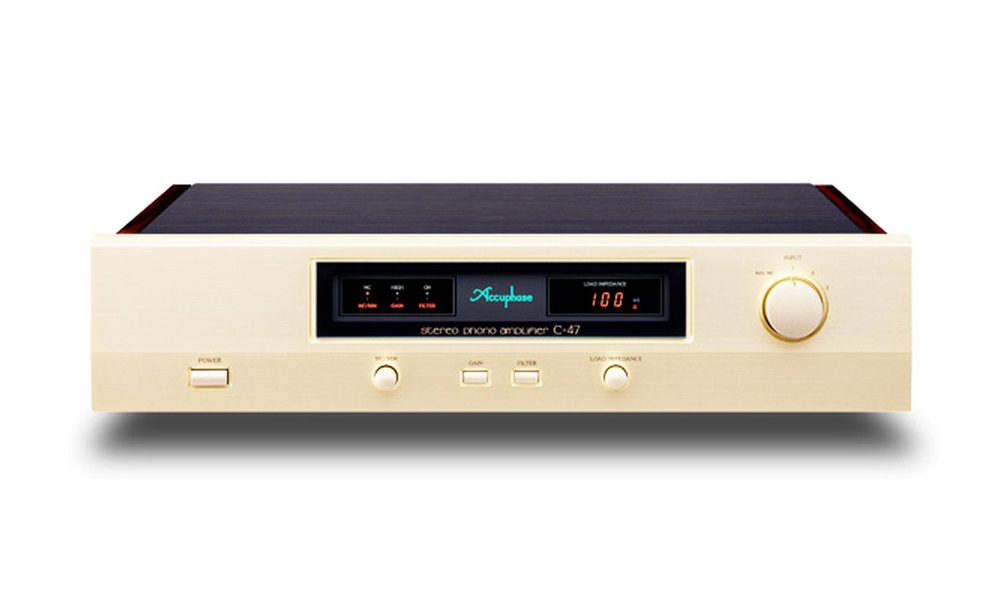
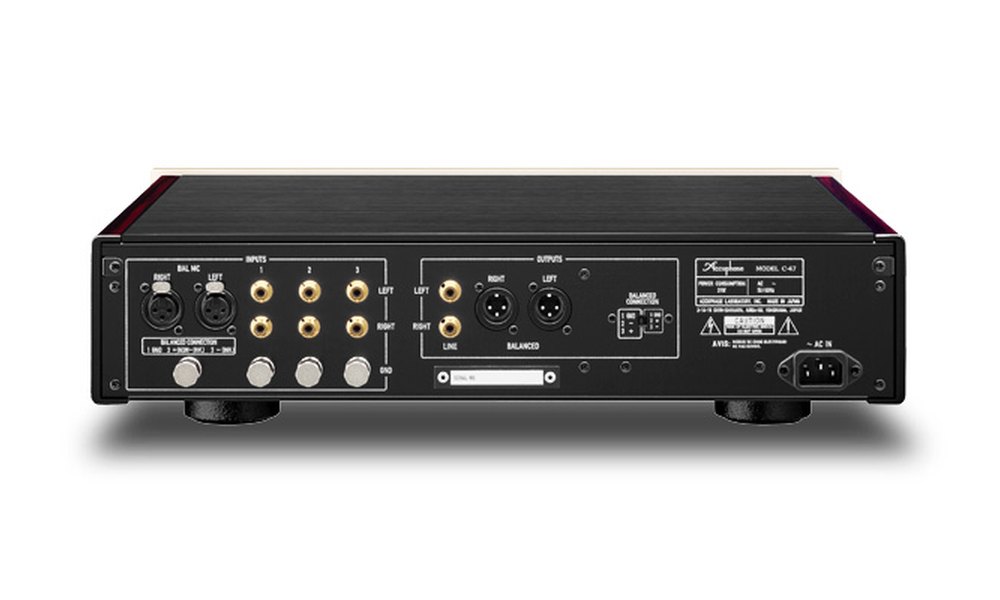
Summary
The C-47 is Accuphase's first symmetrical phono equalizer of the series: dedicated balanced-MC input, three regular phono-ins, memory per input, Gain MC 64/70 dB or MM 34/40 dB, six MC and three MM-loads, RIAA ±0.3 dB, Subsonic, separate ring cores L/R. MSRP often ~€10,750. Statement matching — no value for money or sound champion (M6x / EQ-500).
Assumptions
- Balanced or RCA-Phono-cable from turntable
- Line/Balanced input on the follower
- No SNR/RIAA measurements of our own
Specs (public / manufacturer)
| Type | MM/MC Phono · Symmetrical · Dual mono |
|---|---|
| Gain MC | 64 dB (normal) / 70 dB (high) |
| Gain MM | 34 dB (normal) / 40 dB (high) |
| Load (MC) | 10 / 30 / 100 / 200 / 300 / 1,000 Ω |
| Load (MM) | 1 kΩ / 47 kΩ / 100 kΩ |
| EQ / Filter | RIAA ±0.3 dB · Subsonic −12 dB/oct. from 10 Hz |
| I/O | 1× XLR-MC In · 3× RCA Phono · RCA + XLR Out |
| Price guide | MSRP often ~€10,750 · market price approx. €10,400–10,750 (without guarantee) · Sept 2026 · Check the price date |
Manufacturer specifications (Accuphase)
| Type | stereo phono amplifier, balanced throughout |
|---|---|
| Gain factor | normal: MC 64 dB, MM 34 dB · high: MC 70 dB, MM 40 dB |
| Input impedance/capacitance | MC 10 / 30 / 100 / 200 / 300 Ω / 1 kΩ · MM 1 / 47 / 100 kΩ |
| Signal-to-noise ratio | MC 97 dB · MM 108 dB (normal gain) |
| Distortion | 0.005% or less (1 kHz, rated output) |
| RIAA accuracy | 10 Hz–20 kHz ±0.3 dB (MC/MM) |
| Outputs | 2 V, 50 Ω |
| Data sheet | Accuphase general catalogue (english_cat2210.pdf), C-47 |
| Dimensions | 465 × 114 × 407 mm (W × H × D) |
| Weight | 14.8 kg |
Source: Accuphase – official specifications · As of 16 October 2026 · subject to change by the manufacturer
Scores in detail
Vinyl BotPro Index: 97 · Index band Master 85–97 · Guidance only, not a lab value.
Strengths
- Symmetrical end-to-end
- Dedicated XLR-MC input
- Dual mono power supplies
- Precise load indicator
Weaknesses
- MSRP ~€10,750
- Heavy/large (~14.8 kg)
- No tube/EQ curves except RIAA
- AI is not Ausdition
Comparison models
| Esoteric E-02 | Similar Balanced-MC Focus, ~€12,000 |
|---|---|
| Nagra Classic Phono | Tube/curve, ~€22,900 |
| Moon 610LP | More DIP-switch loading options, ~€9,000 |
System matching
Works well with
- Master decks with XLR phono option
- Low-MC with high gain need
- Accuphase amps / balanced preamps
Less suited
- Budget under ~€5,000
- Only fixed MM if you do not want to adjust anything
Created by Vinyl BotPro (AI) · As of Sept 2026 · Corrections: info@vinylcination.de
Manufacturer and concept
Accuphase is a Japanese manufacturer that has built only high-end amplifiers, sources and phono stages for decades. Typical of the brand are champagne-gold fronts, a very conservative design and a development philosophy that aligns each generation with measurable values such as noise, distortion and damping factor. The C-47 replaced the C-37 as the range's phono stage in 2020 and brought the biggest technical change in a long time.
The central innovation is the balanced design. In the C-47 the signal runs balanced – on two lines of opposite polarity – from the XLR input for MC cartridges to the output. Accuphase calls it the first phono stage in the series to do this from input to output. The C-47 is therefore aimed at owners of high-end decks whose tonearm can be wired balanced.
Technology explained
Balanced signal path
An MC cartridge delivers a few tenths of a millivolt. On its way through the tonearm cable, interference can be picked up and superimposed on the signal. In a balanced connection the signal travels on two conductors with opposite polarity. Interference hits both equally; the input takes the difference and the interference cancels. Japanese critic Ikuo Tsunoda stresses in his report for Phile Web that this is a working principle and does not in itself guarantee better sound. Accuphase reserves the balanced input for MC because on many MM cartridges the shield is connected to one signal pole, so the noise rejection would not work.
Separate input stages for MM and MC
Many phono stages simply add a pre-amplifier in front of the MM stage for MC. The C-47 instead has separate head amplifiers: for MM with junction FETs that provide the high input resistance, for MC with paralleled bipolar transistors that are especially low-noise. The equaliser stage follows. Accuphase specifies a signal-to-noise ratio of 97 dB for MC and 108 dB for MM and distortion of 0.005 % or less.
Dual-mono construction
Left and right channels sit on their own boards stacked above each other, with separate mains transformers and power supplies; the display and control electronics have their own supply too. Load resistors are switched by relays. The aim is that the channels and the control circuitry do not influence each other.
Gain, load and filter
Two gain settings are available: 64 and 70 dB for MC, 34 and 40 dB for MM. The high setting is intended for MC cartridges with very low coil impedance and output. MC load can be set to 10, 30, 100, 200, 300 Ω or 1 kΩ, MM load to 1, 47 or 100 kΩ; the chosen value appears in plain figures on a seven-segment display. A subsonic filter with −12 dB per octave from 10 Hz suppresses rumble and warps without touching audible bass. RIAA accuracy is ±0.3 dB from 10 Hz to 20 kHz according to Accuphase.
What the noise figures mean
Signal-to-noise ratio states how far the phono stage's noise floor lies below rated level. With MC cartridges this is especially hard to achieve because the input signal is around ten times smaller than with MM, and every decibel of first-stage noise is amplified by 64 or 70 dB. 97 dB for MC is a very high value for a phono stage. In practice the background stays silent even at high volume and in quiet passages, and the record's groove noise becomes the only audible disturbance.
Sound according to international reviews
In his report for Phile Web, Ikuo Tsunoda describes the C-47 as a “highly transparent, vast canvas”: a very calm, low-noise foundation on which instruments and space unfold freely. He took the stage into his own system. Reports consistently highlight the extremely low noise and describe a denser, larger and more dynamic sound in balanced MC operation than via RCA.
The number of detailed English-language reviews of this unit is limited, which is not unusual for a phono stage in this price class. Our assessment is based on these reports and the manufacturer data; we do not run our own listening tests.
Features and practice
Three RCA inputs and one XLR input allow up to four tonearms. Each input stores its own gain and load settings, so nothing needs readjusting when switching. Outputs are XLR and RCA at 2 V rated level and 50 Ω output impedance, so the C-47 drives long cables and low-impedance preamp inputs easily.
For balanced operation the turntable needs a tonearm cable with XLR plugs and two signal conductors per channel plus shield; many tonearms can be retrofitted by changing the cable. At 465 × 114 × 407 mm and 14.8 kg the C-47 needs its own rack shelf, ideally away from power-amp supplies.
Setting up in practice
A load of 100 Ω is usually a good starting point for low-output MC cartridges; from there, compare 30 and 200 Ω. Higher values often sound more open, lower ones calmer. 47 kΩ is standard for MM. The high gain setting should only be used if the preamp volume otherwise has to be turned up very far.
Operation and display
Operation follows Accuphase logic: a few large rotary controls on the front, all values visible. Input, gain, load and filter are selected directly on the unit, and the display shows the selected load in plain figures. Because each setting is stored per input, the C-47 also suits comparisons between two tonearms on the same deck. In practice, the right settings are found once and rarely changed afterwards. As with all high-end phono stages, the electronics need a few minutes after switching on to settle thermally, and cables should only be changed with the system switched off.
Matching system
A phono stage of this class only shows its strengths if deck, arm and cartridge keep up. Sensible partners are Master-level turntables with a replaceable tonearm cable and MC cartridges such as the Ortofon Cadenza Black or the Lyra Delos. On the amplifier side, balanced preamps and integrated amps with XLR inputs benefit from the balanced signal path; see our best amplifiers.
Who it suits
The C-47 suits Master-level systems whose deck and tonearm justify the effort: high-end MC cartridges, balanced preamps or integrated amps, and listeners running several tonearms. Anyone listening only to MM or with a phono-stage budget below about €5,000 will find more sensible solutions at the Expert and Premium levels. Those needing alternative equalisation curves for older pressings are better served by a unit with curve selection.
Comparison with alternatives
- Esoteric E-02: also Japanese, with a balanced MC focus, somewhat more expensive.
- Moon 610LP: cheaper, with extensive switch-selectable loading.
- Luxman EQ-500: valves with built-in transformers, sound champion of the Master level.
- Nagra Classic Phono: valves with alternative equalisation curves, considerably more expensive.
- Boulder 1108: American statement solution at more than twice the price.
The full overview is in our best phono preamps.
More questions about the Accuphase C-47
Can I connect MM cartridges balanced?
Accuphase intends the XLR input for MC only. MM cartridges connect to one of the three RCA inputs.
Which load is right for my MC cartridge?
A good starting point is the value given by the cartridge maker. Without one, a rule of thumb is ten times the coil impedance. From there, compare the next higher and lower value, because tonearm cable, phono stage and room all play a part.
Do I need an Accuphase amplifier?
No. Any preamplifier or integrated amplifier with a line input works. A balanced input on the following unit lets the balanced chain continue to the amplifier.
What is the subsonic filter for?
Warped records and deck rumble produce signals below 20 Hz that you cannot hear but that make woofers pump visibly and waste amplifier power. The C-47 filter starts at 10 Hz and is practically inaudible in the bass. With flat records and well-isolated decks it can stay off.
Is a balanced tonearm cable worth it?
The benefit is greatest if the tonearm allows it and the system sits in an environment with many sources of interference – network equipment, dimmers, long cable runs. In quiet environments the difference can be small.
Verdict
The Accuphase C-47 is a consistently balanced phono stage with separate MM and MC input stages, dual-mono power supplies and very low noise according to the manufacturer. Press reports describe an exceptionally calm, spacious presentation, especially in balanced MC mode. In our best list it is the overall winner of the Master level with an index of 97 – a phono stage for systems in which even the last trace of noise matters and whose tonearm can be connected balanced.
Read more: best phono preamps 2026 · What is hi-fi?