
Turntable · AI analysis · Starter, rank 11
Cambridge Audio Spira Review
AI analysis (research): Cambridge Audio's most affordable turntable to date – belt drive with a 1.8 kg steel platter, aluminium tonearm with removable headshell, factory-aligned Audio-Technica AT3600L, switchable phono stage and Bluetooth transmitter for €349 – guidance from manufacturer data and international launch reports, no listening test of our own.
Summary
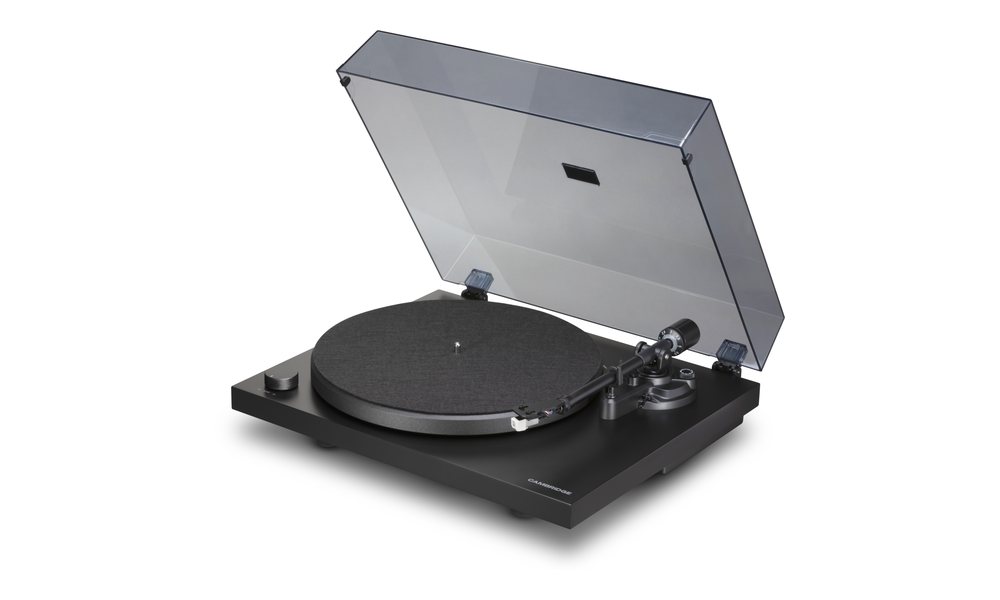
The Cambridge Audio Spira is the new entry point into the London brand's turntable range and is priced well below the Alva models. Cambridge Audio announced it on 14.10.2026. The idea: unpack, connect, put on a record. An Audio-Technica AT3600L is fitted and aligned at the factory, a switchable phono stage allows direct connection to amplifiers without a phono input or to active speakers, and a Bluetooth transmitter sends the record wirelessly to speakers or headphones. Mechanically, the Spira relies on belt drive with a sub-platter, a 1.8 kg steel platter and an aluminium tonearm with adjustable tracking force, adjustable anti-skate and a removable headshell. The RRP in Germany is €349 (as of 26.10.2026, no guarantee). In the Starter field, the Spira lands in rank 9 with an index of 48.
Assumptions
- Manual belt-drive deck with electronic speed switching 33⅓/45; phono stage and Bluetooth switchable
- Assessed as a complete package with factory-fitted AT3600L and dust cover
- Assessment based on manufacturer data and international product launch reports
Technical data (public)
| Drive | Belt on sub-platter · DC motor |
|---|---|
| Speed | 33⅓ / 45 (electronic via dial) · Wow and flutter < 0.15 % |
| Tonearm | Aluminium, straight, removable headshell · effective length 218.5 mm · effective mass 7.3 g · Tracking force and anti-skating adjustable |
| Cartridges | Audio-Technica AT3600L (MM), factory fitted and aligned · recommended tracking force 3–3.5 g · Upgrade stylus 3600LE (elliptical) |
| Platter / plinth | 1.8 kg steel with sub-platter, ball bearing, felt mat · MDF plinth, lacquered, rubber feet |
| Phono / Bluetooth | Built-in RIAA phono stage (switchable, signal-to-noise ratio 60 dB) · Bluetooth transmitter |
| Outputs | RCA (line or phono, switchable) · Ground terminal · no USB |
| Dimensions / weight | 418 × 343 × 122 mm (W × D × H) · 5.95 kg |
| Phono / auto | Yes (switchable) / No (manual) |
| Price guide | DE MSRP 349 € · £329 (UK) · US$499 · As of 26.10.2026 · without guarantee |
Manufacturer specifications (Cambridge Audio)
| Type | manual turntable, belt drive, DC motor |
|---|---|
| Speeds | 33⅓, 45 rpm (electronic dial) |
| Wow and flutter | < 0.15% |
| Tonearm | aluminium, straight, removable headshell, effective length 218.5 mm, effective mass 7.3 g |
| Cartridge (fitted) | Audio-Technica AT3600L (MM), recommended tracking force 3–3.5 g |
| Platter | 1.8 kg steel with sub-platter, ball bearing, felt mat |
| Phono stage | built in (RIAA), switchable, signal-to-noise ratio 60 dB |
| Bluetooth | built-in transmitter |
| Connections | RCA (line/phono), ground terminal, no USB |
| Dimensions | 418 × 343 × 122 mm (W × D × H) |
| Weight | 5.95 kg |
| Power consumption | 5 W |
Source: Cambridge Audio – official specifications · As of 26 October 2026 · subject to change by the manufacturer
Rating criteria in detail
The four criteria feed into the Vinyl BotPro Index with weights of 25/20/25/30. The index is scaled across all tiers (see Methodology); that is why we do not show individual sub-scores.
Strengths
- Ready to play out of the box: cartridge fitted and aligned, phono stage on board
- Bluetooth transmitter for wireless speakers and headphones
- Removable headshell, adjustable tracking force and adjustable anti-skate for later upgrades
- Heavy 1.8 kg steel platter and electronic speed switching via dial
Weaknesses
- AT3600L is a simple MM cartridge with a conical stylus and high tracking force
- No USB output for digitising, no auto-stop
- Cambridge Audio does not state the Bluetooth codecs or version
Comparison models
| Rega Replay | Same price, skeletal chassis, RB110 and Carbon MM – more elaborate deck, but without phono stage and Bluetooth |
|---|---|
| Pro-Ject T1 Phono SB | Similar all-in-one concept with phono stage and electronic speed control, glass platter and Ortofon OM 5E |
| Audio-Technica AT-LP3XBT | Automatic deck with Bluetooth and phono stage – more convenient, but without a removable headshell |
| Teac TN-3B | Belt-drive deck with switchable phono stage, USB and AT-VM95E – more expensive, with a better cartridge |
System matching
Works well with
- Active speakers with a line input, for example from the active bookshelf speakers best-of list
- Amplifiers without a phono input or streaming amplifiers with a line input
- Bluetooth speakers and wireless headphones for quiet listening in the evening
Less suited
- Anyone who wants to digitise records via USB
- Anyone who expects an auto-stop at the end of the record
- Anyone who wants to run a high-quality MC cartridge straight away
Specs & Features
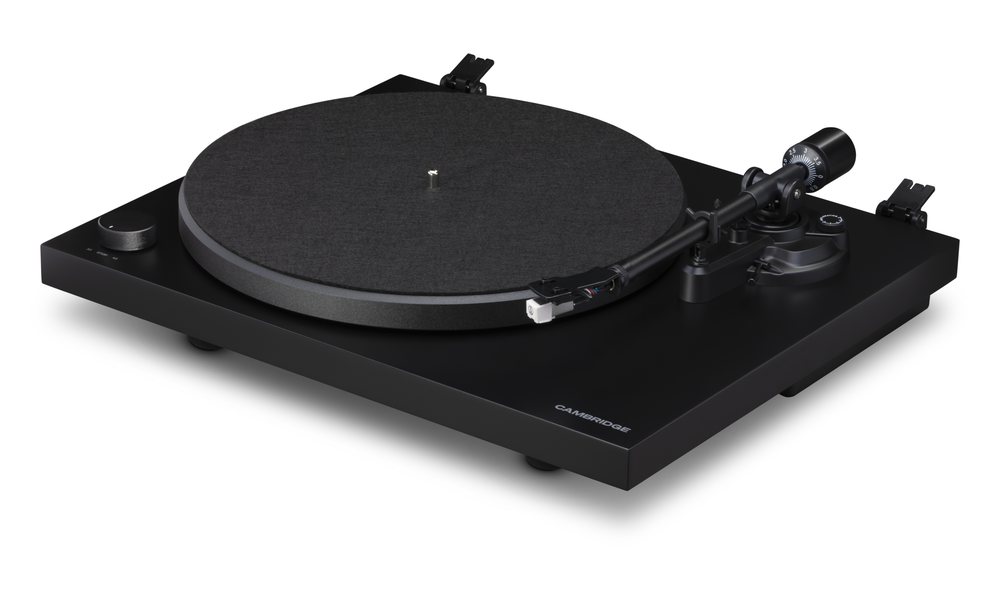
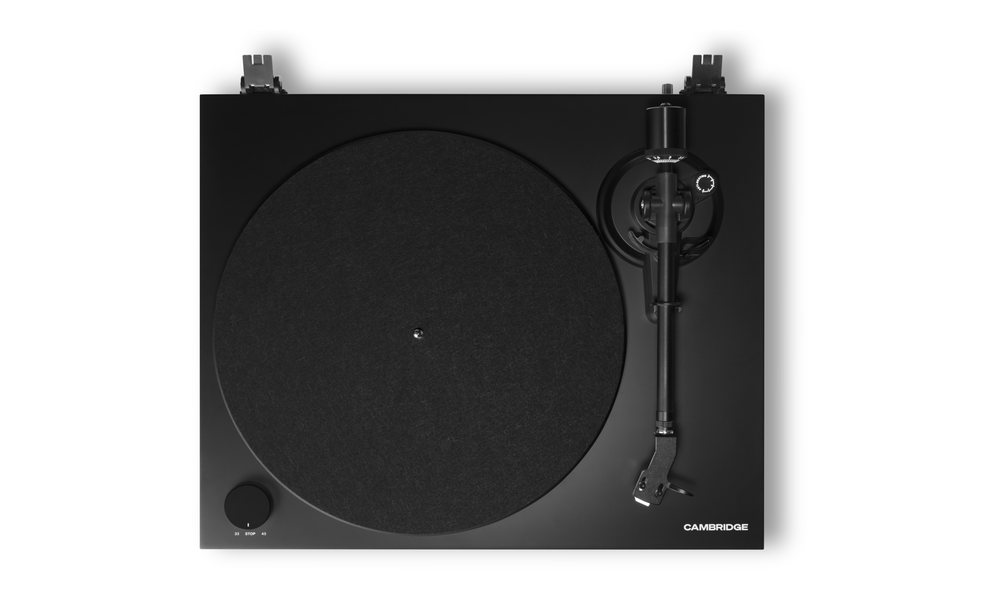
The Spira is a manual belt-drive deck. A DC motor drives a sub-platter via a belt, on which the 1.8 kg steel platter sits with a felt mat; the main bearing is a ball bearing. The plinth is made of lacquered MDF and stands on isolating rubber feet. A dial at the front left switches between 33⅓ and 45 rpm; the belt does not have to be moved. Cambridge Audio quotes wow and flutter below 0.15 per cent.
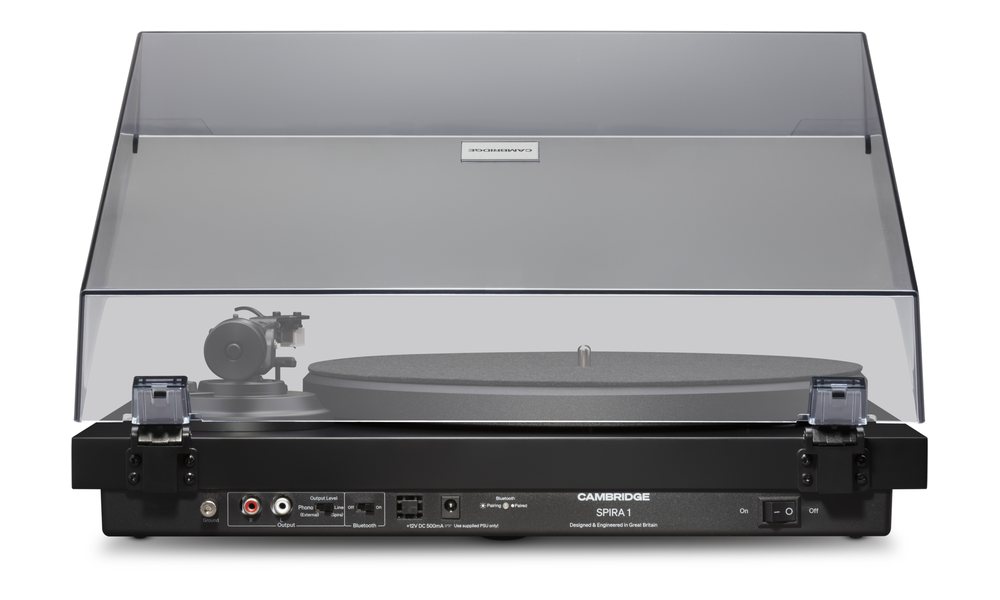
The straight aluminium tonearm has an effective length of 218.5 mm and an effective mass of 7.3 g. Tracking force and anti-skate are adjustable, and the headshell is removable. Fitted is an Audio-Technica AT3600L, an MM cartridge with a conical stylus and a recommended tracking force of 3 to 3.5 g. As the first upgrade step, Cambridge Audio names the elliptical 3600LE replacement stylus. On the rear are an RCA output, a switch between Line (built-in phono stage) and Phono (signal straight from the cartridge), a Bluetooth switch with pairing button and a ground terminal. The box contains a power supply, RCA cable, the removable dust cover, an alignment protractor and a single adapter. Dimensions 418 × 343 × 122 mm, weight 5.95 kg. Available in black, white, blue, green and orange, matching the active speakers of Cambridge Audio's L/R series.
Research Consensus
The sources are Cambridge Audio's press release of 14.10.2026, the product page with a complete data sheet and the international launch reports in the international trade press. Recurring points: the Spira is the brand's most affordable deck to date, it is ready to play out of the box and still upgradeable. The international specialist press places it, by price, between two Bluetooth turntables from Sony, one review sees it as an entry point below the Alva TT V2, and another review highlights the easy operation for vinyl newcomers.
In short: if you want to start with records without extra boxes and already own active speakers, Bluetooth speakers or headphones, the Spira gives you a ready-to-play package that can later grow with a better stylus, a different cartridge or an external phono stage. If you want the more elaborate deck at the same price and already have a phono input, look at the Rega Replay.
For whom / Matching
Arm
The aluminium arm with 7.3 g effective mass suits MM cartridges of medium compliance. Thanks to the removable headshell, a second cartridge can be pre-mounted and swapped quickly.
Phono
With the switch set to Line, the built-in phono stage is active; any line input will then do. If you upgrade later, switch to Phono and use an external phono stage from the phono preamp best-of list.
Budget
At €349 RRP (as of 26.10.2026, no guarantee), the Spira is level with the Rega Replay and below the Teac TN-3B. Around €100 more for a better stylus or a simple phono stage are the most sensible first expenses.
Upgrade
Stylus 3600LE, then an MM cartridge of the next class from the cartridge best-of list on a second headshell, plus an external MM phono stage.
What makes this AI analysis special
AI summary of manufacturer data and international product launch reports, published twelve days after the Spira was announced. VinylCination does not have its own listening tests or measurements — each source is linked. Prices and availability change (as of 26.10.2026, without guarantee).
Vinyl BotPro Score Logic
The Vinyl BotPro Index is scaled across all tiers, 0–100. Starter typically sits at ~40–54. The Spira receives 48 (rank 11 Starter): a high features share thanks to the switchable phono stage, Bluetooth transmitter and removable headshell, a good value weighting, but a restrained expected performance because of the simple conical AT3600L. It ranks ahead of the Teac TN-3B (also 48) because it offers similar features at around €100 less; the Audio-Technica AT-LP120XUSB (49) is just ahead. The champion seals remain unchanged: sound Rega Planar 1, value for money Pro-Ject Essential III. Weights: technology/build ~25 · features ~20 · performance (expected) ~25 · value ~30. Rank ≠ lab rating – no listening test of our own. Details: Details on weighting · Methodology.
Created by Vinyl BotPro (AI) · AI analysis · As of 26.10.2026 · Corrections: info@vinylcination.de · Prices without guarantee.
Manufacturer and concept
Cambridge Audio was founded in Cambridge in 1968 and today develops its products in London. The brand is best known for integrated amplifiers, CD players and streamers, and for some years it has also made turntables: the direct-drive Alva TT with Bluetooth came first, followed by the belt-driven Alva ST and the Alva TT V2. All three sit well above the starting budget of many newcomers to vinyl. The Spira is designed to close exactly this gap.
Cambridge Audio describes the Spira as a turntable that fits any system and grows with a record collection. The package is put together so that nothing is missing on the first evening: the cartridge is fitted and aligned, a phono stage is built in, and a Bluetooth transmitter is on board. At the same time, the manufacturer has included the parts you need for later improvements: a removable headshell, adjustable tracking force and adjustable anti-skate, plus an output that also delivers the signal without the built-in preamp. The Spira was announced on 14 October 2026 and costs €349 in Europe.
Technology explained
Belt drive with sub-platter
In the Spira, a DC motor drives a small sub-platter via a belt. The main platter sits on top of it. The belt decouples motor vibration from the platter, so less running noise reaches the groove. Speed is switched electronically: a dial on the plinth selects 33⅓ or 45 rpm without moving the belt. Cambridge Audio quotes wow and flutter of less than 0.15 per cent.
Heavy steel platter
The steel platter weighs 1.8 kg. Mass in the platter acts like a flywheel: small irregularities in the drive are smoothed out and the speed stays more stable. A felt mat damps the resonances of the metal and stops the record from slipping. The main bearing is a ball bearing. The plinth is made of lacquered MDF, the feet of isolating rubber.
Tonearm and cartridge
The straight aluminium tonearm has an effective length of 218.5 mm and an effective mass of 7.3 g. A counterweight with a scale sets the tracking force, a separate control sets the anti-skate. Fitted at the factory is the Audio-Technica AT3600L, a robust MM cartridge with a conical stylus that tracks at 3 to 3.5 g. Conical styli are tolerant of small alignment errors but trace fine groove modulations less precisely than elliptical profiles. That is why Cambridge Audio names the elliptical 3600LE replacement stylus as the first upgrade step.
Phono stage and Bluetooth
A cartridge delivers only a few millivolts and needs equalisation to the RIAA curve. In the Spira this job is done by a built-in phono stage with a signal-to-noise ratio of 60 dB. A switch on the rear selects between Line (with preamp) and Phono (without). The Bluetooth transmitter sends the signal to wireless speakers or headphones; Cambridge Audio does not state which codecs it supports.
Sound according to international reviews
This assessment is based on the manufacturer's data and the international launch coverage in the international trade press. The international specialist press places the Spira, by price, between two Bluetooth turntables from Sony that the magazine rated five stars, which makes clear which competition it faces. One review highlights the heavy platter, the ground terminal and the isolating feet, which are meant to keep hum and rumble out of the signal. Another review stresses the deliberately simple operation. The technology indicates where the Spira is aimed: stable, quiet running thanks to the belt and steel platter, a forgiving but not particularly high-resolution cartridge, and sonic headroom that can be unlocked with a new stylus or cartridge.
Features and everyday use
Setting it up is quick: place the platter, loop the belt over the sub-platter, screw on the counterweight and set it to the recommended tracking force, then set the anti-skate to the same value. An alignment protractor is included, but it is not needed at first because the cartridge is aligned at the factory. The dust cover is removable and folds back during play.
There are three ways to connect it. With the switch set to Line, the Spira goes straight into any line input of an amplifier, a streaming amplifier or active speakers. With the switch set to Phono, it belongs on a phono input or an external phono stage. Via Bluetooth it reaches wireless speakers and headphones, which Cambridge Audio also suggests for late-night listening without a cable across the room. There is no USB output for digitising records and no auto-stop either: at the end of the record you lift the arm by hand.
Who it suits
The Spira is aimed at beginners who are starting out with records and do not want to put together separate components. It makes particular sense if you already own active speakers, an amplifier without a phono input or good Bluetooth headphones. If you like the colours, you can pair it with Cambridge Audio's matching L/R active speakers. It is less suitable for listeners who want to digitise records, are looking for an automatic deck or want to run a high-quality MC cartridge from day one.
Comparison with alternatives
At the same price, the Rega Replay sits in 3rd place in the Starter tier. It offers the more elaborate deck with a skeletal chassis, RB110 arm and Carbon MM, but does without a phono stage and Bluetooth. The Pro-Ject T1 Phono SB follows a similar all-in-one concept with a phono stage and electronic speed control. If you want convenience, the Audio-Technica AT-LP3XBT is an automatic deck with Bluetooth. The Teac TN-3B costs around €100 more but comes with an AT-VM95E and a USB output. The champions of the tier are the Rega Planar 1 (Sound) and the Pro-Ject Essential III (value).
More questions about the Cambridge Audio Spira
Do I need an amplifier with a phono input for the Spira?
No. With the switch set to Line, the built-in phono stage is active and the Spira connects to any line input or to active speakers. A phono input is only needed if you want to bypass the built-in preamp.
Which cartridge is fitted?
An Audio-Technica AT3600L with a conical stylus, fitted and aligned at the factory. As an upgrade, Cambridge Audio names the elliptical 3600LE replacement stylus.
Can I use the Spira with Bluetooth headphones?
Yes. The built-in Bluetooth transmitter pairs with wireless headphones or speakers. Cambridge Audio does not state the supported codecs.
How much does the Spira cost and when is it available?
The RRP is €349, £329 in the UK and US$499 in the USA (as of 26 Oct 2026, no guarantee). Cambridge Audio has been selling it since 14 October 2026 through its own shop and specialist retailers.
Verdict
The Cambridge Audio Spira is a well-thought-out starter package: ready to play out of the box, with a phono stage, a Bluetooth transmitter and a heavy steel platter, plus the adjustments you need for later improvements. With an index of 48 it ranks 9th in the Starter tier. If you want to play records through active speakers or headphones without extra boxes, it belongs on your shortlist; if you already have a phono input and want the more elaborate deck, the Rega Replay is the alternative at the same price.
Sources
Read more: best turntables 2026 · What is hi-fi?