
Turntable · AI analysis · Starter, rank 3
Rega Replay Review
AI analysis (research): Rega's new entry-level deck below the Planar 1 – skeletal low-mass chassis as on the Planar 8 and 10, RB110 tonearm, factory-aligned Carbon MM and 23 mm phenolic platter for €349 – guidance from manufacturer data and an international listening test, no listening test of our own.
Summary
The Rega Replay is the new entry point into Rega's turntable range and sits below the Planar 1. Instead of a full plinth, a skeletal low-mass chassis with an MDF core carries bearing, motor and tonearm – the principle of the flagship Planar 8, Planar 10 and Naia in entry-level form. It adds the hand-assembled RB110 with fixed bias, the factory-aligned Carbon MM and the 23 mm phenolic platter of the Planar 1. RRP €349 (as of 22.10.2026, no guarantee), in the UK £259. In the Starter field, the Replay lands in rank 3 with an index of 52 – right behind the two champions Rega Planar 1 (sound) and Pro-Ject Essential III (value for money).
Assumptions
- Manual belt-drive deck without built-in phono stage; speed change 33⅓/45 by moving the belt by hand
- Rated as a complete package with factory-fitted Carbon MM and dust cover
- Listening findings exclusively from published international reviews
Technical data (public)
| Drive | Belt (EBLT Advanced) on sub-platter · 24 V low-noise synchronous motor (AC) as a module |
|---|---|
| Speed | 33⅓ / 45 (manual, move the belt) |
| Tonearm | RB110 (hand-assembled) · bias fixed · 111 g counterweight with end stop |
| Cartridges | Rega Carbon MM, factory fitted and aligned, replaceable stylus |
| Platter / chassis | 23 mm phenolic resin with flywheel mass · Skeletal chassis with black MDF core, laminated |
| Power supply | Rega PS2 (plug-in power supply 24 V, 100 mA) |
| Outputs | RCA (phono), earth internally via the left channel |
| Dimensions / weight | 415 × 115 × 320 mm (W × H × D, with lid) · 2.2 kg |
| Phono / auto | No / No (manual) |
| Price guide | MSRP €349 · £259 (UK) · US$395 · As of 22.10.2026 · without guarantee |
Manufacturer specifications (Rega)
| Type | belt drive (EBLT Advanced), 24 V low-noise synchronous motor |
|---|---|
| Speeds | 33⅓, 45 rpm (manual via belt) |
| Tonearm | Rega RB110 (hand-assembled, 111 g counterweight) |
| Cartridge (fitted) | Rega Carbon (MM), factory fitted and aligned, replaceable stylus |
| Platter | 23 mm phenolic resin |
| Bearing | factory-sealed precision main bearing |
| Power supply | Rega PS2 (100 mA) |
| Connection | RCA phono cable, earth internally via left channel |
| Dimensions | 415 × 115 × 320 mm (W × H × D, with lid) |
| Weight | 2.2 kg |
Source: Rega – official specifications · As of 22 October 2026 · subject to change by the manufacturer
Rating criteria in detail
The four criteria feed into the Vinyl BotPro Index with weights of 25/20/25/30. The index is scaled across all tiers (see Methodology); that is why we do not show individual sub-scores.
Strengths
- Skeletal chassis modelled on the Planar 8, Planar 10 and Naia
- RB110, Carbon MM and phenolic platter from the Planar 1
- Setup in about a minute: push the counterweight to its stop, done
- Handmade in the UK, lifetime manufacturer warranty against manufacturing defects
Weaknesses
- No built-in phono stage; amplifier with MM input or separate phono stage required
- Bias and feet not adjustable; needs a level, stable surface
- 45 rpm only by moving the belt; dust cover removable rather than hinged
Comparison models
| Rega Planar 1 | Same arm, same cartridge, same platter in a conventional plinth with hinged lid; Starter sound champion |
|---|---|
| Pro-Ject Essential III | Starter value-for-money champion with Ortofon OM10 – similar price, different arm and deck philosophy |
| Pro-Ject T1 Phono SB | With phono stage and electronic speed change – more convenience, glass instead of phenolic platter |
| Pro-Ject Primary E | Cheaper entry with OM cartridge – less engineering in the deck |
System matching
Works well with
- Amplifiers with an MM phono input (e.g. Rega Io) or a compact MM phono stage
- Newcomers who want to play records without scales and protractors
- Compact bookshelf speakers in a living room or study
Less suited
- Anyone expecting USB, Bluetooth or auto-stop
- Anyone who often swaps cartridges and wants to fine-tune bias
- Placement on wobbly furniture right next to the speakers
Specs & Features
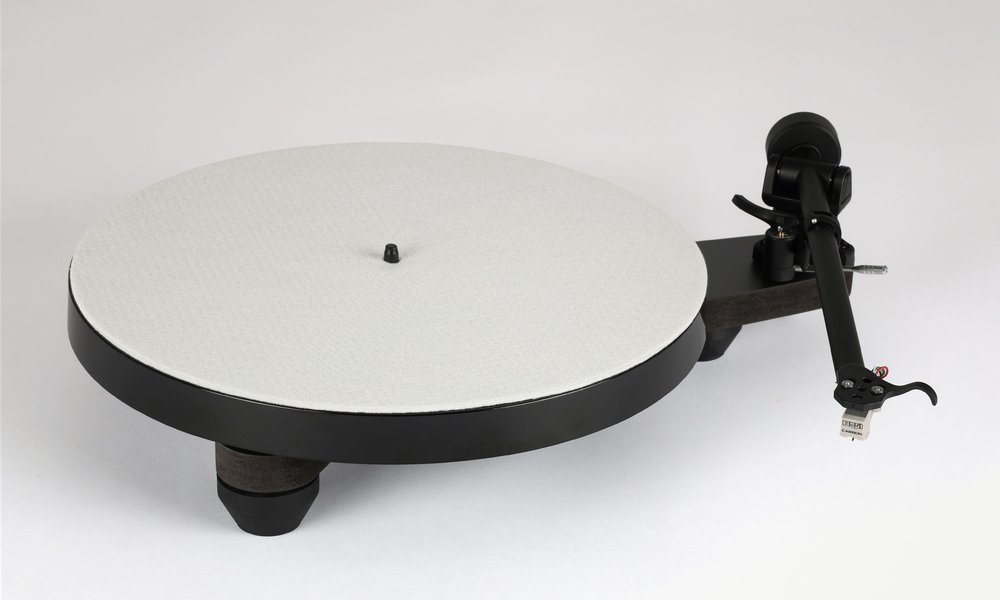
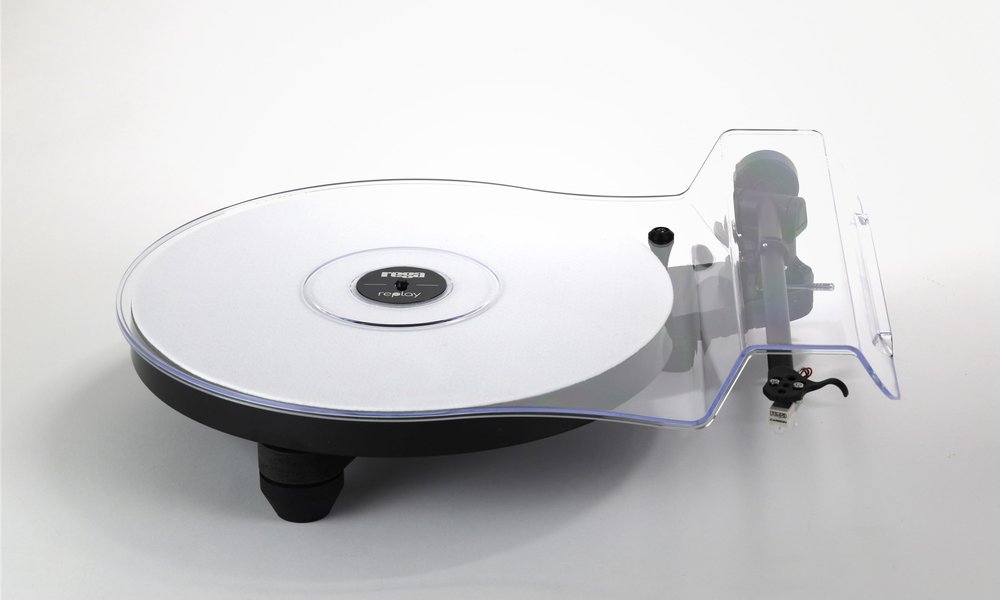
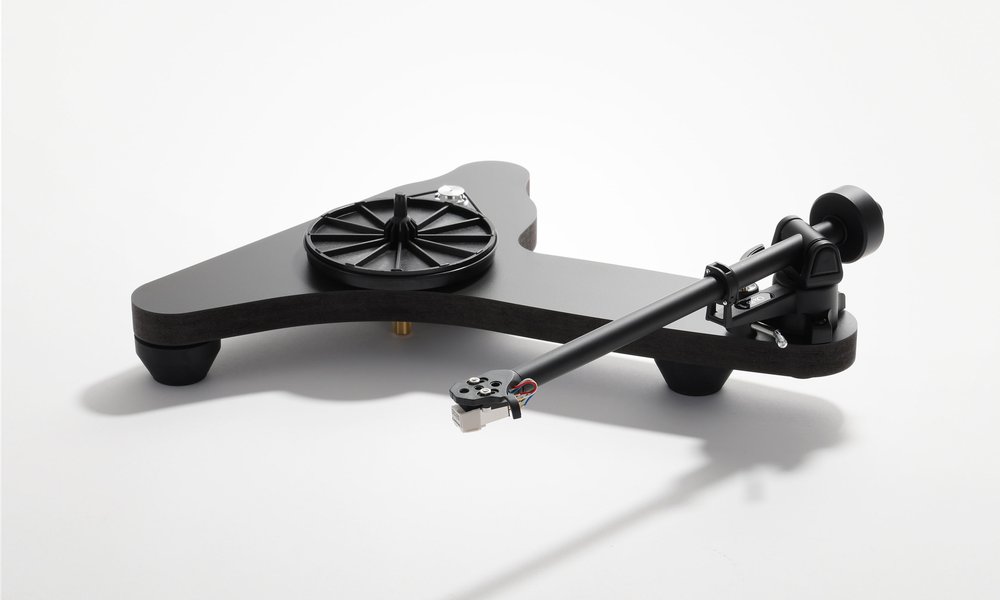
The Replay is a manual belt-drive deck. The chassis is reduced to the essentials: it connects only the main bearing, motor and tonearm base and consists of a black MDF core laminated on both sides. Below it sit three newly designed feet. A round belt (EBLT Advanced) drives a sub-platter that carries the 23 mm phenolic platter with its flywheel mass at the rim. The main bearing sits in a newly designed brass housing (patent pending).
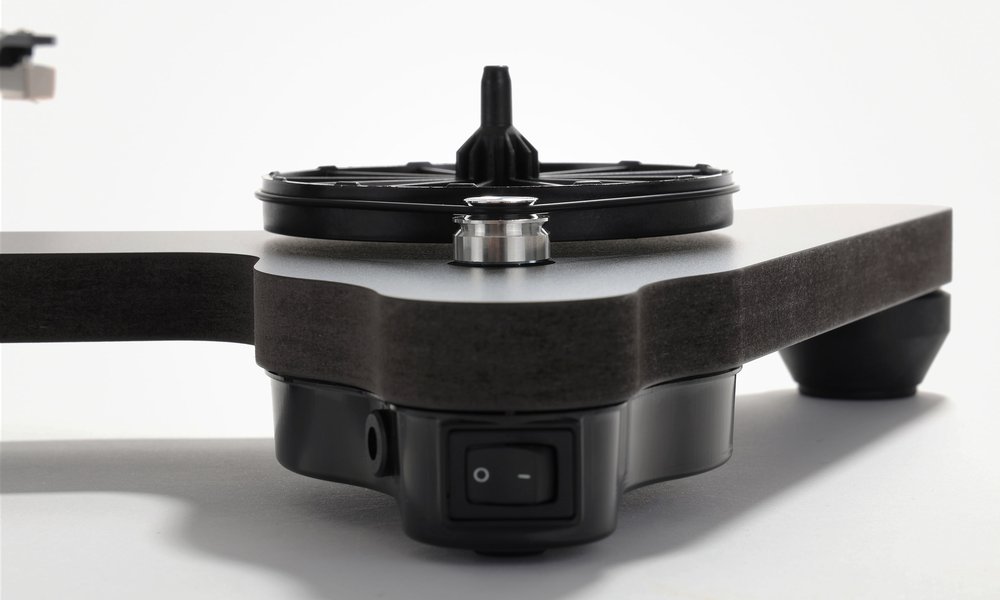
The RB110 runs in Rega's own patented precision bearings. Bias is set at the factory, and the 111 g counterweight is pushed on as far as its stop – which sets the correct tracking force for the factory-fitted Carbon MM. The 24 V synchronous motor sits in its own module with a new circuit board, CNC-machined aluminium pulley, power switch, power inlet and rear foot. The PS2 plug-in power supply and a removable dust cover that follows the shape of the chassis are included. Dimensions 415 × 115 × 320 mm, weight 2.2 kg. RRP €349 (as of 22.10.2026, no guarantee); in Germany, the market launch has been announced for November 2026.
What international reviewers heard
Several reviews from the international specialist press are available for the Rega Replay. Here we summarise the overall picture in our own words; all sources are linked at the end of the page.
Sound character
- One review hears a coherent, well-timed presentation with clear imaging and wide bandwidth. According to the review, the Replay conveys the musical message of a record so directly that it is easy to get lost in the music.
Tonal balance
- Tonally, one review describes the Replay as more even-handed than many decks in this class. Recordings and performers are presented evenly, without any frequency range being pushed forward.
Dynamics, bass & staging
- With rock from Jeff Beck and electronica from The Prodigy, the Replay shows strong, muscular bass and plenty of energy according to the review, even on heavily compressed recordings. Cymbals come across as incisive and bright.
Strengths
- Another review names the very low price for a complete UK-built deck with arm and cartridge, the simple setup and the rigid, minimal plinth as strengths. Solo violin is also rendered with convincing timbre.
Setup, room & partners
- Listening was done with a Rega Aria phono stage. One international review recommends a stable, level surface rather than a sideboard next to the speakers, because the feet are not adjustable. Without a phono input on the amplifier, a separate phono stage is needed.
Consensus & differences
- In a direct comparison, a run-in Planar 1 sounded somewhat more refined and better timed in the treble; the Replay improved audibly with playing time. For very dense jazz guitar material, a further review sees an upgrade to a Rega Nd3 as worthwhile.
Research Consensus
The sources are already good for a model presented in October 2026: Rega's product page with a detailed data sheet, international presentations and a first listening test from the specialist press. Recurring patterns: the Replay takes arm, cartridge, platter and motor principle from the Planar 1 and replaces the plinth with a skeletal chassis of the kind Rega has so far reserved for its expensive models. A second review sees it as a direct challenger to the long-standing budget favourite Pro-Ject Primary E. One international review stresses that Rega credits the Replay with performance close to the Planar 1. The verdict of international reviews is assessed in detail in the section What the international specialist press hears.
For whom / Matching
Arm
The RB110 is matched to Rega's own MM cartridges; the fixed bias suits the Carbon and the Nd models. A later switch to the Rega Nd3 or the Carbon Pro replacement stylus (elliptical profile) is the obvious upgrade path.
Phono
A phono stage is mandatory: either the amplifier's MM input or a separate MM phono stage. Rega itself names the Io, the Brio and the Fono Mini A2D as partners.
Budget
At an RRP of €349 (as of 22.10.2026, no guarantee), the Replay sits around €50 below the Planar 1 and level with the Essential III. Setting aside some budget for a stable support pays off, because the feet are not adjustable.
Upgrade
Carbon Pro stylus or Nd3 cartridge, plus a better phono stage. Step-up paths within Rega: Planar 1 Plus with built-in phono, Planar 3 and Planar 3 RS.
What makes this AI analysis special
This section is an AI summary of published international listening reviews and the manufacturer data from Rega. Vinyl BotPro puts the reviewers’ findings into context and links them with the data sheet and comparison models; VinylCination does not run its own listening tests or measurements; all sources are linked at the end of the page. Prices and availability change (as of Oct. 2026, no guarantee); please check technical values against the current data sheet.
Vinyl BotPro Score Logic
The Vinyl BotPro Index is scaled across all tiers, 0–100. Starter typically sits at ~40–54. The Replay receives 52 (rank 3 Starter): a high technology/build share thanks to the skeletal chassis, RB110 and phenolic platter, a very strong value-for-money weighting, offset by lean features without phono and with manual speed change. The index puts the Planar 1 (54) narrowly ahead, because the first listening comparison credits it with a little more refinement in the treble and it comes with a hinged lid. Compared with the Pro-Ject T1 Phono SB (also 52), the Replay ranks ahead because it offers more elaborate deck engineering at a lower price. The champion seals remain unchanged: sound Rega Planar 1, value for money Pro-Ject Essential III. Weights: technology/build ~25 · features ~20 · performance (expected) ~25 · value for money ~30. Rank ≠ lab rating – no listening test. Details: Details on weighting · Methodology.
Created by Vinyl BotPro (AI) · AI analysis · As of 22.10.2026 · Corrections: info@vinylcination.de · Prices without guarantee.
Manufacturer and concept
Rega has built turntables in Southend-on-Sea, England, for more than 50 years and still makes tonearms, cartridges and decks in its own factory. One principle runs through every model: as little mass in the chassis as possible, combined with high rigidity. A light, stiff structure stores less vibrational energy and releases it faster, so the arm and stylus can work in the groove with less interference. Rega applied this idea most consistently in its flagship models Planar 8, Planar 10 and Naia: there is no plinth any more, just a skeleton that connects bearing, motor and tonearm. The ancestor of this design is the Naiad research project.
With the Replay, Rega brings this idea to the entry level for the first time in autumn 2026. According to the manufacturer, three years of development went into the model, which now sits below the Planar 1 as the most affordable Rega deck. Rega itself calls the Replay, with a wink, the audiophile gateway drug. The goal is clearly stated: a turntable that even newcomers can have playing in under a minute, without scales, protractors or jargon.
The technology explained
Skeletal chassis instead of a plinth
The Replay's chassis is a flat part with a black MDF core, laminated on the top and bottom. It is roughly triangular with rounded corners and carries only what it has to carry. One review puts its thickness at 19 mm. Unlike the Planar 8 and 10, the core is MDF rather than special foam – a cost decision that keeps the basic idea intact. Three newly designed rubber feet isolate the deck from its support.
Platter, bearing and drive
The platter is the same as the Planar 1's: 23 mm of phenolic resin, a hard plastic with a reinforced outer rim. The mass at the rim acts like a flywheel and stabilises speed. The platter sits on a sub-platter that a round belt drives from the motor. Rega uses this principle on all its models; motor irregularities are meant to reach the platter less than with a long belt around the platter rim. The main bearing runs in a newly designed brass housing, for which Rega has filed a patent.
The motor is a 24 V synchronous motor of the kind Rega uses in every deck. What is new is the motor module: it combines the circuit board, CNC-machined aluminium pulley, power switch, power inlet, ventilation and rear foot in one part. For 45 rpm, the belt is moved by hand to the larger step of the pulley.
Tonearm and cartridge
The RB110 is Rega's simplest tonearm, but it uses the same in-house precision bearings as the larger models and a stiff aluminium tube. Bias is fixed and matched to Rega's MM cartridges. The counterweight has an end stop: push it all the way on and the tracking force is right for the factory-fitted Carbon. The Carbon's stylus is replaceable; as an upgrade, Rega offers the Carbon Pro replacement stylus with an elliptical profile.
Sound according to international reviews
The first listening review was published in the international trade press. The reviewer used the Replay with a Rega Aria phono stage and compared it with a run-in Planar 1. His findings: coherent timing, clear imaging and wide bandwidth, plus an even-handed tonal balance and strong bass with rock and electronica. The run-in Planar 1 sounded somewhat more refined in the treble, but the Replay improved audibly with playing time. For very dense material, one review recommends a better cartridge such as the Nd3 later on. The launch reports in the international trade press describe the concept and technology.
Features and everyday use
Setup is deliberately short: remove the card shim under the sub-platter, fit the platter and mat, push the counterweight to its stop, take off the stylus guard, connect the power supply and RCA cable. The mat has a textured underside that grips the equally textured platter. The dust cover is a removable lid that locates on the spindle and a hole next to the arm. It protects platter and arm when not in use and comes off for listening.
Because the feet and bias are not adjustable, the Replay should stand on a level, stable surface – a sturdy shelf or a wall bracket is better than a sideboard right next to the speakers. There is no built-in phono stage. The amplifier therefore needs an MM phono input; otherwise a separate phono stage is required.
Who it suits
The Replay is aimed at newcomers looking for a genuine hi-fi turntable without any adjustment work, and at anyone who wants to build a compact Rega system with an amplifier such as the Io. It also works as a second deck, for example in a study. It is less suited to listeners who expect conveniences like electronic speed change, Bluetooth or a built-in phono stage, and to tinkerers who frequently swap cartridges and want to set every parameter themselves.
Comparison with alternatives
- Rega Planar 1: same arm, same cartridge and same platter in a conventional plinth with hinged lid, around €50 more.
- Pro-Ject Essential III: similar price, Ortofon OM10 and MDF platter.
- Pro-Ject T1 Phono SB: with built-in phono stage and speed button, but a simpler arm.
- Pro-Ject Primary E: cheaper and also ready to play straight away, with less engineering in the deck.
All models are listed with index and price in the turntable rankings and in the belt-drive sub-list.
More questions about the Rega Replay
How does the Replay differ from the Planar 1?
Mainly in the chassis: the Replay uses a skeletal low-mass chassis, the Planar 1 a conventional plinth with hinged lid. Arm, cartridge, platter and motor principle are closely related. The Replay also has a synthetic mat instead of felt, the motor module with power switch and the removable dust cover.
Do I need a phono stage for the Replay?
Yes. The Replay has no built-in phono stage. An amplifier with an MM phono input is enough; otherwise you need a separate MM phono stage between the turntable and the amplifier.
Can I upgrade the cartridge later?
Yes. The simplest step is the Carbon Pro replacement stylus with an elliptical profile. For more, fit a Rega Nd3. Because bias is fixed, Rega's own MM cartridges are the best match.
How do you switch to 45 rpm?
Lift off the platter and move the belt to the larger step of the pulley. Rega also offers a 45 rpm adaptor for singles with a large centre hole.
Verdict
The Rega Replay brings the skeletal principle of Rega's flagship models to the entry level and combines it with proven parts from the Planar 1. Manufacturer data and a review’s first listening review paint the picture of a deck that convinces with good timing, an even tonal balance and strong bass, and that can be set up in a minute. In return, it does without a phono stage, electronic speed change and adjustable feet. In the Starter level of our rankings it sits in 3rd place with an index of 52.
Sources
- Rega — Replay (product page, technical data)
- Rega — Replay announcement (23.09.2026)
- The Ear — Rega Replay steals budget turntable crown (listening review)
- What Hi-Fi? — Rega Replay launch report
- StereoNET — Rega Replay Spins Up Affordable Vinyl Thrills
- Darko.Audio — Rega’s new $395 Replay turntable goes skeletal
Read more: best turntables 2026 · What is hi-fi?