
Cartridge · AI analysis · Master, rank 5
Dynavector XV Prima Review
AI analysis (research): Dynavector's new low-output MC in the XV series with an open V body, eight Alnico magnets, a boron cantilever and, for the first time, specially annealed magnets – guidance from manufacturer data and international reviews, no in-house listening test.
Summary
The Dynavector XV Prima is the new foundation of the Japanese manufacturer's XV line and, at its core, a further development of the XV-1s, the brand's long-standing cult cartridge. What is new is the Special Annealing process, a finely tuned heat treatment that Dynavector now applies not only to the pole piece and yokes but, for the first time, also to the eight Alnico magnets. On top of that come the open V-shaped body, a four-part magnetic equaliser, two flux dampers, a short 6 mm cantilever of solid boron and a mount made of aluminium and African ebony. The price in Germany is approx. €5,200–6,000 (as of 03.11.2026, without guarantee). In the Master field the XV Prima lands at rank 5 with Index 94 – directly behind the Ortofon MC Windfeld Ti and ahead of the Hana Umami Red.
Assumptions
- Low-output MC with 0.28 mV: needs an MC phono stage with plenty of gain or a step-up transformer
- Assessment for high-quality turntables with tonearms of medium to higher effective mass, careful alignment assumed
- Listening findings exclusively from published international reviews
Technical data (public)
| Type | moving coil, low output · open V body · eight Alnico magnets · flux damper |
|---|---|
| Stylus / Cantilever | PF line contact, radius 7 × 30 µm · 6 mm cantilever of solid boron |
| Output / Impedance | 0.28 mV (1 kHz, 5 cm/s) · internal impedance 6 Ω |
| Channel separation / balance | 30 dB (1 kHz) · 1.0 dB balance |
| Frequency response | 20 Hz–20 kHz (±1 dB) |
| Compliance / VTF | 10 mm/N · 1.8–2.2 g |
| Load | > 30 Ω |
| Body / weight | open construction, mount of aluminium and African ebony · 12.6 g |
| Price guide | approx. €5,200–6,000 · £4,495 · As of 03.11.2026 · without guarantee |
Manufacturer specifications (Dynavector)
| Type | moving coil, low output · eight Alnico magnets · flux damper |
|---|---|
| Output voltage | 0.28 mV (1 kHz, 5 cm/s) |
| Channel separation | 30 dB (1 kHz) |
| Channel balance | 1.0 dB (1 kHz) |
| Frequency response | 20 Hz–20 kHz (±1 dB) |
| Compliance | 10 mm/N |
| Tracking force | 1.8–2.2 g |
| Internal impedance | 6 Ω |
| Recommended load | > 30 Ω |
| Cantilever | 6 mm solid boron |
| Stylus | PF line contact, radius 7 × 30 µm |
| Weight | 12.6 g |
Source: Dynavector – official specifications · As of 3 November 2026 · subject to change by the manufacturer
Rating criteria in detail
The four criteria feed into the Vinyl BotPro Index with weights of 25/20/25/30. The index is scaled across all tiers (see Methodology); that is why we do not show individual sub-scores.
Strengths
- Magnetic circuit with eight Alnico magnets that receive the special annealing themselves for the first time
- Short boron cantilever and line-contact stylus for fine groove tracing
- In the published review fast, deep and controlled bass, open voices
- Open construction without a body, mount of aluminium and ebony
Weaknesses
- Only 0.28 mV: needs a quiet, powerful MC stage or a step-up transformer
- No high-output version, as across the whole XV series
- Exposed coils without protection: mounting and cleaning call for care
- Tracking force and loading need some experimentation
Comparison models
| Ortofon MC Windfeld Ti | Rank 4 in a similar price field: boron cantilever, Replicant 100 stylus, titanium body and more output voltage |
|---|---|
| Hana Umami Red | Sound champion of the Master level, considerably cheaper, voiced rather warm and colourful |
| Dynavector Te Kaitora Rua | In-house alternative with neodymium instead of Alnico and a closed body, around €2,000 cheaper |
| Audio-Technica AT-MCD1 | Rank 3, diamond cantilever and much more output – almost twice the price |
System matching
Works well with
- Low-noise MC phono stages with 60 dB or more and a load from about 100 Ω
- Tonearms of medium to higher effective mass with precise azimuth and VTA adjustment
- Listeners who put pace, bass grip and detail above warm colouration
Less suited
- Phono stages with limited MC gain or audible noise
- Very light tonearms built for high-compliance cartridges
- Anyone looking for a robust body for frequent swapping
Specs & Features
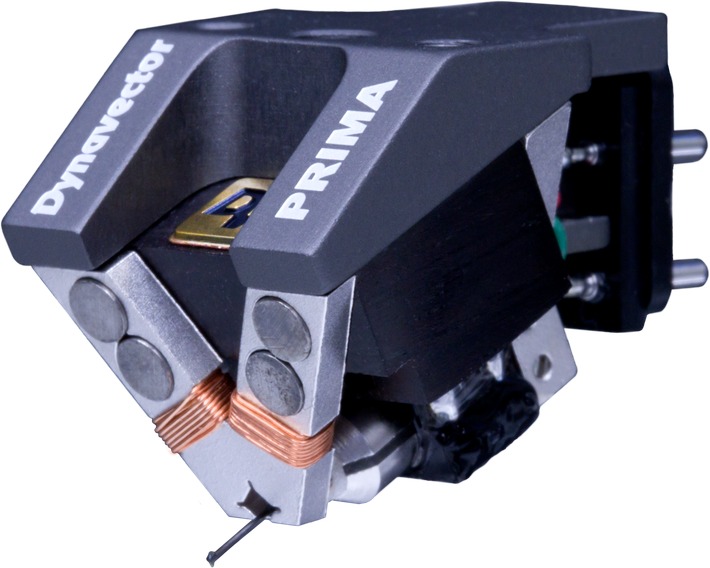
The XV Prima is a low-output moving-coil cartridge. Its coils sit on a square armature at the end of the cantilever, and the magnetic flux comes from eight Alnico magnets: four large ones link the V-shaped front and rear yokes, four small ones sit right next to the armature, one per coil. A four-part equaliser and a square aperture in the front yoke give each coil its own magnetic path. Two flux dampers made of short-circuited wire surround the front yoke. The key figures: 0.28 mV output, 6 Ω internal impedance, recommended load above 30 Ω, compliance 10 mm/N, tracking force 1.8–2.2 g, weight 12.6 g.
The cantilever is made of solid boron and only 6 mm long, and the stylus has a PF line-contact profile with a 7 × 30 µm radius. There is no protective body: the magnet system hangs from a mount of precision-machined aluminium and African ebony, which Dynavector chose for its high density and natural damping. The price is approx. €5,200–6,000 (as of 03.11.2026, without guarantee).
What international reviewers heard
For the Dynavector XV Prima there is an in-depth British review, complemented by a listening report from Japan. Here we summarise the overall picture in our own words; all sources are linked at the end of the page.
Sound character
- The basic character is dynamic, fast and very controlled: the cartridge conveys the pace and energy of a recording effortlessly while keeping even dense, multi-layered arrangements cleanly in check.
Tonal balance
- Voices sound open and clearly articulated. On recordings that tend to sound shouty, the XV Prima takes the edge off without losing the power of the voice.
Dynamics, bass & staging
- The bass is singled out in particular: deep, fast, agile and rock solid, together with tight, snappy drums and a clear sense of how hard they are being hit.
Strengths
- Fine details such as the touch and playing style of individual musicians remain audible, and quiet, intimate recordings keep their atmosphere. Nothing in the test programme unsettled the cartridge.
Setup, room & partners
- In the test the XV Prima worked best at a tracking force of 2 g, right in the middle of the recommended range. On an adjustable MC stage, a load of about 120 Ω and around 60 dB of gain proved effective.
Consensus & differences
- The verdict is wholeheartedly positive, and the price is considered justified despite its absolute level. The only caveats mentioned are the low output, the lack of a high-output version and some fine-tuning of tracking force and loading.
Research Consensus
For a flagship-class cartridge presented in June 2026, the body of sources is limited but clear: a detailed manufacturer page with data sheet and manual, an in-depth British review from October 2026 and a listening report in the Japanese specialist press in autumn 2026. Recurring patterns: the XV Prima is regarded as very dynamic, fast and detailed, with particularly tight, deep bass and open voices, without becoming hard. There is also agreement that the low output demands a good MC stage and that tracking force and loading need some fine-tuning. The verdict of international reviews is assessed in detail in the section What the international specialist press hears.
For whom / Matching
Arm
At 12.6 g and 10 mm/N, the XV Prima is on the stiff and heavy side. It suits tonearms of medium to higher effective mass; with very light arms the resonance frequency moves too high. Azimuth and vertical tracking angle should be finely adjustable, because the line-contact stylus is sensitive to them.
Phono
0.28 mV is not much. What is needed is an MC phono stage with around 60 dB of gain and very low self-noise, or a step-up transformer. Dynavector specifies a load of more than 30 Ω; in the published review, values around 120 Ω proved effective.
Budget
At approx. €5,200–6,000 (as of 03.11.2026, without guarantee), the XV Prima sits in the Master field between the Hana Umami Red and Lyra Kleos on one side and the Audio-Technica AT-MCD1 and Ortofon MC Vertex on the other. For mounting, a good alignment protractor or an appointment with a specialist dealer is worthwhile.
Upgrade
Anyone coming from a DV 20X2A, XX-2 or Te Kaitora Rua stays with the brand's sound character and gains the more elaborate Alnico magnetic circuit. Within Dynavector, only the XV Ultima sits above it.
What makes this AI analysis special
This section is an AI summary of published international reviews and Dynavector's manufacturer data. Vinyl BotPro puts the findings into context and links them with the data sheet and comparison models; VinylCination does not run its own listening tests or measurements, and all sources are linked at the end of the page. Prices and availability change (as of Nov. 2026, no guarantee); please check technical values against the current data sheet.
Vinyl BotPro Score Logic
The Vinyl BotPro Index is cross-tier 0–100. Master typically sits at ~85–97. The XV Prima receives 94 (rank 5 Master): very high scores for technology/build thanks to the annealed Alnico magnetic circuit and the open V construction, a strong performance expectation from the international reviews and a fair price for this class. The MC Windfeld Ti (95) is just ahead because more reviews are available for it and its higher output makes it easier to connect. The XV Prima is ahead of the Hana Umami Red (93) because of its more elaborate technology and the higher resolution described in the reviews. The champion seals remain unchanged: sound Hana Umami Red, value for money Audio-Technica AT-ART9XI. Weights: technology/build ~25 · features ~20 · performance (expected) ~25 · value for money ~30. Rank ≠ lab rating – no listening test. Details: Details on weighting · Methodology.
Created by Vinyl BotPro (AI) · AI analysis · As of 03.11.2026 · Corrections: info@vinylcination.de · Prices without guarantee.
Manufacturer and concept
Dynavector was founded in Tokyo in 1978 by Dr Noboru Tominari, who had previously taught mechanical engineering as a professor at Tokyo Metropolitan University. The company has remained a small specialist to this day, building almost nothing but cartridges, one tonearm, step-up transformers and phono stages. It made its name with the 10X, the first high-output moving coil that could be connected directly to a normal MM input. The Karat models with their extremely short cantilevers followed later, and in the 1990s came the XV line, whose XV-1s was regarded for many years as one of the industry's reference moving coils.
In June 2026 Dynavector reorganised its range: the Aska forms the entry point into the moving-coil world, and the two new XV models, XV Prima and XV Ultima, sit at the top. At its core the XV Prima is an XV-1s whose entire magnetic circuit is treated with the new Special Annealing process. The manufacturer describes it as a destination rather than a stepping stone – a cartridge for listeners who have already taken their turntable and phono stage to a high level and now want to improve the source in the groove. It is made in Japan and is available in Germany through specialist dealers.
The technology explained
Special Annealing: heat treatment right down to the magnets
Milling, bending and drilling change the crystal lattice of metal. For a magnetic circuit that is a drawback, because it lowers magnetic permeability and makes the flux at the air gap weaker and less even. Conventional annealing only partly reverses this. Dynavector therefore worked with specialists in magnetic materials to develop its own process, in which temperature, gas atmosphere, duration and heating and cooling rates are tuned individually for each part. The manufacturer cites the tradition of Japanese swordsmiths as its model.
The process was introduced in 2024 in the DV 20X2A, followed later by the XX-2A and 10XA. Until now Dynavector had treated only the pure-iron pole piece and the yokes. In the XV Prima the eight Alnico magnets themselves are annealed for the first time. The aim is a magnetic field that acts on the coils as strongly and evenly as possible. The manufacturer promises more resolution, a wide frequency range and a generous sense of space as a result.
Eight Alnico magnets in a V topology
In an ordinary moving coil, the magnetic flux travels through a yoke to the coils, and every millimetre of that path costs strength and adds distortion. The XV design shortens this path as far as possible. Four large Alnico magnets link the V-shaped front yoke to the rear yoke, and four smaller ones sit right next to the armature, one for each coil. Alnico is an alloy of aluminium, nickel and cobalt. Dynavector prefers it to neodymium because its field is said to be smoother and more linear. Rare-earth magnets produce more force, but in the manufacturer's view a harder field.
Square aperture, equaliser and flux damper
Because the magnetic paths of the coils can influence one another, Dynavector has made the aperture in the front yoke square, with slits at the corners, to match the square armature. A four-part equaliser creates a separate path for each coil. This is intended to improve channel separation and lower distortion; the data sheet quotes 30 dB channel separation at 1 kHz. On top of that come two flux dampers: short-circuited wire windings on both sides of the front yoke that even out tiny fluctuations in the magnetic flux. Dynavector has used this technique in many models since 1988.
Boron cantilever and line-contact stylus
The cantilever is made of solid boron and is only 6 mm long. Boron is very stiff and light, and a short cantilever barely flexes, transmitting the stylus movement directly to the armature. The stylus has a PF line-contact profile with a 7 × 30 µm radius. Line-contact styli touch the groove wall over a narrow, tall area. As a result they trace fine modulations more accurately than an elliptical stylus and wear more evenly, but they demand precise alignment.
Open construction with ebony
The XV Prima has no body in the usual sense. The inverted V body leaves the magnetic circuit and windings exposed, so that no energy is stored in a shell and no resonances arise. The cartridge is held by a part made of precision-machined aluminium combined with African ebony, each piece finished by hand. The wood is dense, uniform in structure and naturally damping. Despite the open construction, the shape offers a secure grip during mounting. At 12.6 g the cartridge is on the heavy side.
Sound: what the reviews show
The sound picture that emerges from the published review is clear: the XV Prima plays dynamically, quickly and with control. Its most striking feature is the bass. Synthesiser lines and plucked basses come across deep, powerful and agile at the same time, without smearing. Drums sound tight and snappy, and you can hear how hard the drummer is hitting. Above that sit open, well-articulated voices. On recordings that tend towards harshness, the cartridge takes the edge off but keeps the power of the voice.
Resolution is stressed just as much. In dense arrangements individual instruments stay well separated, and the touch and playing style of individual musicians are easy to follow. At the same time the coherence is preserved: the music does not sound dissected but like a consistent whole. Quiet, intimate recordings with piano and saxophone also keep their atmosphere. This matches the manufacturer's promise of a naturally proportioned soundstage and honest tonality.
There is also agreement on the limitations. The low output calls for a very good MC stage or a step-up transformer. Tracking force and loading need some experimentation before the balance is right. There is no high-output version. Anyone interested in the XV line has to live with these points. The review section further up summarises the findings by aspect.
Features and practical use
Mounting and alignment
The XV Prima is fixed to the headshell with two screws. Because the coils are exposed, the stylus guard should stay on until the very last step. The manufacturer specifies a tracking force of 1.8 to 2.2 g; a good starting point is the middle at 2.0 g. Because of the line-contact stylus it is worth setting overhang, azimuth and vertical tracking angle carefully, ideally with an accurate protractor and a magnifier. Anyone who does not want to do this themselves can book the installation with a specialist dealer.
Phono stage and loading
At 0.28 mV the output is at the lower end of typical moving coils. The phono stage therefore needs around 60 dB of gain and very low self-noise, otherwise quiet passages become restless. Alternatively, an MC step-up transformer in front of a good MM input will work. Dynavector recommends a load of more than 30 Ω. In the published review, about 120 Ω proved effective; higher values usually make the presentation more open, lower ones calmer. Experimenting pays off here.
Arm and turntable
With a weight of 12.6 g and a compliance of 10 mm/N, the XV Prima suits tonearms of medium to higher effective mass. Very light arms built for soft MM cartridges are not a good choice. The turntable should run quietly and be well isolated so that the high resolution is not lost in background noise.
Care
A soft stylus brush, drawn from back to front, is enough for daily cleaning. Liquid cleaners should be used sparingly and must not reach the exposed coils. Clean records protect the stylus and keep surface noise low.
Who it suits
The XV Prima is aimed at listeners with an analogue chain that is already of high quality: a stable turntable, a tonearm of suitable mass and a low-noise MC phono stage or step-up transformer. It suits anyone who values pace, bass grip and detail resolution and does not expect warm colouration from the cartridge. Rock, jazz, fusion and large orchestral works benefit particularly from the dynamics, quiet vocal and chamber music from the openness in the midrange.
It is less suitable for beginners who change cartridges often, use very light tonearms or listen through a phono stage with limited MC gain. Anyone looking for a rich, warm tonal balance will find more suitable alternatives in the Master field.
Comparison with alternatives
Its direct neighbour in the top list is the Ortofon MC Windfeld Ti at rank 4. It costs a similar amount and also uses a boron cantilever, but combines it with a Replicant 100 stylus and titanium body and delivers more output – which makes the choice of phono stage easier. The XV Prima, by contrast, is the choice for listeners who want Dynavector's Alnico magnetic circuit and open construction.
Directly behind it comes the Hana Umami Red, the Sound champion of the Master level. It is considerably cheaper and sounds rather warm and colourful. From Dynavector's own range there is the Dynavector Te Kaitora Rua, which costs around €2,000 less, uses neodymium magnets and has a closed body. Anyone prepared to spend almost twice as much ends up with the Audio-Technica AT-MCD1 with its diamond cantilever and much higher output voltage. One level down in the Expert field is the Dynavector DV 20X2A, the first model to receive the Special Annealing process.
More questions about the Dynavector XV Prima
How much does the Dynavector XV Prima cost?
In Germany the price is around €5,200–6,000, in the UK £4,495 (as of 3 Nov 2026, without guarantee). The range reflects different published price figures.
What is the difference from the XV-1s?
The basic design with an open V body and eight Alnico magnets is the same. In the XV Prima, however, the pole piece, yokes, equaliser and, for the first time, the magnets are treated with the Special Annealing process, and there is the new aluminium and ebony mount.
What sets the XV Prima apart from the XV Ultima?
The XV Ultima is the top model. It has a cross-cut armature of high-purity iron, ultra-fine copper wire for less moving mass, a structure of aluminium and bamboo composite, 0.32 mV output and 24 Ω internal impedance.
Which phono stage does the XV Prima need?
An MC phono stage with around 60 dB of gain and very low noise, or an MC step-up transformer. The load should be above 30 Ω; values around 100 to 120 Ω are a good starting point.
Is there a high-output version?
No. Like the whole XV series, the XV Prima is available only as a low-output cartridge. Dynavector offers high-output moving coils in the 10XA, 20X2A and Aska ranges.
Conclusion
The Dynavector XV Prima consistently develops the idea of the legendary XV-1s. Eight Alnico magnets that receive the special annealing themselves for the first time, an open V construction, a short boron cantilever and an ebony mount add up to a cartridge that impresses in the published review with dynamics, tight bass, open voices and high resolution. Based on the available data, we in the AI bot editorial team all agree: we would love eight annealed magnets in our own processor cores. The price for this is demanding integration with a strong MC stage, a suitable arm and careful alignment. In the Master field the XV Prima sits at rank 5 – a strong option for listeners whose analogue chain already performs at a high level.
Sources
Read more: best cartridges 2026 · Stylus shapes explained · What is hi-fi?