
Cartridge · AI analysis · Master, rank 6
Hana Umami Red: Analysis
AI analysis (research): Umami Red with Auricle duralumin, ebony, urushi, nude MicroLine on boron, SmCo — manufacturer/retailer specifications, no listening test.
Summary
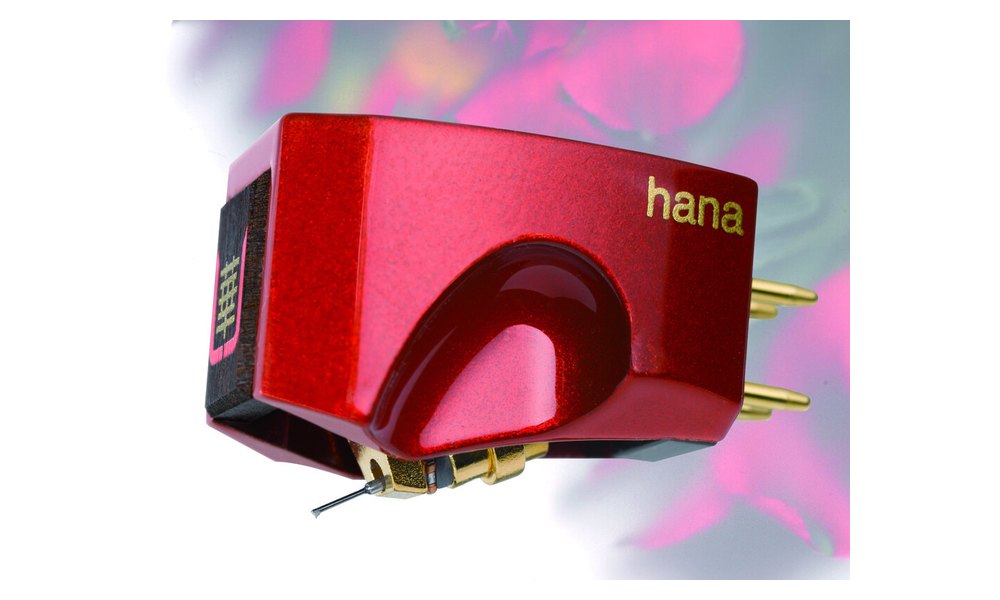
The Hana Umami Red belongs to Hana's top-tier Umami series: Auricle A7075 + ebony, urushi lacquer, nude MicroLine on boron, samarium-cobalt magnets, cryo-treated iron parts, 0.4 mV, 6 Ω, loading >60 Ω, compliance 10×10⁻⁶ cm/dyne @100 Hz (estimated 16 @10 Hz per Hana's spec sheet), VTF 2.0 g, 10.5 g. MSRP often €3,700. Sound Vinyl BotPro Champion of this Master tier — not the overall winner by index (Verismo).
Assumptions
- LO-MC-Phono · Load typ. >60 Ω
- Medium arm; Compliance @100 Hz marked
- No listening tests of our own
Specs (public / manufacturer)
| Type / Stylus | LO-MC · Nude Microline · Boron cantilever |
|---|---|
| Output | 0.4 mV (1 kHz) |
| Compliance | not specified by manufacturer |
| Trackability | 70 µm @ 2 g |
| VTF | 2.0 g |
| Impedance / load | 6 Ω · recommended > 60 Ω |
| Weight / body | 10.5 g · A7075 + Ebony · Urushi Red |
| Price guide | MSRP often €3,700 · market price approx. €3,500–3,700 (without guarantee) · Sept 2026 — check the price date |
Manufacturer specifications (Hana)
| Type | moving coil (low output), samarium-cobalt magnet |
|---|---|
| Output voltage | 0.4 mV |
| Frequency response | 10–50,000 Hz |
| Channel separation | 30 dB (1 kHz) |
| Channel balance | < 0.5 dB (1 kHz) |
| Trackability | 70 µm at 2 g |
| Tracking force | 2 g |
| Stylus | Microline |
| Cantilever | boron |
| Coil impedance | 6 Ω (1 kHz) |
| Recommended load | > 60 Ω |
| Cartridge weight | 10.5 g |
| Body | duralumin (A7075), ebony, urushi lacquer |
Source: Hana – official specifications · As of 16 October 2026 · subject to change by the manufacturer
Scores in detail
Vinyl BotPro Index: 93 · Index band Master 85–97 · Guidance only, not a lab value.
Strengths
- Microline + boron according to manufacturer
- 0.4 mV more practical than 0.2 mV Exclusive
- Auricle body with threaded holes
- Sound champion of this tier
Weaknesses
- No replaceable stylus
- Compliance specification @100 Hz — Check arm matching
- MSRP 3,700 remains master budget
- An AI analysis is not an audition
Comparison models
| Umami Blue | Alnico/Melamin, MSRP 2,500 — value for money-stronger |
|---|---|
| Cadenza Black | Shibata/Bor/WRD Ortofon ~€3,000 |
| Verismo | Exclusive Diamond — Index higher, Price higher |
| Kleos | Lyra Line-Contact ~€3,250–3,400 |
System matching
Works well with
- Master Arm with Clean Alignment
- MC-Phono from ~60 Ω load window
- If you want Hana musicality as a sound focus
Less suited
- MM-only chains
- Stylus-swap fans
Created by Vinyl BotPro (AI) · As of Sept 2026 · Corrections: info@vinylcination.de
Manufacturer and concept
Hana is the cartridge brand of the Excel Sound Corporation from Yokohama, Japan. Excel was founded in 1970 and for a long time built cartridges for other brands as an OEM supplier. When CD took over, the company moved into accessories. With the vinyl revival, Excel restarted cartridge production in 2015 and launched the Hana brand. Lead designer is company owner Masao Okada.
The Umami Red was the brand's flagship when it launched in late 2020; the Umami Black with a diamond cantilever now sits above it. It is a low-output MC cartridge and, according to Okada, is assembled entirely by hand. He told StereoNET that builders train for five to ten years and that about eight units are made per day. The Umami Blue sits below it. In our cartridge overview, the Umami Red is in the master tier.
The technology explained
Half-open design
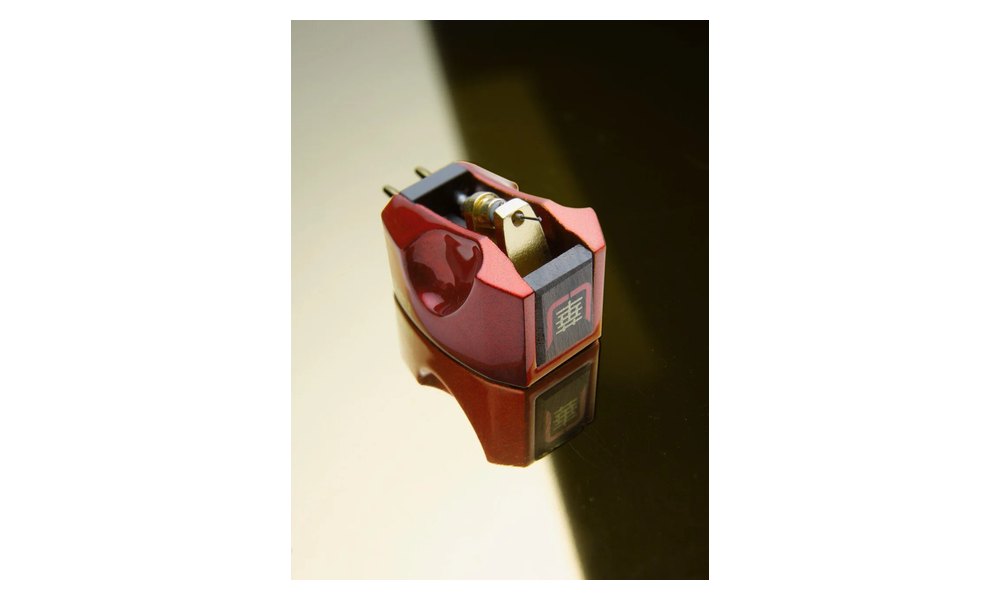
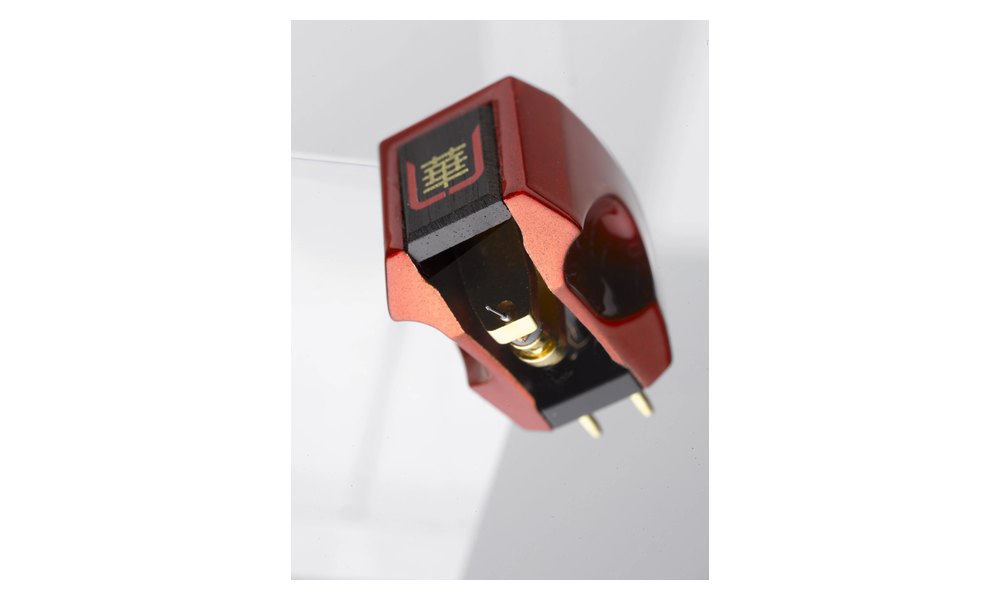
The Umami Red's generator is not sealed inside a closed body but only surrounded by a shroud of Duralumin, a hard aluminium alloy (A7075). According to Okada, this is meant to suppress unnecessary body resonance. The shroud carries several layers of Urushi lacquer, a traditional Japanese finish that gives the cartridge its red colour. An ebony inlay adds further damping. The drawback of open designs: dust and dirt reach the generator more easily, and the cantilever is more vulnerable.
Generator
According to the manufacturer, a samarium-cobalt magnet provides low internal impedance together with a decent output. The square Permalloy armature is hand-wound with 30 µm copper wire. The pole piece, yokes and gold output pins are deep-cryogenically treated. Internal impedance is 6 Ω, output 0.4 mV.
Stylus and cantilever
The cantilever is boron, which is stiffer and lighter than aluminium. It carries a nude-mounted Microline diamond from Japanese specialist Namiki. Microline is a line-contact profile with a very small radius at the contact area. It follows fine groove modulations accurately, wears slowly and needs precise alignment.
What the manufacturer's data means
Hana specifies 0.4 mV at 1 kHz, a frequency response of 10 to 50,000 Hz, 30 dB channel separation and under 0.5 dB channel balance at 1 kHz, trackability of 70 µm at 2 g, a tracking force of 2 g, a coil impedance of 6 Ω, a recommended load above 60 Ω and a weight of 10.5 g. Compliance is missing from Hana's product page; Hana's spec sheet gives 10 × 10⁻⁶ cm/dyne at 100 Hz and an estimated 16 × 10⁻⁶ cm/dyne at 10 Hz. That is on the low side and points to tonearms of medium to higher effective mass.
Sound according to international reviews
David Price of StereoNET awarded 8.5 out of 10. He described a clean, precise sound with a great deal of detail, a slightly lit-up upper treble and superb tracking. Bass was tight, propulsive and free of overhang. Despite the high resolution it never sounded analytical, and big dynamic swings came across relaxed and effortless. Imaging was precise, if not the widest. He named the Ortofon MC Windfeld Ti as the closest rival: slightly silkier, but without the same musicality and momentum.
The Ear, Positive Feedback and Audiophilia have also reviewed the Umami Red and consistently praise detail, imaging, bass extension and low surface noise. All statements come from the trade press, not from our own listening tests.
The right phono stage
0.4 mV calls for an MC phono stage with around 60 to 66 dB of gain and low noise. Hana recommends a load above 60 Ω. In practice, many units work well at 100 Ω. Higher values tend to sound more open, lower ones calmer. A step-up transformer with a suitable ratio is an alternative. It raises the voltage passively and suits cartridges with 6 Ω internal impedance well, as long as it is designed for low-impedance MC cartridges. Careful, well-shielded placement matters, because transformers can pick up hum from power supplies. Suitable phono stages include the Luxman EQ-500 or the Pro-Ject Phono Box DS3 B. More models are in our best phono preamps.
Matching tonearm
At 10.5 g, the Umami Red is fairly heavy. Combined with the rather low compliance quoted in international reviews, tonearms of medium to higher effective mass, roughly 12 to 20 g, are a good match. StereoNET used an SME Series V, Hi-Fi News an SME 309. The goal is a resonance frequency between 8 and 12 Hz. The arm must be able to balance the weight; light arms may need an extra counterweight. Height and azimuth should be adjustable, as the Microline profile is sensitive to errors.
Installation and alignment
The oblong body has clear edges that make aligning with a protractor easier. The cartridge is fixed via two threads in the body, which one review notes are fairly shallow, so tighten the screws carefully and not too hard. A good stylus guard is supplied. Then set overhang and offset with a protractor, set the tracking force to 2 g with a digital scale and check azimuth. Adjust the vertical tracking angle via arm height, starting with a level arm.
The right system around it
A cartridge of this class only shows its strengths if the deck runs quietly and the tonearm bearings are clean. A heavy turntable with a well-damped platter and an arm without bearing play are the foundation. Short, well-shielded phono cables keep the small 0.4 mV signal free of hum. A clean ground connection between turntable and phono stage matters too. The Umami Red reveals weaker recordings openly but does not make them unpleasant. A very bright system may still emphasise its slightly lit-up treble. Suitable decks are listed in our best turntables.
Buying new or used
Used cartridges of this class are cheaper, but you rarely know how many hours the stylus has run. A microscope check shows the diamond's condition and whether the cantilever is straight. With a half-open design, it is also worth checking for dust on the generator. Buying new gets you a warranty and a fresh stylus.
Care and lifespan
With clean records, a Microline diamond often lasts considerably longer than an elliptical one. Many manufacturers quote lifespans of around 1,000 to 2,000 hours for line-contact profiles. Always clean the stylus from back to front with a soft brush. Because of the half-open design, avoid touching the cartridge unnecessarily when changing records. Regular record cleaning protects stylus and generator from dust.
Umami Red or Umami Blue
The Umami Blue is the cheaper sibling. According to Hana, it shares the Red's Duralumin Auricle body, boron cantilever and Microline diamond but uses the Alnico generator of the Hana ML. The Umami Red uses samarium-cobalt, Duralumin, ebony and Urushi lacquer. If you have the budget and a suitable phono stage, the Red gets you the flagship. If value for money matters more, the Blue is a good choice.
The Hana family at a glance
Below the Umami series, Hana offers the SL Mk II, SH Mk II, EL Mk II and EH Mk II. The S models have a Shibata stylus, the E models an elliptical one. L stands for low output, H for high output. The high-output versions also work on an MM input. There are also the ML and MH with a Microline stylus. Within the Umami series, the Umami Red sits between the more affordable Umami Blue and the more expensive Umami Black.
Strengths and limits at a glance
- Strength: boron cantilever with nude Microline diamond.
- Strength: very detailed, dynamic and rhythmically strong according to the press.
- Strength: excellent tracking, 70 µm at 2 g.
- Strength: hand-built, very elaborate construction.
- Limit: 0.4 mV requires a good MC phono stage.
- Limit: 10.5 g and rather low compliance narrow the choice of tonearm.
- Limit: shallow threads, care needed when mounting.
- Limit: high price.
Who it suits
The Umami Red suits experienced vinyl listeners with a medium to heavy tonearm and a low-noise MC phono stage. Anyone looking for a precise, dynamic and detailed cartridge should make a point of auditioning it. If you are after an even more neutral voicing, compare it with the Lyra Kleos: The Ear found the Umami Red slightly warmer than the Kleos SL.
Compared with alternatives
The Ortofon MC Windfeld Ti sounds slightly silkier. The Ortofon Cadenza Black is cheaper and has a Shibata stylus. The Lyra Kleos plays in a similar price class. The Dynavector Te Kaitora Rua is another alternative. More in our best cartridges.
Analysis: the Hana Umami Red in depth
What this analysis adds
The sections above briefly summarise the manufacturer's data and a few voices from the specialist press. For this analysis we have broadened the source base considerably and assigned every statement to a dated source: Hana's product page [1], Hana's spec sheet comparing the Umami Red, ML, SL and EL [2], the product page of the sister model Umami Blue [3], Adam Smith's two-page review in Hi-Fi News [4] with Paul Miller's lab report [5], Herb Reichert's column in Stereophile [6], David Price's review at StereoNET [7], Andre Jennings' review in The Absolute Sound [8], Holger Barske's German-language review at hifitest.de [9], Michael Johnson's review at Audiophilia [10], Michael Fremer's report at Analog Planet [11], Greg Weaver's long-form review at Positive Feedback [12], Jonathan Gorse's review at The Ear [13] and the Hi-Fi News review of the new flagship, the Umami Black [14].
Vinyl BotPro has neither listened to nor measured the Umami Red. Statements about sound and measurements belong to the authors named; we label our own calculations and conclusions as such. Rank, index and prices on this page are unchanged. The reviews date from 2021 to 2025. The cartridge has been on sale since late 2020 and, according to the manufacturer pages we retrieved, is still offered unchanged [1].
On where the review samples came from: Reichert paired the Umami Red with the Nova III phono stage from US distributor Musical Surroundings and asked the distributor for background [6]; Johnson received a demo unit from the same distributor and then bought it [10]; Weaver sent his sample, with the distributor's approval, to a paid stylus-geometry correction service [12]. The other reviews do not state the origin explicitly.
Excel Sound, Hana and where the Umami Red sits
Hana is made by Excel Sound Corporation of Yokohama. According to StereoNET, Stereophile and Audiophilia, Excel was founded in 1970 and built cartridges for other brands for decades [6][7][10]. Positive Feedback adds that Masao Okada started working on cartridges as early as 1964 and that the company initially sold its own models under the name ES-70 [12]. With the vinyl revival, Excel returned to making cartridges under its own name; StereoNET, hifitest.de and Audiophilia give 2015 [7][9][10], while Positive Feedback and Hi-Fi News give 2016 as the start of the Hana brand [12][14]. Stereophile describes Hiroshi Ishihara of Hana-Youtek as the person who commissioned the line [6]. The Ear, by contrast, writes that Hana was founded in 2021 and that Excel has been making cartridges since 1964 [13]; these figures differ from every other source, and we follow the majority.
When it launched, the Umami Red was the flagship. Fremer puts it in context: until then, Hana's US range ran from 475 to 1,200 US dollars, while the Umami Red cost 3,950 US dollars [11]. The more affordable Umami Blue followed in 2023, and there is now an even more expensive model with a diamond cantilever, the Umami Black, which Hi-Fi News reviewed in March 2026 [14]. Since then the Red has been the middle of three Umami models rather than Hana's most expensive cartridge.
On the name, Stereophile reports that the US distributor proposed the word Umami: it stands for the fifth taste and for many ingredients working together [6]. Hi-Fi News and hifitest.de use the same image [4][9].
Construction: body, generator, stylus
The body is made of the aluminium alloy A7075 (Duralumin) with an ebony inlay [1][2]. Hana calls the sculpted side pockets "Auricle", meaning ear-shaped [4][11]. Fremer explains that this shape places the partly open generator close to the body walls to increase stiffness and reduce resonance, and that the semi-open design offers more protection than a fully open one [11]. According to Hi-Fi News, the Urushi lacquer is built up in several layers: a black undercoat, a red layer containing fine silver powder, the logo in gold powder and a final clear coat [4]. Fremer describes the same build-up [11]. According to the spec sheet, the terminal plate is made of PEEK plastic and the output pins are plated with 24-carat gold [2].
The generator uses a samarium-cobalt magnet and a square Permalloy armature; the other parts of the magnetic circuit are pure iron [2]. The coils are high-purity copper; StereoNET and Analog Planet quote a wire thickness of 30 µm [7][11]. The pole piece, front and rear yokes and the output pins are cryogenically treated [4][8]. Fremer attributes the low internal impedance of 6 Ω to fewer coil turns and a powerful magnet system [11].
The cantilever is solid boron, and the stylus is a nude-mounted diamond with a Microline profile [1][2]. According to StereoNET, the diamond comes from Adamant Namiki [7]. Hi-Fi News describes the profile as mimicking the shape of a cutting-lathe stylus so that it traces the groove as accurately as possible [4]; hifitest.de says the same [9]. Positive Feedback quotes a typical Microline profile of about 2.5 to 3.8 µm by 75 µm [12].
Accounts of how the cartridge is built differ. Hana writes that its craftsmen assemble the Umami Red by hand [1]. Okada told StereoNET that every unit is assembled entirely by hand, about eight a day [7]. Hi-Fi News speaks of a combination of automation and handcrafting [4], and hifitest.de stresses that Excel has automated MC production to a remarkable degree [9]. Fremer notes that the coils are hand-wound, but using a winding machine [11]. The sources probably describe different steps of the process; this cannot be verified.
Manufacturer data and where the sources disagree
Hana's spec sheet lists 0.4 mV at 1 kHz, 6 Ω coil impedance, a load above 60 Ω, 10 to 50,000 Hz, 0.5 dB channel balance, more than 30 dB channel separation, 2 g tracking force, 70 µm trackability at 2 g and a weight of 10.5 g [2]. The product page matches this [1]. Compliance is missing from the product page but appears in the spec sheet: 10 × 10⁻⁶ cm/dyne at 100 Hz and an estimated 16 × 10⁻⁶ cm/dyne at 10 Hz [2]. The "not specified" entry in our data table refers to the product page; the spec sheet figure is the one that counts.
Some sources differ. StereoNET and Analog Planet quote a frequency response starting at 15 Hz instead of 10 Hz [7][11]. The Ear gives the weight as 9 g [13], every other source as 10.5 g [2][5][6][11]. Our own calculation: the unit 10⁻⁶ cm/dyne is exactly 1 µm/mN, which is why hifitest.de correctly writes 10 µm/mN [9]. Comparisons with other brands therefore fail not because of the unit but because of the measuring frequency: values at 100 Hz come out lower than at 10 Hz, as Hana's own estimate of 10 versus 16 shows [2].
What the measurements show
Paul Miller measured the Umami Red in the lab for Hi-Fi News [5]. Output was 0.465 mV into 100 Ω (re. 5 cm/s), with a channel balance of 0.14 dB. Our own calculation: that is about 1.3 dB more than the 0.4 mV on the spec sheet. Channel separation reached 31 dB at 1 kHz and 20 dB at 20 kHz, and the vertical tracking angle was at the ideal 22 degrees [5].
Miller measured compliance at 9 (vertical) and 10 (lateral) compliance units and therefore considers the Umami Red suitable for tonearms of 10 to 16 g effective mass [5]. The arm/cartridge resonance was well damped at about +10 dB. Tracking ability was 70 µm on the right and 75 µm on the left channel, which Miller calls just slightly below the very best cartridges; at +15 dB groove modulation distortion stayed at around 1 % [5].
Miller's frequency response shows a slight asymmetry: above 8 to 9 kHz the right channel rises to about +4 dB at 18 kHz (lateral), the left channel only to about +1.6 dB [5]. Miller expects the extra bite to diminish as the cartridge runs in [5]. Our interpretation, not from the sources: such a treble rise may explain why StereoNET describes the Umami Red as "slightly well lit up top" [7]; several other authors, however, hear it as rather warm (see below).
Fremer checked individual figures with his own tools: using an oscilloscope he achieved 29 dB of channel separation with less than 1 dB difference between channels, and at 2 g the cartridge cleanly tracked the 70 µm band of an Ortofon test record [11]. Andre Jennings reports that channel balance and crosstalk met the manufacturer's specification in all three tonearms he used [8].
What the international and German press hear
The reviews agree that the Umami Red offers a great deal of detail, precise imaging, deep and tight bass and quiet groove tracing. They disagree on tonal balance.
David Price (StereoNET) describes a clean, precise, "modern Japanese high end" sound, slightly lit up at the top, with tight, energetic bass and superb tracking; it is never analytical, he says, and big dynamic swings come across as relaxed [7]. He awards 8.5 out of 10 and names the Ortofon MC Windfeld Ti as the closest rival, which sounds a little silkier but has less momentum [7].
Adam Smith (Hi-Fi News) places the Umami Red between lush, warm traditional MCs and cool, analytical designs, with a touch more warmth than the analytical ones [4]. He praises its front-to-back perspective and especially its handling of acoustic instruments. In the deepest bass of electronic music he found his Clearaudio MC Essence a little tighter and more controlled [4].
Herb Reichert (Stereophile) describes a clear, grain-free presentation that makes LPs sound "like analog tape"; vocal intelligibility was better than with the Hana ML or the Zu Denon DL-103 Mk.2, and he draws a comparison with the much more expensive My Sonic Lab Ultra Eminent Ex [6].
Andre Jennings (The Absolute Sound) calls the voicing exceptionally balanced and a little closer to neutral than the Hana SL; compared with the ML, it offers more macro-dynamics, harmonic complexity and warmth, with smoother and more extended treble [8]. On the SME V, the Umami Red sounded less visceral to him than on the Graham Phantom III and Basis Vector IV tonearms [8].
Holger Barske (hifitest.de) describes the Umami Red as more direct, open and lively than the Avid Reference Ruby and praises its agility, differentiation and sheer enthusiasm [9].
Michael Johnson (Audiophilia) hears a smooth, warm and natural basic character with a silky treble, much more detail and soundstage width than the Hana ML and faster bass [10]. Fremer (Analog Planet) describes the speed and precision brought by the boron cantilever while the midrange keeps its warmth; in systems that emphasise the upper bass, he warns, that region may become too much [11].
Greg Weaver (Positive Feedback) describes exceptionally extended bass and a slightly warm, smooth voicing. Comparing it directly with his reference Etsuro Gold, which costs about five times as much, he estimates that the Umami Red reaches 80 to 85 per cent of its performance [12]. Jonathan Gorse (The Ear) found the Umami Red slightly warmer than his Lyra Kleos SL and praises its very low surface noise; on one of the two turntables he used, he missed some transparency and speed compared with his own combination [13].
Our interpretation: "bright" (StereoNET) and "warm" (Audiophilia, Positive Feedback, The Ear) only appear to contradict each other. The authors used very different tonearms, phono stages and load settings. With a cartridge whose treble rises slightly and whose lower midrange is strong, the impression depends heavily on the rest of the system.
Load impedance and gain in practice
Hana recommends more than 60 Ω [2]. Hi-Fi News explains this with the rule of thumb of ten times the coil impedance [4], and hifitest.de suspects the same reasoning [9]. The authors used very different values: Reichert 80 Ω on the US distributor's recommendation [6], Jennings 96 Ω on the Musical Surroundings Phonomena II+ [8], Gorse and Barske 100 Ω [9][13], and Johnson 117 Ω, which sounded more balanced to him than 69 Ω [10]. Barske found the sound leaner and less settled with much higher values but considered the cartridge tolerant overall [9]. Jennings explains his choice by how well each phono stage handles ultrasonic peaks [8].
Our own calculation on gain: at 0.4 mV, a phono stage with 60 dB of gain delivers about 400 mV, and with 66 dB about 800 mV at its output (both at 5 cm/s). With a step-up transformer (SUT) into a 47 kΩ MM input, the coil sees 47 kΩ divided by the square of the turns ratio: 1:10 gives 470 Ω, 1:20 about 118 Ω and 1:30 about 52 Ω. A 1:30 transformer would therefore fall below Hana's recommended 60 Ω, while 1:20 adds about 26 dB of voltage gain and lands in the range the reviewers used.
Tonearm, compliance and resonance
Because of its low compliance, StereoNET considers the Umami Red suitable for tonearms of medium to high effective mass [7], and Hi-Fi News gives 10 to 16 g after measuring it [5]. Our own calculation using the usual resonance formula, 10.5 g cartridge weight and about 1 g for screws: on a tonearm with 12 g effective mass, resonance is about 8.2 Hz using Hana's 10 Hz estimate of 16 × 10⁻⁶ cm/dyne and about 10.4 Hz using the 100 Hz figure of 10 × 10⁻⁶ cm/dyne. At 16 g it is about 7.6 or 9.6 Hz, at 20 g about 7.1 or 9.0 Hz, and at 9 g about 8.8 or 11.1 Hz.
It follows that with the manufacturer's 10 Hz estimate, very heavy arms slip just below the usual target range of 8 to 12 Hz. The range of 12 to 20 g in our FAQ is therefore on the generous side; Miller's 10 to 16 g is the more cautious recommendation [5]. The reviewers used the Umami Red on arms including the SME Series V, SME 309, SME Series IV, Schick 10.5-inch, Kuzma 4Point, Acoustic Signature TA-7000, Graham Phantom III and Basis Vector IV [4][6][7][8][11][13].
Mounting and alignment from the reviewers' experience
Several sources praise the mounting. The straight edges make alignment with a protractor easier [7], and a stylus guard that encloses the whole cartridge is supplied [7][10][11]. The threads for M2.5 screws sit at the usual half-inch spacing [9] but are shallow. Jennings gives a thread depth of 3 mm; screws of 4, 5 and 6 mm are supplied, and for the thick headshell of the Graham Phantom III he needed the 8 mm screws that came with the arm [8]. Hi-Fi News and StereoNET advise short screws and care when tightening [4][7].
On alignment: Hi-Fi News found 2 g to be the sweet spot and describes the Umami Red as sensitive to azimuth [4]. With the arm level, Fremer found a stylus rake angle of about 92 degrees and raised the arm slightly [11]; Jennings likewise set the arm a couple of millimetres higher [8]. Weaver had the stylus geometry measured by a specialist service and corrected with a matching shim [12]. Fremer points out that the stylus sits somewhat tucked under the body, so you have to look for it deliberately when cleaning [11]. Johnson heard the final character only after about 25 hours of use [10].
Umami Red, Umami Blue and Umami Black
According to Hana, the Umami Blue shares the Red's Duralumin Auricle body, boron cantilever, diamond and copper coils, but uses the Alnico-magnet generator from the Hana ML [3]. In the US Hana lists 2,500 US dollars for the Blue and 3,950 US dollars for the Red [1][3]; Hi-Fi News gives 2,149 and 3,399 pounds in the UK [14]. Our own calculation: in both markets the Red costs about 58 % more than the Blue.
The Umami Black costs 7,995 pounds in the UK and has a solid diamond cantilever and a reworked generator; it shares the Microline profile with the Red and Blue [14]. Our own calculation: it costs about 2.35 times as much as the Red.
Prices and context
Hana lists 3,950 US dollars and a two-year warranty [1]. Hi-Fi News, StereoNET and The Ear give 3,399 pounds [4][7][13], hifitest.de about 3,700 euros [9], which matches the price on our page. hifitest.de names High Fidelity Studio in Augsburg as the German distributor [9]. Our own calculation: 3,700 euros without 19 % German VAT is about 3,109 euros. Hana's US prices are quoted without sales tax.
On value: asked whether the Umami Red offers three times as much as the Hana ML, Fremer answers with a "qualified yes" if the turntable and phono stage are up to it [11]. Johnson calls it one of the smartest steps into the high end for listeners who have so far used cartridges up to 2,000 US dollars [10].
What the sources add up to
For a cartridge in this price class, the source base for the Umami Red is unusually broad: nine detailed reviews from specialist publications in the UK, North America, Australia and Germany, plus a lab measurement. The measurements largely confirm the manufacturer's data and show a slight treble lift in the right channel [5]. On sound, all authors praise detail, bass and tracking; whether the Umami Red sounds rather bright or rather warm depends, on the evidence, very much on the tonearm, phono stage and load.
In practice this means: a tonearm of medium effective mass, a low-noise MC phono stage with adjustable loading between about 80 and 120 Ω, careful alignment of azimuth and height, and short screws. Its rating as Sound Vinyl BotPro Champion of the Master tier is based on this body of sources, not on listening tests of our own.
Sources for this analysis
- Hana (Excel Sound): Hana Umami Red – Produktseite mit technischen Daten und US-Preis/product page with specifications and US price (abgerufen/accessed 11.11.2026). https://hanacartridges.com/products/hana-umami-red
- Hana: Umami Red, ML, SL, EL Specification Comparison Chart (PDF-Datenblatt/PDF spec sheet, Oktober/October 2020, abgerufen/accessed 11.11.2026). https://hanacartridges.com/s/HANA-UR_ML_SL_EL-Specification_Comparison_Chart.pdf
- Hana (Excel Sound): Hana Umami Blue – Produktseite/product page (abgerufen/accessed 11.11.2026). https://hanacartridges.com/products/hana-umami-blue
- Hi-Fi News: Hana Umami Red Cartridge (Adam Smith, Labor/lab Paul Miller, 11.01.2021, Seiten/pages 1–2). https://www.hifinews.com/content/hana-umami-red-cartridge
- Hi-Fi News: Hana Umami Red Cartridge – Lab Report (Paul Miller, 11.01.2021). https://www.hifinews.com/content/hana-umami-red-cartridge-lab-report
- Stereophile: Gramophone Dreams #47: Hana Umami Red, Musical Surroundings Nova III, Ampsandsound Bigger Ben (Herb Reichert, 07.04.2021). https://www.stereophile.com/content/gramophone-dreams-47-hana-umami-red-musical-surroundings-nova-iii-ampsandsound-bigger-ben
- StereoNET: Hana Umami Red MC Phono Cartridge Review (David Price, 11.08.2021). https://www.stereonet.com/reviews/hana-umami-red-mc-phono-cartridge-review
- The Absolute Sound: Hana Umami Red Phono Cartridge (Andre Jennings, 13.09.2021). https://www.theabsolutesound.com/articles/hana-umami-red-phono-cartridge/
- hifitest.de: Einzeltest Hana Umami Red – Spitzen-MC, kräftig gewürzt (Holger Barske, Ausgabe/issue 1/2022). https://www.hifitest.de/test/tonabnehmer/hana-umami-red-21202
- Audiophilia: Hana Umami Red MC Phono Cartridge (Michael Johnson, 03.01.2022). https://www.audiophilia.com/reviews/2023/12/22/hanaumamired
- Analog Planet: Who's Umami? (Michael Fremer, 06.02.2022). https://www.analogplanet.com/content/whos-umami
- Positive Feedback: Hana Umami Red Moving Coil Phono Cartridge (Greg Weaver, 13.09.2023). https://positive-feedback.com/reviews/hardware-reviews/hana-umami-red-moving-coil-phono-cartridge/
- The Ear: Hana Umami Red – A cartridge feast for the senses (Jonathan Gorse, 29.09.2025). https://the-ear.net/review-hardware/hana-umami-red-a-feast-for-the-senses/
- Hi-Fi News: Hana Umami Black MC cartridge (Adam Smith, Labor/lab Paul Miller, 01.03.2026). https://www.hifinews.com/content/hana-umami-black-mc-cartridge
Created by AI (Vinyl BotPro) from the sources listed; no listening tests or measurements of our own. Detailed human fact-check pending.
Hana Umami Red FAQ
What tracking force does the Umami Red need?
Hana specifies 2 g.
What load impedance is right?
Hana recommends more than 60 Ω. 100 Ω is a good starting point.
Does it work on an MM input?
Only via a step-up transformer. 0.4 mV is not enough for an MM input.
Which tonearm suits it?
Medium to heavy arms with roughly 12 to 20 g effective mass.
How does it differ from the Umami Blue?
The Red has a samarium-cobalt magnet and a Duralumin body with ebony and Urushi lacquer.
Verdict
The Hana Umami Red is a hand-built MC cartridge with a boron cantilever, a Microline diamond and a half-open Duralumin shroud. The international press praises its detail, dynamics, rhythm and tracking; StereoNET ranks it among the best cartridges at its price. If you have a suitable tonearm and a good phono stage, it belongs on your shortlist.
Sources
Read more: best cartridges 2026 · Stylus shapes explained · What is hi-fi?