
Cartridge · Short analysis · Master, rank 9
Lyra Kleos Review
Short analysis (research): Kleos with 7075-Alu, Ogura Lyra Line Contact, boron — Specs Lyra/DE-MSRP, no listening test.
Summary
The Lyra Kleos is handmade LO-MC: Ogura Lyra Line Contact on boron, 7075-Alu with copper rods, 0.5 mV, ~5.4 Ω, Compliance approx. 12×10⁻⁶ @100 Hz, VTF rec. 1.72 g, weight 8.8 g. DE-MSRP often €3,250 (check stand). Expected: high immediacy — close VTF window, import/price as of check.
Specs (public / manufacturer)
| Type / Stylus | LO-MC · Lyra Line Contact (Ogura) · Boron |
|---|---|
| Output | 0.5 mV @ 5 cm/s |
| Compliance | approx. 12×10⁻⁶ cm/dyn @ 100 Hz (manufacturer figure “approx.”) |
| VTF | 1.65–1.75 g · recommended 1.72 g |
| Impedance / load | 5.4 Ω · direct 95.3–816 Ω or step-up transformer for 3–6 Ω |
| Weight | 8.8 g |
| Price guide | MSRP often €3,250–3,400 · Sept 2026 — check the price date |
Manufacturer specifications (Lyra)
| Type / Stylus | LO-MC · Lyra Line Contact (Ogura) · Boron |
|---|---|
| Output | 0.5 mV @ 5 cm/s |
| Compliance | approx. 12×10⁻⁶ cm/dyn @ 100 Hz (manufacturer figure “approx.”) |
| VTF | 1.65–1.75 g · recommended 1.72 g |
| Impedance / load | 5.4 Ω · direct 95.3–816 Ω or step-up transformer for 3–6 Ω |
| Weight | 8.8 g |
Source: Lyra – official specifications · As of 16 October 2026 · subject to change by the manufacturer
Matching tips
- Suits: Adjustable master army
- Suits: if you want Lyra New-Angle deliberately
- Less suited: Lot VTF-alignment
- Less suited: MM-only-Phono
Vinyl BotPro Index: 90 (Master 85–97) · Label: AI research · Sept 2026
Manufacturer and concept
Lyra was founded in Japan in 1983. Its defining designer was Jonathan Carr, who shaped the brand's cartridges for decades. The cartridges are assembled by hand by Japanese specialist Yoshinori Mishima. Lyra builds moving-coil cartridges only, MC for short. The range runs from the Delos through the Kleos up to the Etna and Atlas.
The Kleos arrived in 2010 and has been one of the brand's best-known models ever since. It sits in the middle of the range and inherits many techniques from the dearer models. Besides the standard version there is the Kleos SL with an even lower output and a mono version. At around €3,250 to €3,400, the Kleos sits in our master tier of cartridges.
Where it sits in the Lyra range
The Kleos follows earlier Lyra models such as the Clavis and Helikon and so holds the middle of the range. Compared with the cheaper Delos, it swaps the Namiki cantilever with micro-ridge stylus for the solid Ogura boron cantilever and the line-contact diamond used in the dearer models. It is also the least expensive Lyra with press-fit rods inside the body. Above it come the Etna and Atlas with further measures against resonance. For many listeners, the Kleos is therefore the point where Lyra's core technologies become available without paying for the flagships.
The technology explained
Moving coil in brief
A cartridge converts the stylus movement in the groove into an electrical voltage. In an MC design, tiny coils move inside a fixed magnetic field. Because the coils are very light, the cantilever can follow the finest groove modulations with great accuracy. The drawback is a very small output. The Kleos delivers 0.5 mV, roughly a tenth of a typical moving-magnet cartridge.
New Angle
At rest, the coils of an MC cartridge sit in a certain position in the magnetic field. As soon as tracking force is applied, the cantilever deflects and the coils tilt slightly. Lyra therefore changed the geometry so that the coils only reach their ideal position under tracking force. Lyra calls this New Angle. The aim is for both channels to work symmetrically during playback.
Stylus and cantilever
The cantilever is made of solid boron, a very light and stiff material. It carries a line-contact diamond that Lyra developed with Japanese maker Ogura. According to one review, it measures 3 × 70 µm. A line-contact profile touches the groove wall along a long, narrow line. It traces high frequencies more accurately than an elliptical profile, spreads the force over a larger area and wears more slowly. In return it demands precise alignment.
No body shell
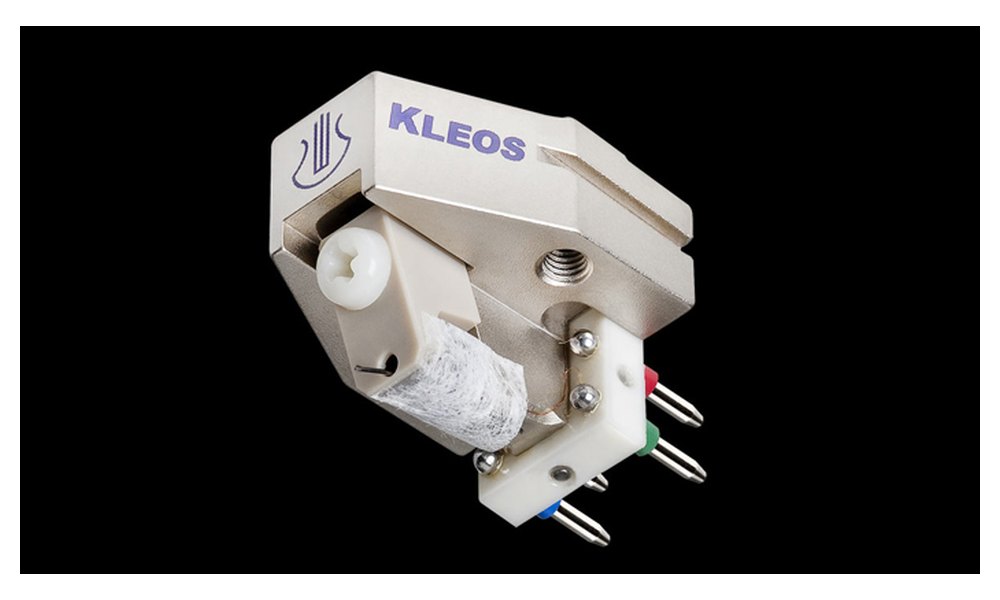
Lyra does without a conventional shell around the generator. The Kleos uses a body machined from 7075 aluminium, a very hard aircraft-grade alloy, with press-fit rods to control resonance. The idea is that energy flows from the diamond and coils into the tonearm without plastic layers in between. The cantilever is exposed, which makes alignment easier but calls for care when cleaning.
What the manufacturer's data means
Lyra specifies 0.5 mV at 5 cm/s, an internal impedance of 5.4 Ω, a compliance of approx. 12 × 10⁻⁶ cm/dyn at 100 Hz, a tracking force of 1.65 to 1.75 g (1.72 g recommended) and a weight of 8.8 g. For direct connection Lyra recommends a load of 95.3 to 816 Ω, or a step-up transformer for 3 to 6 Ω.
Sound according to international reviews
Ken Kessler reviewed the Kleos SL, the lower-output variant. He praised the easy alignment thanks to the exposed cantilever and the secure tracking at 1.75 g. On the following pages he described deep bass, refined treble and a very quiet background. Paul Miller's lab measurements showed excellent channel balance of 0.2 dB and a frequency response extending beyond 30 kHz. He also pointed out that the SL version needs a phono stage with plenty of gain and low noise.
After years with the Kleos, Michael Fremer concluded in international reviews that it was still a particularly smooth-sounding cartridge. In his first review he had already called it Jonathan Carr's best-balanced design up to that point. These assessments come from the trade press, not from our own listening tests.
The right phono stage
0.5 mV is not much. An MC phono stage should therefore offer around 60 to 66 dB of gain while staying very quiet. The Kleos SL needs even more. Even so, the international specialist press got good results with the SL from an affordable valve phono stage at 65 dB. The Kleos is flexible on loading. Lyra quotes a wide range from 95.3 to 816 Ω. As a rule of thumb, a lower value sounds a little calmer and a higher one a little more open. A step-up transformer, which raises the voltage without active gain, is an alternative.
Suitable partners include the Luxman EQ-500 or the Pro-Ject Tube Box DS2, which was used in a review with the Kleos SL. More models are listed in our best phono preamps.
Matching tonearm
With a compliance of approx. 12 × 10⁻⁶ cm/dyn and a weight of 8.8 g, the Kleos suits medium-mass tonearms with roughly 10 to 16 g effective mass. The goal is an arm/cartridge resonance between 8 and 12 Hz. Too low and the arm reacts to warped records and footfall; too high and bass reproduction suffers. It also matters that tracking force, azimuth and vertical tracking angle can be finely adjusted. The line-contact profile is less forgiving of errors than a simpler stylus.
Alignment step by step
First set overhang and offset angle with a good protractor. Then set the tracking force to about 1.72 g with a digital scale. Next check azimuth: the stylus must stand upright in the groove, or channel separation suffers. After that, adjust the vertical tracking angle via the arm height. A tonearm parallel to the record is a good starting point. Small changes are mostly audible on voices and cymbals. Anti-skating should roughly match the tracking force or sit slightly below it.
Installation in practice
The Kleos has threaded holes directly in its body. No nuts are needed; the screws go through the headshell from above. That simplifies mounting but calls for care: tighten the screws only finger-tight, or the thread may be damaged. Lyra supplies screws in several lengths. The colour-coded pins make connecting the tonearm leads easy. Keep the stylus guard on throughout.
At 8.8 g, the cartridge is easily handled by the counterweight of most tonearms. Very light arms may need an extra weight. After installation, a test record with tones for channel separation and tracking ability is worthwhile. It lets you set azimuth and anti-skating more accurately than by ear alone.
Buying new or used
A used Kleos is cheaper but carries a risk: you rarely know how many hours the stylus has already run. Inspection under a microscope shows the condition of the diamond. A bent cantilever or dirt on the coils also shows up that way. If you buy used, budget for a later exchange through Lyra. Buying new gets you the full manufacturer warranty and certainty about the hours.
The right system around it
A cartridge of this class only pays off if the rest of the system keeps up. A stable turntable with quiet running matters as much as short, well-shielded phono cables so the tiny signal does not pick up hum. The ground connection between turntable and phono stage should be clean too. Suitable decks can be found in our best turntables.
Care and lifespan
With good care, a line-contact diamond often lasts 1,500 to 2,000 hours. Clean records extend this considerably. Always clean the stylus with a soft brush from back to front, never sideways. Because the cantilever is exposed, the supplied guard protects it when mounting and removing. Lyra offers an exchange service for worn cartridges.
Kleos, Kleos SL and Kleos Mono
The Kleos SL has a single-layer coil winding, a lower internal impedance and an even smaller output. Lyra promises more purity if the phono stage is up to it. The Kleos Mono is designed for mono records and responds to lateral movement only. If you want to own just one cartridge, the standard version is the most flexible.
Strengths and limits at a glance
- Strength: line-contact diamond on a boron cantilever.
- Strength: New Angle geometry for symmetrical channels.
- Strength: smooth, balanced sound with deep bass according to the press.
- Strength: wide loading range, flexible with phono stages.
- Limit: 0.5 mV requires a low-noise MC phono stage.
- Limit: precise alignment needed.
- Limit: exposed cantilever, care needed when cleaning.
- Limit: high price.
Who it suits
The Kleos suits experienced vinyl listeners with a high-quality, finely adjustable tonearm and a good MC phono stage. If you are new to MC or do not enjoy precise alignment, start with a simpler cartridge such as the Ortofon Quintet Blue.
Compared with alternatives
The cheaper Lyra Delos also uses the New Angle geometry. The Hana Umami Red sits in a similar price class and is considered livelier. The Ortofon MC Windfeld Ti is an alternative with a titanium body. More in our best cartridges.
Lyra Kleos FAQ
Do I need a step-up transformer?
Not necessarily. An MC phono stage with enough gain is sufficient. A transformer is an alternative.
What tracking force is right?
Lyra specifies 1.65 to 1.75 g, with 1.72 g recommended.
How does it differ from the Kleos SL?
The SL has a single-layer winding, lower impedance and less output.
How long does the stylus last?
With clean records, often 1,500 to 2,000 hours.
Can I use the Kleos on an MM input?
Only via a step-up transformer. Connected directly to an MM input, the output is too low.
Verdict
The Lyra Kleos is a hand-built MC cartridge with a boron cantilever, a line-contact diamond and the New Angle geometry from Lyra's dearer models. The international press has praised it for years for a smooth, balanced sound with deep bass. If you bring a suitable tonearm, a low-noise phono stage and patience with alignment, you get a long-term reference cartridge.
Sources
Read more: best cartridges 2026 · Stylus shapes explained · What is hi-fi?