
Bookshelf speaker · AI analysis · Premium, rank 8
ELAC Debut Reference DBR62 Review
AI analysis (research): compact speaker of the Debut Reference line with new cast-basket woofer and revised waveguide; based on manufacturer data and the international specialist press.
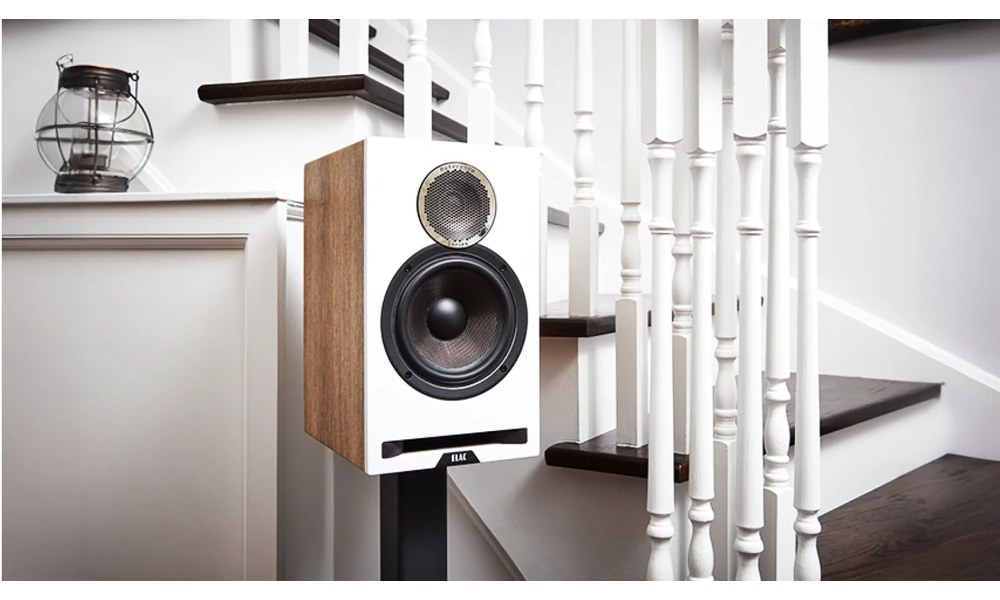
Summary
The DBR62 (approx. 499–598 €/pair) builds on the Debut series: the 165 mm woofer with aramid cone sits in a new cast basket, and the 25 mm cloth dome tweeter got an improved waveguide. ELAC quotes 86 dB sensitivity, 6 Ω and 44 Hz to 35 kHz.
Specs (public / manufacturer)
| Type | 2-way compact speaker · bass reflex (double-flared slot) |
|---|---|
| Chassis | 25 mm cloth dome with waveguide · 165 mm aramid woofer in cast basket |
| Frequency range | 44 Hz–35 kHz · crossover 2,200 Hz |
| Sensitivity | 86 dB (2.83 V/1 m) |
| Impedance / power handling | 6 Ω · max. 120 W |
| Enclosure | MDF (CARB2) · oak/white or walnut/black · metal binding posts |
| Dimensions / weight | 359 × 208 × 275 mm · 8.2 kg |
| Price guide | approx. €499–598/pair · Sept 2026 |
Manufacturer specifications (ELAC)
| Type | 2-way bookshelf speaker, bass reflex (dual flared slot port) |
|---|---|
| Drivers | 1-inch soft dome · 6½-inch woofer (aramid fibre, cast basket) |
| Frequency response | 44 Hz–35 kHz |
| Impedance | 6 Ω (nominal) |
| Sensitivity | 86 dB (2.83 V/1 m) |
| Crossover frequency | 2,200 Hz |
| Recommended amplifier power | max. 120 W power input |
| Enclosure | MDF (CARB2) · 5-way metal binding posts |
| Dimensions | 359 × 208 × 275 mm (H × W × D) |
| Weight | 8.2 kg |
Source: ELAC – official specifications · As of 16 October 2026 · subject to change by the manufacturer
Matching tips
- Good fit: Amplifiers with a clean sound into 6 Ω
- Good fit: Vocals, jazz and acoustic music
- Good fit: Sturdy stands
- Less suited: Anyone mainly after punchy, highly dynamic playback
- Less suited: Very large rooms
Technology in detail
The key change is the woofer: its cast basket is stiffer, reinforces the front baffle and reduces resonances in the driver and cabinet. The 165 mm aramid cone is stiffer and better damped than polypropylene or paper.
The 25 mm cloth dome sits in a newly developed waveguide; together with a more open grille it improves the upper treble. The crossover point is 2,200 Hz. A double-flared bass reflex slot supports the low end.
ELAC quotes 44 Hz to 35 kHz, 86 dB, 6 Ω and a maximum of 120 W. The MDF cabinet comes in oak with a white or walnut with a black front; it measures 359 × 208 × 275 mm and weighs 8.2 kg.
What the specialist press says
One review praises the transparent midrange, the seamless integration of the drivers thanks to the new waveguide, and plenty of detail and finesse.
Who is it for?
For vinyl listeners looking for a finely resolving compact speaker with a clear midrange for a shelf or stand.
What makes this AI analysis special
This AI analysis combines ELAC's technical data with international reviews. All measurements are manufacturer specifications. As of October 2026.
How the score comes about
The index reflects the cast-basket woofer with aramid cone, the revised waveguide and the good review in international magazines. The Vinyl BotPro Index on this page remains 61 (Premium, rank 8) — guidance from manufacturer data and the specialist press, no in-house listening session. The four criteria engineering/build, features, expected performance and value for money are weighted 25/20/25/30 and scaled across all tiers. Methodology
Vinyl BotPro Index: 61 (Premium 55–69) · Label: AI research · Sept 2026
Manufacturer and concept
ELAC was founded in Kiel in 1926 and is one of Europe's oldest audio brands. In recent years the Debut series in particular made the brand known internationally. It was designed by Andrew Jones, a British speaker engineer who had previously worked at KEF, Infinity, TAD and Pioneer and spent several years with ELAC in the USA. His Debut models were seen as outstanding value and won many awards from the press.
The Debut Reference series appeared in 2020 as a more upmarket variant. It consists of the DBR62 standmount, the DFR52 floorstander and the DCR52 centre. The DBR62 is based on the Debut 2.0 B6.2 but improved in many places: a new woofer with a cast basket, a revised tweeter waveguide, stronger internal bracing and a smarter cabinet finish. At about €499 to €598 per pair it sits in our Premium tier of bookshelf speakers.
The technology explained
Woofer with cast basket
The basket is the frame that holds cone, surround, voice coil and magnet together. In budget speakers it is usually pressed steel. A cast aluminium basket is stiffer and vibrates less, which leaves fewer resonances in the driver and in the baffle it is bolted to. The 16.5 cm cone is made of aramid fibre, the material family also used in bullet-proof vests. It is stiff, light and well damped.
Tweeter with new waveguide
The 25 mm tweeter is a cloth dome, the same type as in the cheaper B6.2. What is new is the waveguide, the shallow horn shape around the dome. A waveguide steers the sound so that, around the crossover region, the tweeter disperses about as widely as the woofer. That keeps the sound coherent slightly off axis as well. The grille is more open so it affects the treble less.
Crossover, cabinet and port
The crossover point is 2,200 Hz. The network is designed for single-wiring; bi-wiring is not possible. The MDF cabinet is stiffened with a perimeter brace. ELAC uses a dual-flared slot port: the rounded entry and exit are meant to reduce air noise at high levels.
What the specifications mean
ELAC quotes 44 Hz to 35 kHz. For a speaker with a 16.5 cm woofer that is respectable bass extension. Sensitivity of 86 dB is on the low side: the DBR62 needs more amplifier power than a 90 dB speaker to play equally loud. The 6 Ω nominal impedance is easy. Maximum input power is 120 W. At 36 cm tall and 8.2 kg it is bigger and heavier than many standmounts in this class.
Build and features
There are two finishes: an oak cabinet with a white baffle or a walnut cabinet with a black baffle. One review gave the build five stars and called the speakers pleasingly solid. On the back are metal binding posts that accept spades, banana plugs and bare wire. According to ELAC the cabinet is made of CARB2-compliant MDF, a standard for low formaldehyde emissions.
Sound according to international reviews
One review awarded four stars for sound and five for build. It praised the midrange above all: clean, clear and delicate without sounding forward. Voices gained nuance and texture like those of far more expensive speakers, and the tweeter blended in seamlessly thanks to the new waveguide. The criticism concerned dynamics: with hard-hitting rock or hip-hop, drive and punch were subdued. The magazine described the DBR62 as a cerebral, refined speaker more interested in detail than in a party.
Another review compared the Reference with the regular Debut DB62 and heard a clearly more refined presentation. It noted that the sound did not harden or lose tonal colour at higher volume. The Dutch magazine Alpha Audio also highlighted its size and build quality. These views come from the press, not from tests of our own.
Debut, Debut Reference and Debut 3.0
The regular Debut series is the cheaper line. The Debut B5.3 and Debut B6.3 are the current successors of the B6.2. The Debut Reference sits above them with its cast basket, better cabinet and more elaborate waveguide. If you want more bass and level, the series also offers the DFR52 floorstander. With a depth of 27.5 cm the DBR62 is only partly suited to wall mounting or very small spaces.
Stands and shelves
One international review explicitly recommended solid stands. At 36 cm tall and 8.2 kg the speaker needs a large enough top plate. The tweeter should sit at about ear height. A shelf is possible, but it should be deep enough and the speaker should not be pushed right against the back wall, otherwise the sound becomes congested and less balanced.
Placement and amplification
A further review suggested about 50 cm from the rear wall as a starting point. From there it is worth moving the speakers in small steps until bass and midrange are in balance. A slight toe-in towards the listening seat stabilises the centre image. With 86 dB sensitivity the amplifier should have some headroom; 40 to 80 watts into 6 Ω is a good range. Because the speaker reveals a lot of detail, a quality partner pays off.
Examples of suitable amplifiers
- Cambridge CXA61: named as a partner in international reviews.
- Rega io: compact and rhythmic.
- Yamaha A-S801: powerful, with a phono input.
- Marantz PM6007: on the warm side, balancing the sober speaker.
More choices are in our amplifier rankings.
Room and fine-tuning
The DBR62 works best in small to medium rooms up to about 25 m². In very large rooms it lacks level and weight. If you want a little more bass, move the speakers closer to the wall, at the cost of some openness. A rug between speakers and listener and some damping on the side walls keep reflections from smearing the fine midrange. If you listen to a lot of electronic music or film, a small subwoofer is a useful addition.
The DBR62 in a vinyl system
One review named the Rega Planar 3 as a suitable source, which shows that the speaker deserves a quality front end. With acoustic music, jazz and vocals its midrange strengths come through well, especially on good pressings. A carefully aligned cartridge matters, because the speaker does not hide distortion or groove noise. Suitable decks are in our turntable rankings and cartridges in our cartridge rankings.
Strengths and limits at a glance
- Strength: very clear, delicate midrange, especially with voices.
- Strength: seamless integration thanks to the new waveguide.
- Strength: solid build with cast basket and bracing.
- Strength: good bass extension for a standmount.
- Limit: less dynamics and punch with hard-hitting music.
- Limit: 86 dB sensitivity, needs some amplifier power.
- Limit: does not like placement close to the wall.
- Limit: no bi-wiring.
Who it suits
The DBR62 suits listeners who play a lot of vocals, jazz, classical or acoustic music and value fine detail. If you mainly want to play rock, electronic music or hip-hop loudly, choose a more dynamic speaker. It rewards a good source and a carefully chosen amplifier.
Comparison with alternatives
The DALI Oberon 3 costs about the same and, according to the press, sounds bigger with more bass. The KEF Q150 relies on a coaxial driver with very even dispersion. The Wharfedale Evo 4.2 uses an AMT tweeter and three ways. For an overview see our bookshelf speaker rankings.
Frequently asked questions about the ELAC Debut Reference DBR62
How does the DBR62 differ from the Debut B6.2?
The DBR62 has a cast-basket woofer, a revised waveguide, stronger internal bracing and a higher-quality cabinet.
Can I bi-wire the DBR62?
No, it has a single pair of terminals.
How far from the wall should it be?
A second review suggested about 50 cm as a starting point.
Is a small amplifier enough?
For quiet listening, yes. For higher levels it should deliver 40 watts or more into 6 Ω because of the 86 dB sensitivity.
Are there matching speakers for home cinema?
Yes, the DFR52 floorstander and the DCR52 centre from the same series.
Verdict
The ELAC Debut Reference DBR62 is a highly resolving standmount with a particularly clear midrange and a well-integrated tweeter. International reviewers praise its build and detail and name restrained dynamics as its weakness. Given space from the wall, solid stands and a good amplifier, it performs above its price.
Sources
Read more: best bookshelf speakers 2026 · Improve your hi-fi system · What is hi-fi?