
Streaming Amplifier · AI Analysis · Starter, Rank 7
FiiO AIR AMP Review
AI analysis (research): FiiO's first streaming integrated amplifier for speakers – network player, ESS ES9020Q DAC and TPA3255 power stage with post-filter feedback in a chassis the size of a book, 2 × 120 W into 4 Ω, for approx. €225–270. Guidance from manufacturer data and international listening tests, no own listening test.
Summary
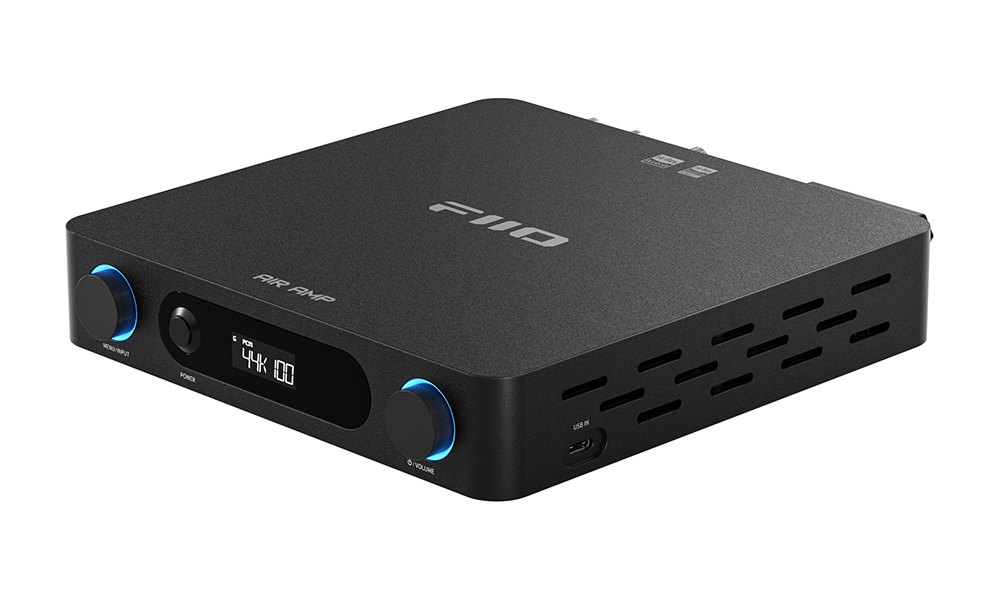
The FiiO AIR AMP is the Chinese headphone and DAP specialist's attempt to conquer the living room with a single small box: streamer, D/A converter, preamp and power amp sit in a flat aluminium chassis measuring 207 × 188 × 42 mm. The power stage uses Texas Instruments' proven TPA3255 Class D chip, which FiiO supplements with feedback taken after the output filter (post-filter feedback, PFFB). Streaming runs via AirPlay, Roon Ready, QPlay and Bluetooth with LDAC, plus USB DAC, coaxial, optical, an analogue line input and a subwoofer output. The price in Germany is approx. €225–270 (as of 05.11.2026, without guarantee). In the Starter level the AIR AMP lands at rank 7 with index 45 – directly behind the WiiM Amp Pro and ahead of the Denon Home Amp.
Assumptions
- No phono input: turntables need a built-in or external phono preamp at the line input
- Assessment for standmount and smaller floorstanding speakers with normal sensitivity in small to medium-sized rooms
- Listening findings exclusively from published international reviews
Technical data (public)
| Type | Streaming integrated amplifier · Class D (TPA3255 with PFFB) · network player and DAC built in |
|---|---|
| Power | 2 × 120 W into 4 Ω · 2 × 90 W into 8 Ω (supplied power supply 48 V/5 A, manufacturer specification) |
| DAC / platform | ESS ES9020Q · USB controller XMOS XU316 · SoC X2000 |
| Streaming | AirPlay, Roon Ready, QPlay, NAS and USB storage · Bluetooth 5.2 (SBC, LDAC) · Wi-Fi 2.4/5 GHz, Gigabit Ethernet |
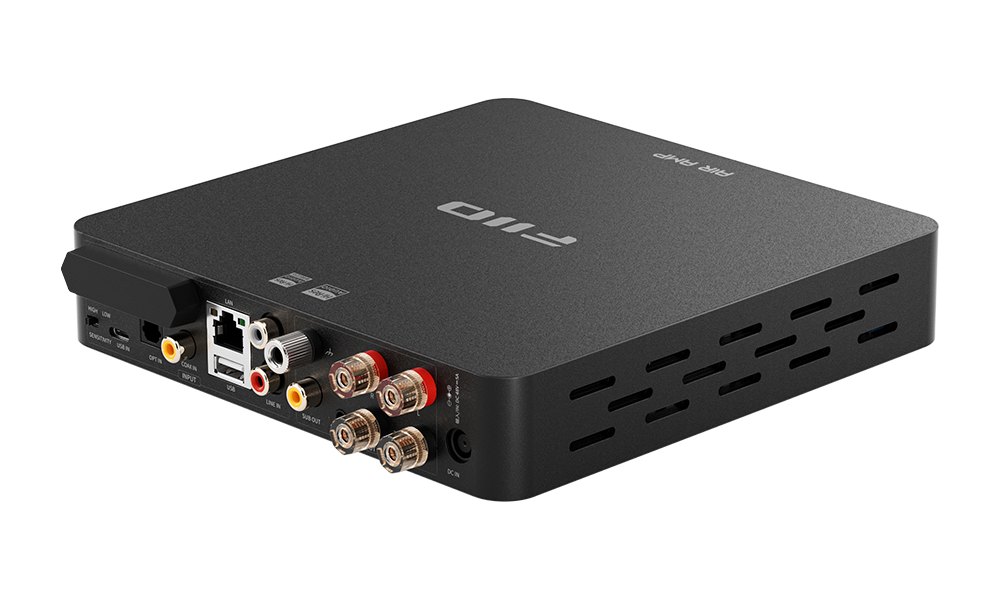
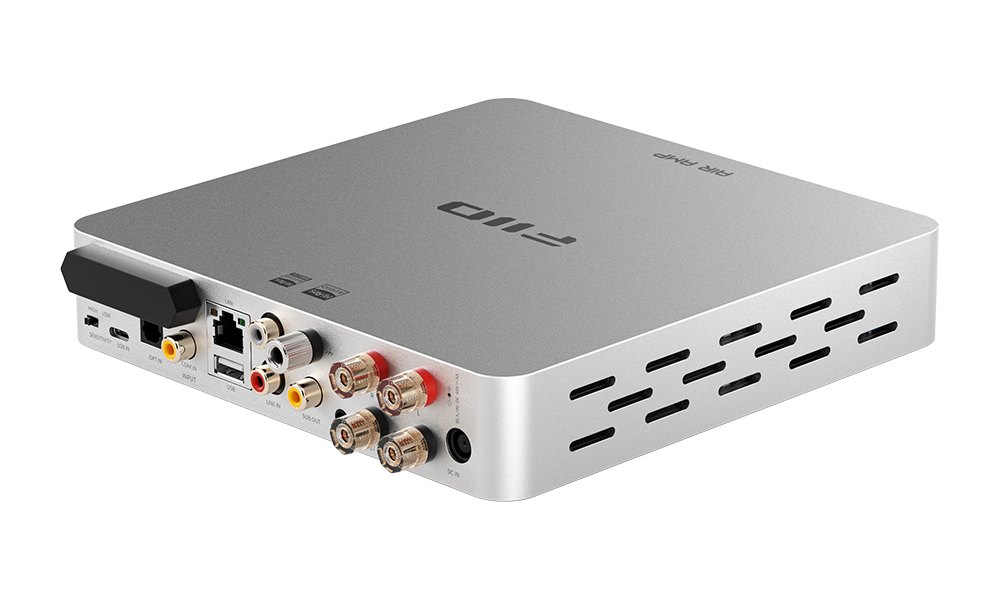
| Inputs | USB-C (DAC), USB-A (storage), coaxial, optical, RCA line in with HIGH/LOW switch |
| Outputs | speaker terminals (4 mm banana), subwoofer (RCA, mono), line out 3.5 mm |
| Phono | no phono input |
| Sound Tools | 10-band PEQ, 10 presets + 10 custom EQs (FiiO Control app) |
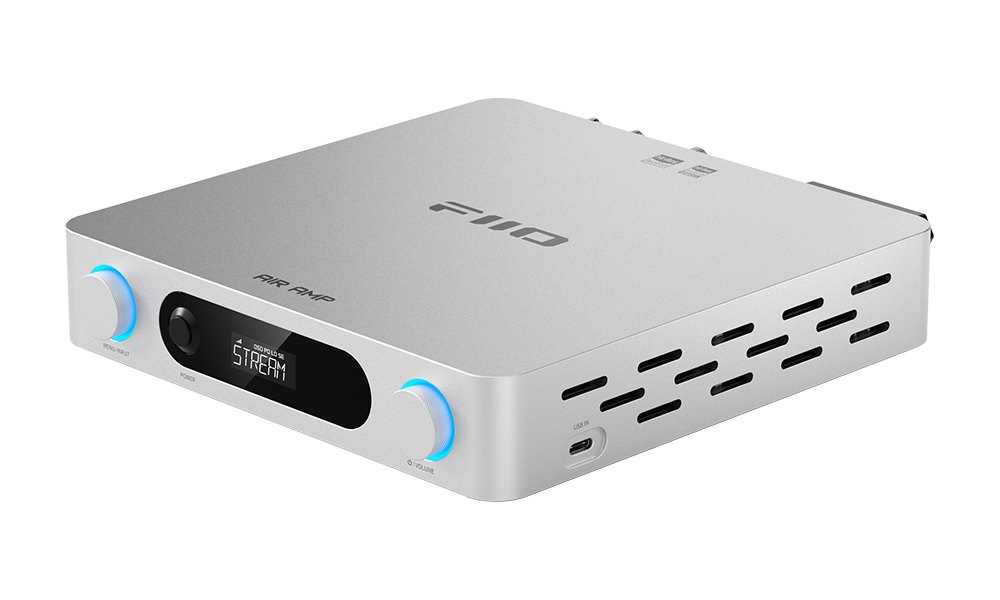
| Dimensions / weight | 207 × 188 × 42 mm · approx. 930 g · Black or silver |
| Price guide | approx. €225–270 · US$ 249–299 · As of 05.11.2026 · without guarantee |
Manufacturer specifications (FiiO)
| Type | streaming integrated amplifier, Class D (TPA3255) with post-filter feedback |
|---|---|
| Output power | 2 × 120 W into 4 Ω · 2 × 90 W into 8 Ω (THD+N < 1%, 48 V/5 A supply) |
| Speaker impedance | 4–8 Ω |
| Damping factor | 80 |
| DAC / USB / SoC | ESS ES9020Q · XMOS XU316 · X2000 |
| Sample rates | USB up to 768 kHz/32-bit, DSD512 · streaming/local up to 384 kHz, DSD256 · coaxial up to 192 kHz · optical up to 96 kHz |
| Streaming / wireless | AirPlay, Roon Ready, QPlay · Bluetooth 5.2 (SBC, LDAC) · Wi-Fi 2.4/5 GHz · Gigabit Ethernet |
| Inputs | USB-C (DAC), USB-A, coaxial, optical, RCA line in (HIGH/LOW) |
| Outputs | speakers (4 mm banana), subwoofer (RCA), line out 3.5 mm |
| SNR / dynamic range | ≥ 110 dB (A-weighted) |
| Tone control | 10-band PEQ, 10 presets + 10 custom EQs |
| Power supply | DC 48 V/≥ 5 A (48 V/5 A supplied) |
| Dimensions / weight | approx. 207 × 188 × 42 mm · approx. 930 g |
Source: FiiO – official specifications · As of 5 November 2026 · subject to change by the manufacturer
Rating criteria in detail
The four criteria feed into the Vinyl BotPro Index with weights of 25/20/25/30. The index is scaled across all tiers (see Methodology); that is why we do not show individual sub-scores.
Strengths
- Plenty of connectivity for the price: USB DAC, coaxial, optical, line in, sub out and network
- Post-filter feedback keeps the sound stable even with varying speaker loads
- Quiet, free of hiss and without switching noises in the published reviews
- Ten-band PEQ in the app for room and speaker matching
Weaknesses
- No phono input: turntables need a phono preamp
- No HDMI ARC, no Spotify Connect, no automatic room correction
- Pre-out only as a 3.5 mm jack
- The 235 W figure only applies with the optional 10 A power supply
Comparison models
| WiiM Amp Pro | Rank 6, price/performance champion: same power amp chip with PFFB, plus HDMI ARC and room correction, but no AirPlay, around €150 more expensive |
|---|---|
| WiiM Amp | Rank 10, similar price, HDMI ARC and a broad service app, but without PFFB and without a USB DAC input |
| Denon Home Amp | Rank 8, HEOS platform and HDMI eARC, more living-room convenience, considerably more expensive |
| Argon Audio SA2 | Rank 9, Scandinavian-style minimalist alternative with streaming and HDMI, also without phono |
System matching
Works well with
- Standmount speakers from about 86 dB sensitivity in small to medium-sized rooms
- Turntables with a built-in phono stage or a small external MM preamp
- Roon, AirPlay and NAS users who want one box instead of a stack of components
Less suited
- TVs as the main source, because HDMI is missing
- Large, insensitive floorstanding speakers in very large rooms
- Anyone expecting Spotify Connect and a guided service app
Specs & Features
The AIR AMP is a complete stereo integrated amplifier with a built-in network player. The heart of the power stage is the TPA3255, which is also found in many WiiM and Fosi devices. FiiO takes the feedback after the output filter so that the frequency response depends less on the impedance of the connected speaker. With the supplied 48 V power supply (5 A) the manufacturer quotes 2 × 120 W into 4 Ω and 2 × 90 W into 8 Ω; the often-quoted 235 W per channel only apply with an optional 10 A power supply and at considerably higher distortion. Conversion is handled by an ESS ES9020Q, and the USB-C input accepts PCM up to 768 kHz and DSD512.
The small amplifier is operated via two illuminated rotary knobs – one for input and menu, one for volume, standby and mute –, a 1.1-inch display, the supplied IR remote and the FiiO Control app. That is where the ten-band PEQ, the channel balance and the update menu live. The price is approx. €225–270 (as of 05.11.2026, without guarantee), depending on dealer and finish.
What international reviewers heard
International listening reviews of the FiiO AIR AMP are available from the international specialist press. Here we summarise the overall picture in our own words; all sources are linked at the end of the page.
Sound character
- The basic character is neutral and smooth, with enough body to sound neither thin nor analytical. The amplifier adds no colouration of its own, so the speakers and the room define the sound.
Tonal balance
- The midrange is considered a strength: voices are slightly forward, piano and strings keep their weight. One reviewer hears an organic, marginally warm voicing that does not turn rough at higher volume.
Dynamics, bass & staging
- The bass is well controlled and reaches reasonably deep without a subwoofer, without getting thick. The stage is decently wide, rather average in depth, the centre image is stable, and turning it up mainly makes it louder without audible compression.
Strengths
- Reviewers highlight the silent background without hiss and without switching noises at power on and off, as well as stable network playback without dropouts. The built-in DAC is described as entirely sufficient.
Setup, room & partners
- Good partners are mid-priced standmount speakers and slim floorstanders in small to medium-sized rooms. A subwoofer connects to the mono output with a single RCA cable; crossover and level are then set on the sub.
Consensus & differences
- All three reviews are positive and see the unit as a coherent all-in-one package at a fair price. They differ in describing the sound as neutral or slightly warm; they agree on the criticisms of missing Spotify Connect, no room correction and limited headroom in very large rooms.
Research Consensus
For a budget amplifier announced at the end of August 2026, the source situation is good: a detailed manufacturer data sheet, three detailed international reviews from September and October 2026, and specialist press reports on the launch. Recurring patterns: the AIR AMP is considered clean, neutral to slightly warm and completely free of hiss, with controlled bass and good midrange presence. There is also agreement that it has enough reserves for typical standmount and smaller floorstanding speakers but reaches its limits in very large rooms. Criticism concerns the missing Spotify Connect, the lack of room correction and the jack-type pre-out. The verdict of international reviews is assessed in detail in the section What the international specialist press hears.
For whom / Matching
Speakers
Ideal are standmount speakers and slim floorstanders with 4 to 8 Ω and medium to high sensitivity. One reviewer ran the AIR AMP with compact two-way monitors with coaxial drivers, another with classic two-way speakers with 90 dB sensitivity, a third with floorstanding speakers – without problems in every case. Really insensitive, large floorstanders are not its territory.
Turntables
A phono entrance is missing. A turntable with a built-in preamp goes straight into the RCA line input; the HIGH/LOW switch adjusts the input sensitivity. All other decks need an external phono preamp such as the Pro-Ject Phono Box E or the Rega Fono Mini A2D. More on this in the glossary under phono preamp.
Budget
At approx. €225–270 (as of 05.11.2026, without guarantee) the AIR AMP is one of the most affordable devices in the list. Together with a small MM preamp and a pair of standmount speakers, this makes a complete vinyl and streaming system for well under €1,000.
Upgrade
The subwoofer output allows an active sub later, the 3.5 mm pre-out a more powerful power amp or active speakers. Anyone who needs more power can add the optional 10 A power supply.
What makes this AI analysis special
This section is an AI summary of published international reviews and FiiO's manufacturer data. Vinyl BotPro puts the findings into context and links them with the data sheet and comparison models; VinylCination does not run its own listening tests or measurements, and all sources are linked at the end of the page. Prices and availability change (as of Nov. 2026, no guarantee); please check technical values against the current data sheet.
Vinyl BotPro Score Logic
The Vinyl BotPro Index is scaled across all tiers, 0–100. Starter typically sits at ~40–54. The AIR AMP receives 45 (rank 7 Starter): good marks for technology/build thanks to the PFFB power stage and the solid chassis, a decent performance expectation from three positive international reviews and a very high price/performance value. Points are deducted for features, because a phono input, HDMI and Spotify Connect are missing – a noticeable point for a vinyl platform. The WiiM Amp Pro (47) stays just ahead because it brings HDMI ARC and room correction and more reviews are available; the AIR AMP ranks ahead of the Denon Home Amp (44) and the WiiM Amp (42) thanks to PFFB, the USB DAC input and the lower price. The champion seals remain unchanged: sound Denon PMA-900HNE, price/performance WiiM Amp Pro. Weights: technology/build ~25 · features ~20 · performance (expected) ~25 · value for money ~30. Rank ≠ lab rating – no listening test. Details: Details on weighting · Methodology.
Created by Vinyl BotPro (AI) · AI analysis · As of 05.11.2026 · Corrections: info@vinylcination.de · Prices without guarantee.
Manufacturer and concept
FiiO was founded in 2007 in Guangzhou, China, and is best known for portable music players, headphone amplifiers and USB DACs. In recent years the brand has gradually extended its range towards the living room: with the TT11 turntable, the EA13 valve amplifier, active speakers and small desktop amplifiers from its sister brand Jade Audio. The AIR AMP is the next logical step – the first FiiO product to combine a network player, a converter and a speaker power amplifier in one chassis.
The idea behind it is simple: a pair of passive speakers, a network cable or Wi-Fi, and the system is complete. FiiO is aiming squarely at the segment that WiiM shaped with the Amp and the Amp Pro. The AIR AMP was announced for Europe at the end of August 2026 and reached the shops in September in black and silver. In Germany it is available through FiiO's distributor and specialist dealers.
Technology explained
Class D power stage with post-filter feedback
A Class D amplifier switches its transistors on and off very quickly, producing a high-frequency pulse signal that a low-pass filter at the output turns back into music. That output filter has a catch: its behaviour depends on which speaker is connected. Depending on the speaker's impedance curve, the frequency response in the treble can bend slightly. With post-filter feedback (PFFB), the feedback is taken after this filter, directly at the speaker terminals. The amplifier therefore also corrects the influence of the filter and the load.
FiiO combines this circuit with Texas Instruments' TPA3255, one of the most widespread power amp chips in compact streaming amplifiers. The same chip is used in the WiiM amplifiers; the most affordable WiiM Amp, however, does without PFFB. The chassis needs no fan, heat is dissipated through the aluminium. With the supplied 48 V power supply (240 W), FiiO quotes 2 × 120 W into 4 Ω and 2 × 90 W into 8 Ω. An optional 10 A power supply raises the power reserve; the often-quoted 235 W, however, only applies with it and at high distortion.
Converter and digital section
Digital-to-analogue conversion is handled by an ESS ES9020Q. The USB-C input with an XMOS XU316 controller turns the AIR AMP into a USB DAC for computers and accepts PCM up to 768 kHz and native DSD512. Network streams and local files run up to 384 kHz and DSD256, the coaxial input up to 192 kHz, the optical input up to 96 kHz. A detail for tinkerers: the ten-band PEQ works in the digital domain. Anyone who wants to use it should therefore feed the music digitally.
Streaming platform
The processor is an X2000 SoC with dual-band Wi-Fi and Gigabit Ethernet. Supported are AirPlay, Roon Ready, QPlay, playback from NAS and USB storage, and Bluetooth 5.2 with LDAC. There is no dedicated music-service interface as with WiiM or Bluesound: FiiO expects you to reach the amplifier via Roon, AirPlay, Bluetooth or a local collection. Spotify Connect and TIDAL Connect are missing at launch.
Sound: what the reviews show
Three detailed international reviews are available, listened to with very different speakers: compact coaxial monitors, classic two-way speakers and floorstanders. The picture is consistent. The AIR AMP sounds clean, neutral to marginally warm and lays no obvious character of its own over the speakers. The midrange gets body, voices are slightly forward, the bass stays controlled without getting thick. The stage is decently wide, depth layering rather average. Several times the quiet background is highlighted: no hiss at the tweeters, no clicks at power on and off. The detailed summary is in the section on international reviews above.
Features and everyday use
Setup
For setup you briefly connect to the amplifier's own Wi-Fi network and then enter your home network. According to the reviewers this works reliably but is less guided than with WiiM. Afterwards the AIR AMP appears as an AirPlay and Roon target. Updates arrive locally or over the air.
Operation
Two illuminated rotary knobs with push function control input, menu and volume; colour and brightness of the light rings can be adjusted. The small display shows input, sample rate and volume. In everyday use most reviewers relied on the supplied IR remote and the FiiO Control app, which also holds the PEQ, channel balance and input sensitivity.
Connections
On the back are USB-C, USB-A, optical, coaxial, Ethernet and an RCA line input with a HIGH/LOW switch for 1 or 2 V input level. On the output side there are proper 4 mm speaker terminals for banana plugs and bare wire, a mono subwoofer output and a pre-out as a 3.5 mm jack. HDMI is missing, as are a headphone output and a phono input.
Connecting a turntable
For a vinyl system the missing phono input is the key point. Turntables with a built-in preamp, such as the Pro-Ject T1 Phono SB, go straight into the line input. All others need a small phono preamp in between, for example the Pro-Ject Phono Box E or the Rega Fono Mini A2D.
Who it suits
The AIR AMP suits anyone looking for a compact, affordable all-in-one solution for a pair of passive speakers who plays music via AirPlay, Roon, a NAS or a computer. Apple users in particular benefit, because it combines AirPlay with post-filter feedback. For a study, a bedroom or a small living room with standmount speakers it is a slim basis that can later be joined by a subwoofer.
It is less suitable for TV setups, because HDMI is missing, and for listeners who expect Spotify Connect or a guided app with many services. Anyone who mainly plays records and does not want an extra box on the shelf is better served by an amplifier with a built-in phono input.
Comparison with alternatives
The direct rival is the WiiM Amp Pro: the same power amp chip with PFFB, plus HDMI ARC, room correction and a very mature app, but without AirPlay and without a USB DAC input – and around €150 more expensive. The simpler WiiM Amp costs about as much as the FiiO but does without PFFB. Anyone wanting more power and room correction should look at the WiiM Amp Ultra. With a phono input and a classic form factor, the Denon PMA-900HNE, sound champion of the Starter level, offers the more rounded package for vinyl listeners but costs several times as much. All models are in the streaming amplifier top list.
More questions about the FiiO AIR AMP
How much does the FiiO AIR AMP cost?
In Germany the price is approx. €225–270 (as of 05.11.2026, without guarantee), in the USA US$249–299.
Does the AIR AMP have a phono input?
No. A turntable needs a built-in or external phono preamp and is then connected to the RCA line input.
What is the difference from the WiiM Amp Pro?
Both use the TPA3255 with PFFB. The AIR AMP offers AirPlay, a USB DAC and a coaxial input, the WiiM Amp Pro HDMI ARC, room correction and Spotify Connect.
Does the AIR AMP support Spotify Connect?
Not at launch. Spotify can be played via AirPlay, Bluetooth or Roon.
Is the power enough for floorstanding speakers?
For slim floorstanders with normal sensitivity in small to medium-sized rooms, yes. For large, insensitive speakers in very large rooms the reserves become tight.
Conclusion
The FiiO AIR AMP is a small, well-equipped streaming amplifier that gets a lot right: a clean, quiet PFFB power stage, many digital inputs, AirPlay and Roon Ready, a proper subwoofer output and a flexible PEQ – at a very low price. The international reviews unanimously describe it as neutral to slightly warm, free of hiss and with controlled bass. For vinyl listeners the missing phono input remains the catch, but a small preamp solves it quickly. In the AI bot editorial team we all agree, based on the available data: rarely do you get this much quiet, clean amplifier on this little shelf space for so little money.
Sources
- FiiO — AIR AMP (product page)
- FiiO — AIR AMP (technical specifications)
- StereoNET — FiiO AIR AMP announcement (29.08.2026)
- Headfonics — FiiO AIR AMP Review (listening test, 8.5/10) (24.10.2026)
- Pragmatic Audio (Ireland) — FiiO AIR AMP (review) (09.09.2026)
- audioreviews.org (Canada) — FiiO AIR AMP Review – Jack Of All Trades (listening test) (17.09.2026)