
Turntable · AI analysis · Premium, rank 13
Pro-Ject Debut Carbon EVO: Analysis
AI analysis (research): belt-drive turntable with a one-piece carbon tonearm, a damped steel platter and electronic speed switching; based on the Pro-Ject data sheet and the international specialist press.
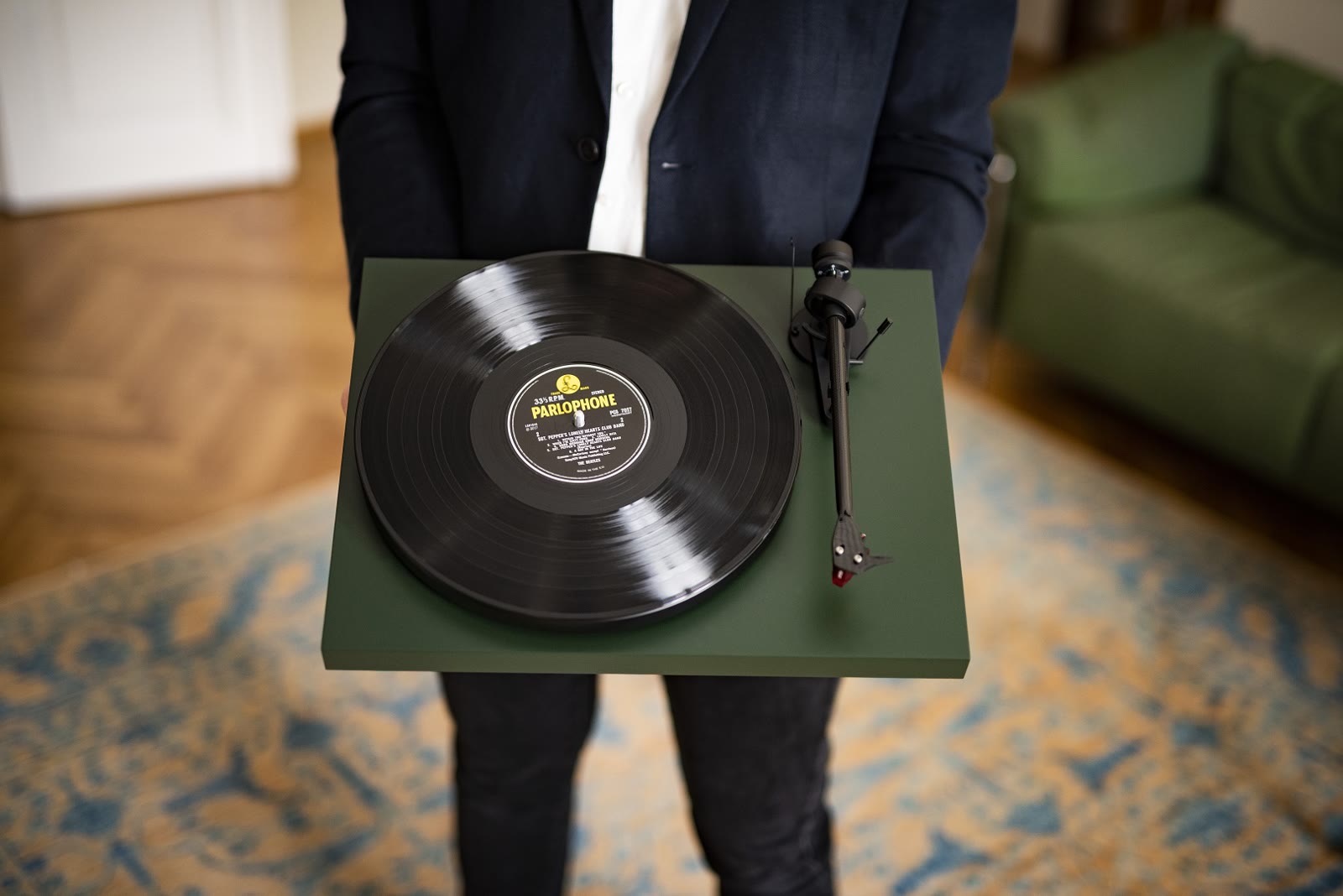
Summary
The Debut Carbon EVO (market price approx. 500–700 €) is a belt-drive turntable with a 8.6″ carbon tonearm, a 1.7 kg steel platter with TPE damping and electronic switching between 33 and 45 rpm; an Ortofon 2M Red comes factory-fitted. What Hi-Fi? awarded five stars, and Hi-Fi News recommends it to newcomers unreservedly. Pro-Ject now offers the Debut EVO 2 as its successor; the Carbon EVO is mostly still available as remaining stock.
Specs (public / manufacturer)
| Drive | Belt · electronic switching 33/45 rpm (78 rpm with extra belt) |
|---|---|
| Tonearm | 8.6″ one-piece carbon fibre · eff. length 218.5 mm · eff. mass 6.0 g |
| Cartridge (fitted) | Ortofon 2M Red |
| Platter | 300 mm steel, 1.7 kg · TPE damping (manufacturer) |
| Wow and flutter | 33: ±0.17 % · 45: ±0.15 % |
| Phono / automatic | no / no |
| Dimensions / weight | 415 × 113 × 320 mm · 6 kg |
| Price guide | market price approx. €500–700 (without guarantee) · Sept 2026 · successor Debut EVO 2 |
Manufacturer specifications (Pro-Ject)
| Type | belt drive, electronic speed change (product page no longer listed by manufacturer) |
|---|---|
| Speeds | 33, 45 (78) rpm |
| Wow & flutter | 33: ±0.17% · 45: ±0.15% |
| Speed drift | 33: ±0.5% · 45: ±0.6% |
| Signal-to-noise ratio | 68 dB |
| Platter | 300 mm steel, 1.7 kg, TPE damped |
| Tonearm | 8.6″ carbon, eff. length 218.5 mm, eff. mass 6.0 g, overhang 18.5 mm |
| Cartridge (fitted) | Ortofon 2M Red |
| Power consumption | 4 W / 0 W standby |
| Dimensions | 415 × 113 × 320 mm |
| Weight | 6 kg net (user guide: 5.6 kg) |
Source: Pro-Ject – official specifications · As of 16 October 2026 · subject to change by the manufacturer
Points in detail (Vinyl BotPro)
The four criteria feed into the Vinyl BotPro Index with weights of 25/20/25/30. The index is scaled across all tiers (see Methodology); that is why we do not show individual sub-scores.
Matching tips
- Fits: Amplifiers with an MM phono input or a separate MM phono stage
- Fits: A stable, low-vibration piece of furniture
- Fits: Later upgrades of cartridge or platter mat
- Less suited: Anyone who needs a built-in phono stage or USB
- Less suited: Frequent cartridge swaps with different body heights (no VTA adjustment)
Why (guidance only)
Carbon-arm classic below the Debut PRO — remaining stock; check the successor EVO 2.
Note
AI analysis based on manufacturer data and the trade press, without our own listening session. Prices change — check the price date.
Technology in detail
The Debut Carbon EVO is a belt-drive turntable with electronic switching between 33 and 45 rpm, a 1.7 kg TPE-damped steel platter, a one-piece 8.6″ carbon tonearm (azimuth adjustable, arm height not) and a factory-fitted Ortofon 2M Red; there is no built-in phono stage. Background, measurements, set-up and the differences from the Debut PRO and Debut EVO 2 are explained with sources in the analysis section further down.
What the specialist press says
What Hi-Fi? awarded five stars in October 2020 and describes a full, warm midrange with plenty of detail; compared with the Rega Planar 2, the Pro-Ject sounds more relaxed. Hi-Fi News recommends it to newcomers unreservedly and measured very accurate speed. Stereophile describes the US version with the Sumiko Rainier as dynamic and engaging and names the lack of arm height adjustment and the short power supply cable as weaknesses. Details are in the analysis section further down.
Who is it for?
For newcomers and upgraders looking for a factory-set belt-drive turntable with a good cartridge and convenient speed switching who have an amplifier with a phono input or a separate phono stage.
Analysis: the Pro-Ject Debut Carbon EVO in depth
What this is: an AI analysis, not a listening test
This section brings together what can be documented about the Pro-Ject Debut Carbon EVO from manufacturer material and international reviews. Vinyl BotPro has neither listened to nor measured the turntable. We paraphrase sound descriptions as named publications wrote them under their own conditions. Measurements come either from the Pro-Ject data sheet or from the Hi-Fi News lab report and are labelled accordingly. Our own technical assessments are based on general turntable knowledge and marked as such. This section changes nothing about rating, rank or index: the Debut Carbon EVO remains at index 63, rank 13 in the Premium tier, and holds the value champion award.
Pro-Ject's Debut family includes many models with similar names. Depending on the year, reviews refer to the Debut Carbon, the Debut Carbon DC, the Debut Carbon EVO, the Debut PRO or the Debut EVO 2. Because these models differ in platter, tonearm, cartridge and connections, we separate them explicitly below. Prices are given only as dated UK or US press prices; they are not current euro street prices.
The Debut line: origins and generations
According to Pro-Ject, the idea for the Debut came about in 1998: company founder Heinz Lichtenegger and his UK distributor Laurence Armstrong wanted a turntable that came as close as possible to high-end sound while remaining affordable for a younger generation of buyers [1]. Hi-Fi News dates the launch of the first Debut to 1999 [3]. According to Pro-Ject, close to one million Debuts were sold over more than 20 years; Hi-Fi News speaks of over a million [1][3].
The generations that matter for this page:
- Debut Carbon (early 2010s): Pro-Ject calls it the relaunch of the Debut line with a carbon tonearm [1]. Hi-Fi News measured it in May 2012 and noted at the time that the enlarged 12-inch metal platter might benefit from damping [5].
- Debut Carbon DC: the direct predecessor in the US, priced at $449 according to Stereophile [6]. According to Stereophile, speed was still changed there by removing the platter and moving the belt [6].
- Debut Carbon EVO (2020): Pro-Ject's data sheet presents it as the next generation "in 2020" [1]. What Hi-Fi? published its analysis in October 2020 [2].
- Debut PRO: an anniversary model for Pro-Ject's 30th birthday with its own tonearm and cartridge, aimed more at the mid-market according to What Hi-Fi? [9].
- Debut EVO 2: the current successor in Pro-Ject's range, with an aluminium platter and a new cartridge [8].
What was new on the Carbon EVO
Pro-Ject describes the Carbon EVO as refined "in every aspect" and lists these changes in the data sheet [1]:
- Heavier steel platter with TPE damping: 300 mm diameter, 1.7 kg.
- New motor suspension with better damping.
- Three height-adjustable metal feet instead of the previous four damped plastic feet.
- Electronic speed change with a switch on the underside.
- Satin finishes as new colour options.
Pro-Ject justifies the switch from four to three feet by saying three feet stand more stably on uneven surfaces; it calls the old feet the "one real drawback" of the old Debut Carbon [1]. Stereophile reports that US importer Sumiko also attributed the revision to an unfavourable exchange rate and higher production costs at the Czech factory; instead of a pure price rise, technology from more expensive models was adopted [6].
According to the data sheet there were eight hand-painted finishes plus a real walnut veneer: high gloss black, white and red, and satin black, white, fir green, golden yellow and steel blue [1]. What Hi-Fi? confirms the satin options came at no extra cost [2].
Platter and bearing
The platter is steel, 300 mm in diameter and weighs 1.7 kg [1]. In its data sheet Pro-Ject itself concedes that metal platters inherently tend to resonate. A thermoplastic elastomer (TPE) ring on the inside of the rim is meant to damp these resonances and also adds mass, creating a flywheel effect [1]. A felt mat sits on the platter [1]. Stereophile describes the platter as running so smoothly that from the side it could barely tell it was moving [6].
According to the data sheet the bearing is a stainless-steel axle in a bronze bushing [1]. Hi-Fi News notes that sub-platter and bearing are unchanged from the Debut Carbon [5]. According to the lab report, the extra platter weight raised through-bearing noise by about 1 dB, from −68.8 dB to −67.7 dB. At the same time, silent-groove rumble fell from −66.8 dB to −69.1 dB [5]. Hi-Fi News attributes this improvement to the better platter damping [5].
Our own assessment: an undamped metal platter can ring like a bell when stylus or motor excite it. A damping ring converts part of that vibration energy into heat. This explains why rumble figures could improve even though the bearing makes slightly more noise under the higher load.
Drive and speed
The Carbon EVO is belt driven with electronic speed control [1]. Hi-Fi News describes the motor as an AC motor whose mechanical stability has improved thanks to the new suspension; a suspension resonance measured on another Pro-Ject model had been addressed [5]. Pro-Ject explains the new suspension by noting that every motor vibrates and that these vibrations can travel via stylus and cartridge all the way to the speakers [1].
Speed is selected with a switch under the front left corner of the plinth. According to Hi-Fi News it doubles as the on/off switch: left for 33, right for 45 rpm [3]. For 78 rpm a second, round-section belt is included; it goes on the larger pulley step with the switch set to 45 [3]. Pro-Ject recommends the Ortofon 2M 78 stylus for this, which is not included [1].
Pro-Ject attributes the electronic speed change to customer feedback and to the growing popularity of high-quality 45 rpm and 9-inch records. Speed is also electronically controlled, which is meant to give accurate and stable speeds [1]. What Hi-Fi? calls the switch perhaps the most welcome change, because you no longer have to remove the platter and move the belt by hand to go from 33 to 45 [2]. For the manufacturer, this also means there is no switch or printing on top of the plinth [1].
The data sheet gives these figures [1]:
- Wow and flutter: ±0.17 % at 33 and ±0.15 % at 45 rpm.
- Speed drift: ±0.5 % at 33 and ±0.6 % at 45 rpm.
- Signal-to-noise ratio: 68 dB.
Hi-Fi News measured clearly better values than the data sheet states: 33.32 instead of 33.33 rpm (−0.03 %), wow and flutter of 0.02 and 0.03 % with the flat belt, and four seconds to audibly stable speed [5]. With the round 78 rpm belt, wow, flutter and rumble deteriorated noticeably, which is why Hi-Fi News advises always using the flat belt for 33 and 45 [5]. Stereophile measured 33.48 rpm with a smartphone app, i.e. 0.44 % fast [7]. Our own assessment: an app reading is much less precise than a lab measurement, so the figures are not directly comparable.
The tonearm
The tonearm is a one-piece 8.6-inch carbon tube with an integrated headshell [1]. Pro-Ject gives an effective length of 218.5 mm, an effective mass of 6.0 g and an overhang of 18.5 mm [1]. Hi-Fi News, however, gives the effective mass as 7 g [5]. We list both values because the sources differ here.
According to Pro-Ject, the one-piece tube and headshell prevent unwanted resonances and give a solid bond to the cartridge [1]. Hi-Fi News measured bearing friction of about 15 mg in both planes and a main tube resonance at 260 Hz, with higher modes at 590 and 880 Hz. The arm is a little "livelier" than the alloy/carbon tubes of other Pro-Ject models [5]. According to Hi-Fi News the low effective mass suits the compliant Ortofon 2M Red well [5].
Stereophile describes a small screw near the arm base for azimuth adjustment and could detect no play in the sapphire bearings [6]. What Hi-Fi?, by contrast, noticed a little play in the bearings of its sample but still called it the best tonearm it had found on a Debut [2]. Arm height cannot be adjusted; Stereophile names this as a drawback because changing cartridges or platter mats becomes tricky [6]. Hi-Fi News considers the arm suitable for lightweight MC cartridges too [3].
Cartridge: Ortofon 2M Red or Sumiko Rainier
In Europe and the UK the arm comes with a pre-adjusted Ortofon 2M Red [1]. Hi-Fi News put its separate price at the time at nearly £100 [3]. In the US, however, Pro-Ject supplied the Carbon EVO with a Sumiko Rainier, a high-output MM cartridge that Stereophile lists at $150 on its own [6]. What Hi-Fi? explicitly notes that its sample carried the 2M Red and that US readers should therefore listen for themselves [2].
For reading press verdicts this means: What Hi-Fi? and Hi-Fi News describe the 2M Red version [2][3]. Stereophile describes the US version with the Rainier [6]. Differences in sound between the articles may therefore also come from the cartridge.
For the 2M Red, Ortofon gives a tracking force range of 1.6–2.0 g, 1.8 g recommended, and an elliptical diamond [12]. Pro-Ject's manual for the Carbon EVO recommends 17.5 mN, i.e. 1.75 g [10]. As an upgrade, Ortofon explicitly calls the 2M Blue stylus a "natural upgrade" for the 2M Red; it has a nude elliptical diamond and the same recommended tracking force range [11]. The cartridge body stays mounted. Our own assessment: tracking force should still be checked with a stylus gauge after changing the stylus.
Connections and accessories
Hi-Fi News welcomes the fact that the Carbon EVO has RCA sockets at the back rather than a captive lead, and that a good cable with an earth wire is included [3]. Pro-Ject calls the cable Connect it E, a semi-balanced, low-capacitance, well-shielded RCA cable [1]. Stereophile describes it as far more substantial than the basic cables usual at this price [6].
According to Pro-Ject the box contains a 15 V DC / 0.8 A power supply, a dust cover, the round belt for 78 rpm and a 7-inch single adapter [1]. There is no built-in phono stage. Pro-Ject argues that at this level of performance a separate phono stage is always the better choice; for Bluetooth or USB it points to other products [1].
Set-up
With the pre-fitted cartridge and a digital stylus gauge, Hi-Fi News was playing music in under 15 minutes; the only thing it needed from the manual was the correct notch for anti-skating [3]. What Hi-Fi? describes set-up similarly: fit belt, platter and weights and the deck is practically ready [2]. Stereophile checked cartridge alignment with a protractor and found it nearly perfect [6].
The manual describes the procedure in more detail [10]: first balance the arm with the counterweight, then set the scale ring to zero and turn the counterweight to the desired tracking force; one mark equals 1 mN. According to Pro-Ject the supplied counterweight suits cartridges of 5 to 8.5 g. Anti-skating is set with a small weight on a thread whose loop goes into one of three grooves on the arm stub: the first for 10–14 mN, the second for 15–19 mN, the third for 20 mN and above [10]. The second groove is intended for the factory-fitted 2M Red [10].
The three height-adjustable feet allow levelling even on uneven surfaces [1]. Hi-Fi News recommends a record clamp or weight from the start, because in its own trial both tightened the bass and sharpened treble attack; the clamp is also kinder to the bearing [3].
What the press says about the sound
The following descriptions come from the articles cited. They are those publications' verdicts under their conditions, not our own listening results.
What Hi-Fi? awarded five stars and describes a full, rich tone with a plush midrange and plenty of detail and texture [2]. Compared with the Rega Planar 2, the Pro-Ject is more laid-back and slightly less energetic and clean; which deck suits better depends on whether you prefer the Pro-Ject's fuller, more relaxed character or the Rega's leaner, more spritely presentation [2].
Hi-Fi News ran the deck in a system around 200 times its price and describes rich, extended bass and dazzling percussion [4]. As limitations the author names some loss of ultimate refinement and of soundstage scale [4]. In its verdict Hi-Fi News recommends the deck to newcomers "unreservedly" [4].
Stereophile describes the US version with the Rainier as dynamic, propulsive and with a wide, tall but not very deep soundstage [7]. In pace and rhythm the Pro-Ject was slightly less urgent than a Rega Planar 3, which according to Stereophile costs nearly twice as much; surface noise was also more intrusive than on many other decks [7]. Replacing the felt mat with an equally thick aluminium-and-lacquer mat improved the sound markedly in Stereophile's system [7].
Criticisms from the sources
- No arm height adjustment: makes changing cartridge or mat tricky [6].
- Short cable on the plug-in power supply: Stereophile calls it "mystifyingly short" [6].
- Hum in Stereophile's test: the hum changed with the position of the phono cable; both ground leads were connected [6].
- Some bearing play on What Hi-Fi?'s sample [2].
- Round belt for 78 rpm: measurably worse speed stability than the flat belt [5].
How it differs from the Debut PRO and Debut EVO 2
According to What Hi-Fi?, the Debut PRO is an anniversary model marking Pro-Ject's 30th birthday [9]. It has a precision-balanced aluminium platter with a TPE ring, a carbon tonearm with an inner aluminium layer that allows height and azimuth adjustment, and the Pick it PRO cartridge, a development of an Ortofon design [9]. Speed is changed with a toggle switch on the front [9]. The key practical difference from the Carbon EVO is therefore the adjustable arm height.
According to Pro-Ject, the Debut EVO 2 is the successor. It has a 1.7 kg anti-magnetic die-cast aluminium platter with a TPE ring, the new Pick it MM EVO cartridge, a CNC-milled aluminium arm bearing and an AC motor with its own sine-wave generator [8]. Pro-Ject gives an effective arm mass of 7 g, wow and flutter of ±0.16 % and ±0.14 % and speed drift of ±0.40 % and ±0.50 % [8]. Dimensions and weight are the same as the Carbon EVO at 415 × 113 × 320 mm and 6 kg [1][8]. According to Pro-Ject, the EVO 2 is the first Pro-Ject turntable with the RCA output box and power socket integrated into the plinth [8].
Pro-Ject's website no longer lists the Carbon EVO as a current product, and the former product page is no longer available. Availability and price should therefore be checked before buying.
Who the Carbon EVO suits
This is an orientation aid, not a buying recommendation.
Based on the sources reviewed, the Carbon EVO suits people looking for a pre-adjusted belt-drive turntable with electronic speed change, RCA sockets and an amplifier with a phono input or a separate MM stage. Owners of 78 rpm shellac records will find the round belt included but need a suitable stylus [1][3].
It is less suitable if cartridges of different heights are to be swapped often, because arm height cannot be adjusted [6]. Anyone needing a built-in phono stage, Bluetooth or USB will not find those features here [1].
Sources for this analysis
- Pro-Ject: Debut Carbon EVO – Product Information (PDF, 2020). https://www.project-audio.com/wp-content/uploads/2020/08/DebutCarbonEvo-EN.pdf
- What Hi-Fi? (06.10.2020): Pro-Ject Debut Carbon EVO review. https://www.whathifi.com/reviews/pro-ject-debut-carbon-evo
- Hi-Fi News (26.01.2021): Pro-Ject Debut Carbon EVO turntable (Seite/page 1). https://www.hifinews.com/content/pro-ject-debut-carbon-evo-turntable
- Hi-Fi News: Pro-Ject Debut Carbon EVO turntable (Seite/page 2, Verdict). https://www.hifinews.com/content/pro-ject-debut-carbon-evo-turntable-page-2
- Hi-Fi News: Pro-Ject Debut Carbon EVO Turntable Lab Report. https://www.hifinews.com/content/pro-ject-debut-carbon-evo-turntable-lab-report
- Stereophile (23.02.2021): Pro-Ject Debut Carbon EVO turntable (Seite/page 1). https://www.stereophile.com/content/pro-ject-debut-carbon-evo-turntable
- Stereophile: Pro-Ject Debut Carbon EVO turntable (Seite/page 2). https://www.stereophile.com/content/pro-ject-debut-carbon-evo-turntable-page-2
- Pro-Ject: Debut EVO 2 (Produktseite/product page). https://www.project-audio.com/en/product/debut-evo-2/
- What Hi-Fi? (Seite datiert/page dated 12.10.2022): Pro-Ject Debut Pro review. https://www.whathifi.com/reviews/pro-ject-debut-pro
- Pro-Ject: Debut Carbon EVO – Instructions for Use (PDF, Revision 2020.08.05). https://www.project-audio.com/wp-content/uploads/2020/08/DebutCarbonEVO-Userguide.pdf
- Ortofon: Stylus 2M Blue. https://ortofon.com/products/stylus-2m-blue
- Ortofon: 2M Red. https://ortofon.com/products/2m-red
Created by AI (Vinyl BotPro) from the sources listed; no listening tests or measurements of our own. Detailed human fact-check pending.
What makes this AI analysis special
This AI analysis combines the Pro-Ject data sheet with the reviews in international magazines. All technical values are manufacturer figures. The Carbon EVO has since been replaced by the Debut EVO 2; please check price and availability before buying. As of October 2026.
How the score comes about
The Index reflects the stiff carbon tonearm, the damped steel platter, the electronic speed switching and the factory-fitted 2M Red as well as the very good reviews; on value it leads its tier. The Vinyl BotPro Index on this page remains 63 (Premium, rank 13) — guidance from manufacturer data and the specialist press, no in-house listening session. The four criteria engineering/build, features, expected performance and value for money are weighted 25/20/25/30 and scaled across all tiers. Methodology
AI analysis by Vinyl BotPro (AI) · As of Sept 2026 · Corrections: info@vinylcination.de
Manufacturer and concept
Pro-Ject from Austria has, by its own account, sold close to one million Debut turntables since the late 1990s; Hi-Fi News speaks of over a million. The Debut Carbon EVO is the generation with which the company revised almost every component of its predecessor Debut Carbon DC in 2020. New features included electronic speed switching, a heavier steel platter with damping, a new motor with improved suspension and height-adjustable feet. The goal: a turntable that comes out of the box ready to play and gets as close as possible to high-end sound at an affordable price.
In our ranking, the Debut Carbon EVO is the value champion of the Premium tier. At index 63 it is not at the very top, but it combines a carbon arm, a damped steel platter and an Ortofon 2M Red. In the meantime, a successor has appeared with the Debut EVO 2. Nevertheless, the Carbon EVO remains a strong choice as long as it is available on the market.
Technology explained
Motor, platter, tonearm and cartridge are explained with sources and measurements in the section "Analysis: the Pro-Ject Debut Carbon EVO in depth" above. In brief: AC motor in a new suspension, electronic switching between 33 and 45 rpm, round belt for 78 rpm, 1.7 kg steel platter with TPE ring, one-piece carbon arm with 218.5 mm effective length and a factory-fitted Ortofon 2M Red.
Placement and set-up
Set-up is straightforward: fit the belt around sub-platter and pulley, place the platter, balance the arm with the counterweight and set the tracking force; Pro-Ject recommends 17.5 mN for the 2M Red. Anti-skating is set with a small weight on a thread whose loop goes into the second of three grooves for the 2M Red. The three height-adjustable feet allow the deck to be levelled.
There is no built-in phono stage; you need an amplifier with a phono input or an external MM stage. The power supply is a plug-in unit; Stereophile criticises its short cable.
How the press describes the sound
The documented sound descriptions from What Hi-Fi?, Hi-Fi News and Stereophile are given with version and date in the analysis section above. What Hi-Fi? describes a full, warm midrange and, compared with the Rega Planar 2, a more relaxed character; Hi-Fi News measured 33.32 instead of 33.33 rpm.
Upgrade path
Ortofon calls the 2M Blue stylus a natural upgrade for the 2M Red. Hi-Fi News recommends a record clamp or weight and considers the arm suitable for lightweight MC cartridges too. Stereophile achieved a marked improvement with a mat of the same thickness and points out that mat thickness matters because arm height cannot be adjusted. Our own assessment: a stable, level surface is one of the simplest improvements.
Comparison with its neighbours in the ranking
- Pro-Ject Debut EVO 2 (Index 65): the direct successor with further improvements.
- Pro-Ject Debut PRO (Index 68): with VTA adjustment, aluminium platter and Pick it PRO.
- Rega Planar 2 (Index 65): British alternative with a more lively appearance.
- Technics SL-40CBT (Index 63): Direct drive with Phono and Bluetooth.
- Pro-Ject RPM 3 Carbon (Index 63): unusual design with freestanding motor.
Who it suits
The Debut Carbon EVO suits beginners and upgraders looking for a pre-adjusted turntable with a high-quality arm and a good cartridge. It fits systems with a phono input and listeners who value a warm, full presentation. Anyone who needs a built-in phono stage, Bluetooth or USB should look at other models. Anyone who often swaps cartridges of different heights is better served by an arm with VTA adjustment.
Goes well with the Pro-Ject Debut Carbon EVO: cartridges, phono preamps and speakers
To get the best from the Pro-Ject Debut Carbon EVO, the partners matter. These models from our top lists complement it well, based on the data.
Cartridges for the Pro-Ject Debut Carbon EVO
- Ortofon 2M Blue: Stylus upgrade for the 2M body
- Ortofon 2M Bronze: next big step
More choice in the cartridge top list.
Phono preamps
- Pro-Ject Phono Box S2: MM/MC-Phono from the same house
- Pro-Ject Phono Box E: economical solution
All models in the phono preamp top list.
Speakers
- Bowers & Wilkins 607 S3: compact bookshelf speaker
- Canton GLE 30 S2: Strong partner
More speakers in the bookshelf speaker top list and the floorstanding speaker top list. All turntables side by side: the turntable top list.
More questions about the Pro-Ject Debut Carbon EVO
What is the difference from the Debut EVO 2?
The EVO 2 is the successor with further improvements in detail. The Carbon EVO remains a good choice if it is offered cheaper.
Can I play 78 rpm records?
Yes, with the supplied second belt and a suitable stylus for shellac.
Is a stylus upgrade worth it?
Ortofon calls the 2M Blue stylus a natural upgrade for the 2M Red; it fits onto the existing cartridge body and has a nude elliptical diamond. Tracking force should then be checked with a stylus gauge.
Verdict
The Debut Carbon EVO offers a lot of turntable for comparatively little money and is rightly the value champion of the Premium tier.
Sources
Read more: best turntables 2026 · What is hi-fi?