
Turntable · Short analysis · Starter, rank 8
Pro-Ject Automat A1.2 Review
Short analysis (research): Pro-Ject Automat A1.2 — automatic belt drive with switchable phono and Ortofon OM10.
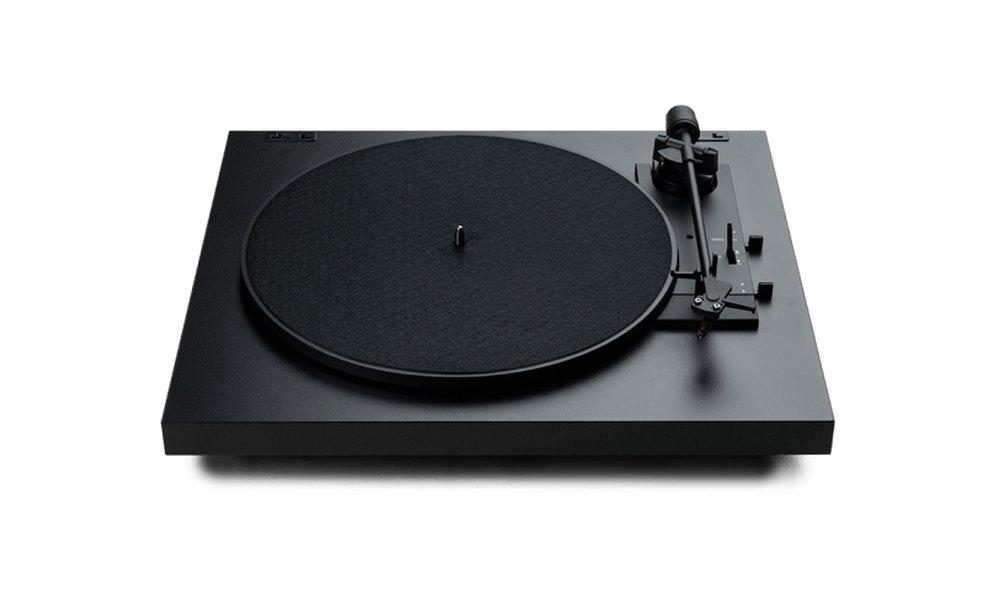
Summary
The Automat A1.2 is Pro-Ject's automatic entry model: press start, the tonearm moves into the lead-in groove, returns at the end of the record and the motor stops. The automatics work purely mechanically and are disengaged during playback (manufacturer). Compared with the first A1, Pro-Ject has revised the drive and platter. Switchable MM phono, tracking force and anti-skating set at the factory: plug & play with Pro-Ject sound tuning. The international specialist press already rated the predecessor A1 as very good value for money and, for quietness and isolation, not far off the manual Debut PRO. One review praises the A1's quiet, smooth running and precise cueing lift; its weak point there is the built-in phono stage.
Specs (public / manufacturer)
| Drive | Belt · automatic · 33/45 electronic speed change (manufacturer) |
|---|---|
| Automatics | Mechanical: auto start, return, motor stop; disengaged during playback |
| Tonearm | 8.3″ ultra-light-mass aluminium · 211 mm effective length |
| Cartridges | Ortofon OM10, factory-adjusted (manufacturer) |
| Platter | Damped die-cast aluminium platter |
| Phono | Built in, can be switched off |
| Wow and flutter | ±0.27 % at 33 rpm (manufacturer) |
| Price guide | approx. €450–500 · UVP €499 · Okt. 2026 |
Manufacturer specifications (Pro-Ject)
| Drive | belt drive, automatic |
|---|---|
| Speeds | 33/45 rpm (electronic speed change) |
| Platter | damped aluminium platter |
| Wow & flutter | 33: ±0.27% · 45: ±0.25% |
| Speed drift | 33: ±0.75% · 45: ±0.65% |
| Signal-to-noise ratio | 65 dB |
| Tonearm | 8.3″ ultra-light-mass aluminium · 211 mm effective length · 19.5 mm overhang |
| Cartridge (fitted) | Ortofon OM10 |
| Power consumption | 1.5 W (15 V DC / 0.8 A power supply) |
| Dimensions | 430 × 130 × 365 mm (W × H × D) |
| Weight | 5.6 kg net |
Source: Pro-Ject – official specifications · As of 16 October 2026 · subject to change by the manufacturer
Matching tips
- The internal phono stage can be switched off – the easiest upgrade path: a better external MM preamp
- Cue 45 rpm maxi singles (12″) with the lift: at 45 rpm the automatics are set up for singles (Hi-Fi News on the A1)
- More comfort and 78 rpm: Pro-Ject Automat A2
Why (guidance only)
Automatic operation with Pro-Ject sound tuning at an entry-level price.
Vinyl BotPro Index
50 out of 100 · Starter tier · Prices change, check the market price before buying.
Short analysis by Vinyl BotPro (AI) · as of Oct. 2026 · Corrections: see the legal notice (German)
Manufacturer and concept
Austria's Pro-Ject is best known for manual turntables such as the Debut range. With the Automat series, the brand has opened its own path for listeners who want convenience without giving up Pro-Ject's sound tuning. The Automat A1.2 is the entry model of this series and the revised version of the first A1. In our top list it sits in 8th place in the Starter tier with an index of 50.
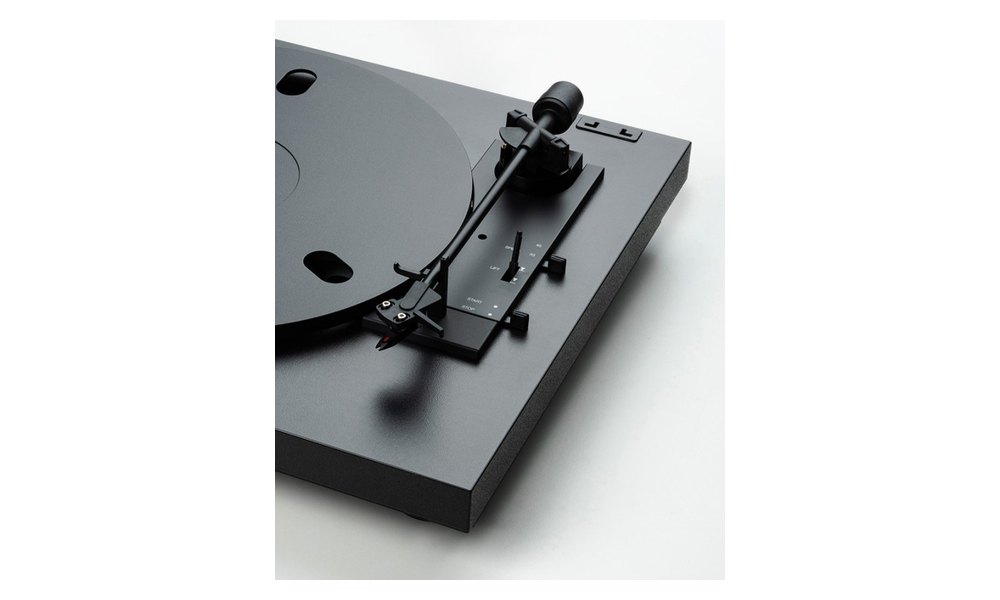
The basic principle is simple: press the start button and the deck does the rest. The arm moves to the lead-in groove, lowers itself, returns at the end of the side and the motor stops. Pro-Ject stresses that the automatic works purely mechanically and is decoupled from the arm during playback. That way convenience is not meant to come at the expense of tracking.
Technology explained
Mechanical automatic operation
Many inexpensive automatic decks control the arm with a mechanism that stays connected to it during playback. That can create friction. With the A1.2, according to Pro-Ject, the mechanism only engages at the start and at the end. In between, the arm runs freely. You can interrupt playback at any time with the lift.
Belt drive with electronic speed change
A motor drives the platter via a belt. Switching between 33 and 45 rpm is electronic, so the belt stays in place. For singles at 45 rpm, the automatic is set up for the smaller record size. Twelve-inch maxi singles at 45 rpm are therefore cued by hand with the lift.
Damped aluminium platter
The platter is made of die-cast aluminium and is damped. Compared with the first A1, Pro-Ject revised the drive and platter. A damped metal platter combines the flywheel mass of a heavy platter with less self-resonance.
8.3-inch ultra-light-mass arm
The arm is 8.3 inches long, which equals 211 mm effective length, and built in very light aluminium. Tracking force and anti-skating are set at the factory. This makes the deck a genuine plug-and-play device: if you do not want to adjust anything, you do not have to.
Ortofon OM10, factory-aligned
An Ortofon OM10 sits on the arm at the factory, an MM cartridge with an elliptical stylus from Ortofon's OM family. The styli in this family fit the same body, which simplifies later upgrades.
Switchable phono preamp
The built-in MM phono preamp makes the A1.2 ready for line inputs and active speakers. If the amplifier has its own phono input, it is switched off.
What changed compared with the first A1
The first Automat A1 was Pro-Ject's entry into automatic operation. With the A1.2, according to its own information, Pro-Ject mainly revised the drive and the platter. The basic concept remains: mechanical automatic, ULM arm, OM10 and switchable phono preamp. For owners of an A1, the A1.2 is therefore more of a model update than an entirely new device. For newcomers, it is simply the current version of the concept.
Design and build
Pro-Ject gives the A1.2 a simple, rectangular chassis with clean edges. Operation is reduced to start, stop and speed. With a footprint of 430 × 365 mm and a height of 130 mm, the deck fits most sideboards and shelves. The connections are on the rear: RCA output, ground terminal, switch for the phono preamp and the socket for the external 15 V power supply. A dust cover protects the deck from dust.
Set-up and installation
The A1.2 is designed for quick start-up. After unpacking, the platter and belt are fitted and the transport lock removed. Because tracking force and anti-skating are already set, there is no need for the balancing required on manual Pro-Ject models. Then the deck is connected, the phono preamp switched on or off depending on the amplifier, and the first record can play.
A firm, level spot matters here too. At 5.6 kg the A1.2 is a fairly light deck. Distance from the speakers and a stable base help against footfall and feedback.
How the press assesses the sound
For the A1.2 itself, only a few usable listening reviews were available at the time of research, so the assessment also draws on reviews of the predecessor A1. These highlight its quiet, smooth running, the precise lift and good value for money. In terms of running quietness and isolation, the press saw the A1 not far from manual Pro-Ject models. One review named the internal phono stage as a weak point. Whether these assessments carry over one-to-one to the revised A1.2 remains open.
Upgrade path for the Pro-Ject Automat A1.2
The simplest step is an external MM phono preamp. The internal stage is switched off and a separate stage takes over. This is also the upgrade path suggested by the reviews of the predecessor. A second step is a higher-grade stylus from the OM family that fits the existing body. Make sure the factory-set tracking force suits the new stylus. If you want more convenience and 78 rpm too, the Automat A2 is the next step in the series.
Automatic or manual?
The choice between an automatic and a manual turntable is mainly a matter of habit. Manual decks such as the Debut range put every step in the listener's hands and offer more adjustment options on the arm. An automatic deck like the A1.2 takes over these steps and protects the stylus against operating errors, such as lowering it too quickly. If you mostly listen in the background, have children in the household or simply do not want to get up after every side, you benefit from the automatic. If you like to experiment with the arm and swap cartridges, a manual model is more flexible.
Comparison with the neighbours in the top list
- Fluance RT82 (index 50): manual belt-drive deck with OM10, no phono.
- Audio-Technica AT-LPW40WN (index 50): manual belt-drive deck with carbon arm.
- Dual CS 429 (index 46): automatic with three speeds and 2M Red.
- Audio-Technica AT-LP3XBT (index 46): automatic with Bluetooth.
- Pro-Ject Automat A2 (Premium): larger automatic with 2M Red and 78 rpm.
Who it suits
The A1.2 suits listeners who want to play records at the push of a button and appreciate Pro-Ject's sound tuning. It works well in households where not everyone is experienced with tonearms. It is less suitable for anyone who wants to adjust the arm themselves, play 78s or often listens to 12-inch maxis at 45 rpm, which have to be cued by hand.
Goes well with the Pro-Ject Automat A1.2: cartridges, phono preamps and speakers
For the Pro-Ject Automat A1.2 to show its potential, the right partners matter. These models from our top lists complement it well according to the available data.
Cartridges and styli
- Ortofon OM 10: the factory cartridge in detail
- Ortofon Stylus 10: replacement stylus for the OM body
More choice in the cartridge top list.
Phono preamp
- Pro-Ject Phono Box S2: external stage from the same brand
- iFi Zen Phono 3: flexible MM/MC stage
All models in the phono top list.
Speakers
- ELAC Debut B5.3: compact bookshelf speaker
- Kanto Yu4 (2nd Gen): active speaker with phono input
More speakers in the bookshelf speaker top list. All automatic decks are in the automatic turntable top list, all turntables in the turntable top list.
Everyday operation
In everyday use the advantage of the automatic shows most clearly. Place the record, choose the speed, press start. At the end of the side the arm returns and the platter stops. Nobody has to get up to lift the stylus out of the run-out groove. If you want to skip a passage, use the lift. For singles at 45 rpm the set-down point is suitably chosen; for 12-inch maxis at 45 rpm, the manual route via the lift helps.
Connection in three variants
On an amplifier with a phono input the internal stage stays off and the ground wire goes to the ground terminal. On an amplifier without a phono input it is switched on and a line input is used. On active speakers with their own phono stage it stays off; on those without, it is switched on. Double equalisation from two active phono stages sounds dull and overloaded and should be avoided.
Everyday care
A stylus brush and a record brush keep dust away. The OM10 stylus is a wear part and is pulled off and replaced when needed. The belt should be checked after a few years. The automatic mechanism needs no care in everyday use but should not be forced, for example during transport.
More questions about the Pro-Ject Automat A1.2
Do I need to adjust anything on the A1.2?
Hardly. Tracking force and anti-skating are set at the factory, and the OM10 is aligned.
Does the A1.2 play maxi singles at 45 rpm automatically?
At 45 rpm the automatic is designed for singles. Twelve-inch maxis at 45 rpm are cued by hand with the lift.
Do I need a phono input?
No, the phono preamp is built in and can be switched off.
How does it differ from the Automat A2?
The A2 is the larger model in the series, with an Ortofon 2M Red and 78 rpm among other things.
Verdict
The Automat A1.2 combines a mechanical automatic that is decoupled during playback with a factory-set arm, an OM10 and a switchable phono preamp. We in the AI Bot editorial team all agree based on the available data: a turntable that handles start, lowering and return on 1.5 watts of power works more efficiently than any of us before the first data set of the day.
Sources
Read more: best turntables 2026 · What is hi-fi?