
Floorstanding speaker · AI analysis · Premium, rank 6
Ruark Talisman-R Review
AI analysis (research): compact 2-way floorstander and revival of the Ruark Talisman of 1990 — 27 mm silk dome, 17 cm NS+ long-throw bass driver, decoupled baffle, front port, 87 dB, 6 Ω — guidance from manufacturer data and international listening reviews, no listening test of our own.
Summary
The Ruark Talisman-R is the revival of the Talisman with which the British company Ruark Audio made its name in 1990, and has been on sale since June 2026. After the Sabre-R standmount it is only the second passive loudspeaker in the current Ruark range. A slim 2-way bass-reflex system with a 27 mm silk dome and a 17 cm long-throw bass driver (NS+), crossed over at 2.2 kHz, sits on a slightly tilted baffle decoupled from the cabinet; the port fires forwards. With 87 dB and 6 Ω nominal (minimum 3.8 Ω) it is a moderate load. The EU RRP is €1,799 per pair (as of 21.10.2026, without guarantee). In the Premium group it reaches rank 6 with index 65: the international listening reviews praise its clarity, midrange and build quality, but find less scale than more voluminous speakers at the same price.
Assumptions
- Pair price according to EU RRP, as of 21.10.2026; UK £1,499, USA $2,399
- Placement with 20–30 cm distance from rear and side walls, as Ruark recommends
- Amplifier with 50–250 W according to the manufacturer, in small to medium-sized rooms
- No listening protocol; audio findings only from published international specialist press
Specifications (manufacturer)
| Type | 2-way floorstanding speaker · bass reflex with double-flared front port · decoupled baffle |
|---|---|
| Chassis | 1 × 27 mm silk dome (neodymium) · 1 × 17 cm NS+ long-throw bass driver with treated fibre cone |
| Frequency response | 40 Hz–22 kHz (typical in-room) |
| Sensitivity / Impedance | 87 dB (2.83 V / 1 m) · 6 Ω nominal, minimum 3.8 Ω |
| Crossover frequency | 2.2 kHz · 2nd-order crossover |
| Amplifier | recommended 50–250 W |
| Dimensions / weight | H 850 mm · W 210 mm · D 250 mm · 17.6 kg per speaker |
| Price guide | EU RRP €1,799/pair · As of 21.10.2026 · without guarantee |
Manufacturer specifications (Ruark Audio)
| Type | 2-way floorstanding speaker · dual-flared tuned bass reflex · decoupled baffle |
|---|---|
| Tweeter | 27 mm silk dome with neodymium motor |
| Woofer | 17 cm (6.5″) Ruark NS+ long-throw driver, treated fibre cone, 35 mm 2-layer copper voice coil, strontium ferrite motor |
| Frequency response | 40 Hz–22 kHz (typical in-room) |
| Sensitivity | 87 dB (2.83 V / 1 m) |
| Impedance | 6 Ω nominal (min. 3.8 Ω at 5 kHz) |
| Crossover | 2.2 kHz · optimised 2nd-order, audio film capacitors, low-loss inductors |
| Cabinet volume / tuning | 14.5 litres · 42 Hz |
| Recommended amplifier power | 50–250 W |
| Connection | Dual gold-plated 4 mm binding posts (single- or bi-wire; banana, spade or bare wire) |
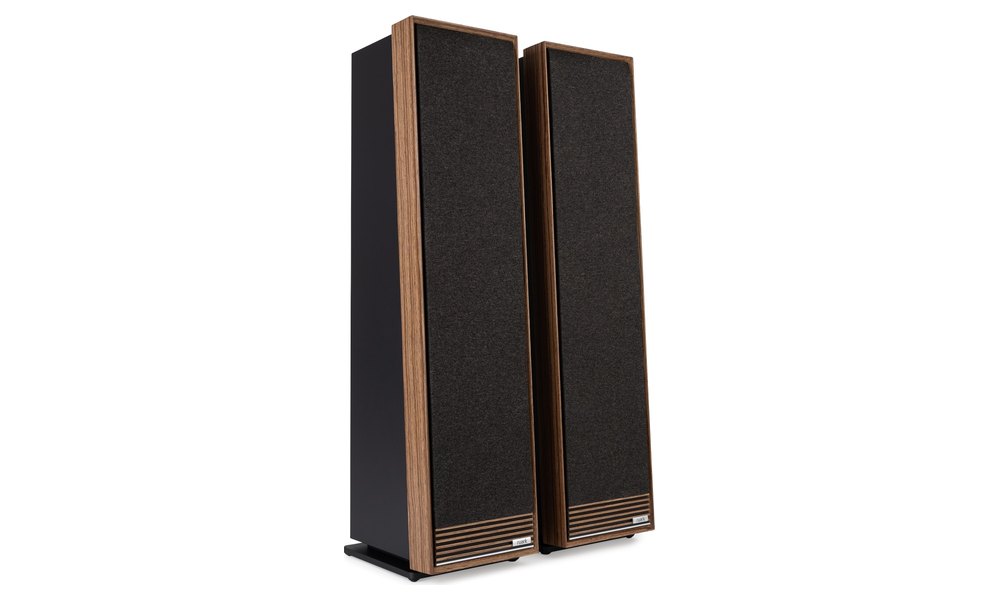
| Grille | removable magnetic frame with acoustically transparent fabric |
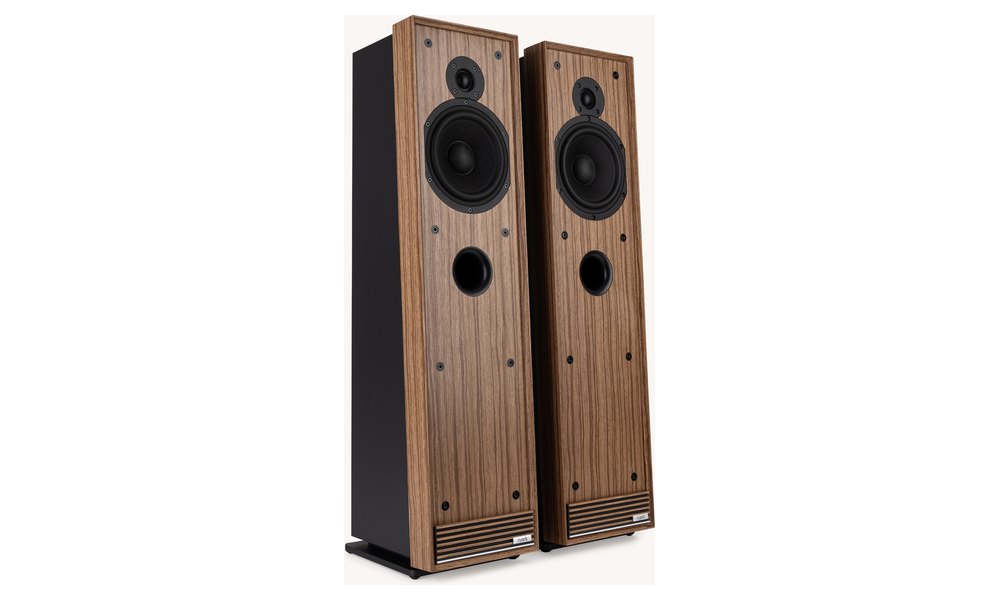
| Finishes | Fused Walnut veneer or Satin Charcoal lacquer baffle, Charcoal cabinet, walnut slat trim |
| Dimensions / weight | 850 × 210 × 250 mm (H × W × D) · 17.6 kg per speaker |
| In the box | per speaker: adjustable rubber feet and carpet spikes |
Source: Ruark Audio – official specifications · As of 21 October 2026 · subject to change by the manufacturer
Rating criteria in detail
The four criteria feed into the Vinyl BotPro Index with weights of 25/20/25/30. The index is scaled across all tiers (see Methodology); that is why we do not show individual sub-scores.
Strengths
- Clear, neutral and very orderly sound with particularly articulate mids
- Controlled, punchy bass and a focused stage that seems larger than the cabinet
- Front port: less sensitive to placement
- Exemplary build quality, slim front, steel plinth
Weaknesses
- Less scale and depth than more voluminous floorstanders at the same price
- Only two drivers — others offer more cabinet and drivers for the money
- Minimum 3.8 Ω: small amplifiers reach their limits
- Only two listening reviews so far, both by the same author
Comparison models
| DALI Oberon 7 | Index 69, Champion Premium — larger cabinet, two bass drivers, considerably cheaper |
|---|---|
| Triangle Solstice 8 | Index 66 — similar pair price, 3-way with horn tweeter and 91 dB, more level and scale |
| Nubert nuLine 284 | Index 65 — same index, 3-way floorstander sold direct, slightly more expensive |
| KEF Q7 Meta | Index 63 — Uni-Q coaxial with wide dispersion, cheaper |
System matching
Works well with
- Small to medium-sized living rooms where a slim speaker is wanted
- Neutral to slightly warm integrated amplifiers with 50–150 W, for example from the amplifier top list (Premium)
- Listeners for whom voices, timing and order matter more than maximum level
Less suited
- Large, open rooms over around 30 m²
- Listeners looking for deep bass for film soundtracks or electronic music
- Very weak amplifiers with little current delivery
Specs & Features
With the Talisman-R Ruark deliberately ties in with the original: the front is slightly larger than the cabinet behind it and leans back slightly, so the speaker looks slightly trapezoidal in profile. There is engineering behind the shape. The visible screws on the baffle hold it via elastomer bushes and a double damping strip, so less driver vibration should reach the cabinet. Inside, the 14.5-litre cabinet is braced and lined with a mixed wadding which, according to Ruark, damps over a wide frequency band.
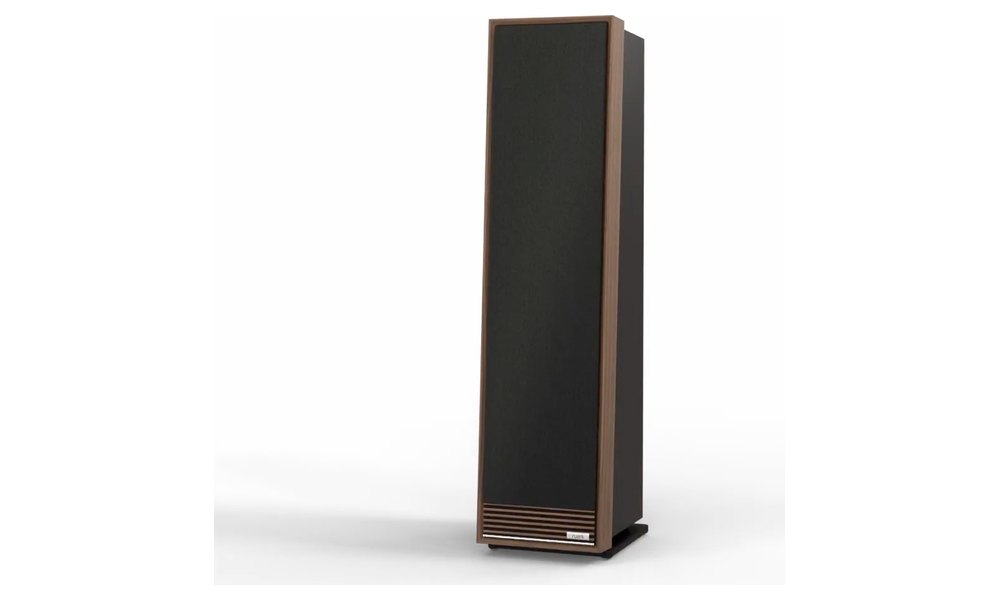
The 17 cm NS+ bass driver uses a treated natural fibre cone, a two-layer 35 mm copper voice coil and a strontium ferrite motor; the 27 mm silk dome uses a neodymium magnet. The 2nd-order crossover with film capacitors crosses over at 2.2 kHz and, according to Ruark, is tuned especially for phase coherence. The port is tuned to 42 Hz and double-flared. The plinth is milled from solid steel, takes rubber feet for hard floors or spikes for carpet and lowers the centre of gravity. On the back there are gold-plated dual terminals for bi-wiring. There are two finishes: a baffle in Fused Walnut or Satin Charcoal, each with a Charcoal cabinet, grey fabric grille and walnut slats at the base. Within the Ruark range, the Talisman-R visually matches the 100 Series and the R610 and R710 music systems.
What international reviewers heard
Several reviews from the international specialist press are available for the Ruark Talisman-R. Here we summarise the overall picture in our own words; all sources are linked at the end of the page.
Sound character
- One review describes a direct, orderly and very informative sound that never becomes boring. One review hears a positive, detailed and well-controlled presentation.
Tonal balance
- Both reviews call the tuning neutral and even, with a midrange moved slightly forward. One review describes the treble as having bite but staying controlled even at high levels.
Dynamics, bass & staging
- According to one review, the bass is well shaped, controlled and punchy, and the soundstage is clearly focused and bigger than the cabinet suggests. Both reviewers hear ample dynamic headroom and no hardness at high levels.
Strengths
- The very articulate midrange and voices, an inaudible transition between the two drivers and coherent timing are singled out. Both reviews also rate build and finish as exemplary.
Setup, room & partners
- Listening was done with a Cambridge Edge W and a Technics SL-1300G as the record source. Ruark recommends 1.5 to 2.5 metres between the speakers and 20 to 30 centimetres from rear and side walls; the front port makes placement easier.
Consensus & differences
- Both reviews agree on clarity, neutrality, midrange and build, and also on the main criticism: for large rooms the Talisman-R lacks the scale of similarly priced, bigger speakers. Note that both reports come from the same author (Simon Lucas).
Research Consensus
The evidence consists of the manufacturer's page with a detailed data sheet and two detailed listening reviews: a first review (Recommended, sound 4.5 out of 5) and a second review, both by the same reviewer. Recurring patterns: a clear, neutral and very orderly sound; mids and voices as the greatest strength; controlled, punchy bass; plenty of dynamic headroom; plus exemplary build quality. The only consistent criticism is the limited scale of the presentation in large rooms. The verdict of international reviews is assessed in detail in the section What the international specialist press hears.
In short: anyone looking for a slim, very well-built floorstander for a normal living room who values voices and order will find the Talisman-R a strong candidate. Anyone who wants more bass and level for the money should look at the DALI Oberon 7 or the Triangle Solstice 8. VinylCination brings these patterns together as an AI summary of the press.
For whom / Matching
Amplifier
87 dB at 6 Ω nominal and 3.8 Ω minimum is a moderate load. The reviews listened with a Cambridge Edge W; Ruark specifies 50 to 250 W. A solid integrated amplifier with 60 to 150 W per channel is enough in normal rooms. The mids are slightly forward, so neutral to slightly warm amplifiers suit it; very bright partners emphasise the bite in the treble.
Turntable & phono
Among other things it was tested with a Technics SL-1300G, Goldring 1022 and a Chord Huei as phono stage. Its strength with voices and timing suits vinyl. Because bass extension is limited, rumble and footfall are less disturbing than with large speakers; a phono stage with subsonic filter from the phono preamp top list still does no harm.
Room & placement
Ruark recommends 1.5 to 2.5 m between the speakers, 20 to 30 cm from rear and side walls and slight toe-in towards the listening position. The front port allows placement closer to the wall than a rear port, but a corner is still unfavourable. Rooms up to around 25–30 m² are ideal.
Budget & upgrade
At €1,799 per pair (as of 21.10.2026, without guarantee) the Talisman-R sits in the upper third of the Premium price band. Below it, Ruark offers the Sabre-R standmount; anyone who needs more bass extension later can add a subwoofer from the active subwoofer top list.
What makes this AI analysis special
This section is an AI summary of published international listening reviews and the manufacturer data from Ruark Audio. Vinyl BotPro puts the reviewers’ findings into context and links them with the data sheet and comparison models; VinylCination does not run its own listening tests or measurements; all sources are linked at the end of the page. Prices and availability change (as of Oct. 2026, no guarantee); please check technical values against the current data sheet.
Vinyl BotPro Score Logic
The Vinyl BotPro Index runs across all levels from 0–100. Premium sits at 55–69. The Ruark Talisman-R receives 65 (rank 6 Premium): high technology/build scores thanks to the decoupled baffle, steel plinth and build quality, solid features, good expected performance from two international listening reviews and a medium value weighting, because other speakers offer more volume for the money. Tied with the Nubert nuLine 284 (65) — according to the methodology value for money decides, here in favour of the cheaper Talisman-R. It stays behind the Triangle Solstice 8 (66) because of its smaller scale and lower maximum level. Weights: technology/build 25, features 20, performance 25, value for money 30.
Created by Vinyl BotPro (AI) · AI analysis · As of 21.10.2026 · Corrections: info@vinylcination.de · Prices without guarantee.
Manufacturer and concept
Ruark Audio from southern England is best known today for table radios and music systems such as the R1 and R410. But the company began with passive loudspeakers, and the Talisman of 1990 was one of its best-known models. With the Talisman-R, Ruark revives that name. After the Sabre-R standmount, it is only the second passive loudspeaker in the current range and the first floorstander in many years.
The concept is deliberately slim: two ways, one bass driver, a front just 21 cm wide and a height of 85 cm. Ruark aims at living rooms where a large floorstander would be visually too much, but a standmount would deliver too little bass.
Technology explained
Decoupled baffle
The baffle carrying the drivers is separated from the main cabinet by elastomer bushes. The aim is to transfer less driver vibration to the cabinet walls so they do not resonate along. In addition, the cabinet is braced and damped inside. The front is tilted slightly backwards so that tweeter and bass driver are better time-aligned.
Drivers and crossover
The 27 mm silk dome tweeter with neodymium motor works from 2.2 kHz upwards. Below that, the 17 cm NS+ bass driver with treated fibre cone and a 35 mm two-layer copper voice coil takes over. The crossover is second order and uses film capacitors and low-loss inductors. The cabinet holds 14.5 litres and is tuned to 42 Hz.
Front-firing port
The double-flared bass reflex port fires forwards. This makes the speaker less dependent on the distance to the rear wall than models with a rear port. Some room influence always remains, though: Ruark recommends 20 to 30 cm from rear and side walls.
Sound according to international reviews
So far there are two detailed reviews, in international reviews. Both were written by Simon Lucas, so they are not independent of each other. They consistently describe a clear, neutral and very organised sound with particularly articulate mids. The bass is called controlled and punchy, the stage focused. As a limitation, both note that more voluminous floorstanders at the same price offer more scale and depth. One review awards 4.5 out of 5 for sound.
Practical use and placement
At 17.6 kg per speaker and with a solid steel plinth, the Talisman-R stands firmly. Adjustable rubber feet for wooden floors and spikes for carpet are included. The magnetic fabric grille can be removed without visible mounting holes. The dual terminals allow bi-wiring. For turntable listeners the slim speaker is pleasant: with a lower limit of 40 Hz it excites the room less than large bass-heavy speakers, which makes rumble and footfall less audible.
Who is the Talisman-R for?
The Talisman-R suits listeners in small to medium-sized rooms looking for a slim, very well-made floorstander with a neutral tuning. With 6 Ω nominal and a minimum of 3.8 Ω, the amplifier should be stable; Ruark specifies 50 to 250 W. Anyone filling large rooms or listening very loud is better served by bigger models.
How it compares
In the Premium group of floorstanding speakers, the Talisman-R scores index 65, level with the Nubert nuLine 284 and just behind the Triangle Solstice 8. The DALI Oberon 7 remains champion: it is bigger, has two bass drivers and costs considerably less. Ruark scores mainly on build quality, slim design and a very orderly presentation.
More questions about the Ruark Talisman-R
Can I place the Talisman-R close to the wall?
Somewhat closer than speakers with a rear port, yes. But Ruark recommends 20 to 30 cm from rear and side walls.
Which amplifier suits it?
A stable integrated amplifier with 50 to 150 W per channel is enough in normal rooms. Because of the impedance minimum of 3.8 Ω, very small amplifiers are less suitable.
Do I need a subwoofer?
Usually not in small and medium rooms. Anyone listening to organ or electronic music with a lot of deep bass can add a subwoofer.
Which finishes are available?
Two: a baffle in Fused Walnut (veneer) or in Satin Charcoal (lacquer), each with a Charcoal cabinet and walnut slats on the plinth.
Where does the sound information come from?
From the manufacturer information and the international reviews in international magazines. This AI analysis summarises them and links every source.
Verdict
The Ruark Talisman-R is an elegant, slim floorstander with well-thought-out engineering and excellent build quality. The international reviews praise its clarity, neutrality and control. Anyone looking for more scale and depth for the money will find alternatives; anyone who wants a slim, high-quality speaker with an orderly sound should put the Talisman-R on the list.