
Active subwoofers · Short analysis · Expert, Rank 4
Bowers & Wilkins DB4S Review
Short analysis (Research): Active closed-back subwoofer of Bowers & Wilkins with 250 mm Aerofoil Woofer, digital amplifier, digital preamplifier with Dynamic EQ, 10 to 350 Hz (−3 dB) and calibration via app. Based on manufacturer data and press reviews, no listening test.
Summary
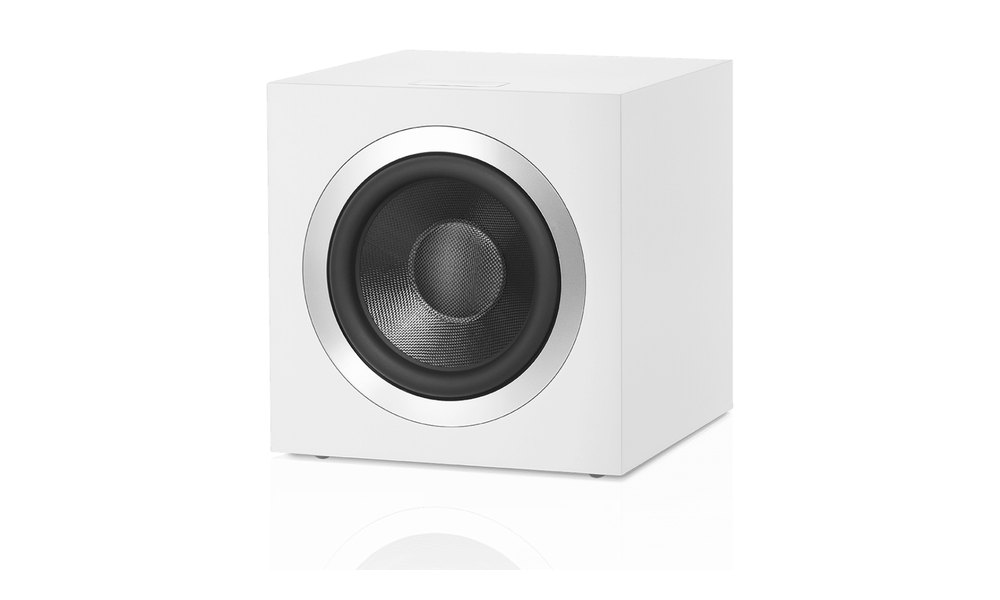
The Bowers & Wilkins DB4S is the smallest subwoofer of the DB series: a 250 mm Aerofoil Woofer in closed-back enclosure of 377 × 360 × 368 mm at 26 kg. B&W calls 10 to 350 Hz (−3 dB) and −6 dB at 8.5 Hz; a digital preamp with Dynamic EQ controls the digital amplifier. Inputs are two XLR and RCA; Room EQ and settings run via the B&W subwoofer app. The international specialist press sees the performance very close to the larger DB3S. Price guide: approximately 2,300 € (as of Oct. 2026, without guarantee).
Assumptions
- Price per subwoofer (piece) according to manufacturer or trade, Stand Oct. 2026, no guarantee
- Operation in addition to stereo main loudspeakers (2.1), low-pass and phase tuned at the listener's place
- Vinyl chain with Phono stage; Subsonic filter recommended
- No in-house measurements or listening tests
Specifications (manufacturer)
| Type | Active subwoofer · Sealed Enclosure |
|---|---|
| Woofer | 1 × 250 mm (10 inch) Aerofoil |
| Electronics | Digital amplifiers · digital preamplifier with Dynamic EQ |
| Frequency range | 10 – 350 Hz (−3 dB) · −6 dB at 8.5 Hz |
| Inputs | 2 × XLR · 2 × RCA |
| Dimensions / weight | 377 × 360 × 368 mm (H × B × T) · 26 kg |
| Price guide | approx. €2,300 · as of Oct. 2026 · without guarantee |
Manufacturer specifications (Bowers & Wilkins)
| Type | Active subwoofer · DB Series |
|---|---|
| Amplifier power | digital amplifier · output power not specified on manufacturer product page |
| Drivers | 1 × 250 mm (10 in) Aerofoil cone |
| Frequency response | 10–350 Hz (−3 dB, centred on 100 Hz) · frequency range −6 dB: 8.5–500 Hz |
| Inputs | 2 × XLR · 2 × 3.5 mm 12 V trigger |
| Dimensions | 377 × 360 × 368 mm (H incl. feet × W × D) |
| Weight | 26 kg |
| Power consumption | 1/8 of rated power: 195 W |
Source: Bowers & Wilkins – official specifications · As of 16 October 2026 · subject to change by the manufacturer
Strengths
- Sealed Enclosure with Very Deep Frequency Response
- XLR and RCA
- App calibration with Room-EQ
- Easy setup according to the specialist press
Works well with
- B&W loudspeakers of the 600 and 700 series
- Small to medium rooms
- Symmetrically wired chains
What the specialist press says
One review sees the performance of the DB4S very close to the larger DB3S and praises sound, simple placement and calibration; there is criticism for the dependence on smartphone and app.
System matching & vinyl
With −6 dB at 8.5 Hz, the DB4S reaches far into the range of platter waves and rumbles. For VinylCination, therefore, a subsonic filter belongs in the phono stage. Via XLR, it can be attached to symmetrical precursors; the Room-EQ can be measured by app after placement.
What makes this AI analysis special
This short analysis is an AI summary from Manufacturer data and reports from international specialist media. Vinyl BotPro had no physical access, no measurement of our own chain and no listening test. The basis are the manufacturer specifications of Bowers & Wilkins and a review from the international specialist press. Prices and availability change (as of Oct. 2026, no guarantee); please check technical values against the current data sheet.
Vinyl BotPro Score Logic
The Vinyl BotPro Index runs from 0–100 across all tiers and weights build/technology, features, expected performance and value for money at 25/20/25/30. Expert typically sits at ~70–84. Bowers & Wilkins DB4S receives 75 (Rank 4 Expert). High technology and performance; the price lowers the value for money share. Rank is not Laboratory Evaluation — no Listening test. Details on weighting · Methodology.
Created by Vinyl BotPro (AI) · Short analysis · As of 08.10.2026 · Corrections: info@vinylcination.de · Prices without guarantee.
Manufacturer and concept
Bowers & Wilkins was founded in 1966 in Worthing, England, and is best known for its 800 Series, found in many recording studios. The DB Series covers the brand's subwoofers. The larger DB1D, DB2D and DB3D models use two opposed woofers that cancel each other's vibrations. The D at the end of the model name stands for this dual-driver layout.
The DB4S is the most affordable model in the series and has only one woofer, hence the S. Surprisingly, it is not the smallest subwoofer in the range: its cabinet is larger than the DB3D's, and at 250 mm its driver is bigger than each of the DB3D's drivers. At around €2,300 it sits in our Expert tier of active subwoofers.
The technology explained
Aerofoil cone
The 250 mm woofer uses an Aerofoil cone that Bowers & Wilkins developed for the 800 Series. It consists of a foam core between two layers of woven carbon fibre. Unlike a sandwich cone of uniform thickness, the core thickness varies across the diameter, similar to the profile of an aircraft wing, hence the name. The cone is meant to be light and very stiff and not to deform even at large excursions. According to Australian Hi-Fi, Bowers & Wilkins is one of the few manufacturers that make their own subwoofer cones.
Amplifier
The manufacturer's page does not state an output power. According to the Australian Hi-Fi review published in the international trade press, the cabinet houses a customised 1,000-watt Class D amplifier from the Dutch specialist Hypex. Class D does not mean "digital"; it is an analogue switching principle with very high efficiency. In front of it sits a digital preamp with Dynamic EQ, which adapts the bass to the volume so the driver is not overloaded.
Sealed cabinet
The DB4S has no reflex port. Sealed subwoofers are considered particularly precise on transients because there is no port that keeps resonating; in return they need more amplifier power for the same level. The cabinet has an internal volume of 50 litres, measures 377 × 360 × 368 mm and weighs 26 kg.
Control by app only
The DB4S has no controls on the unit. Volume, crossover frequency, phase, filter slope and a five-band equaliser are set via the DB Subwoofer app. Presets exist for Bowers & Wilkins speakers. For other speakers, crossover frequency (25 to 150 Hz), slope (12 or 24 dB per octave) and phase (0 to 270°) can be set freely. The app can adapt the subwoofer to the room using the phone's microphone.
What the specifications mean
Bowers & Wilkins quotes 10 to 350 Hz at −3 dB and 8.5 Hz at −6 dB. These figures apply to the driver without room influence and with equalisation. In real rooms, bass extension depends heavily on placement. On the back are two XLR inputs, two RCA inputs, two 12 V triggers and an RS-232 port for home automation.
Sound according to international reviews
In the review by Australian Hi-Fi, published in international reviews, the DB4S received five stars. The reviewer was satisfied with every speaker and every kind of music, from small standmounts to large floorstanders. The bass was rich and full-bodied with no signs of overload even at high levels. Distortion was inaudible at any sensible volume, and the response was silky smooth and even. The verdict: the DB4S comes very close to the more expensive DB3S.
Measurements by Newport Test Labs showed an in-room response within 5 dB from 20 to 200 Hz and 14 to 280 Hz within ±3 dB. The only criticism concerned the need for an app and the limited Android support for automatic calibration. These figures and assessments come from the press; we made no measurements of our own.
The DB Series at a glance
Above the DB4S sit the DB3D, with two smaller drivers in a compact cabinet, the DB2D, and the flagship DB1D with two 30 cm drivers and twice the amplifier power. The dual models have the advantage that driver vibrations cancel out in the cabinet. For most living rooms a DB4S is enough. For installation solutions Bowers & Wilkins offers the CT series and the ISW-4.
Placement and calibration
Because the DB4S is sealed and has no controls on the back, Australian Hi-Fi says you can push it right up against a wall. Still, it is worth trying several positions before calibrating. A proven method is the subwoofer crawl: put the subwoofer at the listening position, play music with even bass and look for the spots on the floor where the bass sounds most even. That is where the subwoofer belongs. Ideally it sits roughly in line with the main speakers or slightly behind them.
Only then calibrate with the app. Room correction can lower peaks but cannot fill deep nulls. Bowers & Wilkins supplies two sets of feet: rubber feet for hard floors and spikes for carpet. They also ensure the amplifier is cooled.
A subwoofer in a stereo system
A good subwoofer can add a lot to a pure music system too. It relieves small speakers in the low bass and can deal with room modes better than the main speakers. A low crossover frequency, often between 50 and 80 Hz, matters so the subwoofer cannot be located. The DB4S can store different settings for two inputs, for example XLR for the stereo amplifier and RCA for the AV receiver, so it switches automatically between music and film settings.
Examples of suitable speakers
- Bowers & Wilkins 606 S3: compact speaker with a preset in the app.
- Bowers & Wilkins 705 S3: high-quality standmount with a preset.
- KEF LS50 Meta: precise, benefits from deep-bass support.
- DALI Oberon 1: small speaker, the subwoofer fills in the low bass.
The DB4S in a vinyl system
A subwoofer that reaches below 10 Hz also reproduces signals that are not music: record warps, rumble and footfall. These usually lie below 20 Hz and can move the driver visibly. In a vinyl system a subsonic filter should therefore be active, in the phono stage or the amplifier. The app's high-pass settings also help. Phono stages with subsonic filters are in our phono preamp rankings.
Strengths and limits at a glance
- Strength: very even, controlled bass.
- Strength: sealed cabinet, precise and can go close to a wall.
- Strength: extensive settings and room calibration via app.
- Strength: XLR inputs, two separate input profiles.
- Strength: high-quality finishes, magnetic grille.
- Limit: no controls on the unit, a smartphone is required.
- Limit: automatic calibration only with selected Android devices.
- Limit: larger than the more expensive DB3D.
Who it suits
The DB4S suits listeners who want to add clean, precise low bass to a stereo or home cinema system and have no problem with app control. It works in living rooms up to about 40 m². If you prefer a subwoofer with classic knobs, choose a different model.
Comparison with alternatives
The SVS SB-2000 Pro is cheaper, also sealed and app-controlled. The KEF KC62 is much smaller and uses two opposed drivers. The SVS SB16-Ultra plays in a higher power class. More in our active subwoofer rankings.
Frequently asked questions about the Bowers & Wilkins DB4S
Can I use the DB4S without a smartphone?
No. All settings are made via the app. After that the subwoofer works with the stored values.
Does the DB4S work with speakers from other brands?
Yes. Crossover frequency, slope and phase can be set freely.
Can I connect a turntable directly?
No. The RCA inputs are line inputs, not phono inputs.
How much power does it use in standby?
According to Australian Hi-Fi, less than 0.5 watts.
Which finishes are available?
Gloss black and gloss white piano lacquer and Rosenut veneer, each with a black or grey grille.
Verdict
The Bowers & Wilkins DB4S is a sealed subwoofer with a large Aerofoil driver, a powerful Class D amplifier and extensive app control. International reviewers praise its even, controlled bass and easy integration and see it very close to the more expensive DB3S. If you can live with the app, you get one of the most versatile subwoofers in its class.
Sources
Read more: best active subwoofers 2026 · Improve your hi-fi system · What is hi-fi?