
Bookshelf speaker · AI analysis · Starter, rank 1
DALI Oberon 1: Analysis
AI analysis (research): compact speaker, 86 dB / 6 Ω, 25–100 W recommended, wood-fibre drivers — specifications and retailer prices, no listening test.
Summary
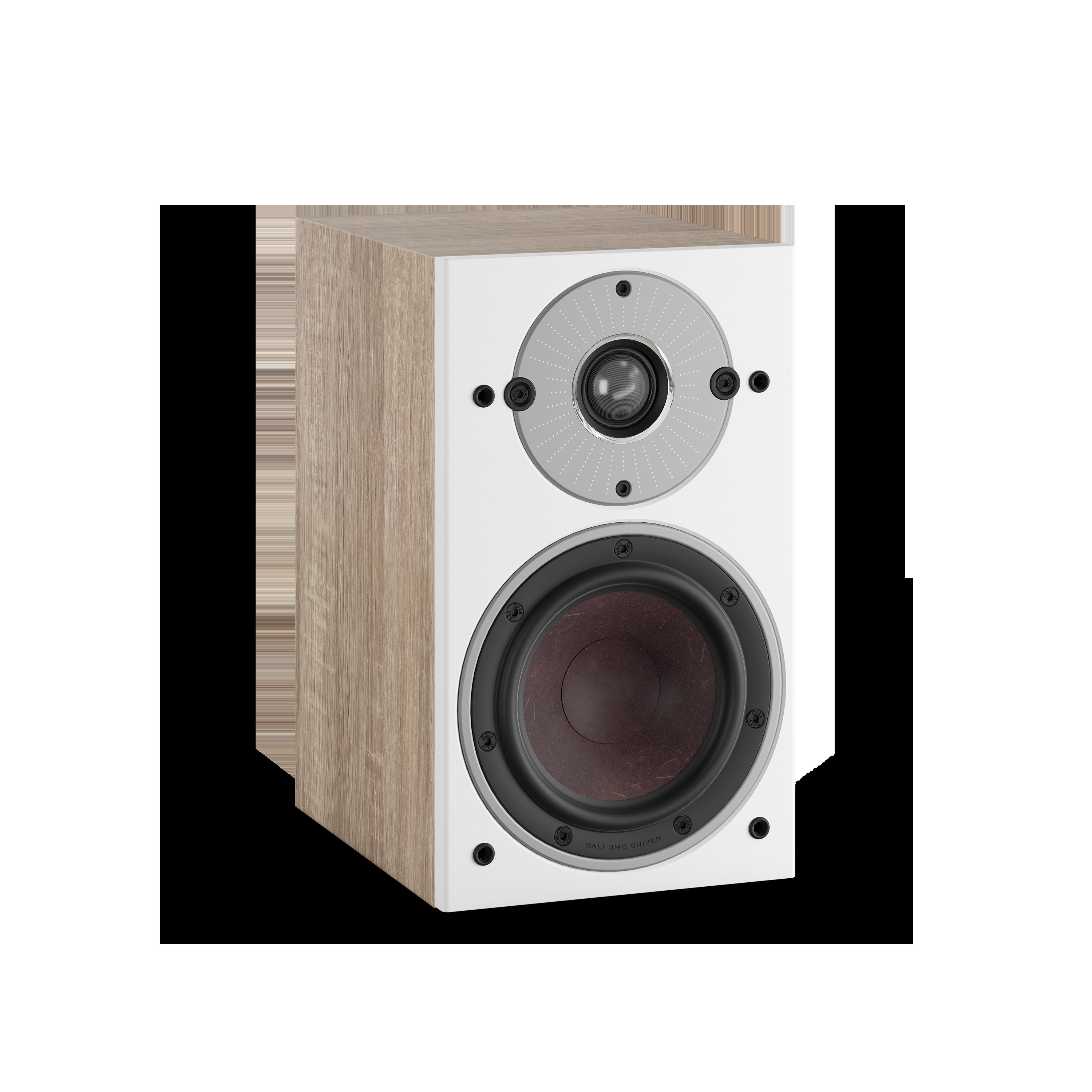
The Oberon 1 is DALI’s compact bookshelf speaker: 86 dB (2.83 V/1 m), 6 Ω, 25–100 W recommended, frequency range 51–26,000 Hz (±3 dB). Market price often approx. €399–458/pair. The wooden fibre What Hi-Fi?, SoundStage! Access and L&B praise above all the midrange, voices and soundstage — useful for starter amps (A-S301/501, PMA-600NE). No replacement for large floorstanding speakers in bass-hungry rooms.
Assumptions
- Price per pair Sept 2026
- Living room / shelf or stand
- Amplifier 25–100 W to 6 Ω
- No measurements or listening tests of our own
Specs (public / manufacturer)
| Type | 2-way compact speaker · Bass-reflex |
|---|---|
| Sensitivity | 86 dB (2.83 V/1 m) |
| Impedance | 6 Ω nominal |
| Rec. Amplifier power | 25–100 W |
| Frequency range | 51–26,000 Hz (±3 dB) |
| Chassis | 130 mm Wood fibre deep-midrange driver · 29 mm fabric dome |
| Dimensions / weight | 274 × 162 × 234 mm · 4.2 kg/piece |
| Price guide | Market price approx. €399–458/pair · Sept 2026 · Check the price date |
Manufacturer specifications (DALI)
| Type | 2-way compact speaker, bass reflex (tuned to 50 Hz) |
|---|---|
| Drivers | 1 × 29 mm soft dome · 1 × 5¼″ wood-fibre SMC woofer |
| Frequency response | 51–26,000 Hz (±3 dB) |
| Sensitivity | 86 dB (2.83 V/1 m) |
| Impedance | 6 Ω nominal |
| Recommended amplifier power | 25–100 W |
| Max. SPL | 106 dB |
| Crossover frequency | 2,800 Hz |
| Dimensions | 274 × 162 × 234 mm (H × W × D) |
| Weight | 4.2 kg |
| Data sheet | DALI OBERON white paper 2020 (spec table) |
Source: DALI – official specifications · As of 16 October 2026 · subject to change by the manufacturer
Scores in detail
Vinyl BotPro Index: 54 · Index band Starter 40–54 · Guidance only, not a lab value.
Strengths
- Strong midrange and voices (consensus of the reviews)
- Easy to drive (86 dB / 6 Ω)
- Compact incl. wall option
Weaknesses
- Limited bass vs. larger bookshelf/floorstanding speakers
- Price per pair at the top starter edge
- No Bi-Wiring
Comparison models
| ELAC Debut B6.3 | More bass volume, often cheaper |
|---|---|
| Wharfedale Diamond 12.1 | Cheaper, slightly lighter/more neutral note |
| KEF Q150 | Uni-Q-imaging, often EOL/clearance stock |
System matching
Works well with
- Vinyl starter with 30–85 W amps
- Small to medium rooms
- If you want heat from analytical hardness
Less suited
- Large rooms without sub
- If you want maximum bass extension
- Expect Extreme Low-ohm Loads
Analysis: the DALI Oberon 1 in depth
What this page is: an AI analysis, not a listening session
This page summarises what can be documented about the DALI Oberon 1 from manufacturer information and three international reviews. Vinyl BotPro has neither listened to nor measured these speakers. We paraphrase sound descriptions as the named authors wrote them under their own conditions, each with a date, and we flag our own assessments. This section does not change the page's rank, index or prices.
Keeping the models apart
- Oberon 1: the passive standmount analysed here. It needs an amplifier [1].
- Oberon 1 C: an active version with a built-in amplifier. L&B Tech Reviews mentions it, but found the passive version even better [4]. The Oberon 1 C is not covered by this analysis.
- Oberon 3: the larger standmount with a 7-inch mid/bass driver [3].
- Oberon 5 and 7: floorstanders with two 5.25-inch and two 7-inch mid/bass drivers respectively [3].
- Oberon Vokal and On-Wall: centre and on-wall speakers [3].
What Hi-Fi? reviewed the Oberon 1 in December 2018, so the series has been on sale since around 2018 [2]. According to What Hi-Fi?, it looks a lot like the cheaper Spektor 2 but sounds clearly better [2].
Technology according to DALI
DALI lists for the Oberon 1 [1]:
- Design: two-way, bass reflex.
- Tweeter: 29 mm soft dome, developed specifically for the Oberon series. According to DALI, the large diaphragm produces more sound pressure with less excursion. The tweeter front plate shares its geometry with the Opticon and Rubicon tweeters.
- Mid/bass driver: 5.25 inch (13 cm according to What Hi-Fi?) with a cone of fine-grain paper pulp reinforced with wood fibres [1][2].
- Motor: the woofer's pole piece includes a patented SMC (Soft Magnetic Composite) disc, intended to reduce distortion caused by hysteresis and eddy currents, especially third-order distortion [1]. SoundStage! Access describes the SMC as a thin 10 mm crown on the iron pole piece [3]; L&B speaks of "a tiny bit" of SMC [4].
- Crossover frequency: 2,800 Hz [1].
- Frequency range: 51 Hz to 26 kHz (±3 dB) [1].
- Sensitivity: 86 dB (2.83 V/1 m) [1].
- Impedance: 6 Ω nominal [1].
- Maximum SPL: 106 dB (1 m) [1].
- Recommended amplifier power: 25 to 100 W [1].
Cabinet
The cabinet is made of high-density CNC-machined MDF with a vinyl finish and internal bracing [1]. SoundStage! Access found the panels very inert in a knuckle test and reports that DALI applies damping material to the sides, top and bottom, but not behind the front baffle [3]. The bass reflex port is at the rear and, according to SoundStage! Access, tuned to 50 Hz [3]. Above it sits a keyhole bracket for wall mounting [1][3].
Dimensions and weight are not on DALI's page. SoundStage! Access gives 10.8 × 6.4 × 9.2 inches (H × W × D) and 9.2 pounds, about 274 × 162 × 234 mm and 4.2 kg [3]. L&B gives 27.4 × 23.4 cm and 4.2 kg [4]. Connection is via a single pair of binding posts; there is no bi-wiring [2][3][4]. L&B calls the terminals cheap but fully functional [4]. Rubber feet are included [3].
Finishes
The Oberon 1 comes in Black Ash, White, Dark Walnut and Light Oak, all vinyl [2][3]. According to SoundStage! Access, the dark finishes have black grilles and the light ones a grey grille; white grilles are available as an accessory [3].
What the figures mean in practice
- 86 dB sensitivity: SoundStage! Access points out that DALI measures at 2.83 V. Into 6 Ω that is about 1.3 W, not 1 W [3]. This makes comparisons with speakers rated at 1 W harder.
- Amplifier: according to SoundStage! Access, DALI rates power conservatively; a somewhat more powerful amplifier is no problem [3].
- Volume: L&B found the Oberon 1 the least efficient of the speakers compared and advises against expecting high volume [4]. SoundStage! Access, however, measured peaks of 99 dBA at about 2.1 m with a subwoofer in use, without the speakers losing composure [3]. In our assessment the difference is mainly because a subwoofer handled the deep bass in the SoundStage! Access setup.
What Hi-Fi? (December 2018)
What Hi-Fi? reviewed the Oberon 1 on 3 December 2018, then priced at £349 [2]. The scores: 5 each for sound, compatibility and build [2]. The impressions [2]:
- Bold, articulate and confident, with a refinement that is rare at this level.
- Especially strong with voices; to do better you would need to spend closer to £1,000.
- Smooth treble with plenty of bite, full-bodied, composed even at high volume.
- Expansive, sharply focused and stable soundstage.
- Little deep bass and less authority than larger speakers such as the Mission QX-2.
The criticisms: limited bass depth and a slight lack of authority [2].
SoundStage! Access (January 2021)
Dennis Burger reviewed the Oberon 1 on 1 January 2021 as part of a 5.1 system with the Vokal centre and the Sub E-9 F subwoofer; the Oberon 1 then cost $599 per pair [3]. He used a Yamaha AV receiver and an 80 Hz crossover to the subwoofer [3]. His impressions [3]:
- Excellent tonal balance, especially in the midrange.
- Plenty of detail; guitars sounded true to life.
- Very wide and even dispersion.
- Composed even at high volume.
- Without a subwoofer it lacks bass impact; he then sees the Oberon 1 more as a nearfield or desktop speaker.
- The very top treble is a touch laid-back, without lacking air.
L&B Tech Reviews (June 2021)
John Alex Hvidlykke compared the Oberon 1 with other affordable standmounts for L&B Tech Reviews on 19 June 2021 [4]. His impressions [4]:
- Particularly clean sound, with a midrange clearly better than any other participant.
- Voices nuanced and detailed in a way he would expect at twice the price.
- Beautiful soundstage width and depth.
- Good bass for the size but limited power. Large orchestra with vocals at high volume sounded compressed, though instruments stayed separable.
Placement
- Orientation: DALI recommends pointing the speakers straight ahead rather than toeing them in. SoundStage! Access first tried a slight toe-in and found it unnecessary because of the wide dispersion; facing straight ahead even improved integration with the surrounds [3].
- Wall distance: What Hi-Fi? found the Oberon 1 more balanced than most rivals even right against a wall, but recommends pulling them about 30 cm into the room for better imaging and midrange [2]. DALI describes the rear port as a way to use the rear wall to support the bass [1].
- Wall mounting: the bracket sits directly above the port. SoundStage! Access considers that an unhappy combination and advises using stands or a shelf, with at least about 5 cm of breathing room [3].
- Tilt: SoundStage! Access tilted the speakers back slightly on a low piece of furniture [3].
- Dispersion: DALI promises wide dispersion and therefore more freedom in placement [1]. SoundStage! Access confirms wide, even dispersion by ear [3].
With a subwoofer and in home cinema
SoundStage! Access used four Oberon 1s as front and surround speakers with the Vokal and the Sub E-9 F [3]. With pink noise he heard a slight timbre mismatch in the midrange between the Oberon 1 and the Vokal, which largely disappeared with films and music [3]. According to SoundStage! Access, the Sub E-9 F did not reach below 30 Hz but played in a controlled way [3]. For stereo without a subwoofer he saw the Oberon 1 more as a nearfield solution [3].
In a vinyl system
The reviews did not use turntables [2][3][4]. For vinyl, only what follows from the data applies: the Oberon 1 is passive and needs an amplifier; a turntable needs a phono stage in the amplifier or as a separate unit. The praised voice reproduction should, in our assessment, suit vocal-led music; that is not a statement the sources make about vinyl.
Where the sources agree
- Midrange and voices: the greatest strength [2][3][4].
- Soundstage: wide and stable [2][3][4].
- Bass and volume: limited; a subwoofer or a smaller room helps [2][3][4].
- Placement: forgiving; wide dispersion [1][2][3].
Open points and limits of this analysis
- Dimensions and weight: not on DALI's page, only from reviews [3][4].
- Headroom: L&B advises against high levels, while SoundStage! Access played very loud with a subwoofer [3][4].
- Prices: £349 (2018), $599 per pair (2021) [2][3]. The page's price information stays unchanged.
- Measurements: none of the sources publishes measurements.
- A detailed human fact-check of this analysis is still pending.
Sources for this analysis
- DALI – OBERON 1 (Produktseite mit Spezifikationen). https://www.dali-speakers.com/en-gb/products/oberon/oberon-1
- What Hi-Fi? – Dali Oberon 1 review (03.12.2018). https://www.whathifi.com/reviews/dali-oberon-1
- SoundStage! Access – Dennis Burger, DALI Oberon 1 / Vokal / E-9 F Home-Theater Speaker System (01.01.2021). https://soundstageaccess.com/index.php/equipment-reviews/1103-dali-oberon-1-vokal-e9f-home-theater-speaker-system
- L&B Tech Reviews – John Alex Hvidlykke, Review: DALI Oberon 1 (19.06.2021). https://www.lbtechreviews.com/test/speakers/dali-oberon-1
Created by AI (Vinyl BotPro) from the sources listed; no listening tests or measurements of our own. Detailed human fact-check pending.
Created by Vinyl BotPro (AI) · As of Sept 2026 · Corrections: info@vinylcination.de
Manufacturer and concept
Model separation (Oberon 1, active Oberon 1 C, Oberon 3/5/7) and the series background are now covered, with sources, in the analysis above.
The technology explained
The tweeter, wood-fibre cone, SMC, cabinet with its 50 Hz port and what 86 dB at 2.83 V means are now explained in the analysis above, with sources.
Sound according to international reviews
We evaluate the reviews by What Hi-Fi? (12/2018), SoundStage! Access (01/2021) and L&B Tech Reviews (06/2021) above, separately, with names and dates.
The Oberon series at a glance
The Oberon family includes the standmounts Oberon 1 and Oberon 3, the floorstanders Oberon 5, Oberon 7 and Oberon 9, plus a centre and an on-wall model. All share the same 29 mm tweeter, so they combine well tonally. The Oberon 3 has a larger 18 cm woofer and more bass but needs more space. For an even cheaper entry there is the DALI Spektor 2.
Build and finishes
The Oberon comes in four foil finishes: black ash, white, dark walnut and light oak. What Hi-Fi? (2018) described the cabinet as solid and nicely made. The terminals are simple, and bi-wiring is not provided. For a speaker in this class the look is understated and homely.
Placement and amplification
The Oberon 1 is undemanding about placement. What Hi-Fi? (2018) found that it sounds more balanced right against a wall than most rivals, but recommended pulling it about 30 cm into the room to make the most of its imaging and midrange. DALI recommends pointing the speakers straight ahead. The tweeter should sit at about ear height; on a sideboard a small tilting foot can help.
An amplifier with 30 to 60 watts into 6 Ω is enough for normal levels. Because sensitivity is on the low side, the amplifier should not be too weak.
Examples of suitable amplifiers
- Yamaha A-S301: affordable entry with a phono input.
- Marantz PM6007: warm and musical.
- Cambridge AXA35: lean and clear.
- Yamaha A-S501: more headroom for larger rooms.
More candidates are in our amplifier rankings.
First steps
After unpacking, a short plan helps. First place the speakers where you want them, left and right at the same distance from the listening seat. Then connect the cables: plus to plus, minus to minus, the same on both sides. A reversed connection on one side makes the centre image vague and the bass thin. Then start with a recording you know well and move the speakers away from the wall in steps of a few centimetres until bass and voices are in balance. New speakers usually change little in the first hours; what matters more is that your ears get used to the new sound.
Cables and accessories
For the Oberon 1, solid speaker cables with a cross-section of 1.5 to 2.5 mm² are enough. Very expensive cables are out of proportion to the overall budget for a speaker in this price class. More important are equal lengths on both sides and clean, tight connections. Banana plugs make connecting easier. Suitable models are in our speaker cable rankings. For stands, stable and heavy beats tall and wobbly. Small rubber or felt feet stop the speaker from sliding on smooth surfaces.
Room and fine-tuning
The Oberon 1 works best in rooms up to about 20 m². In a study, a kitchen or a small living room it plays to its strengths. In larger rooms the sound stays clean but feels smaller. If you want more bass, move the speakers closer to the wall or add a small subwoofer such as the DALI Sub E-9 F. A rug and curtains reduce hard reflections.
The Oberon 1 in a vinyl system
A typical starter system with the Oberon 1 consists of an integrated amplifier with a phono input and a simple turntable. Newcomers will find suitable models in our turntable rankings, for example the Pro-Ject Debut Carbon EVO or the Audio-Technica AT-LP5x. The Oberon 1's strength with voices suits singer-songwriter, jazz and soul. A carefully aligned cartridge is still worthwhile because the speaker reveals plenty of detail.
Strengths and limits at a glance
- Strength: excellent with voices.
- Strength: bold, articulate sound for its size.
- Strength: easy to place, even near a wall.
- Strength: wall bracket built in.
- Limit: limited deep bass.
- Limit: 86 dB sensitivity, do not choose too weak an amplifier.
- Limit: too small for large rooms.
Who it suits
The Oberon 1 suits newcomers and listeners with little space who still want serious sound. It also works as a second system in a study. If you want lots of bass or high levels in large rooms, go for the Oberon 3 or a floorstander.
Comparison with alternatives
The ELAC Debut B5.3 is similar in size and price. The KEF Q150 images very evenly thanks to its coaxial driver but is deeper. The Wharfedale Diamond 12.1 is known as warm and affordable. More options in our bookshelf speaker rankings.
Frequently asked questions about the DALI Oberon 1
Can I hang the Oberon 1 on the wall?
Yes, a keyhole is provided on the back. Because of the rear port, leave a little space to the wall.
Oberon 1 or Oberon 3?
The Oberon 1 is smaller and more flexible; the Oberon 3 has more bass and level but needs more space and distance from the wall.
Do I need to toe the speakers in?
DALI recommends pointing them straight ahead.
Do I need a subwoofer?
For music in small rooms usually not. For films or electronic music a small subwoofer can help.
Is the Oberon 1 suitable for home cinema?
Yes. SoundStage! Access (01/2021) used it as front and rear speakers together with the DALI Vokal centre and the Sub E-9 F subwoofer and praised the whole system.
Which finishes are available?
Black ash, white, dark walnut and light oak.
Verdict
The DALI Oberon 1 is a small, uncomplicated standmount with a great talent for voices and a bold, articulate sound. In 2018 What Hi-Fi? gave it 5 each for sound, compatibility and build and named limited bass depth and a slight lack of authority as limits. For small rooms and starter systems it is a very good choice.
Sources
Read more: best bookshelf speakers 2026 · Improve your hi-fi system · What is hi-fi?