
Floorstanding speaker · Short analysis · Master, rank 17
Canton Reference 5 Review
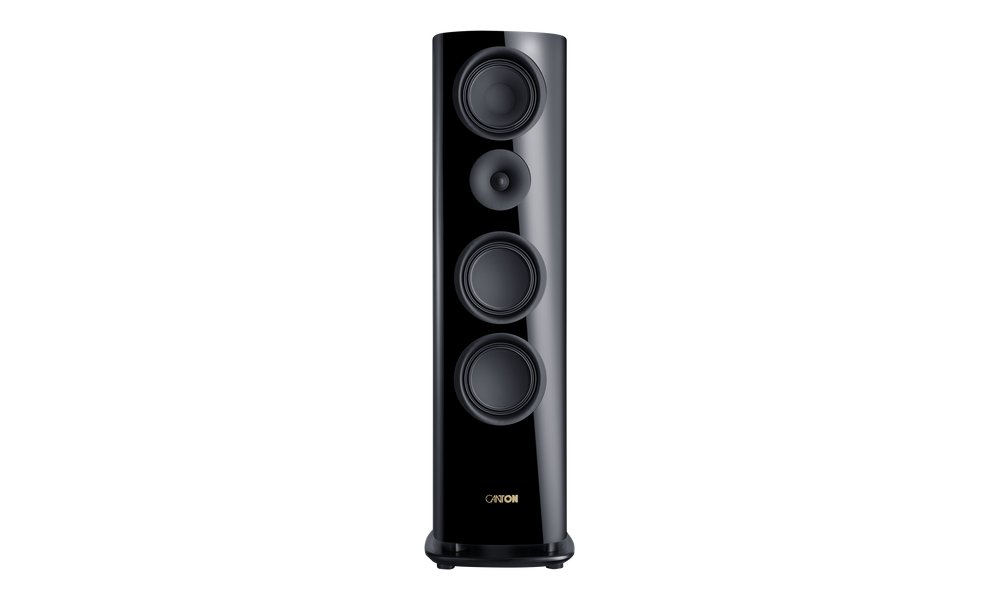
Short analysis (research): mid-sized floorstander of Canton's current Reference series — 3-way bass reflex (downfire) with a 25 mm BC tweeter, a 174 mm BCT midrange and two 174 mm BCT woofers. Based on manufacturer data and press reviews, no listening test.
Summary
The Canton Reference 5 is the middle floorstander of the current Reference series, built in Weilrod. For the cabinets, Canton developed round baffles for the first time, made on a 5-axis CNC mill; curved side panels, bases and tops are designed to markedly reduce cabinet resonances. The mid and bass drivers use the BCT cone; the WBT nextgen terminal carries the RC (Room Compensation) controls and connections for bi-wiring and bi-amping. canton.de lists €4,400 per speaker, i.e. €8,800 per pair, with a 10-year warranty (as of Oct. 2026, without guarantee).
Assumptions
- Pair price = 2 × single price from canton.de (RRP), as of Oct. 2026, no guarantee
- Free-standing placement with some distance from the rear wall
- Amplifier with headroom for a 4–8 Ω load
- No in-house measurements or listening tests
Specifications (manufacturer)
| Type | 3-way floorstanding speaker · Bass reflex (downfire) |
|---|---|
| Chassis | 25 mm BC tweeter · 174 mm BCT midrange · 2 × 174 mm BCT woofers |
| Frequency range | 21–40,000 Hz (manufacturer) |
| Crossover frequencies | 170 / 3,000 Hz |
| Sensitivity | 88 dB (2.83 V/1 m) · The international specialist press measures 89.4 dB(B) |
| Impedance | 4–8 Ω |
| Power handling | 200 W Nominal / 370 W music power |
| Dimensions / weight | B 30 × H 102 × T 46 cm · 36 kg per speaker |
| Connection / technology | WBT nextgen · Bi-wiring / bi-amping · RC room adjustment |
| Price guide | RRP €4,400 per speaker · €8,800/pair · as of Oct. 2026 · without guarantee |
Manufacturer specifications (Canton)
| Type | 3-way bass reflex (downfire, Bass Guide) |
|---|---|
| Drivers | 25 mm aluminium ceramic oxide tweeter · 174 mm BCT midrange · 2 × 174 mm BCT woofers |
| Frequency response | 21–40,000 Hz |
| Crossover frequency | 170 / 3,000 Hz |
| Impedance | 4–8 Ω |
| Sensitivity | 88 dB (2.83 V / 1 m) |
| Power handling | 200 W nominal / 370 W music power handling |
| Dimensions | 30 × 102 × 46 cm (W × H × D, incl. base) |
| Weight | 36 kg per speaker |
Source: Canton – official specifications · As of 16 October 2026 · subject to change by the manufacturer
Strengths
- Excellent measurements, 89.4 dB(B) sensitivity
- Large-scale, punchy, deep and powerful bass
- RC room adjustment and bi-amping terminal
- Round baffle from CNC production, 10-year warranty
Works well with
- Powerful integrated amplifiers and power amps
- Medium to large rooms
- Music with dynamics and higher levels
What the specialist press says
One review reviewed the Reference 5 in depth; in the measurements John Atkinson credits it with excellent measured performance and found 89.4 dB(B) at 2.83 V/1 m — more than the manufacturer's figure. In the deep bass the load is demanding, so a powerful amplifier is part of the package. Another review praises the large-scale, punchy presentation, the deep and powerful bass, the excellent build and the tonal adjustability; according to the editors, the Reference 5 shows its strengths especially at higher volume.
System matching & vinyl
The Reference 5 is efficient but a demanding load in the deep bass: a powerful amplifier keeps the bass taut. The RC controls compensate for a bright cartridge or a reverberant room. Suitable partners: Best amplifiers (Master).
What makes this AI analysis special
This short analysis is an AI summary of manufacturer data from canton.de and reports by international specialist media. Vinyl BotPro had no physical access, no measurement of our own chain and no listening test. The 2023 Reference generation is Canton's current range. For the Reference 5, detailed international reviews with measurements are available; their key points are summarised in our own words. Prices and availability change (as of Oct. 2026, no guarantee); please check technical values against the current data sheet.
Vinyl BotPro Score Logic
The Vinyl BotPro Index runs from 0–100 across all tiers and weights build/technology, features, expected performance and value for money at 25/20/25/30. Master typically sits at ~85–97. The Canton Reference 5 is at rank 17 (Master). It scores 86: BCT technology, CNC-made cabinet and RC room adjustment, strong measurements in international reviews and good value for the Master entry level at €8,800 per pair.
Created by Vinyl BotPro (AI) · Short analysis · As of 06.10.2026 · Corrections: info@vinylcination.de · Prices without guarantee.
Manufacturer and concept
Canton was founded in 1972 in the Taunus region of Germany and builds its top models in Weilrod. The Reference series has been Canton's flagship line for decades. The current generation appeared in 2023 and comprises eight models, from the large Reference 1 through several floorstanders to a centre and a subwoofer. The Reference 5 is one of the smaller floorstanders in the series but inherits the key technologies of the top model.
Canton offers a ten-year warranty on the Reference series. The list price is €4,400 per speaker, or €8,800 per pair, which places the Reference 5 in our Master tier of floorstanding speakers.
The technology explained
BCT cones
BCT stands for Black Ceramic Tungsten. The cones are made of aluminium, about a quarter of which is converted into a ceramic structure and enriched with tungsten and other metal particles. The goal is a cone that is both light and very stiff. A stiff cone moves as a whole instead of deforming, which lowers distortion. The process also gives the cones their black colour.
The Reference 5 uses three 17.4 cm drivers with BCT cones. Two work as woofers up to 170 Hz; the third covers the range from 170 Hz to 3,000 Hz as a midrange driver. That keeps the midrange free of large bass excursions, which should keep the mids cleaner.
BC tweeter with waveguide
Above 3 kHz a 25 mm tweeter made of aluminium ceramic oxide (BC) takes over. It sits in an asymmetrically shaped waveguide that controls dispersion and eases the transition to the midrange.
Curved cabinet
The cabinet consists of several bonded layers of fibreboard with damping material in between, pressed into shape. The front baffle is curved and produced on a five-axis CNC machine. Curved walls are stiffer than flat ones and prevent strong standing waves from forming inside. The rounded front is also meant to improve dispersion.
Downfiring port and tonal adjustment
The bass reflex port fires downwards onto a base plate that Canton calls Bass-Guide, which makes the speaker less sensitive to rear-wall distance than a model with a rear port. Above the terminals is a small metal bridge that adjusts midrange and treble by ±1.5 dB each. The terminals are by WBT and allow bi-wiring and bi-amping.
What the specifications mean
Canton quotes 21 Hz to 40 kHz, 88 dB sensitivity, 4 to 8 Ω and power handling of 200 W nominal and 370 W music power. Each speaker weighs 36 kg. The 21 Hz figure is ambitious; it describes the range in which the speaker still produces sound, not a linear frequency response. The international specialist press measured a sensitivity of 89.4 dB(B), slightly more than specified, but pointed out a demanding load in the low bass.
Sound according to international reviews
Press opinions differ. One review reviewed the Reference 5 in depth and found its measured performance excellent. A second review was more critical and gave three stars for sound but five for build. It praised the scale and authority of the sound, the deep, powerful and taut bass and the ability to play loud effortlessly. Imaging was stable, focused and well layered.
The criticism concerned rhythm and fine dynamics. With music that relies on groove the speaker sounded mechanical and detached, and the tonality was on the cool side. One international review described the character as analytical. Ear height should also not be too far above the tweeter; tilting the speaker back slightly via the adjustable feet helped. These statements come from the press, not from tests of our own. With such different verdicts, an audition of your own is especially worthwhile.
The Reference series
Within the series the Reference 5 sits between smaller models such as the Reference 9 and larger ones such as the Reference 1. The Reference 7 is a slimmer alternative with less bass. All models use the same BCT and BC technology and the same cabinet construction. The Reference 1 is the flagship with more drivers and a much higher price.
Placement and amplification
A further review placed the speakers in a medium-sized room about a metre from the rear wall and well away from the side walls. A slight toe-in towards the listening seat firmed up the centre image. The downfiring port eases placement, but the speaker still needs space. At 36 kg, set it up with two people.
The amplifier needs good current delivery. One review pointed to a low impedance in the bass region. A powerful integrated amplifier or a pre/power combination keeps the woofers in check. Low-powered valve amplifiers are unsuitable.
Examples of suitable amplifiers
- McIntosh MA352: plenty of power, warm valve character offsets the cool tonality.
- Hegel H590: very powerful, with a high damping factor.
- Luxman L-509Z: finely detailed, with tone controls.
- Accuphase E-4000: load-stable and high quality.
More partners in our amplifier rankings.
Room and fine-tuning
The Reference 5 is designed for medium to large rooms from about 25 m². In small rooms the deep bass can become too strong. The adjustment bridge helps adapt the sound to the room: in lively rooms you can lower the treble slightly, in heavily damped rooms raise it. Given the cool tendency described in international reviews, a warm-sounding partner and a room with rugs and curtains are worthwhile.
The Reference 5 in a vinyl system
One more review used a high-end turntable in its review. If you run the Reference 5 with vinyl, choose a warmly voiced cartridge to balance the cooler tonality. MC cartridges such as the Ortofon Cadenza Bronze or the Hana Umami Red fit this class. Turntables are in our turntable rankings.
Strengths and limits at a glance
- Strength: big, authoritative sound with deep, taut bass.
- Strength: plays loud effortlessly.
- Strength: excellent build, ten-year warranty.
- Strength: tonal adjustment, WBT terminals, bi-amping.
- Limit: limited rhythm and fine dynamics.
- Limit: rather cool tonality.
- Limit: demanding load in the bass.
- Limit: watch the listening height.
Who it suits
The Reference 5 suits listeners with a large room, a powerful amplifier and a taste for level, bass and analytical accuracy. If you mainly look for warmth, groove and fine dynamics, audition alternatives before buying.
Comparison with alternatives
The KEF R11 Meta is cheaper and images very precisely. The Focal Sopra N°2 is considered livelier. The Bowers & Wilkins 804 D5 is similarly priced and also a demanding load. More in our floorstanding speaker rankings.
Frequently asked questions about the Canton Reference 5
What does BCT mean?
Black Ceramic Tungsten: an aluminium cone partly converted into ceramic and enriched with tungsten.
How much wall distance does the Reference 5 need?
One international review got the best results with about one metre from the rear wall.
Can I adjust the sound?
Yes, a metal bridge on the back changes midrange and treble by ±1.5 dB.
Is bi-amping possible?
Yes, the WBT terminals are designed for bi-wiring and bi-amping.
Which finishes are available?
Piano black, satin white and walnut.
Verdict
The Canton Reference 5 impresses with build, technology and a big, powerful sound. A further review praises its measurements, while another review misses rhythm, warmth and fine dynamics. If you have a large room, a powerful amplifier and a liking for analytical reproduction, it is worth an audition.