
Tube amplifier · Hybrid · AI analysis · Master, rank 3
McIntosh MA352: Analysis
AI analysis (research): McIntosh hybrid MA352 with tube preamp, direct-coupled transistor power stage 200 W/8 Ω and MM phono — specs/retailer prices, no listening test.
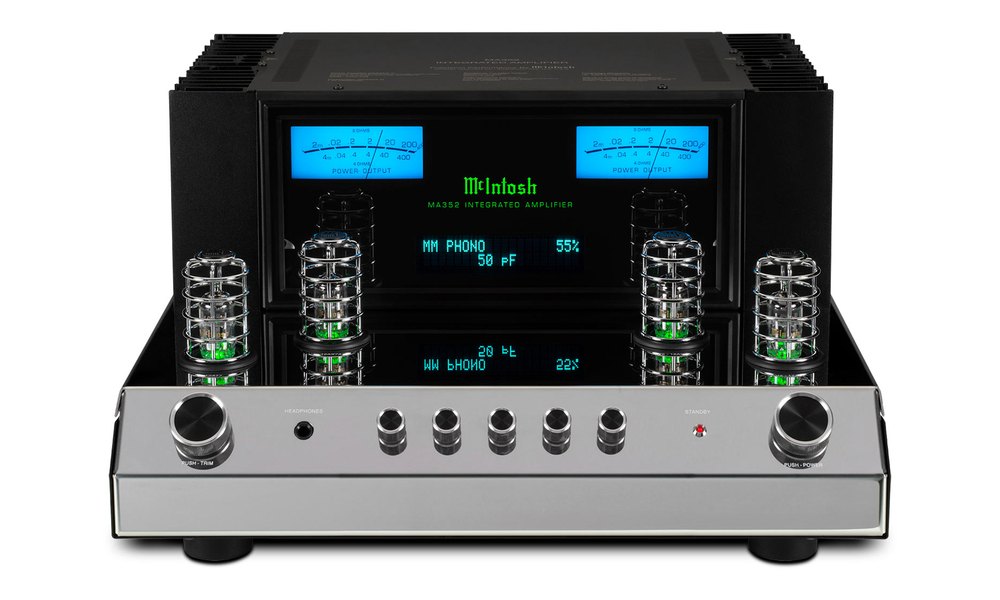
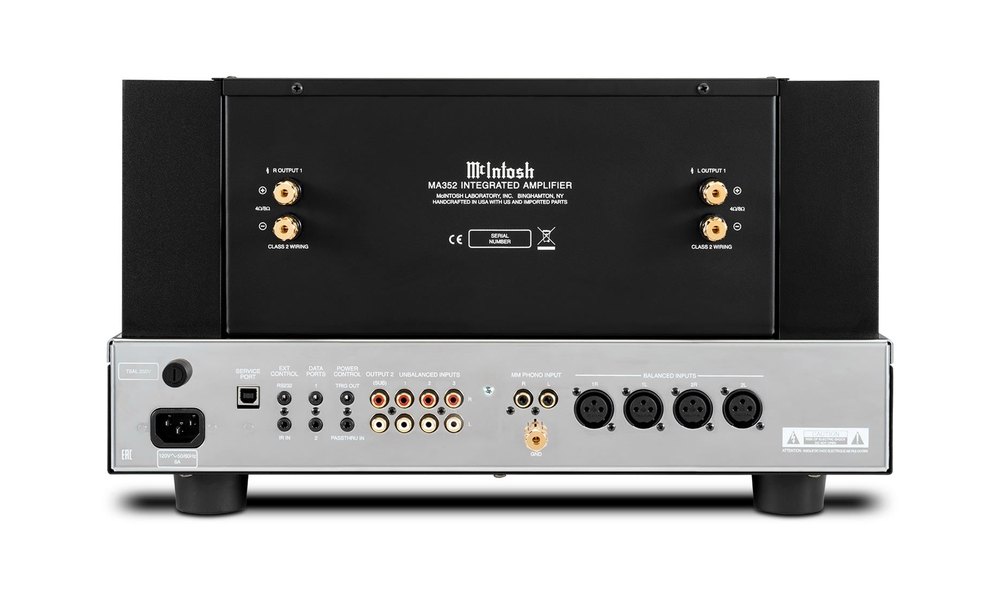
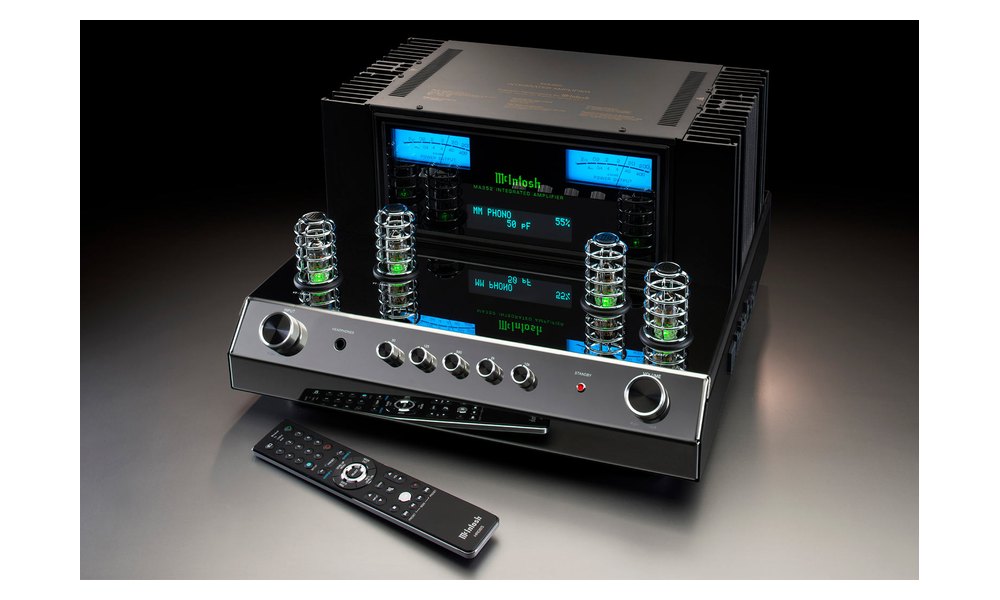
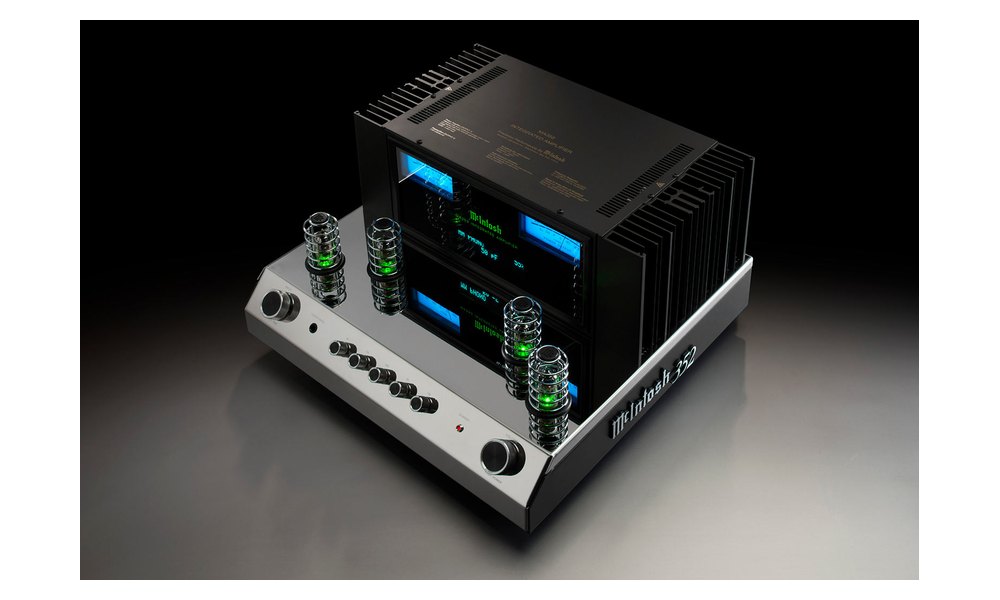
Summary
According to McIntosh, the MA352 combines 2×12AX7A/12AT7 in the preamp with a 200 W/8 Ω (320 W/4 Ω) direct-coupled transistor power stage (no autoformer) and MM phono with adjustable loading. Market price often approx. €10,580 (price as of check). No DAC — Analog/Hybrid focus.
Assumptions
- MM system (MC needs step-up/external phono stage)
- No DAC onboard
- Check the German price as of Sept 2026
Specs (public / manufacturer)
| Type | Hybrid-integrated amplifier · Tube Pre + Solid-State |
|---|---|
| Power | 200 W into 8 Ω · 320 W into 4 Ω (20 Hz–20 kHz, 0.03% THD) · direct-coupled transistor power stage (no autoformer) |
| Phono | MM · Yes · Load adjustable · no MC |
| Digital | No DAC |
| Features | 5-Band EQ · HXD-headphones · Dual Sub · HT bypass · XLR |
| Price guide | approx. €10,580 · Sept 2026 · Check the price date |
Manufacturer specifications (McIntosh)
| Power per channel (20 Hz–20 kHz, 0.03% THD) | 200 W into 8 Ω · 320 W into 4 Ω |
|---|---|
| Dynamic headroom | 1.5 dB |
| Frequency response | 20 Hz–20 kHz +0/−0.5 dB · 10 Hz–100 kHz +0/−3 dB |
| Phono (MM) | 2.5 mV · S/N 93 dB · adjustable loading |
| Damping factor | > 200 (8 Ω) · > 100 (4 Ω) |
| Design | Vacuum tube preamp · solid-state power amp, direct coupled |
| Tone controls | 5-band |
| Dimensions (W × H × D) | 445 × 251 × 443 mm |
| Weight | 29.9 kg |
Source: McIntosh – official specifications · As of 16 October 2026 · subject to change by the manufacturer
Scores in detail
Vinyl BotPro Index: 91 · Index band Master 85–97 · Guidance only, not a lab value.
Strengths
- MM-Phono with load selection
- High power incl. 4 Ω
- Tone/EQ analog
Weaknesses
- No MC-Phono
- No DAC
- Price ~10.5k €
Comparison models
| McIntosh MA252 | Smaller hybrid, cheaper |
|---|---|
| Luxman L-507Z | MM/MC, less "Mc-Watt" |
| Mark Levinson № 5805 | MM/MC + DAC, other branding |
System matching
Works well with
- MM-cartridge
- Boxes that want electricity and level
- HT bypass usage
Less suited
- Pure low-MC without external stage
- Digital All-in-One Expectation
Created by Vinyl BotPro (AI) · As of Sept 2026 · Corrections: info@vinylcination.de
Manufacturer and concept
McIntosh Laboratory was founded in the USA in 1949 and has been based in Binghamton, New York, for decades. The brand is known for black glass fronts, blue-lit power meters and amplifiers that stay in service for decades. Many McIntosh power amplifiers use output transformers that McIntosh calls Autoformers, designed to deliver the same power into any speaker impedance.
The MA352 takes a different route. It is a hybrid integrated amplifier: the preamp uses valves, the power amp uses transistors coupled directly to the speakers, without Autoformers. The MA352 was announced in September 2019, has been available since the end of October 2019 and is the bigger sibling of the MA252. It is a purely analogue design with no built-in DAC. At a market price of around €10,580 it sits in our Master tier of amplifiers.
The technology explained
Valve preamplifier
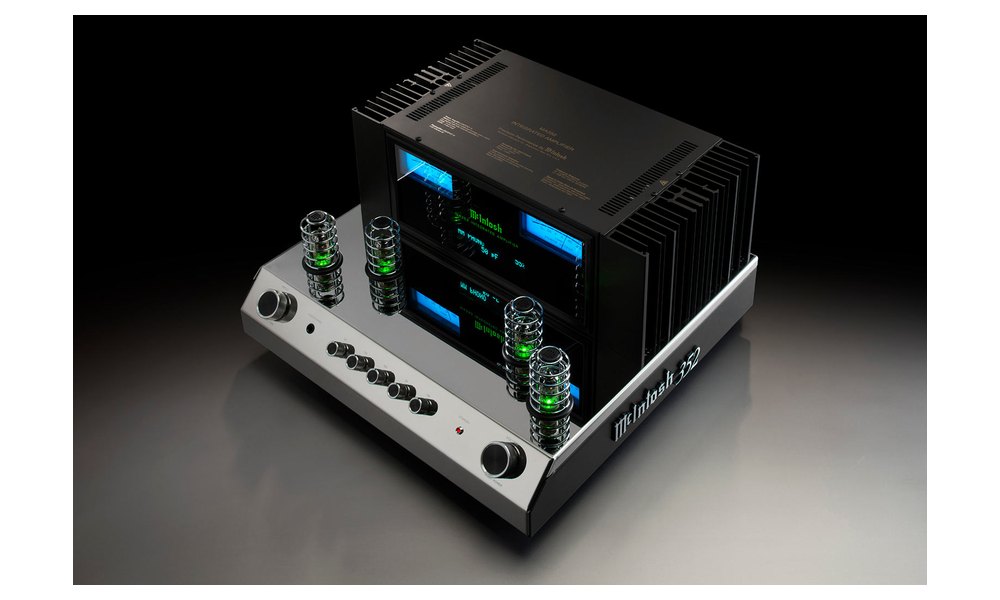
The preamp uses four valves: two 12AX7A and two 12AT7. The preamp amplifies the source signal, controls the volume and passes the signal to the power stage. Valves produce different, mostly even-order harmonics than transistors, which many listeners find particularly natural and pleasant. The valves sit visibly on top of the chassis under protective cages and glow in operation. They can be replaced when needed.
Direct-coupled solid-state power amp
According to McIntosh the power amp delivers 200 watts into 8 Ω and 320 watts into 4 Ω per channel, measured from 20 Hz to 20 kHz at 0.03% distortion. Direct-coupled means there is no transformer between the output transistors and the speaker terminals. As a result power rises into 4 Ω and the damping factor is high: more than 200 into 8 Ω. A high damping factor helps keep the speakers' woofers under tight control.
MM phono stage
The MA352 has a built-in phono stage for moving-magnet cartridges with adjustable loading. McIntosh quotes an input sensitivity of 2.5 mV; for signal-to-noise ratio, the product page says 93 dB, the specification sheet 82 dB referenced to a 5 mV input. There is no dedicated moving-coil input; for MC cartridges you need a step-up transformer or an external phono stage.
Features
On the back are two balanced XLR inputs, three RCA inputs, the phono input, two subwoofer outputs and a home theatre pass-through mode. On the front are a five-band equaliser, a headphone output with McIntosh's HXD circuit and the blue power meters. The chassis measures 445 × 251 × 443 mm and weighs 29.9 kg.
What the specifications mean
200 watts into 8 Ω is more than enough for almost any speaker. The dynamic headroom of 1.5 dB describes how much extra power the amplifier delivers briefly on transients. Frequency response extends from 10 Hz to 100 kHz (−3 dB). The five-band equaliser allows targeted adjustment to room and recordings, but can also be bypassed.
Sound according to international reviews
The British reviewer at Pursuit Perfect System described the MA352 as exceptionally smooth and effortless, even at high volume. He highlighted a deep, three-dimensional soundstage and powerful, controlled bass with a rounded, musical character. Voices sounded relaxed and never hard. His only reservation was that the amplifier sometimes plays it a little safe and lacks bite. He gave it an Essential Audition award.
The Speaker Shack praised the combination of valve preamp and solid-state power amp: body and naturalness from the valves, power and immediacy from the transistors. The bass had real physical impact, and the sound stayed clean without becoming cold. SoundStage! Australia stressed its effortlessness, dynamic realism and tonal accuracy. These assessments come from the international press; we did no listening or measurement tests of our own.
Why hybrid?
Valve power amplifiers usually deliver little power, run hot and need new valves regularly. Solid-state power amps are powerful and efficient but sound too sober to some listeners. A hybrid amplifier uses valves only where they handle little power, in the preamp, while the power stage does the heavy lifting. That keeps valve life long and lets the amplifier control demanding speakers.
Placement and operation
At almost 30 kg and 44 cm deep, the MA352 needs a sturdy, deep piece of furniture. The valves and the heatsinks on the sides give off heat, so leave space above and beside the unit; a closed cabinet is unsuitable. The speaker terminals are on the back of the power amp section. After switch-on the valves are lit orange; after about 11 to 15 seconds the lighting changes to green and the amplifier is ready.
Suitable speakers
- KEF Reference 1 Meta: precise, benefits from the strong drive.
- Focal Sopra N°2: lively, suits the relaxed character of the MA352.
- Bowers & Wilkins 804 D5: a demanding load that needs power.
- Canton Reference 5: demanding in the deep bass, needs current.
More candidates in our floorstanding speaker rankings.
The MA352 in a vinyl system
The built-in MM phono stage with adjustable loading makes the MA352 attractive for record lovers. A high-quality MM cartridge such as the Ortofon 2M Black or a turntable such as the Rega Planar 6 is a good match. If you want to use an MC cartridge such as the Hana Umami Red, you need an external phono stage such as the Luxman EQ-500 or a step-up transformer. More phono stages in our phono preamp rankings.
Digital sources
Because the MA352 has no DAC, streaming and CD need an external device with an analogue output. Ideal is a streamer or DAC with a balanced XLR output connected to one of the two XLR inputs. That keeps the signal path inside the amplifier purely analogue.
Everyday operation
Operation follows typical McIntosh logic: a large volume knob, input selection by rotary control and tone controls right on the front. A slim system remote is included. In the setup menu you can, among other things, assign an input to home theatre pass-through. An AV receiver can then use the power stage for the front speakers while the MA352's volume control is bypassed. If you listen quietly in the evening, the equaliser helps: a slight bass lift compensates for the ear's lower sensitivity at low levels.
Valves, heat and care
Preamp valves such as the 12AX7A and 12AT7 work with small signals and are therefore under little stress. They age slowly, and replacements are available worldwide. If you want to experiment you can fit other valves of the same type; the difference is usually small, and the factory selection is carefully chosen. Good ventilation matters. Dust on valves and heatsinks can be removed with a soft brush, but only with the unit switched off and cooled down. Clean the glass front with a slightly damp microfibre cloth.
What to check when buying used
McIntosh amplifiers hold their value and are often offered second-hand. With an MA352, check that all meters light evenly, that both channels play without hum and that the valves glow evenly. Scratchy controls indicate dirt. The original box and remote make later resale easier, and a receipt helps with warranty questions.
Strengths and limits at a glance
- Strength: valve sound in the preamp with big solid-state power.
- Strength: 200 W into 8 Ω, 320 W into 4 Ω, high damping factor.
- Strength: MM phono with adjustable loading.
- Strength: five-band EQ, XLR, two sub outputs, headphone amp.
- Limit: no MC phono.
- Limit: no DAC, digital sources only via external units.
- Limit: high price, heavy and large.
- Limit: a little too relaxed in character for some listeners.
Who it suits
The MA352 suits listeners looking for a powerful, long-lived analogue amplifier with valve character who mainly play records and high-quality analogue sources. It works in large rooms and with demanding speakers. If you want a compact all-rounder with streaming, a streaming amplifier will serve you better.
Looks matter too. The combination of valves, glass front and blue meters is eye-catching and divides opinion. If you like the McIntosh style, you get a unit that still looks current after many years and has a high resale value.
Comparison with alternatives
The smaller McIntosh MA252 uses the same hybrid concept with less power and costs considerably less. The Luxman L-509Z offers MM and MC phono and a different, more finely detailed character. The Accuphase E-4000 is a Japanese alternative with very high build quality. All candidates are in our amplifier rankings.
Analysis: the McIntosh MA352 in depth
Context and sources
This analysis adds measurements, manufacturer data and the verdicts of ten sources to the overview above. It was compiled by Vinyl BotPro from the sources listed below; there were no listening tests or measurements of our own. Where we do our own calculations, we say so explicitly. The basis is McIntosh's product page and specification sheet [1], the launch news items from fairaudio and LowBeats in September 2019 [2][3], two reviews with lab measurements from Hi-Fi World and Audio Review [4][5], and listening reports from SoundStage! Australia, Lyd & Billede, Pursuit Perfect System, HiFi and Music Source and Hi-Fi+ [6][7][8][9][10].
On timing: fairaudio announced the MA352 on 25 September 2019 and gave availability as the end of October 2019 [2]; LowBeats reported it as early as 21 September 2019 [3]. The first in-depth reviews appeared in early 2020 [4][5]. The amplifier has therefore been on sale since 2019, and McIntosh still lists it as a current model [1].
Concept: valve preamp meets solid-state power amp
After the smaller MA252, the MA352 is McIntosh's second hybrid integrated amplifier [5][7]. The preamp uses four double triodes: two 12AX7A and two 12AT7 [1][4][10]. Audio Review assigns all four valves to the line section and notes that they correspond to the ECC83 and ECC81 types; the valves are labelled McIntosh, the company does not name the valve maker, and Audio Review suspects JJ Electronic from their construction [5]. In its launch news, fairaudio mentioned only one 12AT7 [2]; the specification sheet and all reviews list two, and we follow that figure.
The power stage is a direct-coupled transistor circuit without the Autoformers McIntosh uses in many of its larger amplifiers [1][8]. SoundStage! Australia mentions high-current ThermalTrak transistors and around 60 joules of power-supply energy storage [6]. According to McIntosh, the output transistors are connected directly to the heatsinks bearing the "Mc" monogram, which is meant to shorten the time to thermal equilibrium [1]. Two protection circuits are fitted: Power Guard adjusts the input signal before the power stage clips hard, and Sentry Monitor disconnects the output stage without a fuse if current gets too high and then reconnects it automatically [1]. Audio Review quotes McIntosh's Power Guard figure of "less than 2% THD with up to 16 dB of overdrive at 1 kHz" [5].
Hi-Fi World stresses that while the signal path is analogue, control runs via a microprocessor on a robotically assembled surface-mount board [4]. That explains the many menu functions: renaming and disabling inputs, level matching per input, balance, mono/stereo, home theatre pass-through and an automatic switch-off after 30 minutes that can be disabled [4][6].
Manufacturer data and what it means
McIntosh specifies 200 W into 8 Ω and 320 W into 4 Ω per channel, measured from 20 Hz to 20 kHz at no more than 0.03% distortion, plus 1.5 dB of dynamic headroom and a damping factor of over 200 into 8 Ω and over 100 into 4 Ω [1]. Frequency response is given as 20 Hz to 20 kHz (+0/−0.5 dB) and 10 Hz to 100 kHz (+0/−3 dB) [1].
Our own calculation: 200 W into 8 Ω corresponds to an output voltage of about 40 V, and 320 W into 4 Ω to about 35.8 V. An ideal voltage source would deliver 400 W into 4 Ω; the ratings reach 80% of that. The 1.5 dB of dynamic headroom works out at roughly 283 W into 8 Ω for short bursts.
For sensitivity, McIntosh quotes 250 mV on RCA and 500 mV on XLR for rated output [1][5]. Our own calculation: going from 0.25 V to 40 V means about 44 dB of total gain, or about 38 dB via XLR. The MM phono stage reaches rated output with 2.5 mV [1]; that is about 84 dB of total gain, so the phono stage itself contributes about 40 dB.
There are two manufacturer figures for the phono signal-to-noise ratio: the product page says 93 dB [1], while the specification sheet printed in Audio Review and Hi-Fi+ says 82 dB, referenced to a 5 mV input [5][10]. The 82 dB matches the measurements (see below). For the line inputs, all sources give 93 dB [1][5][10].
McIntosh lists the dimensions as 445 × 251 × 443 mm [1]; the 521 mm depth quoted in several reports includes cables and plugs, according to Hi-Fi World [3][4][9]. The 445 mm width fits a 19-inch rack, but the 251 mm height needs plenty of room between shelves [4].
Measurements by Hi-Fi World and Audio Review
Two magazines measured the MA352 in their own labs. Hi-Fi World measured 264 W into 8 Ω and 530 W into 4 Ω, well above the rating [4]. Our own calculation: that is 32%, or about 1.2 dB, above rated power into 8 Ω. Into 4 Ω the power almost doubles, and the output voltage stays practically the same at just over 46 V into both loads. That points to a very strong power supply.
Audio Review also found more power than specified and measured up to 730 W per channel into 2 Ω with 40-millisecond bursts; into reactive loads, limiting only set in above roughly 350 W, with peak currents of up to ±30 A [5]. Our own calculation: 730 W into 2 Ω equals about 38 V and 19 A RMS, or about 27 A peak, which fits the ±30 A. Audio Review points out that earlier McIntosh integrated amplifiers without Autoformers tended to struggle with difficult loads, whereas the MA352 does not [5].
Distortion and noise are low. Hi-Fi World measured 0.01% distortion at 10 kHz and 1 W into 4 Ω, no crossover distortion, 70 dB of channel separation and a noise figure of −98 dB on the line inputs [4]. Audio Review reports a signal-to-noise ratio of about 100 dB on the line inputs and 82.3 dB on phono MM [5]. According to Audio Review, distortion is slightly higher because of the valves than on the brand's purely solid-state models, which mostly stay below 0.01%, but still at a very low level [5]. Audio Review gives the slew rate as 27 V/µs [5].
For frequency response, Hi-Fi World measured 8 Hz to 100 kHz (−1 dB) with the tone controls out [4]. Audio Review found −0.2 dB at 20 Hz and −1 dB at 70 kHz on the line inputs; with the equaliser engaged, the −1 dB point was at 53 kHz [5]. Both are far outside the audible range.
Damping factor: three numbers, one explanation
The damping factor figures differ. McIntosh quotes over 200 into 8 Ω [1]. Hi-Fi World measured an output impedance of 0.09 Ω and therefore a damping factor of 88 [4]. Audio Review measured 324 at 100 Hz and 314 at 1 kHz into 8 Ω and gives the output impedance as no more than 25 milliohms [5].
Our own interpretation: differences like these often come from the measuring point, that is, whether the reading is taken at the board, at the terminals or with a length of cable. All three values are high. Our own calculation: a speaker cable 2 × 3 m long with a 2.5 mm² cross-section has a resistance of about 0.04 Ω. From the speaker's point of view, the effective damping factor then drops to about 120 (with 0.025 Ω) or about 60 (with 0.09 Ω). The cable therefore has about as much influence as the amplifier itself. Because of the low output impedance, Audio Review also considers bi-wiring via the existing terminals effective [5].
Sound according to the specialist press
The sound descriptions agree on one point: the MA352 plays effortlessly and with a large power reserve. Opinions on its character differ.
Hi-Fi World describes the sound as rather dry, very clean and dynamically powerful; the bass is tight and clean but not overly heavy. The valves probably contribute body and a broad soundstage, but the amplifier is grippy and powerful rather than warmly romantic [4]. The magazine's verdict is "Outstanding – amongst the best" [4].
SoundStage! Australia highlights the effortlessness with large dynamic swings, a very wide soundstage and depth that the author counts among the best in integrated amplifiers. The warmth comes from a very slight upper-bass emphasis, without boom [6]. Compared with good valve or Class-A amplifiers, Edgar Kramer heard slightly less midrange body and openness, but placed the MA352 among the top Class-AB solid-state amplifiers [6].
Lyd & Billede describes the tonal balance as warm, with full bass and midrange and silky treble, plus excellent dynamic contrast and a large, airy soundstage [7]. Pursuit Perfect System calls the sound extremely smooth and effortless, with a deep, three-dimensional soundstage and rounded, controlled bass; its only reservation is that the amplifier plays it a little safe and lacks some bite [8]. The "Essential Audition" award came from there [8].
HiFi and Music Source speaks of a very smooth sound without harshness and with plenty of power, and particularly praises piano reproduction [9]. Hi-Fi+ found the MA352 well balanced, musical, dynamic and detailed, with tight, easy-to-follow bass and no objectionable weaknesses [10].
Our own interpretation: the range from "dry and grippy" [4] to "warm and romantic" [7][8] is wider than for many other amplifiers. One reason is probably the very different speakers in the listening rooms, from electrostatics [4] to Sonus Faber [8] to Wilson Audio and Magico [6]. For system planning this means the MA352 leans towards fullness rather than sharpness, and anyone looking for a very direct, analytical sound should hear it with their own speakers.
Comparisons from the reviews
Several reviews compare the MA352 directly with other amplifiers. Lyd & Billede compared it with the Devialet Expert 220 Pro: the Devialet sounded tighter and more focused, but lacked the McIntosh's charm [7]. Against the McIntosh MA7200 with Autoformers, the MA352 seemed equally powerful at normal levels, while the MA7200 was slightly better controlled when pushed [7]. Lyd & Billede describes the gap to the 100 W per channel MA252 as clear [7], and Audio Review also sees the MA352 clearly ahead of the smaller model with difficult speakers [5].
Pursuit Perfect System compared it with the Galion TS120SE valve amplifier, which gave voices more character but was outclassed in bass, scale and at high volume [8]. The Leema Tucana II Anniversary sounded more neutral and direct with lighter-footed bass; with the Sonus Faber speakers, the McIntosh was the better match [8]. HiFi and Music Source places the MA352 at the opposite end of the scale from the very clean and precise T+A PA 2000 R [9]. Hi-Fi+ listened against a similarly priced pure solid-state amplifier and found more emotion and impact from the McIntosh [10].
The phono stage in practice
The phono input is designed for MM cartridges, with a 47 kΩ load and capacitance adjustable in 50 pF steps from 50 to 800 pF [4][5][7]. Audio Review measured 48 kΩ and 70 pF at the lowest setting, an overload margin of 92 mV at 1 kHz and a slight dip of −1.4 dB at 20 Hz [5]. Hi-Fi World found the equalisation flat from 10 Hz to 20 kHz and measured 3 mV sensitivity for full output [4].
Our own calculation: an overload limit of 92 mV with a typical MM level of 5 mV gives about 25 dB of headroom. That is easily enough for loud passages and clicks.
There is no dedicated input for MC cartridges. Here the sources disagree: Hi-Fi World thinks that with the input trim set to +6 dB, the sensitivity is sufficient for MC cartridges with strong output [4]. Audio Review, on the other hand, writes that the trim only balances levels between inputs and does not raise sensitivity [5]. Our own calculation: an MC cartridge with 0.4 mV reaches no more than 6.4 V at the output with 2.5 mV sensitivity, or about 5 W into 8 Ω. For low-output MC cartridges, a step-up transformer or an external phono stage is therefore the safe solution.
In practice the phono stage was praised. Hi-Fi World found records sounded better than the digital source [4], according to Lyd & Billede it is far from an afterthought [7], and HiFi and Music Source ran a Rega cartridge at 50 pF and describes a soft, deep sound [9]. Pursuit Perfect System considered the built-in stage the more coherent solution overall compared with the external AVID Pellar, but stresses that this part was only briefly assessed [8].
Tone controls, subsonic filter and operation
The five-band equaliser works at 30 Hz, 125 Hz, 500 Hz, 2 kHz and 10 kHz, two octaves apart, and is specified at ±12 dB [1][6]. Hi-Fi World measured ±15 dB [4]. According to Hi-Fi+, the equaliser is off by default and has to be switched in via the remote [10]; Hi-Fi World used the button for direct comparisons with and without tone controls and heard no difference with all controls centred [4].
One detail McIntosh does not mention itself: switching the equaliser in also activates a subsonic filter. Hi-Fi World measured a steep roll-off below 15 Hz with −20 dB at 4 Hz [4], and Audio Review describes a second-order high-pass filter at about 11 Hz with only −0.2 dB at 20 Hz [5]. That helps with warped records and with bass-reflex speakers, whose cones would otherwise move a lot below the tuning frequency [5].
There is also criticism of the controls. Pursuit Perfect System complains that the equaliser knobs have no markings apart from the centre detent and are easily moved when cleaning [8]. HiFi and Music Source finds the volume knob, which has no click steps, very sensitive, which calls for care with so much power [9]. The remote control was praised in several reviews [4][6].
Headphone output
McIntosh describes the headphone output as a high-drive circuit with the HXD crossfeed function [1]. There are two figures for suitable headphone impedance: 20 to 600 Ω in the launch news [2][3] and 100 to 600 Ω in the specification sheet [5][10]. Audio Review measured 9.1 V unloaded, 3.15 V into 33 Ω and 1.29 V into 10 Ω, very low noise and an output impedance of 48 Ω [5].
Our own calculation: 3.15 V into 33 Ω equals about 0.3 W. The 48 Ω output impedance is uncritical for high-impedance headphones, but can slightly alter the frequency response of low-impedance models with varying impedance; that is also the only limitation Audio Review mentions [5]. In practice the output drove a Sennheiser HD 660S [7], a Focal Clear [10] and a Meze 109 Pro [9] without problems.
Power, levels and speaker choice
The blue power meters show actual power on a logarithmic scale; mid-scale is 2 W [4]. Even at high volume in a large room, Hi-Fi World rarely saw more than 20 W [4], and Pursuit Perfect System reports something similar [8].
Our own calculation: a speaker with 88 dB sensitivity (2.83 V, 1 m), such as the Magico A5 used by SoundStage! Australia [6], reaches about 91 dB with 2 W, about 101 dB with 20 W and about 112 dB with 264 W at 1 m. At 3 m, expect roughly 6 to 9 dB less in a room, depending on acoustics. The MA352's reserve therefore mainly serves peaks and low-sensitivity speakers rather than continuous level.
Because the power stage has no Autoformers, there is only one pair of terminals per channel, and power rises into lower impedances [1][5]. The terminals sit unusually high on the back, directly behind the power amplifier boards [4][8][9]. For subwoofers there is a stereo preamp output that can feed one or two powered subwoofers; the same output can also drive a more powerful amplifier [1][6].
Placement, heat and valves
At 29.9 kg the MA352 is heavy, and several authors recommend a second person for lifting [4][6][9]. Cooling works without a fan; Hi-Fi World found the unit only warm in operation and mentions a thermal cut-out [4]. After switch-on, LEDs light the valves orange from below; after 11 to 15 seconds the colour changes to green and the amplifier is ready [4][5][7]. On overload the LEDs switch back to orange [4][10]. Lighting and displays can be dimmed or switched off [6][7].
The valves sit under removable metal cages and can be replaced [4][9]. Pursuit Perfect System sees valve rolling as a way to change the sound of voices specifically, but did not try it [8]. SoundStage! Australia gives three years of warranty on the unit and 90 days on the valves for Australia [6]; McIntosh lists a three-year limited warranty on its product page [1]. Terms may differ by country.
Prices over time
Prices have moved considerably since launch. LowBeats gave a retail price of €8,490 including VAT in 2019 [3], and Audio Review €10,500 in Italy in 2020 [5]. In the UK the price was £8,495 in 2020 [4] and £8,995 from 2023 [8][9][10]; Hi-Fi+ also quotes US$7,000 [10]. SoundStage! Australia gives AU$13,995 [6] and Lyd & Billede 59,000 Danish kroner [7].
Our own calculation: the market price of around €10,580 given on this page is about 25% above the German launch price of 2019. We did not find a current German list price from an independent source; we deliberately did not use retailer pages as sources.
Verdict of the analysis
The sources paint a consistent picture: the MA352 is a very powerful, well-measuring integrated amplifier with a valve preamp that contributes body and space rather than classic valve softness. The measurements by Hi-Fi World and Audio Review show more power than specified, low distortion and high stability into difficult loads [4][5]. The listening reports praise effortlessness, soundstage and bass; as weaknesses, individual authors mention a slight lack of bite [8] or less midrange fullness than pure valve amplifiers [6].
The limits are clear: no DAC, no MC input, a high price and considerable weight [1][7]. According to the reviews evaluated, anyone who mainly plays records with MM cartridges, connects digital sources externally and owns speakers that need current will find the MA352 a very coherent solution. This analysis is based solely on the sources listed; we did not carry out any listening tests or measurements of our own.
Sources for this analysis
- McIntosh Laboratory: MA352 Integrated Amplifier – Produktseite mit technischen Daten/product page with specifications (abgerufen/accessed 12.11.2026). https://www.mcintoshlabs.com/products/integrated-amplifiers/MA352
- fairaudio: Glänzend: Der McIntosh MA352 AC Hybrid-Vollverstärker (News, Jochen Reinecke, 25.09.2019). https://www.fairaudio.de/news/mcintosh-ma352-ac-vollverstaerker/
- LowBeats: Neu: Hybrid-Vollverstärker McIntosh MA 352 AC (News, Holger Biermann, 21.09.2019). https://www.lowbeats.de/hybrid-vollverstaerker-mcintosh-ma-352-ac/
- Hi-Fi World (UK): McIntosh MA352 – Solid Power, mit Messungen/with measurements (Noel Keywood, Ausgabe/issue February 2020; Nachdruck/reprint PDF auf/on mcintoshlabs.com). https://www.mcintoshlabs.com/-/media/Files/mcintoshlabs/ReviewAwardDocuments/MA352-Hi-Fi-World-February-2020.pdf
- Audio Review (Italien/Italy): McIntosh MA352, mit Labormessungen/with lab measurements (Fabrizio Montanucci, n. 418, März/March 2020; Nachdruck/reprint PDF auf/on mcintoshlabs.com). https://www.mcintoshlabs.com/-/media/Files/mcintoshlabs/ReviewAwardDocuments/MA352-Audio-Review-March-2020.pdf
- SoundStage! Australia: McIntosh Laboratory MA352 Integrated Amplifier (Edgar Kramer, 15.10.2020). https://www.soundstageaustralia.com/index.php/reviews/462-mcintosh-laboratory-ma352-integrated-amplifier
- Lyd & Billede (Dänemark/Denmark): McIntosh MA352 (Lasse Svendsen, 19.05.2020). https://www.lydogbillede.dk/test/hi-fi/mcintosh-ma352/
- Pursuit Perfect System (UK): McIntosh MA352 Integrated Amplifier Review – Textfassung zum Video/written summary of the video review (Terry Ellis, August 2023, online 02.10.2023). https://www.pursuitperfectsystem.com/mcintosh-ma352-integrated-amplifier-review/
- HiFi and Music Source (UK): McIntosh MA 352 integrated amplifier (Simon Wilce, 23.10.2023). https://hifiandmusicsource.com/2023/10/mcintosh-ma-352/
- Hi-Fi+ (UK): McIntosh Labs MA352 (Chris Frankland, 13.11.2024). https://hifiplus.com/articles/mcintosh-labs-ma352/
Created by AI (Vinyl BotPro) from the sources listed; no listening tests or measurements of our own. Detailed human fact-check pending.
Frequently asked questions about the McIntosh MA352
Does the MA352 have Autoformers?
No. The power stage is direct-coupled, which is why power rises to 320 watts into 4 Ω.
Can I connect an MC cartridge?
Only via a step-up transformer or an external phono stage. The built-in input is designed for MM cartridges.
Do I have to change the valves often?
Small-signal preamp valves usually last many thousands of hours, so replacement is rarely needed.
Can I connect a subwoofer?
Yes, the MA352 has two subwoofer outputs.
How much power do I really need?
For normal levels in living rooms a few watts are often enough. The MA352's large reserve pays off on transients, with low-sensitivity speakers and in large rooms, because the amplifier never reaches its limits.
MA352 or MA252?
The MA252 has less power and a smaller chassis. It is enough for small rooms and easy-to-drive speakers; the MA352 offers much more power reserve and a more extensive feature set.
Does the MA352 have streaming or Bluetooth?
No. It is purely analogue; digital sources need an external DAC or streamer.
Verdict
The McIntosh MA352 combines a valve preamp with a powerful, direct-coupled solid-state power amp. International reviewers praise its smooth, effortless sound, deep soundstage and controlled bass. If you use MM cartridges and connect digital sources externally, you get a long-lived amplifier with plenty of power and an unmistakable presence.
Read more: Tube amplifier top list 2026 (German) · What is hi-fi?