
Turntable · AI analysis · Master, rank 2
Rega Planar 10: Analysis
AI analysis (research): Rega Planar 10 — ceramic platter, RB3000, P10 PSU. Moved from expert-transitional model to master. Specs & recurring assessments of specialist press, no listening test.
Summary
The Planar 10 is Rega’s reference level below the Naia: a ceramic-oxide platter, RB3000, a dedicated P10 PSU, and a skeletonised Tancast/HPL plinth with ceramic bracing. Market price often from approx. €5,500 without a cartridge; with an Apheta/Aphelion, significantly more (Sept 2026 — check). Here deliberately in Master (no longer in the Expert core band). Weigh against Planar 8 and Naia; co-calculate phono and placement. Guidance, not pressure to buy.
Assumptions
- External phono stage mandatory; MC packages need matching MC-Phono
- Cartridge package dominates market price
- No listening access of our own
Technical data (public)
| Drive | Belt · P10 PSU · 33/45 (manufacturer) |
|---|---|
| Tonearm | RB3000 |
| Platter | Ceramic oxide · diamond cut (manufacturer) |
| Plinth | Skeletonized Tancast/HPL with Ceramic Bracing |
| Phono / auto | No / No |
| Price guide | approx. €5,500–7,000+ per cartridge · Sept 2026 — Master |
Manufacturer specifications (Rega)
| Type | belt drive (EBLT Reference), 24 V synchronous motor, dedicated P10 PSU |
|---|---|
| Tonearm | Rega RB3000 |
| Cartridge (fitted) | Apheta 3 or Aphelion 2 (MC) optional |
| Platter | ceramic oxide, diamond cut |
| Dimensions | 420 × 115 × 350 mm (with dust cover) · PSU 218 × 80 × 320 mm |
| Weight | 4.7 kg · PSU 3 kg |
Source: Rega – official specifications · As of 16 October 2026 · subject to change by the manufacturer
Scores in detail
Scores = AI guidance within the Master league, not pressure to buy and not a “better than Expert” fact.
Strengths
- Traceable Rega reference below Naia
- RB3000 + ceramic platter + dedicated P10 PSU
- Detailed press analyses (What Hi-Fi?, Stereophile, Hi-Fi World)
- Upgrade path to the Naia remains open
Weaknesses / limits
- Clearly above a typical Expert budget
- No phono stage / no automatic
- Expensive MC bundles approaching Naia money
- An AI analysis is not a demo
Comparison models
| Rega Planar 8 | Upper Expert — often the more fitting entry point |
|---|---|
| Rega Naia | Master reference above · significantly more expensive |
| Pro-Ject Signature 12 | Different high-mass/12″ philosophy |
System matching
Works well with
- Good MM- or MC-Phono per bundle
- Users who have outgrown a Planar 8
- A demo before an expensive MC package
Less suited
- Expert core budget → Planar 6/8 / X2 B
- If you want direct drive → Technics reference class
Technology in detail
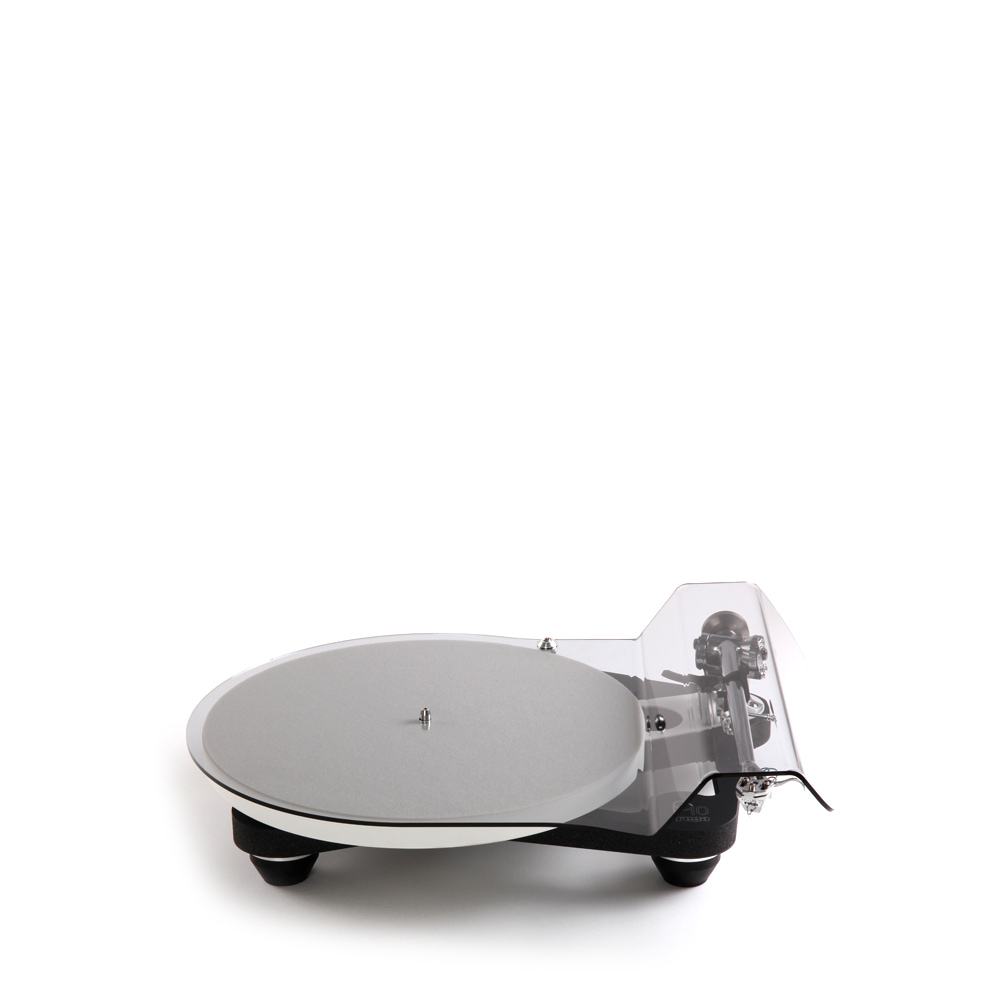
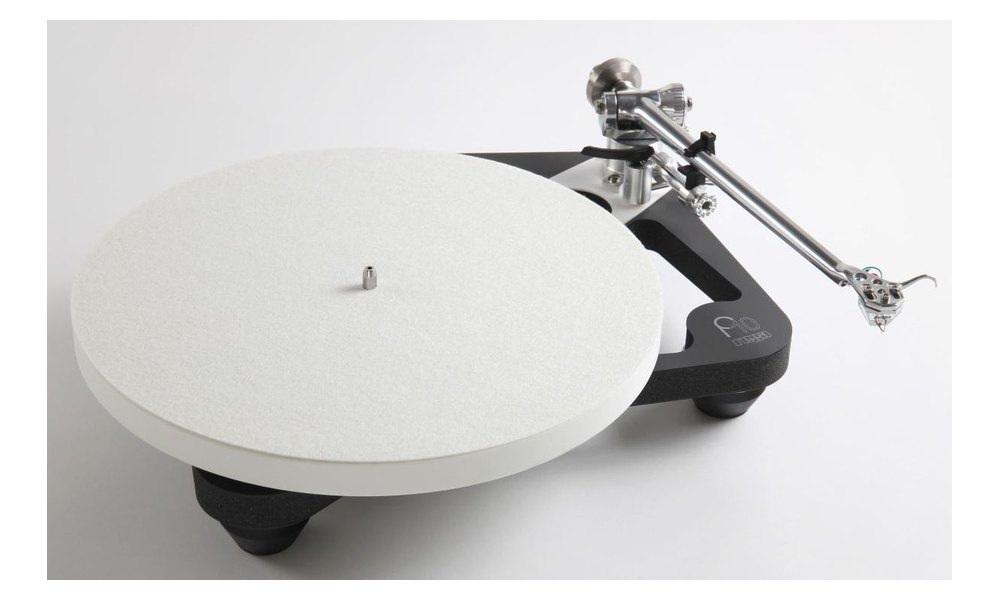
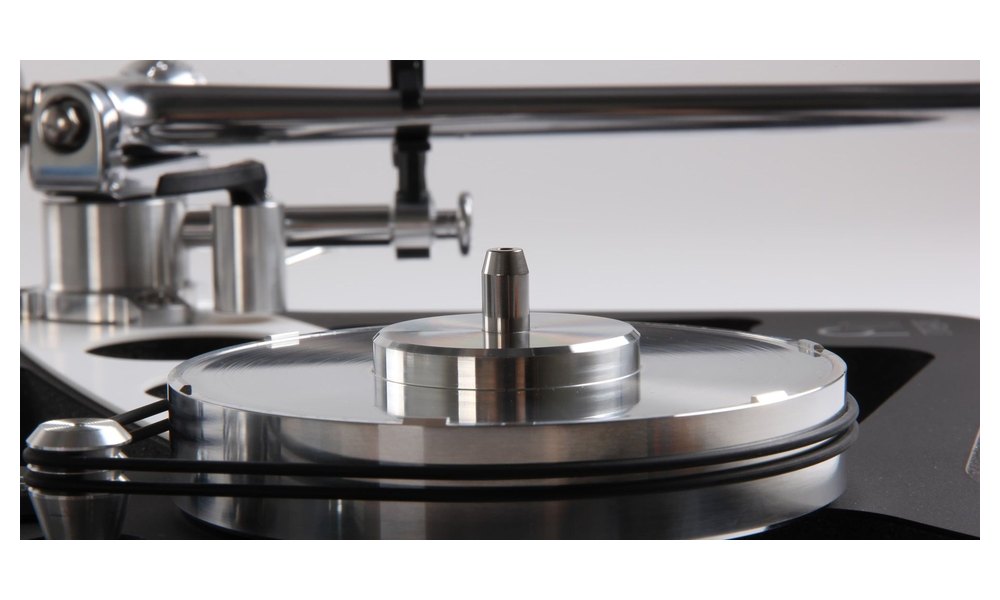
According to Rega, the Rega Planar 10 is inspired by the Naiad: a Tancast 8 plinth between two HPL layers, a ceramic top brace and a phenolic bottom brace between bearing and tonearm mount, a diamond-cut ceramic platter, an aluminium sub-platter with a tool-steel spindle in a brass housing, and the RB3000 tonearm. A bottom-mounted 24 V synchronous motor drives the platter via two EBLT Reference belts; the outboard P10 PSU (also called PL10 PSU by Rega) switches between 33 and 45 rpm at the press of a button. There is no phono stage and no automatic function.
According to Rega, it differs from the Planar 8 (RB880 tonearm, glass platter, Neo PSU) mainly in platter, tonearm, ceramic brace and power supply. The Naia above it has a graphene-impregnated carbon plinth, a ZTA ceramic bearing, the RB Titanium tonearm and Triple Reference belts. Details with sources are in the analysis section further down.
What the specialist press says
What Hi-Fi? (December 2019) describes the Planar 10 with Apheta 3 as not instantly spectacular, but over time as unusually transparent, detailed and dynamic. Stereophile (February 2020) praises the fast, tight bass and calls it Rega’s most sophisticated turntable yet; those who like suspended decks may find it somewhat forward. Hi-Fi World (March 2020) measured good speed stability and describes mild treble from the Apheta 3.
The sources name the non-adjustable feet and the hingeless dust cover, which is removed for play, as limits. The light, unsuspended design needs a firm, level surface; the power supply and a suitable MC phono stage need planning. Evidence is in the analysis section.
Who is it for?
Arm
The RB3000 has three-point mounting for Rega cartridges; according to the manual, overhang is then set automatically. According to Stereophile, the supplied gauge gives a modified Stevenson alignment. The Planar 10 is available factory-fitted with the Apheta 3 or Aphelion 2; with other cartridges, tracking force and bias are set as described in the manual.
Phono
An external phono stage is required. The Apheta 3 with 350 µV needs an MC stage; What Hi-Fi? suggests 100 ohms and 1000 pF as a starting point.
Budget
Master entry from approx. 5.5–7 k€+ (prices as of Sept 2026), plus a phono stage and a stiff, level surface. Factory-fitted cartridges raise the package price; at launch the UK premium for the Apheta 3 was £900 according to What Hi-Fi?.
Upgrade
According to the manual, speed can be checked with the separately available Rega Strobe kit and fine-tuned on the power supply in 0.01 rpm steps; the belts should be replaced every five years. Within Rega, the Naia sits above it.
Analysis: the Rega Planar 10 in depth
What this is: an AI analysis, not a listening test
This section brings together what can be documented about the Rega Planar 10 from manufacturer material and international reviews. Vinyl BotPro has neither listened to nor measured the turntable. We paraphrase sound descriptions as named publications wrote them under their own conditions. We explain technical relationships using general turntable knowledge and label our own assessments as such. This section changes nothing about rating, rank or index: the Planar 10 remains at index 96, rank 2 in the Master tier, and holds the value champion award.
Rega uses similar design principles and similar names for its upper turntables. Reviews mention the RP10, the Planar 8, the Planar 10, the Naia and the Naiad. Because these models differ markedly in platter, tonearm, power supply and materials, we separate them explicitly below. Prices are given only as dated UK or US press prices; they are not current euro street prices.
Origins: from Naiad to Planar 10
The starting point is the Naiad, Rega's most elaborate turntable. What Hi-Fi? describes it as a pure engineering exercise that was never originally meant for production. Because of demand, Rega built a limited run of 50 units in total at around £30,000 [7]. Stereophile gives roughly $45,000 for the Naiad [8].
According to Rega, the Planar 10 was inspired by the Naiad [1]. What Hi-Fi? describes it as the closest the company has come to a production version of the Naiad, built on standard production lines with materials that are relatively easy to obtain and work with [7]. Stereophile notes that Rega first used its Naiad research in the Planar 8 and then in the Planar 10 [8].
The timeline according to the sources:
- RP10: the predecessor. According to Rega, the Planar 10 plinth is 30 per cent lighter than the original RP10's and yet more rigid [1].
- Planar 10 (2019): What Hi-Fi? reported the launch on 9 September 2019 [6] and published its analysis in December 2019 [7].
- White finish (from April 2023): since April 2023 Rega has offered a matt white version with a clear dust cover and black mat; the other colour is Polaris grey [1].
- Revised platter: Rega cites a modified construction for the current platter with improved coupling to the sub-platter [1]. Rega gives no date for this.
The plinth: lightweight with a double brace
The plinth consists of a Tancast 8 core, a light polyurethane foam from aerospace, sandwiched between two thin, very rigid layers of high-pressure laminate (HPL) [1]. According to Rega, the Planar 10 is the third Rega turntable built this way [1]. Stereophile describes how Rega removed all material not needed for tonearm, bearing, motor and the three feet, leaving a skeletal structure [8]. Rega warns against damaging the edges when unpacking [8].
Rega calls the bracing "Double Brace Technology": a ceramic top brace and a phenolic resin bottom brace link the tonearm mount to the main bearing [1]. According to Rega, the Planar 10 is the first production turntable with a ceramic brace [1]. What Hi-Fi? explains that combining two materials is meant to improve resonance control and stiffens the link between bearing and arm without adding much mass [7].
Rega's reasoning, in short: mass absorbs energy, and lost energy means lost music [1]. Heavy plinths can also transfer motor and bearing noise into the record [1]. Stereophile relays Rega's view that a turntable is a "vibration measuring machine" and that over-damping can make it sound lifeless [8]. Our own assessment: this is a design philosophy, not a universally accepted law. Other manufacturers deliberately rely on high mass and damping.
Platter and bearing
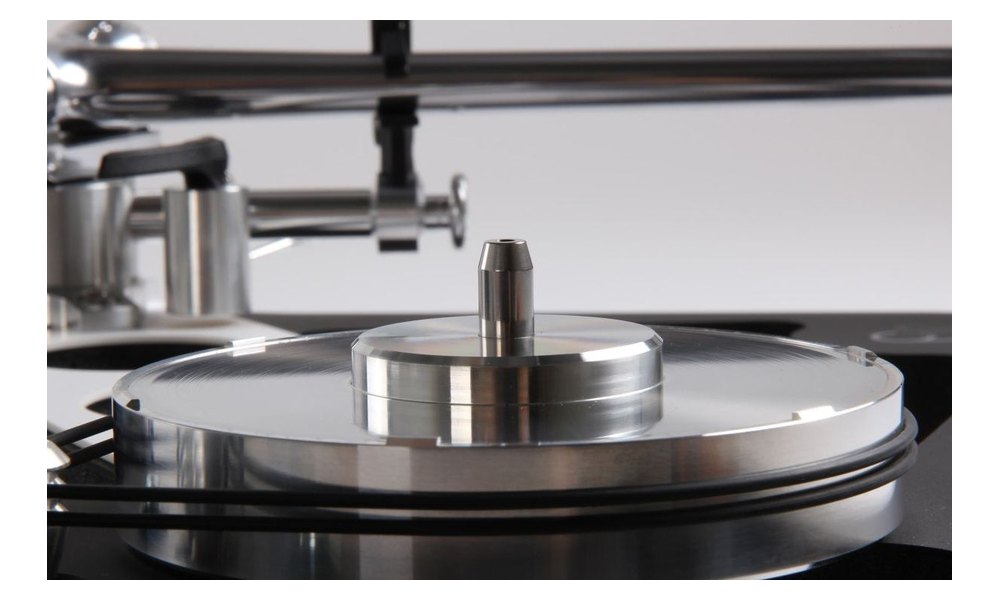
The platter is made from ceramic oxide powder that is compressed, fired and then diamond cut for an accurate, flat surface [1]. What Hi-Fi? writes that most of the mass sits at the outer edge to maximise the flywheel effect [7]. Stereophile gives a weight of about 5 lb, roughly 2.3 kg [8]. According to What Hi-Fi?, Rega's engineers value the material's hardness and consider it better than metal, glass or acrylic [7].
According to Rega, the main bearing consists of a single-piece machined aluminium sub-platter with a hardened tool-steel spindle running in a custom brass housing [1]. What Hi-Fi? found no free play on its sample [7]. Stereophile describes the bearing as a much improved version of the Planar 8 design; a wider top section fits the ceramic platter's wider opening and is meant to improve coupling and stability [8].
Motor, belts and the P10 power supply
According to Rega, the 24 V synchronous motor is mounted from the bottom, a technique taken from the Naiad. It is meant to remove stress from the motor body and hold the pulley still [1]. Each motor is hand-tuned to its own power supply to optimise the anti-vibration circuit [1]. What Hi-Fi? and Stereophile describe two round-section belts [7][8]. Rega calls the belts EBLT Reference and says it spent three years on its own rubber compound and on precise tooling to make them [1].
Rega calls the outboard supply P10 PSU or PL10 PSU [1]. It generates the speed with a DSP generator based on a stable crystal and powers the motor with a near-sinusoidal signal [1]. Stereophile reports that the electronics are the same as in the older RP10 [9]. The supply measures 218 × 80 × 320 mm and weighs 3 kg; the turntable itself weighs 4.7 kg [1].
The manual describes operation [2]:
- Speed: buttons for 33⅓ and 45 on the front of the supply.
- Fine adjustment: on the back, in steps of 0.01 rpm; factory set and only to be changed if necessary.
- Checking: with the separately available Rega Strobe kit, whose LED pulses quartz-locked at 100 Hz.
- Connection: an XLR cable from turntable to supply; the supply should be placed as far from the turntable as the cable allows to avoid hum.
- Belt replacement: Rega recommends changing the belts every five years.
Hi-Fi World found its sample's speed accurate and stable for a belt drive, though not quite at the level of Technics direct drives [10]. Stereophile had to adjust the speed, criticised the manual's instructions for this as confusing, and afterwards found very good speed and speed consistency [9].
The RB3000 tonearm
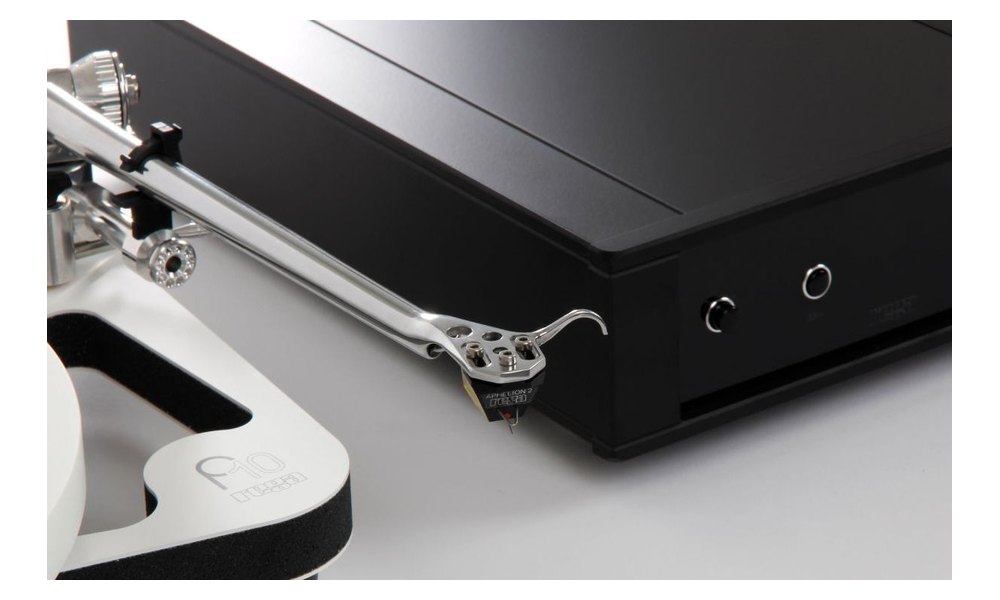
According to Rega, the RB3000 is the first Rega arm made with a new manufacturing process that improves the roundness and parallelism of the bearings [1]. Tolerances are so tight that no adhesive is used anywhere in the arm; the preloaded bearings are adjusted to less than a thousandth of a millimetre [1]. The aluminium arm tube is hand polished and, according to Rega, was redesigned to redistribute mass and reduce stresses [1]. What Hi-Fi? highlights that the bias adjuster is metal rather than plastic [7].
The manual describes a slider for bias: around 1.0 to 1.5 for moving-magnet and 1.5 to 2.0 for most moving-coil cartridges [2]. Tracking force is set on a dial marked 0 to 3; if in doubt, Rega recommends the upper end of the cartridge maker's range [2]. With Rega cartridges using three-point mounting, overhang is set automatically [2]. Stereophile adds that the supplied alignment gauge produces a modified Stevenson alignment, which mainly suits records cut close to the label [9]. Hi-Fi World found the curved finger lift awkward for its reviewer's hand [10].
Cartridge options
Rega offers the Planar 10 without a cartridge or factory-fitted with the Apheta 3 or Aphelion 2 [1]. The Apheta 3 is a moving-coil cartridge with a nude "Fine Line" diamond, a one-piece aluminium body, 350 µV output and 1.9–2.0 g tracking force; Rega gives 100 ohms as the input load impedance [5]. What Hi-Fi? suggests 100 ohms and 1000 pF on the phono stage as a starting point [7]. According to Rega, the Aphelion 2 has a boron cantilever [1].
At launch What Hi-Fi? quoted £3,599 without and £4,499 with the Apheta 3; the Apheta 3 alone then cost £1,250 [6][7]. In the US, Stereophile quoted $5,695 without and $6,695 with the Apheta 3; that was only $200 more than the RP10 without a cartridge and the same as the RP10 with Apheta 2 [8]. These are 2019–2020 prices and only serve as a historical relation.
Placement and set-up
According to the manual, the Planar 10 needs a rigid, level surface [2]. The three feet are not height-adjustable; Stereophile and Hi-Fi World both point this out [9][10]. Hi-Fi World therefore recommends a firm, level base [10]. What Hi-Fi? calls the Planar 10 not overly fussy but recommends a level, low-resonance and ideally low-mass platform well away from the speakers [7]. For wall mounting Rega offers a bracket for the Planar 8, Planar 10 and Naia [1]. According to Rega, this bracket can also be adjusted for use on uneven walls [1].
Our own assessment: with such a light turntable without suspension, a great deal depends on how still and level the supporting surface is. The sources therefore consistently recommend a firm, level and rather light base instead of heavy furniture with large resonant surfaces. What Hi-Fi? also advises keeping the turntable well away from the loudspeakers, while Hi-Fi World points to the non-adjustable feet as the reason a level base matters so much [7][10].
The dust cover is a single piece without hinges and is removed completely for play [1][10]. Hi-Fi World sees the advantage that no top clearance for an open lid is needed, but you need somewhere to put the cover [10]. Stereophile describes set-up as quick provided the surface is level and a cartridge is factory-fitted [9].
Measurements from the press
We only have measurements from reviews; Vinyl BotPro measured nothing itself. Hi-Fi World reports for its sample [10]:
- Speed: a 3150 Hz test tone was reproduced at exactly 3150 Hz, with wander of about ±2 Hz.
- Speed stability: wow around 0.1 per cent, flutter 0.05 per cent; total 0.07 per cent DIN weighted and 0.05 per cent to the Japanese JIS standard.
- Cartridge: the Apheta 3's frequency response rolls down noticeably at high frequencies, which according to Hi-Fi World gives a mild balance with strong bass. The magazine rates tracking at 2 g as good.
Hi-Fi World stresses that DIN figures are always somewhat higher than JIS figures, so comparisons with Japanese makers' specifications only make sense on the same standard [10]. Our own assessment: such figures apply to a single sample and a single test record. They indicate an order of magnitude, not a guarantee for every unit.
What the press says about the sound
The following descriptions come from the articles cited, all with the Apheta 3. They are those publications' verdicts under their conditions, not our own listening results.
What Hi-Fi? writes that the first impression is less instantly lovable than with Rega's cheaper models; the Planar 10 avoids sonic fireworks [7]. Over time it reveals a rare combination of transparency, detail resolution and dynamics, plus rhythmic security, a clear midrange, agile, weighty bass and a stable, deep soundstage [7]. Anyone looking for a stereotypically warm sound should look elsewhere [7].
Stereophile describes the bass as fast, tight and well defined and rejects the idea that a lightweight turntable cannot deliver deep bass [9]. Listeners who prefer the richness of a suspended turntable may find the Planar 10 somewhat "in your face" [9]. In its conclusion Stereophile calls it Rega's most sophisticated, quiet and subtle turntable yet [9].
Hi-Fi World describes powerful yet tight bass, a deep soundstage and, thanks to the Apheta 3, gentle treble [10].
How it differs from the Planar 8 and Naia
The Planar 8 uses the same plinth construction but, according to Rega, has the RB880 tonearm, a triple-layer glass platter and the smaller Neo power supply; it weighs 4.2 kg, the supply 0.6 kg [3]. It is offered factory-fitted with various MM and MC cartridges [3]. According to What Hi-Fi?, the Apheta 2 is the recommendation for the Planar 8 and the Apheta 3 for the Planar 10 [6].
The Naia sits above the Planar 10. Rega lists a graphene-impregnated carbon-fibre plinth with a Tancast 8 core, a zirconium-toughened alumina (ZTA) ceramic main bearing, the RB Titanium tonearm, a tungsten balance-weight shaft, ceramic top and bottom braces, a Reference power supply and Triple Reference belts [4]. It weighs 4.65 kg including dust cover [4]. Its power supply has the same dimensions and weight as the P10 supply [1][4].
According to the manufacturer data, the key differences between Planar 8 and 10 lie in platter, tonearm, brace and power supply. Between the Planar 10 and the Naia, they lie in plinth material, main bearing, tonearm and belts.
Limits and trade-offs
- No phono stage: depending on the cartridge, an external MM or MC stage is needed [2].
- Feet not height-adjustable: the surface must be level [9][10].
- Hingeless dust cover: removed for play and needs a place to sit [10].
- Power supply distance: the supply should sit as far away as possible to minimise hum but is connected by a cable of limited length; Hi-Fi World mentions about one metre [2][10].
- Fine speed adjustment: Stereophile found the manual's instructions confusing [9].
- Rega-style geometry: the gauge produces a modified Stevenson alignment [9].
Source situation and conflicts
Some figures differ between sources. We state them openly rather than picking one version:
- Dimensions: Rega gives 420 × 115 × 350 mm [1]. Hi-Fi World gives 429 mm wide, 315 mm deep and 125 mm high with the dust cover on [10]. The difference may come from different measuring points; the sources do not say.
- Naiad price: What Hi-Fi? gives around £30,000 [7], Stereophile around $45,000 [8]. These are different currencies and markets.
- Bracing: Rega describes a ceramic top brace and a phenolic bottom brace [1]. We follow the manufacturer here.
- Power supply name: Rega uses both P10 PSU and PL10 PSU [1]. Both refer to the same outboard supply.
Hi-Fi World also stresses that the Planar 10 is fully manual with no automatic functions; the arm is lowered with a damped lift [10]. The magazine describes the tonearm as tied to the main bearing so that the two cannot move relative to each other [10].
Who the Planar 10 suits
This is an orientation aid, not a buying recommendation.
Based on the sources reviewed, the Planar 10 suits people looking for a light, rigid belt-drive turntable with precise electronic speed control, who have a level, firm surface and plan for a suitable MC phono stage. Anyone wanting a warm, suspended-deck character will, according to What Hi-Fi? and Stereophile, find other concepts more suitable [7][9].
Sources for this analysis
- Rega: Planar 10 (Produktseite/product page). https://www.rega.co.uk/products/planar-10
- Rega: Planar 10 User Manual (PDF). https://www.rega.co.uk/download/d1050man-a00-1-web.pdf
- Rega: Planar 8 (Produktseite/product page). https://www.rega.co.uk/products/planar-8
- Rega: Naia (Produktseite/product page). https://www.rega.co.uk/products/naia
- Rega: Apheta 3. https://www.rega.co.uk/products/apheta-3
- What Hi-Fi? (09.09.2019): Rega promises highest level of performance yet with Planar 10 turntable. https://www.whathifi.com/news/rega-promises-highest-level-of-performance-yet-with-planar-10-turntable
- What Hi-Fi? (27.12.2019): Rega Planar 10/Apheta 3 review. https://www.whathifi.com/reviews/rega-planar-10-apheta-3
- Stereophile (18.02.2020): Analog Corner #295 – Rega Planar 10 (Seite/page 1). https://www.stereophile.com/content/analog-corner-295-rega-planar-10-turntable-rb3000-tonearm-apheta-3-phono-cartridge
- Stereophile: Rega Planar 10 (Seite/page 2). https://www.stereophile.com/content/rega-planar-10-turntable-rb3000-tonearm-apheta-3-phono-cartridge-page-2
- Hi-Fi World (03/2020): Rega Planar 10/Apheta 3 (Nachdruck/reprint, Rega-PDF). https://www.rega.co.uk/pdf/rega-planar-10-apheta-3-hfw-mar20.pdf
Created by AI (Vinyl BotPro) from the sources listed; no listening tests or measurements of our own. Detailed human fact-check pending.
The special features of this analysis
This AI analysis brings together manufacturer specifications, technical data and the verdicts of the specialist press in a compact assessment. It shows where the sources agree, which strengths come up again and again, and which system the product suits best. Prices as of Sept 2026.
How the score comes about
Vinyl BotPro Index 0–100; Master ~85–97. Planar 10: 96 (rank 2 / value-for-money champion): very high engineering and performance shares, moderate features, value for money somewhat friendlier than the Naia, but clearly Master. Weights ~25/20/25/30. Rank is not a lab test; the Champion titles are an AI assessment, not a listening test. Details on weighting · Methodology.
Created by Vinyl BotPro (AI) · As of Sept 2026 · Corrections: info@vinylcination.de · Rank = guidance · rare/import: price as of check
Manufacturer and concept
According to Rega, the Planar 10 is inspired by the Naiad, a reference turntable that What Hi-Fi? says was built in only 50 units. It carries ideas from it into a production turntable: a light, rigid plinth, a ceramic platter, a bottom-mounted motor and a dedicated power supply to which each motor is individually tuned. In our ranking it is the value champion of the Master tier and, at index 96, the second-strongest turntable in the entire list.
Technology explained
Platter, double-braced plinth, RB3000 tonearm, motor and P10 PSU are explained with sources in the section “Analysis: the Rega Planar 10 in depth” above. In brief: a ceramic platter with its mass at the rim, a ceramic and a phenolic brace between bearing and arm, an adhesive-free tonearm with preloaded bearings, a bottom-mounted 24 V motor and a crystal-controlled DSP power supply.
How the press describes the sound
The documented sound descriptions from What Hi-Fi?, Stereophile and Hi-Fi World are given with dates in the analysis section above. What they share is the picture of a fast, detailed turntable with tight bass that adds no warm colouration.
Placement and set-up
According to the manual, the Planar 10 needs a stiff, level surface; the feet are not height-adjustable. What Hi-Fi? recommends a light, low-resonance support well away from the speakers, and Rega offers a wall bracket. The power supply should be placed as far from the turntable as the XLR cable allows. Factory-fitted cartridges are already aligned; a suitable MC phono stage is needed.
Comparison with its neighbours in the ranking
- Rega Naia (Index 97): the Rega reference above it, according to the manufacturer with a carbon plinth, ZTA ceramic bearing and RB Titanium tonearm.
- SME Model 6 (Index 94): the opposite approach with a massive chassis, suspension and SME arm.
- Technics SL-1000R (Index 93, Sound-Champion): reference-class direct drive with very high weight.
- Rega Planar 8 (Expert): the more affordable entry into Rega’s skeletal construction.
Who it suits
Based on the sources reviewed, the Planar 10 suits people entering the Master tier who are looking for a light, rigid belt-drive turntable with electronic speed control. Anyone wanting an automatic, a built-in phono stage or direct drive will find other models in the list.
Goes well with the Rega Planar 10: cartridges, phono preamps and speakers
To get the best from the Rega Planar 10, the partners matter. These models from our top lists complement it well, based on the data.
Cartridges for the Rega Planar 10
- Lyra Kleos: MC for very high demands
- Ortofon MC Windfeld Ti: precise MC of the upper class
More choice in the cartridge top list.
Phono preamps
- Rega Aria MK3: solid base
- Moon 610LP: High-end phono with large reserve
All models in the phono preamp top list.
Speakers
- Bowers & Wilkins 805 D4: Shelf Reference
- Canton Reference 9: for larger rooms
More speakers in the bookshelf speaker top list and the floorstanding speaker top list. All turntables side by side: the turntable top list.
More questions about the Rega Planar 10
How does it differ from the Naia?
According to Rega, the Naia has a graphene-impregnated carbon plinth with a Tancast 8 core, a ZTA ceramic main bearing, the RB Titanium tonearm, ceramic top and bottom braces and Triple Reference belts. The Planar 10 uses a Tancast 8/HPL plinth, an aluminium, tool-steel and brass bearing, the RB3000 tonearm and EBLT Reference belts. The power supplies of both turntables have the same dimensions and weight.
Is the Planar 10 also available without a cartridge?
Yes, depending on the market it is also offered without a cartridge. A dealer should then handle the alignment.
Verdict
The Planar 10 carries ideas from the Naiad into a production turntable that is comparatively accessible for the Master tier, and earns the tier’s value-for-money title.
Sources
Read more: best turntables 2026 · What is hi-fi?